


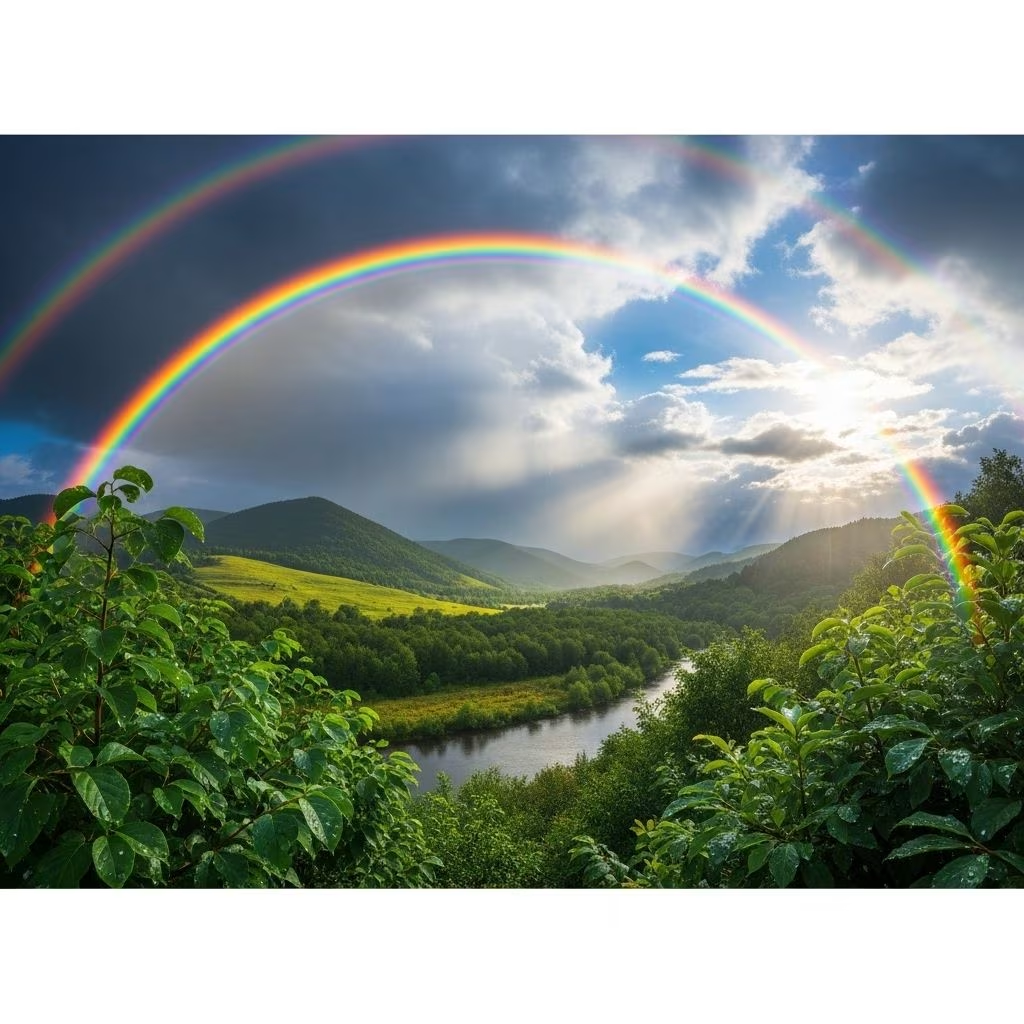
Curious Things to Know About Rainbows
Rainbows have long captured human imagination, symbolizing wonder, hope, and the beauty of nature. Their radiant colors and ethereal presence in the sky have inspired poets, scientists, and storytellers for millennia. But rainbows are more than just pretty arcs — their creation, appearance, and significance are rooted in fascinating science and diverse cultural beliefs. In this guide, explore the remarkable facts, scientific principles, myths, and lesser-known phenomena surrounding rainbows.
What Is a Rainbow?
A rainbow is an optical phenomenon resulting from sunlight interacting with water droplets in the atmosphere. When sunlight enters a raindrop, it bends (refracts), reflects off the inside surface of the drop, and then bends again as it exits. This process splits the light into its constituent colors, forming an arc across the sky.
- Refraction: Light bends as it enters and leaves the water droplet.
- Reflection: Light reflects inside the droplet.
- Dispersion: Colors separate due to differing wavelengths.
Most commonly, rainbows appear when sunlight breaks through after a rain shower, with the observer standing between the sun and the rain with the sun behind their back.
Why Are Rainbows Shaped Like an Arc?
Rainbows typically manifest as arcs because they are part of a circle whose center lies directly opposite the sun. The angle at which the light refracts—usually around 42 degrees for the primary colors—means only part of the circle is visible from most ground positions.
- If the horizon and obstacles weren’t in the way, we’d see a full circle rainbow.
- In rare cases, such as from high vantage points or airplanes, it is possible to witness the full circular rainbow.
How Many Colors Are in a Rainbow?
The classic depiction involves seven colors: red, orange, yellow, green, blue, indigo, and violet (ROYGBIV). However, in reality, rainbows contain a continuum of color. The seven-part division was popularized by Isaac Newton, matching the number of notes in a musical scale.
- Red: Outer edge of the arc.
- Violet: Inner edge.
- The bands blend smoothly; intermediate shades and even faint pinks or turquoise may be seen on occasion.
The Science Behind Rainbow Formation
Rainbows rely on a combination of meteorological and optical factors:
- Water droplets act as miniature prisms.
- Sunlight provides the white light, which contains all colors.
- Observational position determines what part of the arc you see.
- Rainbows are not located at a specific point; rather, they appear wherever the necessary conditions are met.
The intensity and vibrancy of the colors depend on droplet size; larger droplets generally result in brighter, more saturated colors.
Types of Rainbows
- Primary Rainbow: The most common, with red on the outside and violet on the inside.
- Secondary Rainbow: Appears outside the primary arc, with colors reversed and fainter brightness, created by two internal reflections within droplets.
- Supernumerary Rainbow: Faint, closely spaced additional arcs on the inner side of the main rainbow, caused by smaller droplets and interference effects.
- Double Rainbow: Refers to presence of both primary and secondary rainbows simultaneously.
- Monochrome Rainbow: Occurs when the light source contains mostly a single color, such as near sunrise or sunset, resulting in a predominantly red or yellow arc.
Rare and Unusual Rainbow Phenomena
- Circular Rainbows: From mountaintops, tall buildings, or aircraft, observers may see a complete circle.
- Twinned Rainbows: Appear as two rainbows emerging from a single base, each with distinct color orders. Caused by mixed-size raindrops.
- Rainbow Clouds (Circumhorizontal Arcs): Not true rainbows, but colored bands appearing in cirrus clouds due to ice crystals refracting sunlight.
- Fogbows: Formed in fog rather than rain, appearing pale or white due to the tiny size of fog droplets.
- Moonbows: Rainbows that form at night from moonlight — usually faint and colorless due to the low intensity of lunar light.
Rainbow Chasers: Why Do Some People Travel for Rainbows?
Rainbow chasing is a hobby for those entranced by the phenomenon’s transient nature and vibrant beauty. Photographers and weather enthusiasts may seek out ideal locations—waterfalls, coastal areas, mountainous regions—where atmospheric conditions favor rainbow appearances. The pursuit sometimes involves:
- Tracking weather patterns to anticipate showers and sunlight.
- Positioning for optimal viewing angles (with the sun low behind).
- Capturing rare forms, such as full-circle or moonbows.
Common Rainbow Myths and Folklore
- Pot of Gold: Irish legend states a pot of gold waits at the rainbow’s end, guarded by a leprechaun. In reality, the rainbow’s location is relative to each observer and cannot be approached.
- Rainbow Bridges: Many cultures imagine rainbows as bridges for gods, spirits, or souls — notably in Norse mythology, where the Bifröst connects Earth to the realm of gods.
- Omens and Good Luck: Sightings of rainbows are often considered positive omens or signals of peace after a storm.
- No Two People See the Same Rainbow: Since a rainbow forms by light refracted at a specific angle to each observer, every person views a unique rainbow.
Curious Scientific Insights About Rainbows
- The center of the rainbow’s circle is always in line with the observer’s antisuion — the point directly opposite the sun.
- Rainbows can exist with different numbers of bands, especially in mist or spray from waterfalls.
- Each color’s angle is slightly different — red refracts at about 42°, violet at about 40° — producing the color placement from outer to inner arc.
- If the sun is higher than 42° above the horizon, you won’t see a rainbow.
Rainbows in Art, Literature, and Symbolism
- Hope and Harmony: Frequently used in literature and visual art to symbolize hope, promise, and unity after adversity.
- Pride and Social Movements: The rainbow flag stands as an emblem for LGBTQ+ pride and diversity.
- Cultural Motifs: Rainbows feature in ancient murals, folk songs, and religious rituals.
Rainbow FAQs
Q: Can everyone see the same rainbow?
A: No, every observer sees their own rainbow depending on their specific angle relative to the sun and rain. The location and height of the arc change with observer position.
Q: Why are there sometimes double rainbows?
A: Double rainbows occur when sunlight is reflected twice inside each raindrop, creating a second, fainter arc above the main rainbow. The color sequence in the secondary rainbow is reversed.
Q: Is it possible to touch the end of a rainbow?
A: No, because the rainbow is an optical effect seen only from a particular viewpoint. When you try to approach it, the appearance shifts and the ‘end’ always lies farther away.
Q: Why are there more than seven colors in a real rainbow?
A: The seven-color model is a convention. A real rainbow displays a continuum of colors, with seamless gradations and intermediate shades beyond the distinct ROYGBIV divisions.
Q: How do fogbows differ from regular rainbows?
A: Fogbows are formed in fog or mist, with droplets that are much smaller than typical raindrops. As a result, they appear much paler – sometimes white, with very faint coloration.
Rainbow Fast Facts Table
| Feature | Description |
|---|---|
| Typical Number of Colors | Seven named bands, but countless intermediate shades |
| Shape | Arc (part of a circle); full circle can appear from altitude |
| Primary Formation Angle (Red) | 42° from anti-solar point |
| Secondary Rainbow | Appears outside the primary, reversed colors, fainter |
| Underlying Cause | Refraction, reflection, and dispersion of sunlight in droplets |
| Visibility Conditions | Sun behind observer, rain in front; sun below 42° above horizon |
| Rare Types | Moonbows, fogbows, circular rainbows, supernumerary rainbows |
Tips for Seeing and Photographing Rainbows
- Look for rainbows whenever sunlight and rain coincide, with the sun low in the sky.
- Best viewing is early morning or late afternoon when the sun’s angle is most favorable.
- Incorporate landscape features (trees, mountains, bodies of water) for dramatic rainbow photographs.
- Polarizing filters can enhance the colors when taking photographs.
- For rare rainbows such as fogbows or moonbows, check forecasts for fog or full moon nights during light showers.
Fun Activities and Experiments with Rainbows
- Create your own mini rainbow with a glass of water, a mirror, and sunlight. Fill a clear glass, angle the mirror inside it, and direct sunlight to generate a spectrum on a wall.
- Spraying water in your backyard on a sunny day can produce a rainbow; stand with the sun at your back.
- Use a prism to split sunlight into its component colors on a sheet of white paper for a controlled demonstration.
Conclusion: The Enduring Magic of Rainbows
Rainbows blend scientific intricacy with poetic beauty. They remind us of the interconnectedness between light, water, and perspective, inspiring curiosity and wonder in those who chase, study, or simply pause to admire them. Whether encountered after a storm or actively sought in the wild, rainbows remain one of nature’s most mesmerizing spectacles, connecting science, myth, and universal awe.
References
- https://strainy.ca/strain/treehugger/rainbow-zktlz
- https://montrosecannabis.ca/product/rainbow-zktlz-slims-pre-rolls-10×0-4g/
- https://rainbow-rangers.fandom.com/wiki/Tree_Hugger
- https://www.cannabisgreybruce.ca/cannabis-menu-southampton-dutchie?dtche%5Bproduct%5D=treehugger-rainbow-zktlz-slims-pre-roll-sativa-10×0-4g


