


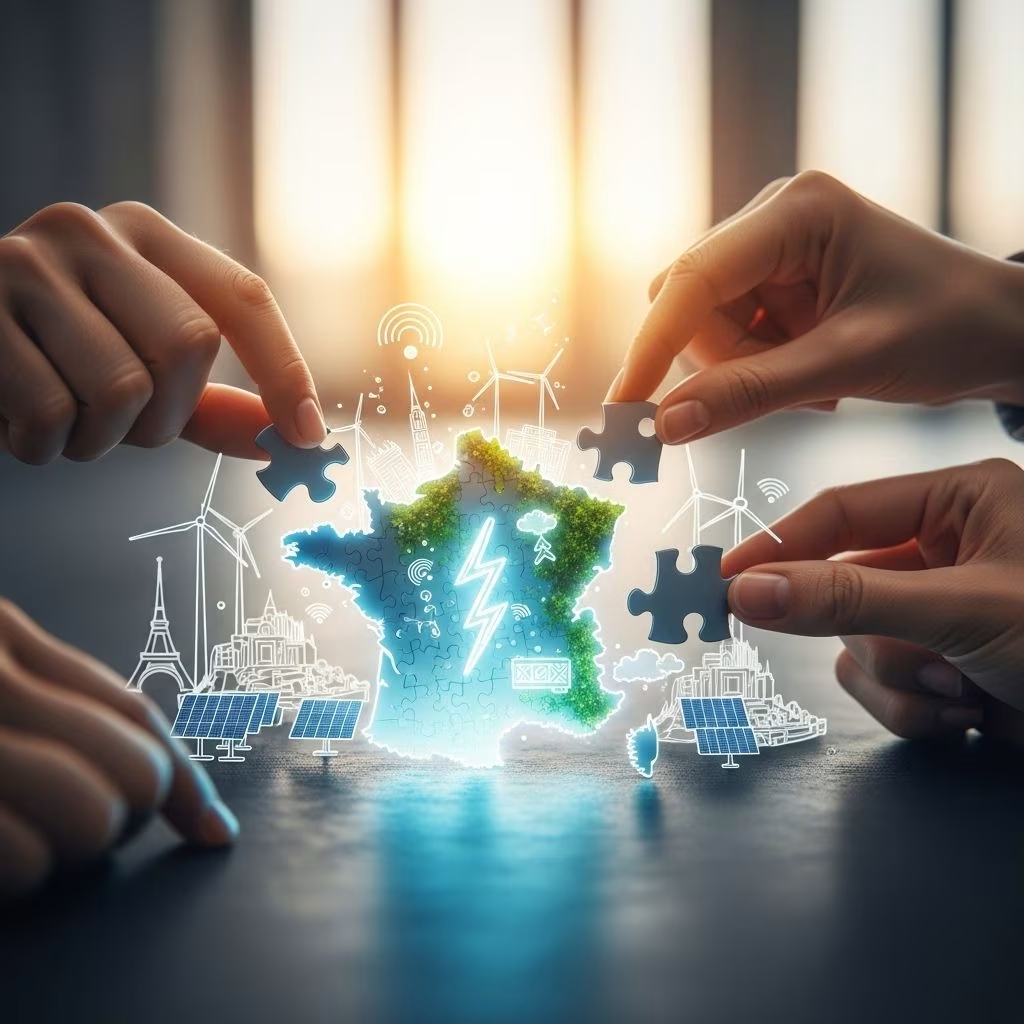
France Redefines Energy Sobriety: Collective Action for a Low-Energy Future
In recent years, France has launched an ambitious energy sobriety plan designed to reduce national energy consumption. Spurred by both climate objectives and geopolitical events threatening European energy supplies, the plan marks a paradigm shift: from focusing purely on production and renewables, to prioritizing conscious and collective reductions in energy use. This article explores the pillars of France’s energy sobriety initiative, the rationale behind it, society’s evolving attitudes, and the policies and practical actions that are changing the way the French live, work, and use energy.
Understanding Energy Sobriety
Energy sobriety (la sobriété énergétique) is more than just cutting back or enduring deprivation. Instead, the term refers to a deliberate reduction in unnecessary consumption, driven by conscious choices, technological adaptation, and social cooperation. In France, the movement for sobriety has grown from niche activism to government policy and everyday reality.
- Not simply less, but better: Sobriety means using energy more thoughtfully—maintaining comfort and standards of living while avoiding excess and waste.
- Collective commitment: The approach requires buy-in from every sector: citizens, businesses, the state, local authorities, and institutions.
- Efficient and fair: Sobriety promotes technical improvements (like smart thermostats or insulation) but also encourages behavioral changes, from driving less to switching off unneeded lights.
The Policy Context: Why Sobriety, Why Now?
France’s turn towards energy sobriety is rooted in both environmental priorities and urgent geopolitical realities. The invasion of Ukraine in early 2022 and disruptions to European gas supply sharpened the need to use less energy. But the plan is just as much about long-term climate targets, economic resilience, and energy autonomy.
- Ambitious reduction targets: The official goal is to cut energy consumption by 10% by 2024, and by 40% by 2050, moving towards net-zero carbon emissions.
- Part of a bigger strategy: Sobriety stands alongside three other national energy pillars: efficiency, rapid renewable energy development, and revitalized nuclear capacity.
Key Sectors and Stakeholders
- Buildings: Regulated heating and cooling, smart building management, limits on hot water, and mandatory improvements for public and private real estate.
- Transport: Promoting cycling, public transit, and carpooling, while reducing official travel and lowering speed limits for government vehicles.
- Individuals: Public awareness campaigns, self-assessment tools, “sobriety bonuses,” and financial aid for efficient appliances and renovations.
- Companies: Lighting restrictions, heating control, encouraging remote work, and mandatory operational changes—especially for major energy users.
- Sports and Culture: Limits on event lighting, reduced heating for sports venues, and energy benchmarks for cinemas and arts institutions.
From Crisis to Opportunity: The Shift in Public Perception
For decades, French society associated energy with technical progress, comfort, and abundance—embodied by the iconic maison individuelle, or suburban home, and the late-night city lights of Paris. Previous calls for sobriété were often dismissed as backward-looking frugality. But the context has changed.
- High energy prices, supply threats, and visible effects of climate change have made energy restraint a virtue rather than a hardship.
- Government campaigns emphasize that saving energy is “everyone’s business,” and highlight practical actions over guilt or sacrifice.
- Sobriety is being reframed as an opportunity for greater equality, comfort, health, and financial security.
Core Measures: What the Energy Sobriety Plan Involves
The plan is national in scope, but its core recommendation is simple: every action counts. Below are the main measures, by sector and stakeholder.
For Households
- Adoption of programmable and smart thermostats to regulate heating and save up to 15% on yearly consumption.
- Government grants and incentives for replacing old gas boilers with heat pumps or energy-efficient electric appliances.
- Real-time guidance from the Ecowatt “electricity weather” platform, warning of usage peaks and possible grid strain.
- Promotion of small, accessible habits: lowering thermostats, delaying appliance use, and switching off devices.
For Buildings and Property Owners
- Wider installation of Building Automation Control Systems (BACS) to control lighting, heating/cooling, and optimize energy use—potentially lowering waste by 20% or more.
- Temperature caps (typically 19°C in offices, with exceptions for special cases), and curtailment of hot water in workplaces.
- Staggered heating schedules and reduced lighting in public spaces.
For Businesses and Employers
- Mandatory switching-off of exterior and promotional lighting after business hours.
- Work-from-home incentives and reconfigured schedules to avoid energy peaks.
- Reduced business travel and encouragement of videoconferencing.
For Government and Public Authorities
- Heating in state buildings capped at 18°C; authorities model staggered energy demand and digital energy savings.
- Local governments reduce public lighting, shrink heated building footprints by consolidating offices, and restrict heating for sports and cultural venues.
For Sports and Culture
- Reduced lighting time before and after sporting and cultural events.
- Lower temperatures for pools and gyms.
- Switching to more efficient lighting and equipment for theaters, museums, and concert halls.
Technology and Innovation: The Digital Edge
France leverages technology to accelerate sobriety. Digital innovation, from smart meters to public platforms, enables citizens and companies to monitor, compare, and optimize usage in real time.
- Ecowatt platform: Offers live and forecast alerts for the national grid, nudging consumers to shift or reduce usage during high-demand periods.
- Subsidized devices: Smart thermostats, connected water heaters, and automated lighting receive financial support to accelerate adoption.
- Building Analytics: Energy management software is used in both public and private buildings to benchmark, diagnose, and continuously improve efficiency.
Economic and Social Impacts
The energy sobriety plan has broad economic aims: save energy, reduce bill volatility, safeguard public services, and avoid mandatory blackouts. The government emphasizes that sobriety is not a return to austerity, but a path to sustainable growth and social progress.
- Estimates suggest French households cut electricity and gas use by 12% between August 2022 and August 2023, much of it attributed to new habits, aids, and policy guidance.
- German and Belgian plans with similar measures are expected to collectively save billions of euros in the coming years, suggesting the economic rationale of the approach transcends national borders.
- Sobriety initiatives are designed to be inclusive, targeting financial aid to lower-income households most affected by energy poverty.
International Context and Comparisons
France shares its new sobriety doctrine with Germany, Belgium, and the UK, all of which have enacted voluntary or mandatory measures in response to recent crises and longer-term climate commitments. Common approaches include:
- Limiting heating in public/private buildings
- Mandatory installation of BACS or similar smart systems
- Promotion of electric vehicle adoption and sustainable transport
- Information campaigns empowering citizens to take responsibility
Challenges and Criticisms
Despite its breadth and ambition, the French energy sobriety plan is not without challenges:
- Most measures are voluntary rather than binding, relying on goodwill and coordination more than enforcement.
- Structural inequalities persist: not all households or firms can afford rapid upgrades or adapt to higher energy prices equally.
- Some sectors, especially heavy industry and agriculture, remain difficult to decarbonize and are granted exceptions, risking slower progress.
- Sustainability experts warn that behavioral change must be sustained over years, not just during acute shortages, to lock in real gains.
What Does Success Look Like?
The long-term objective is a society that values energy as a common good, where responsible consumption habitually replaces waste, and where efficiency goes hand-in-hand with comfort, economic growth, and cultural vibrancy. France’s energy sobriety plan is both a blueprint and a living experiment, closely watched across Europe.
Current Progress
- Millions of citizens already participate through subsidies, Ecowatt, or local authority programs.
- Major cities have led by example in public lighting and transport, while new buildings set higher efficiency benchmarks every year.
- National debates increasingly link energy use with climate justice, economic resilience, and everyday wellbeing.
Table: Key Measures in France’s Energy Sobriety Plan
| Sector | Measures | Target Impact |
|---|---|---|
| Households |
| 10–15% reduction in energy use/year |
| Buildings |
| Up to 20% less energy waste |
| Transport |
| Lower transport energy demand and emissions |
| State & Local Authorities |
| Enables peak demand management |
Frequently Asked Questions (FAQs)
What is the difference between energy sobriety and energy efficiency?
Energy sobriety refers to strategies and habits for reducing total consumption through behavioral or structural changes—such as lowering heating or using less hot water. Efficiency means using technologies and processes that deliver the same results with less energy, like LED bulbs or smart automation. Both are essential for France’s energy transition.
Are the sobriety measures mandatory?
Most current measures are voluntary recommendations, with strong encouragement and financial support rather than strict enforcement. The government may adopt stricter rules if shortages threaten supply or targets are not met.
How can individual households participate?
Easy steps include setting thermostats lower, delaying appliance use during peak hours (using Ecowatt for alerts), switching to efficient devices, and applying for renovation or equipment subsidies. Every small gesture contributes to the national goal.
Will energy sobriety lower my bills?
In most cases, yes—less energy used means lower bills, especially with today’s higher prices. Financial incentives and grants help to offset the cost of upgrades and encourage long-term, sustained behavioral change.
What are the plan’s environmental impacts?
Reduced consumption of fossil fuels means lower greenhouse gas emissions, which contributes to climate goals, air quality improvements, and more resilient infrastructure in the face of global shocks.
Conclusion: A New Normal for Energy Use
France’s energy sobriety plan is a pioneering experiment in large-scale behavioral and structural change—demonstrating that a modern society can adapt its comfort, economy, and traditions in pursuit of a common good. As the movement spreads and deepens, it sets a benchmark for other nations grappling with similar challenges in the balance between progress, resilience, and sustainability.
References
- https://climate-laws.org/document/energy-sobriety-plan_c00e
- https://www.wattsense.com/blog/building-management/the-energy-sobriety-plan-for-the-building-management-sector/
- https://actualites.nexelec.fr/en/tout-savoir-sur-le-plan-de-sobri%C3%A9t%C3%A9-%C3%A9nerg%C3%A9tique-en-france?hsLang=en
- https://www.service-public.fr/particuliers/actualites/A16856?lang=en
- https://www.euractiv.com/section/eet/news/france-unveils-ambitious-energy-efficiency-plan-with-no-binding-measures/
- https://www.twobirds.com/en/insights/2025/france/overview-of-the-french-market-and-french-legal-framework-applicable-to-data-centres
- https://energynews.pro/en/france-launches-an-energy-sobriety-plan-to-face-the-winter/
- https://www.eiffel-ig.com/en/si2cdocuments/sobriete-energie/
- https://www.frstrategie.org/sites/default/files/documents/publications/recherches-et-documents/2025/RD%20082025.pdf


