The Green Revolution: An Overview
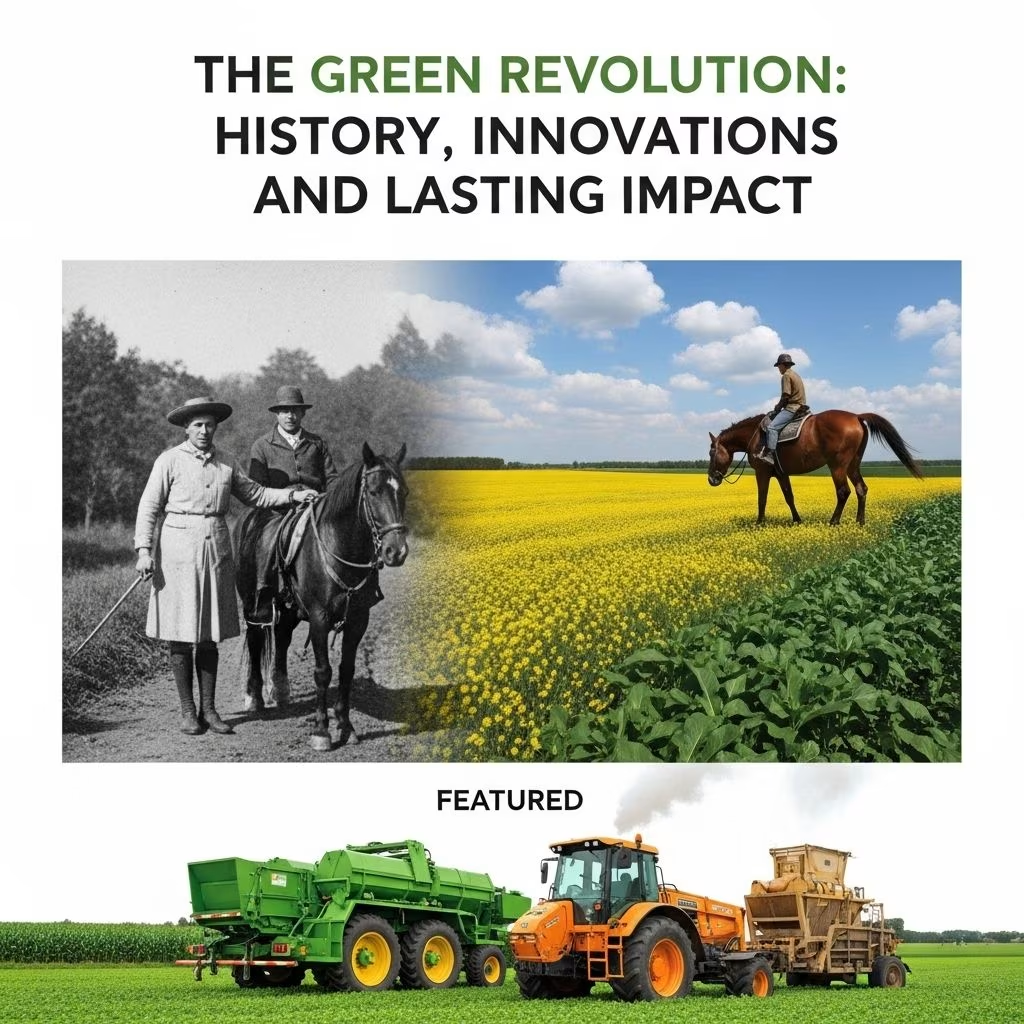
The Green Revolution describes a sweeping transformation in global agriculture that began in the early to mid-20th century and peaked between the 1940s and 1970s. Through advances in plant breeding, chemical fertilizers and pesticides, mechanization, and irrigation, the Green Revolution sought to eliminate widespread hunger and malnutrition by dramatically increasing food production—especially in developing nations. While its innovations averted famine and lifted millions from poverty, the movement’s far-reaching impacts have been complex, driving profound changes to society, economies, and the environment.
Origins and History of the Green Revolution
The seeds of the Green Revolution were planted in the 1940s, as scientists and policymakers sought effective responses to global food shortages. The pivotal figure was agronomist Norman Borlaug, who developed high-yield, disease-resistant wheat varieties in Mexico. These varieties, when combined with the adoption of synthetic fertilizers and modern irrigation, rapidly raised wheat harvests. The success of such programs in Mexico set a template soon replicated across Asia and beyond.
- 1940s-1960s— The initial phase saw the development and distribution of high-yielding varieties (HYVs) of wheat and rice.
- 1960s— Launch of major international efforts, including the establishment of the International Rice Research Institute (IRRI) in the Philippines and the International Maize and Wheat Improvement Center (CIMMYT) in Mexico.
- 1970s— Broad implementation across India, Southeast Asia, and parts of Latin America and Africa, leading to dramatic boosts in staple crop outputs.
The Green Revolution’s roadmap combined modern plant science with a vision for alleviating hunger, transforming not just fields but entire societies.
Defining Innovations of the Green Revolution
The Green Revolution’s achievements result from a suite of intertwined technological and agronomic developments:
- High-Yielding Varieties (HYVs): Hybrid crops, particularly wheat and rice, bred for enhanced productivity, disease resistance, and adaptability to intensive input use.
- Chemical Fertilizers: Large-scale application of nitrogen, phosphorus, and potassium fertilizers replaced traditional organic nutrients, enabling faster plant growth and higher yields.
- Pesticides and Herbicides: Synthetics protected crops from pests, diseases, and competing weeds, further stabilizing and increasing yields.
- Irrigation Expansion: Large dam projects, tube wells, and efficient channels extended water access, allowing multiple cropping cycles per year, even in drier regions.
- Mechanization: Introduction of tractors, combine harvesters, mechanical seeders, and threshers accelerated sowing and harvesting, reduced labor demands, and enabled large-scale monoculture.
Together, these technologies were often packaged and delivered as coordinated solutions—fertilizers, seeds, and machinery—to farmers through government or industry extension services.
Major Regions Impacted by the Green Revolution
Although the Green Revolution was a global phenomenon, its most transformational impacts occurred in several key regions:
| Region | Primary Crops | Impact |
|---|---|---|
| India & South Asia | Wheat, Rice | Achieved food self-sufficiency, major poverty reduction, rural economic shifts |
| Mexico & Latin America | Wheat, Maize | First major successes; model replicated globally |
| Southeast Asia | Rice | Significant yield increases, dietary changes |
| China | Wheat, Rice | Boosted food security, urbanization rates increased |
| Africa | Corns, Wheat (limited adoption) | Mixed results due to suitability and infrastructure gaps |
Key Benefits of the Green Revolution
- Increased Food Production: Cereal output, including rice and wheat, tripled in some regions with only modest expansion of farmed area, saving millions from famine and severe hunger.
- Poverty and Malnutrition Reduction: Greater food availability lowered prices, improved household nutrition, and elevated rural incomes for many participating farmers.
- Technological Modernization: Spurred widespread adoption of modern farming techniques, research infrastructure, and advanced equipment.
- Economic Growth: Enhanced rural economies, stimulated agribusiness growth, and fostered new government and donor investments in agriculture.
- Land-Sparing Effect: Higher yields allowed for increases in overall output without a proportional increase in agricultural land, which may have helped limit large-scale deforestation.
Environmental and Social Costs
Despite remarkable achievements, the Green Revolution introduced a host of unintended consequences that have sparked ongoing debate:
- Resource Intensiveness: Modern agriculture required vast inputs of water, energy, and chemicals, often subsidized by governments or corporations.
- Loss of Biodiversity: Focus on a narrow range of high-yield crops displaced traditional and locally-adapted varieties, reducing the genetic pool and resilience to shocks.
- Soil Degradation: Heavy fertilizer use and continuous monocropping often depleted soil nutrients and structure, while excessive irrigation led to salinization and waterlogging.
- Pesticide Pollution: Overuse of chemical pesticides led to contaminations of waterways, buildup of toxins in food chains, and the emergence of resistant pests.
- Greenhouse Gas Emissions: Industrial farming’s fossil fuel dependency, both for machinery and fertilizer manufacturing, increased emissions of carbon dioxide and nitrous oxide—major contributors to climate change.
- Social Inequality: Large, wealthier landowners benefited disproportionately, while some smallholders lacking capital or access to technology were left behind, exacerbating rural poverty and migration.
The Food System Transformed
Besides direct increases in crop yields, the Green Revolution dramatically changed global food systems:
- Monoculture and Market Dependence: Many communities became dependent on purchasing seeds, fertilizers, and pesticides from multinational corporations, marking a shift from self-sufficiency to market integration.
- Industrial Agriculture Model: Small-scale, diverse farms declined in favor of intensive, specialized large farms designed for maximum output.
- Infrastructure and Research: Investments in roads, storage, irrigation, and agricultural science enabled ongoing adoption and scaling of innovations.
Yet, the environmental and social externalities—from water use to pesticide toxicity—continue reshaping the debate on the best path forward for agriculture.
Lessons and Critiques of the Green Revolution
Decades after its unfolding, the Green Revolution is regarded as both a historic success and a source of cautionary lessons. Major critiques focus on:
- Sustainability Concerns: Short-term productivity gains often ignored long-term ecological limits, creating cycles of input dependency and diminishing returns.
- Inequitable Outcomes: Benefits frequently accrued to those with resources to afford new technologies, further stratifying rural societies.
- Nutritional Imbalances: Concentration on high-calorie cereals didn’t always translate to nutritionally diverse and healthy diets, sometimes displacing more nutrient-rich traditional foods.
- Displacement and Migration: Marginalized rural populations unable to compete with large-scale operations often migrated to cities, reshaping social landscapes.
Despite these critiques, the movement’s core ambition—increasing the world’s capacity to feed itself—remains central to ongoing agricultural development discussions worldwide.
The Legacy and Path Forward
Modern agricultural and food systems are still deeply influenced by the Green Revolution’s legacy. Current priorities include:
- Sustainable Intensification: Raising production while minimizing environmental harm—emphasizing techniques like precision agriculture, integrated pest management, and reduced tillage.
- Agrobiodiversity: Revitalizing and preserving traditional crop varieties to enhance resilience to climate and pest shocks.
- Equitable Access: Expanding the availability of agricultural innovation to smallholder and resource-poor farmers worldwide.
- Environmental Regeneration: Integrating soil health, water conservation, and ecosystem restoration within productive systems.
- Resilience: Preparing food systems for climate change, shifting weather patterns, and emerging pests and diseases.
Frequently Asked Questions (FAQs)
What is the Green Revolution?
The Green Revolution refers to the major wave of agricultural innovation and intensified production that began in the mid-20th century, designed to combat global hunger through high-yield crop varieties, chemical inputs, and modernization of farming techniques.
Who is credited with leading the Green Revolution?
Norman Borlaug, an American agronomist, is recognized as the “father of the Green Revolution” for creating high-yield, disease-resistant wheat strains and promoting their adoption—initiatives that saved millions from famine.
What were the main positive impacts?
The chief benefits included a dramatic increase in food production, reduced rates of hunger and malnutrition, falling food prices, and economic growth in many rural regions.
What are the most significant criticisms?
Key criticisms include environmental degradation, resource depletion, overreliance on chemical inputs, loss of agricultural biodiversity, and increased rural income inequality.
How does the Green Revolution affect us today?
The innovations and approaches introduced set the foundation for modern industrial agriculture, but their ecological and social costs have inspired new movements for sustainable, regenerative, and inclusive food systems.
Summary Table: Pros and Cons of the Green Revolution
| Pros | Cons |
|---|---|
| Increased yields, food security | Environmental degradation, pollution |
| Poverty reduction (in some cases) | Social inequality among farmers |
| Lower food prices | Genetic erosion, loss of biodiversity |
| Economic development in rural areas | Resource-intensive (water, fossil fuels) |
| Modernization of farming | Pesticide resistance, toxic buildup |
Conclusion: Rethinking the Green Revolution’s Legacy
While the Green Revolution represented an extraordinary breakthrough in alleviating hunger and modernizing agriculture, it also demonstrated that increases in productivity alone are not sufficient for true sustainability. Today, the lessons of the Green Revolution remind us that innovation, equity, and environmental guardianship must go hand in hand to nourish future generations while respecting the planet’s ecological limits.
References
- https://www.albert.io/blog/the-green-revolution-ap-environmental-science-review/
- https://pmc.ncbi.nlm.nih.gov/articles/PMC7611098/
- https://www.ebsco.com/research-starters/agriculture-and-agribusiness/green-revolution
- https://en.wikipedia.org/wiki/Green_Revolution
- https://www.pnas.org/doi/10.1073/pnas.0912953109
- https://www.agdaily.com/insights/brief-history-of-the-green-revolution-norman-borlaug/
- https://www.britannica.com/event/green-revolution