


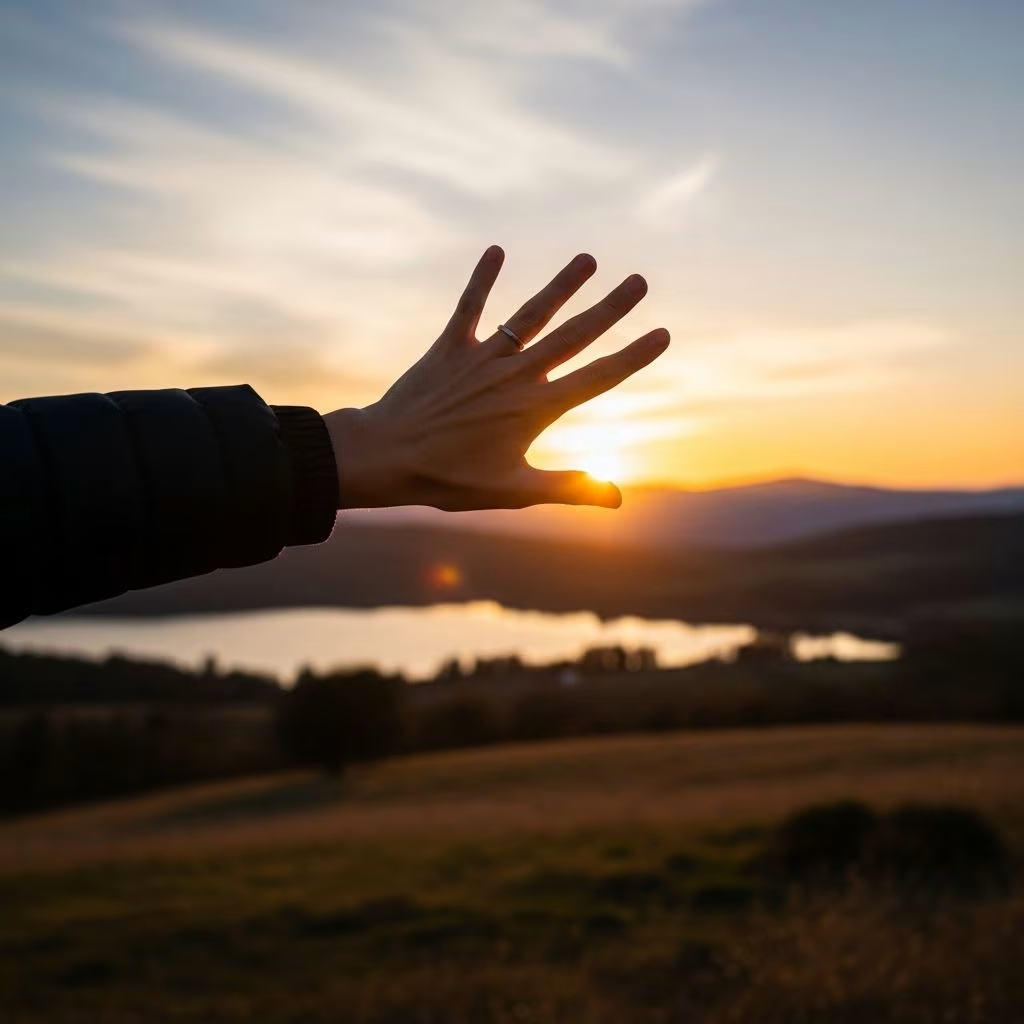
Whether you’re hiking in the wilderness, camping in a remote national park, or simply out for an evening stroll, knowing how much daylight remains can make the difference between a leisurely finish and a stressful race against darkness. In moments when technology fails or a quick estimate is needed, your hand can become a remarkably accurate tool for gauging time until sunset. This practical technique, grounded in simplicity and proven through generations, ensures you can make informed decisions about when to set up camp or start your journey home.
Why Estimate Remaining Daylight?
Understanding how much daylight is left is crucial for outdoor enthusiasts. It allows you to:
- Plan camp setup before darkness falls
- Avoid hazardous night hiking or travel in unfamiliar terrain
- Finish tasks safely while light remains
- Manage time effectively in survival situations
As reliable as watches and smartphones are, they can run out of battery, lose signal, or simply be unavailable. The hand method gives you a low-tech, reliable backup.
The Hand Measurement Method Explained
The technique for measuring daylight with your hand is straightforward, requiring nothing but your hands and a clear line of sight to the setting sun.
Step-by-Step Instructions
- Face the Sun: Turn towards the sun as it approaches the horizon in the late afternoon.
- Extend Your Arm: Stretch one arm fully out in front of you at shoulder height, palm facing towards you.
- Stack Your Fingers: Hold your fingers close together, keeping them horizontal (do not use your thumb).
- Align with Horizon and Sun: Place the bottom of your pinky finger level with the horizon. The rest of your fingers should stack above, bridging the gap between the horizon and the bottom of the sun.
- Count the Fingers: Count how many finger widths (across your four fingers) fit between the sun and horizon, stacking one hand over the other if needed as you bridge the gap upwards.
- Calculate Time: Multiply the number of finger widths by 15 minutes. Each finger width represents approximately 15 minutes until sunset. Four fingers, side by side, is about one hour.
Quick Example
If there are 8 finger widths between the sun and horizon, you have roughly 2 hours (8 x 15 minutes) of daylight left. If only 3 finger widths remain, that’s about 45 minutes before sunset.
Why Does This Work?
The method leverages the relatively consistent movement of the sun across the sky and the standard width of human fingers when held at arm’s length. Because the apparent size of your hand compared to the sky stays proportional regardless of personal height or arm length, the method is surprisingly accurate for most individuals.
- Each four-finger width at arm’s length subtends a consistent angle of about 5 degrees, which translates to about 15 minutes of solar travel before sunset.
- Variations in hand size and arm length introduce only minor changes, making this approach broadly applicable.
When and Where Does This Technique Work Best?
- Best used in the late afternoon or early evening as the sun is setting. It is not useful at sunrise or when the sun is high overhead.
- Most accurate near the equator and at mid-latitudes (except during periods of extreme daylight variation near the poles).
- Adjust for terrain: In mountainous regions, estimate the horizon at sea level rather than the local peak to determine the time until true sunset.
Practical Tips for Accuracy
- Do not use your thumb; only count the four fingers per hand.
- Hold your hand at arm’s length. Bending your elbow can throw off the timing.
- Fingers close together: Avoid spreading your fingers apart, as this artificially increases gaps and can lead to overestimation.
- For a more precise reading, keep your palm horizontal to the ground as you stack fingers upward or use multiple hands if the sun is higher above the horizon.
- If the sun is partly obscured by clouds, estimate its position as best as possible from the visible glow.
Limitations of the Hand Measurement
- Not accurate near the poles: In polar regions or during seasons of midnight sun, the method does not work reliably.
- Varies with personal anatomy: While the difference is small, hand and arm size, as well as distance from your eyes, could slightly impact the results—generally less than a 10-minute margin of error per finger for most adults.
- Difficult in poor visibility: Heavy cloud cover or obstructions on the horizon (like trees, mountains, tall buildings) can make measurements less precise.
- Does not account for twilight: This technique estimates the time until the sun’s disk disappears below the horizon, but twilight (the period of lingering light) may last up to an additional 30-40 minutes depending on location and season.
Additional Uses: Gauging Noon and Daylight Remaining
Although primarily used to measure time until sunset, similar hand techniques can help gauge:
- Midday Estimation: If you know the time and location of sunrise, count the finger widths from the horizon up to the current sun position to estimate how much time has passed since sunrise. This is less precise due to the sun’s variable arc and the time of year.
- Total Daylight: By noting sunrise and sunset times, you can divide the total number of finger widths between dawn and dusk to approximate hourly intervals.
History and Cultural Context
This method belongs to a family of ancient “naked eye” techniques used by sailors, nomads, and survivalists over centuries. It is simple enough to be transmitted orally and does not depend on special tools or even numeracy, making it a vital part of fieldcraft lore.
The Sun’s Movement and the Science Behind the Method
On average, the sun moves about 15 degrees per hour across the sky. Since a hand at arm’s length covers about 5 degrees per four fingers, this method yields roughly one hour per hand.
| Number of Fingers | Time Remaining |
|---|---|
| 1 | 15 minutes |
| 2 | 30 minutes |
| 3 | 45 minutes |
| 4 | 1 hour |
| 8 | 2 hours |
| 12 | 3 hours |
When Should You Use This Method?
This technique is especially invaluable when:
- You’ve lost track of time on a hike or outdoor excursion
- You are camping or navigating in unfamiliar areas
- Your phone or watch has lost power
- You want a quick check on whether you have time for a detour or additional activity before dusk
Safety and Survival: Why It Matters
Underestimating the approach of sunset can lead to:
- Setting up camp in darkness, which increases the risk of injury
- Becoming disoriented or lost after dark
- Increased encounters with nocturnal wildlife or hazards
This hand method empowers you to make decisions grounded in a realistic appraisal of remaining daylight, supplementing or serving as a fallback when other timekeeping methods fail.
Best Practices for a Reliable Estimate
- Practice the technique in familiar settings to calibrate your intuition.
- Combine this hand-estimate with environmental cues—lengthening shadows, drop in temperature, shift in birdsong, etc.—for even better accuracy.
- Prepare to act conservatively; give yourself extra time based on your estimation to avoid being caught out.
Common Mistakes and How to Avoid Them
- Hand not at full arm’s length: Always stretch your arm fully to standardize the angle.
- Stacking fingers incorrectly: If the sun is more than one hand’s width above the horizon, stack hands on top of each other, not side by side.
- Ignoring landscape features: Estimate the geometric (sea level) horizon, especially in hilly terrain.
Frequently Asked Questions (FAQs)
Q: Does hand size affect the outcome?
A: Minor differences in hand and finger size have little effect because most adults’ arms and hands are proportionally similar. For children, the timing will be slightly off, but still usable with a margin for error.
Q: What if the horizon is blocked by hills or buildings?
A: Try to estimate where sea level would be; placing your hand at the highest point of obstruction gives you time until the sun disappears there, not true sunset.
Q: Can this technique help estimate sunrise?
A: It is designed for the afternoon and approaching sunset. For sunrise, its usefulness is limited.
Q: Is this method reliable around the world?
A: It works almost everywhere, except near the poles where long or short days distort normal sunrise and sunset angles.
Q: What about twilight?
A: The method gives time until the sun is gone; however, ‘civil twilight’ may provide another 30-40 minutes of usable light after sunset.
Fieldcraft for the Modern Explorer
While modern devices make timekeeping easy, the hand method is timeless, requiring only knowledge and observation. Whether you’re a dedicated backpacker, family camper, or simply want to reconnect with the environment, mastering this simple technique adds a practical skill and a sense of connection to the natural world.
Final Thoughts
Estimating remaining daylight using your hand is a valuable, low-tech survival and outdoor tool. Simple to learn, adaptable to most regions, and remarkably accurate for practical purposes, it is a skill every outdoor adventurer should have in their repertoire. Try it on your next walk at dusk—you’ll soon appreciate its utility and reliability.


