


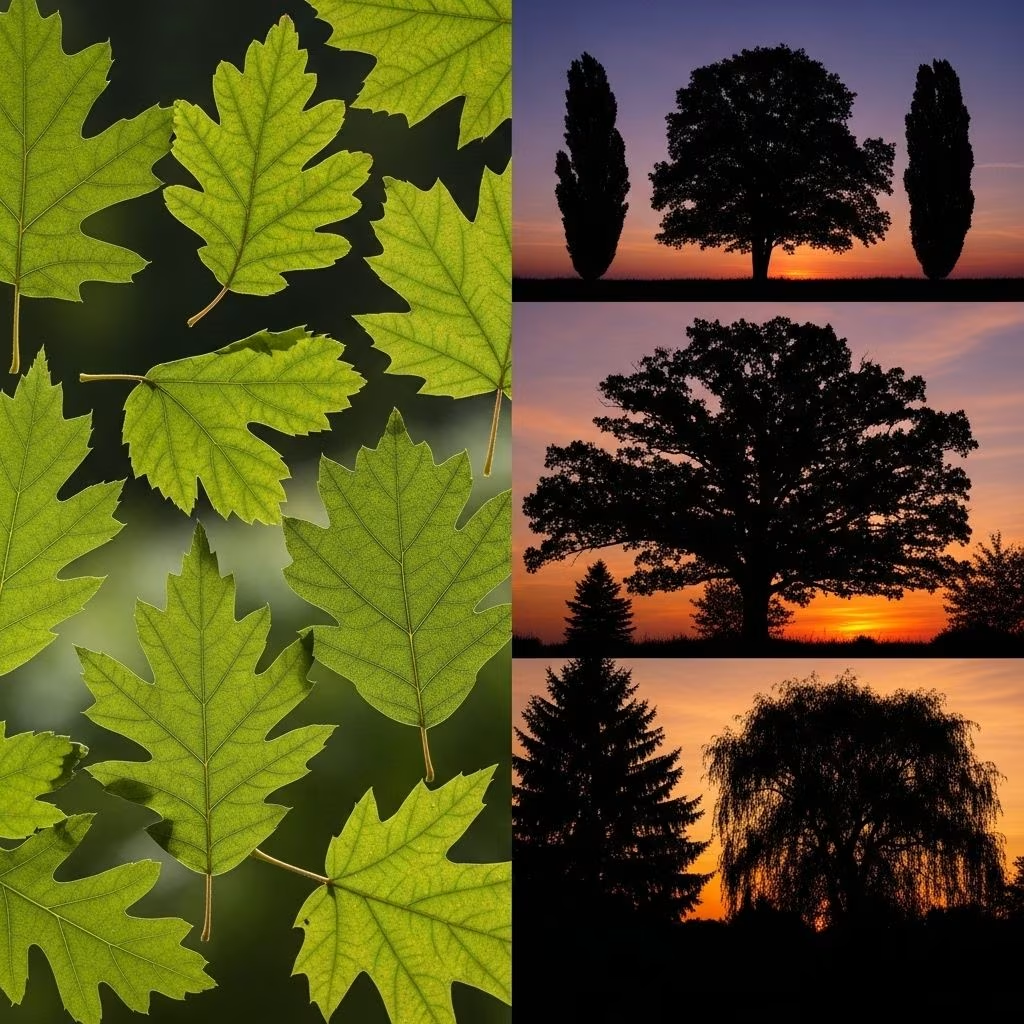
Identifying trees by their leaves is a fundamental skill for botanists, nature enthusiasts, and anyone curious about the natural world. While bark, flowers, and fruit can also help, leaves are often the most accessible and reliable feature for quick ID—especially during spring and summer months when foliage is abundant. This guide dives deep into the art and science of tree identification using leaf silhouettes, focusing on shape, margin, arrangement, and other visual clues that make each species unique.
Why Use Leaf Silhouettes for Tree Identification?
Leaves are the plant’s primary photosynthetic organs, and their structures are fine-tuned by evolution for each species’ habitat and survival strategy. This means that leaf shape and form are often highly consistent within a species, making them a reliable identification feature. While bark can be variable and flowers or fruits are seasonally limited, leaves are usually present and diagnostic for much of the year. Even in winter, persistent leaves or distinctive bud scars can provide clues.
Moreover, leaf identification is accessible to everyone—no special equipment is needed. With a basic understanding of botanical terms and a bit of practice, anyone can start recognizing common and even less common trees in their area.
Basic Leaf Vocabulary You Should Know
- Leaf Blade: The flat, expanded portion of the leaf, often the most visible part.
- Petiole: The stalk that attaches the blade to the stem.
- Midrib: The central vein running down the leaf.
- Margin: The edge of the leaf, which can be smooth, lobed, toothed, or spiny.
- Apex/Base: The tip (apex) and bottom (base) of the leaf blade.
- Simple vs. Compound: Simple leaves have a single blade; compound leaves are divided into multiple leaflets.
- Arrangement: How leaves are positioned on the stem—alternate, opposite, or whorled.
Common Leaf Shapes and Their Trees
Recognizing leaf shapes is often the first step in narrowing down a tree’s identity. Here are some of the most common shapes you’ll encounter in the wild, along with examples of trees that bear them.
| Leaf Shape | Description | Example Trees |
|---|---|---|
| Ovate/Elliptical | Oval with a pointed tip, widest at the middle | Cherry, Dogwood, Beech |
| Lanceolate | Long and narrow with a pointed tip, like a lance | Willow, Olive, Eucalyptus |
| Cordate (Heart-shaped) | Heart-shaped with a notch at the base | Eastern Redbud, Linden, Catalpa |
| Orbicular/Circular | Nearly circular | Ginkgo (when young), Lilac |
| Palmate | Shaped like a hand, with lobes radiating from a center | Maple, Sweetgum, Sycamore |
| Linear | Very long and narrow, almost grass-like | Pine, Spruce, Juniper (as needles) |
Many trees can be identified at a glance by their distinctive leaf shape. For instance, the Canadian flag features the palmate leaf of the sugar maple, while the ginkgo’s unique fan-shaped leaf is instantly recognizable.
Leaf Margins: Smooth, Lobed, Toothed, and More
The leaf margin—the edge of the blade—can also be a distinguishing feature. Here’s a breakdown of common margin types:
- Entire: Smooth, unbroken edge (e.g., magnolia, dogwood).
- Serrate/Toothed: Sharp, saw-like teeth pointing forward (e.g., elm, beech).
- Dentate: Square or rounded teeth (e.g., American basswood).
- Lobed: Deep indentations that do not reach the midrib (e.g., oak, maple).
- Crenate: Rounded or scalloped edges (e.g., kousa dogwood).
- Spiny: Sharp, stiff points (e.g., holly).
Noting the margin often helps distinguish between similar-looking leaves. For example, red maple and sugar maple both have palmate leaves, but sugar maple’s margins are smooth between the lobes, while red maple’s are toothed.
Basic Leaf Arrangement Patterns
Leaf arrangement on the stem—alternate, opposite, or whorled—is another key identifier:
- Alternate: One leaf per node, staggered along the stem (most hardwood trees).
- Opposite: Two leaves per node, directly across from each other (e.g., maple, ash, dogwood).
- Whorled: Three or more leaves per node, arranged in a circle (e.g., catalpa, some viburnums).
This trait alone can narrow down the possibilities significantly. For example, in North America, only a few common trees have opposite leaves—maple, ash, dogwood, and horse chestnut are the main ones.
Compound vs. Simple Leaves
Is it a simple leaf (single blade) or a compound leaf (multiple leaflets)? This is a critical distinction:
- Simple: The leaf consists of a single blade attached to a petiole (e.g., oak, maple, beech).
- Compound: The leaf is divided into multiple leaflets, each attached to a central stalk called a rachis (e.g., walnut, hickory, ash, locust).
Compound leaves are further divided into pinnate (leaflets arranged on either side of the rachis, like a feather) and palmate (leaflets radiating from a central point, like fingers on a hand).
Advanced Features: Venation, Texture, and Seasonal Changes
While shape, margin, and arrangement are the big three, other features can help refine your identification:
- Venation: The pattern of veins—pinnate (one main vein with smaller veins branching off) or palmate (several main veins radiating from the base). Ginkgo, for example, has parallel venation, which is rare in broadleaf trees.
- Texture: Leaves can be glossy, hairy, waxy, or rough to the touch. For instance, magnolia leaves are thick and waxy, while mulberry leaves are slightly rough.
- Seasonal Changes: Some trees have leaves that change color dramatically in fall (e.g., sugar maple, red oaks), while others (e.g., live oak) are evergreen. Paying attention to these cues can aid identification year-round.
Common Tree Identification Mistakes to Avoid
Even with good guides, beginners often make a few common mistakes:
- Ignoring Arrangement: Focusing only on the leaf shape and missing whether leaves are alternate or opposite.
- Overlooking Compound Leaves: Mistaking a leaflet for a simple leaf, especially in species like ash or walnut.
- Confusing Native and Non-Native Species: Urban areas often have both native and exotic trees; know your region’s common species.
- Seasonal Confusion: Not considering that leaves may look very different in spring (young) versus fall (mature, possibly colored).
Step-by-Step: How to Identify a Tree by Its Leaf
Here’s a practical, step-by-step approach to identifying trees using leaf silhouettes:
- Collect a Sample: Pick a healthy, mature leaf from the tree. Avoid damaged or very young leaves.
- Check Arrangement: Note whether leaves are alternate, opposite, or whorled.
- Determine if Simple or Compound: If you’re not sure, look for a bud at the base of the stalk—if present, it’s a simple leaf.
- Observe Shape: Compare the leaf to common shapes (see table above).
- Examine the Margin: Is it smooth, toothed, lobed, or spiny?
- Look at the Base and Apex: Is the base squared, rounded, or notched? Is the apex pointed or rounded?
- Check for Unique Features: Texture, scent, sap, or unusual coloration.
- Cross-Check with a Field Guide or App: Use a regional guidebook, online database, or identification app to confirm.
With practice, this process becomes second nature, and you’ll soon recognize many trees at a glance.
Frequently Asked Questions
Q: Can I identify trees in winter when there are no leaves?
A: Yes! While leaves are the easiest feature, bark, buds, twigs, and fruit can all aid winter identification. Focus on bark texture, color, and pattern, as well as the shape and arrangement of buds.
Q: Are there trees that can’t be identified by their leaves?
A: Most trees can be identified by their leaves, but some evergreens (e.g., pine, spruce) are often recognized by their needles or cones. In some cases, bark or fruit may be more distinctive.
Q: How accurate are leaf ID apps?
A: Many apps (e.g., PlantNet, iNaturalist) are quite accurate with clear photos, but errors can occur, especially with young, damaged, or non-native leaves. Always double-check with additional resources.
Q: What’s the easiest tree to identify by its leaf?
A: Trees with highly distinctive leaves—like ginkgo, sweetgum, or maple—are among the easiest. For beginners, start with these “signature” species to build confidence.
Q: Do all trees of the same species have identical leaves?
A: No, individual variation exists. Leaves may differ slightly in size, lobe depth, or margin details. Look for the most common pattern in your sample.
Conclusion
Identifying trees by their leaf silhouettes is a rewarding skill that connects you more deeply with the natural world. By learning key terms, recognizing common shapes and margins, and understanding leaf arrangement, anyone can become proficient at tree identification—whether for casual enjoyment, scientific study, or environmental stewardship. The next time you’re outdoors, take a closer look at the leaves around you; you’ll be surprised by how much they can reveal about the living landscape.
References
- https://woodlandstewards.osu.edu/sites/woodlands/files/d6/files/pubfiles/b899-leaf%20key.pdf
- https://extension.uga.edu/content/dam/extension-county-offices/clarke-county/4-h/forestry-judging-information/leaf-identification.pdf
- https://footstepsintheforest.com/tree-leaf-photos-gallery-eastern-us-trees/
- https://www.nycgovparks.org/learn/trees-and-plants/how-identify-trees-by-their-leaves
- https://treezilla.org/assets/downloads/tree-id-guide.pdf
- https://www.arborday.org/tree-identification
- https://utarboretum.tennessee.edu/tree-identification-guide/
- https://www.scfc.gov/wp-content/uploads/2023/12/UnbeleafableKidsTreeIDBook.pdf


