


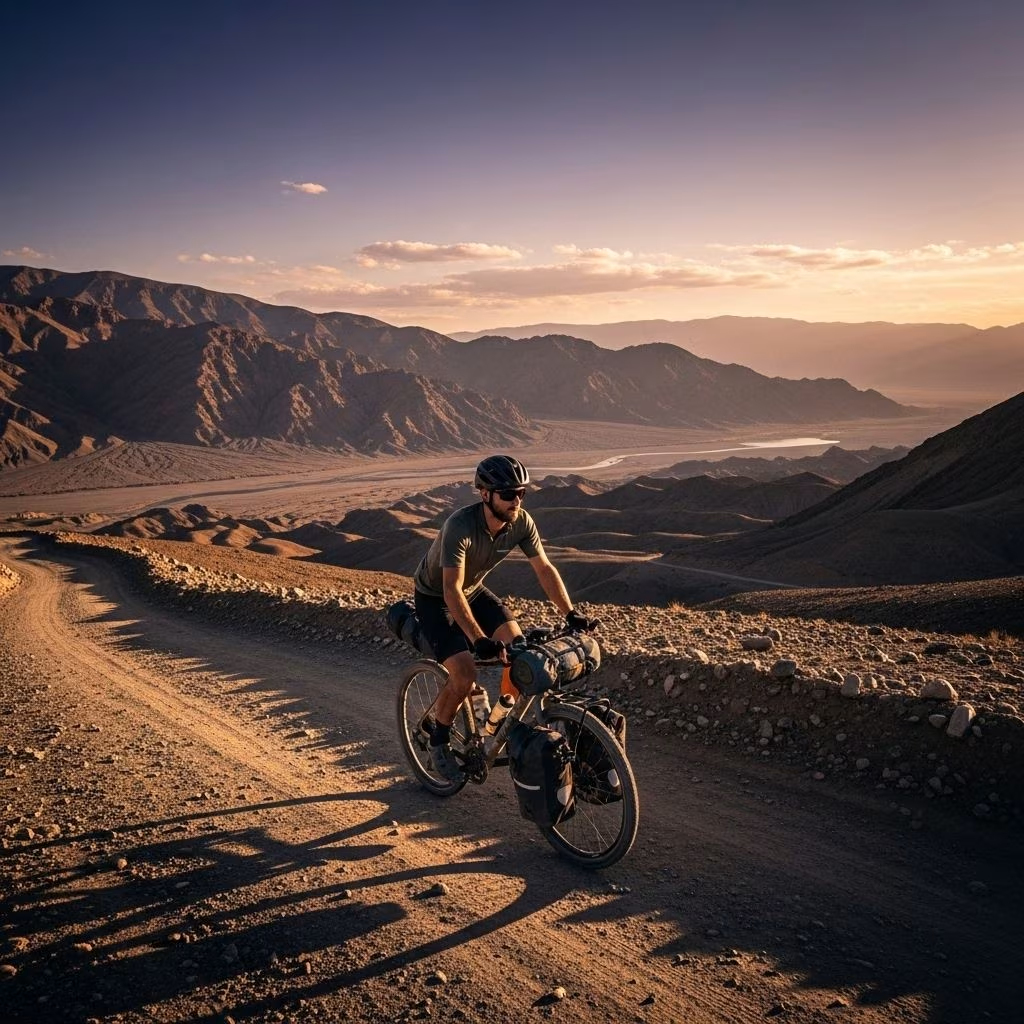
Lands of Lost Borders: Cycling the Silk Road Beyond Limits
Lands of Lost Borders by Kate Harris is a singular blend of travel memoir, reflection on the meaning of frontiers, and an ode to the spirit of adventure. Through a nearly year-long bicycle expedition along the mystical Silk Road—stretching from Turkey, passing through the tapestry of Central Asia, and climbing towards Tibet—Harris weaves a story not just about geography and terrain, but about questioning boundaries: geopolitical, personal, and philosophical.
The Quest for Exploration in a Mapped World
Harris’s journey begins long before her wheels hit the ancient roads of Asia. As a child, captivated by tales of Marco Polo and the age of exploration, she dreamed of traversing uncharted worlds. By adolescence, she confronted the striking realization that the era of mapping the blank spaces on Earth was over; satellites and science had seemingly demystified every corner of the planet. This sense of being “born centuries too late for the life I was meant to live” becomes a central tension of her memoir, propelling her restless imagination from the lab bench—she was a Rhodes Scholar at Oxford and pursued scientific research at MIT—to the wild, ambiguous edges of the world beyond academia’s confines.
- At Oxford and MIT, Harris searches for meaning and challenge, yet academia cannot quell her urge for discovery.
- The romantic image of the explorer—equal parts scientist and wanderer—looms over her ambitions, as she dreams of walking on Mars when the frontiers on Earth appear closed.
- Her journey truly begins when she realizes that exploration is not about blank spaces on maps, but about the willingness to step outside the “lines” of prescribed existence.
Setting Out: The Silk Road’s Allure
The Silk Road—an ancient network of trade routes that historically connected East and West—offers Harris the perfect metaphor and challenge. Joined by her lifelong friend Mel, Harris chooses the bicycle as her vehicle of discovery: a mode of slow travel that magnifies both the hardships and granular beauties of the landscape. Their chosen route would test their endurance and adaptability across thousands of miles of shifting conditions, often ascending to 17,000 feet, braving heat and snow, bureaucracy and loneliness, all while encountering myriad cultures.
- The decision to cycle underscored a philosophy: to refuse living “between the lines,” embracing unpredictability and vulnerability as keys to real discovery.
- Along the way, the two women encounter a dizzying array of cultural differences, local hospitality, and unrelenting physical and psychological challenges.
- Their route included Turkey, Azerbaijan, Iran, Kazakhstan, Uzbekistan, China, Tibet, and Nepal—countries whose borders are at times closed, and whose geographies reflect centuries of shifting empires and changing rules.
Living the Adventure: Hardships and Joys
The heart of Lands of Lost Borders lies in its candid, poetic depiction of life on the road. Harris presents the reality of exploration not as a sequence of perfect vistas, but as a tapestry of struggle, awe, confusion, and connection. There are moments of bitter cold, run-ins with stern police and arbitrary border closures, language barriers, and nights spent shivering in tents. Yet just as often, the women are uplifted by the unexpected compassion of strangers: invitations to share meals, offers of shelter, and the generosity of those living on the edges of what most people see as civilization.
- Cycling day after day in desolate regions—across high-altitude plateaus, windswept grasslands, and colonial relics—becomes both a test and a meditation, stripping away nonessentials and sharpening the senses.
- Food and culture intermingle: from enduring on bland survival rations to the euphoria of a “baklava hangover” in markets bursting with flavors.
- Nature’s beauty and harshness coexist; the broken landscapes sometimes mirror the internal doubts and yearnings of the journeyers.
The Meaning of Borders
One of the memoir’s core themes is the question: why do we draw borders, and what do they mean? Harris approaches this both philosophically and through lived experience. Political boundaries in Central Asia are often arbitrary, fiercely protected, and painfully divisive, as in the strained relationships between neighbors in the South Caucasus. The very act of crossing—or being denied the right to cross—a border becomes an existential question: how do borders shape us, separate us, and what do we lose or gain by them?
- Harris deftly probes the difference between borders as necessary constructs for safety and order, and their role as artificial walls shaped by fear and inertia.
- Encounters with law enforcement and border officials repeatedly highlight how nationalism, suspicion, and the legacy of conflict permeate everyday life.
- The author notes, “The more I learned about the South Caucasus, with its closed borders and warring enclaves, the more the place seemed like a playground game of capture-the-flag, all in the dubious name of nationalism.”
Ultimately, Harris argues that the most meaningful borders to question are those we draw within ourselves: limits on compassion, curiosity, and courage. By pushing past the boundaries of comfort and certainty, she finds the possibility of deeper connection—with place, with strangers, and within her own psyche.
Internal Journeys: Growth and Reflection
As with the best travel writing, Lands of Lost Borders is a memoir as much of internal reckoning as of outer adventure. Harris’s prose moves between encounters with people and places and her ongoing meditation about purpose, risk, and the forever provisional nature of self-knowledge.
- She continually wrestles with her own motives: “At what point was I running away from life, and at what point was I running toward it?”—exposing the fragile and dynamic border between escape and embrace.
- The journey becomes an avenue for her to ponder the nature of scientific inquiry: how the imagination that drives space missions is kin to the spirit of earthly wanderers.
- The kindness of strangers, the logic of landscapes, and the ever-present risk all become mirrors for her evolving understanding of fulfillment and homecoming.
Encounters and Connections: Humanity Without Frontiers
Again and again, Harris highlights that traveling slowly through places others see only as obstacles leads to communion rather than alienation. The book is scattered with rich anecdotes: a family in Turkey who shelters them from a storm, Central Asian shepherds sharing tea, borderland officials whose suspicion sometimes gives way to curiosity, and countless unnamed people ensuring that the “other side” is never so distant after all.
- Such acts of hospitality defy the rhetoric of division, suggesting that connection is possible wherever the urge to reach out outpaces the fear of difference.
- Each interaction, no matter how brief, becomes part of an unspoken web tying the journeyers to the communities they pass through.
Literary Qualities: Style and Impact
The memoir stands out for its thoughtful style—at once fierce and lyrical, with passages that move from wry humor and historical reflection to poetry and awe. Critics have noted the book’s capacity to inspire, its careful interweaving of researched history and felt experience, and its resonance with classics of travel literature. Comparisons have been made to works like Rory Stewart’s The Places in Between and Cheryl Strayed’s Wild, though many reviewers argue that Harris’s voice remains distinct: less focused on personal catharsis and more on the thrill, uncertainty, and humility of the outer and inner unknown.
- This is “exemplary travel writing: inspiring, moving, heartfelt, and often breathtaking.”
- Kate Harris’s background in science and love for literature infuse her prose with a sense of wonder at both the physical world and the unlimited terrain of the mind.
Broader Implications: What is Exploration?
Perhaps the most enduring question raised by Lands of Lost Borders is: What does it mean to be an explorer today? Harris reflects that the work of discovery is never finished, and that “exploring still exists, will always exist: In the basic longing to learn what in the universe we are doing here.”
| Classic Explorers | Modern Exploration |
|---|---|
| Mapped uncharted territory | Tests personal limits, questions self and society |
| Named rivers and peaks | Forges connections across boundaries |
| Driven by external mysteries | Probes internal frontiers and meaning |
| Voyaged into blank spaces | Discovers wildness within and all around, even in mapped lands |
Frequently Asked Questions (FAQs)
Q: What sets Kate Harris’s journey apart from other travel memoirs?
A: Harris’s journey on the Silk Road is distinctive for its blend of rigorous physical challenge, reflective prose, and philosophical meditation on borders. Unlike many memoirs that focus on personal struggle, her focus is equally on the landscapes she traverses and the human and ecological complexity of those regions.
Q: Why did Kate Harris choose to cycle rather than use another form of transport?
A: Cycling allowed Harris and her travel partner Mel to engage deeply with their environment, moving slowly enough to experience every nuance of climate, geography, and culture. It was also a deliberate rejection of convenience, making vulnerability and adaptability central to the experience.
Q: What are the central themes addressed by ‘Lands of Lost Borders’?
A: The book explores the meaning of borders—physical, cultural, and personal—the nature of curiosity and risk, the enduring quest for adventure, and the human capacity for kindness across divides.
Q: How does Harris portray the people and cultures of Central Asia?
A: Harris provides a nuanced, respectful view of the diverse cultures met on her travels, emphasizing hospitality, resilience, and the capacity for generosity, even amidst hardship and isolation.
Q: Who would benefit most from reading this book?
A: Anyone intrigued by exploration, adventure travel, borderlands, or the inner workings of human ambition and uncertainty will be captivated. It is especially recommended for readers seeking thoughtful, literary travel writing rich in contemplation and narrative drive.
A Modern Classic of Travel & Reflection
In Lands of Lost Borders, Kate Harris has crafted not only a record of a formidable physical achievement, but a meditation on the yearning to be unsettled, to live fully outside prescribed margins, and to seek connection in a world of persistent boundaries. As both travelogue and philosophical inquiry, her memoir reminds us that the spirit of exploration is less about escaping the world than inhabiting it—curiously, courageously, and with a mind open to wildness wherever it is found.
References
- https://thechroniclesofhistory.com/2020/08/28/book-review-%E2%95%BDlands-of-lost-borders-a-journey-on-silk-road-by-kate-harris/
- https://journeywoman.com/destinations/bike-the-silk-route-in-kate-harris-memoir-lands-of-lost-borders/
- https://www.kirkusreviews.com/book-reviews/kate-harris/lands-of-lost-borders/
- https://app.thestorygraph.com/reviews/eb96346c-f5ee-4408-bf2e-10541b9d55ab
- https://thebcreview.ca/2020/06/30/852-stewart-harris-lands-of-lost-borders/
- https://www.thegeorgiareview.com/posts/lands-of-lost-borders/
- https://www.washingtonindependentreviewofbooks.com/bookreview/lands-of-lost-borders-a-journey-on-the-silk-road


