The Vidalia Onion: Sweet Roots and Bitter Legal Battles
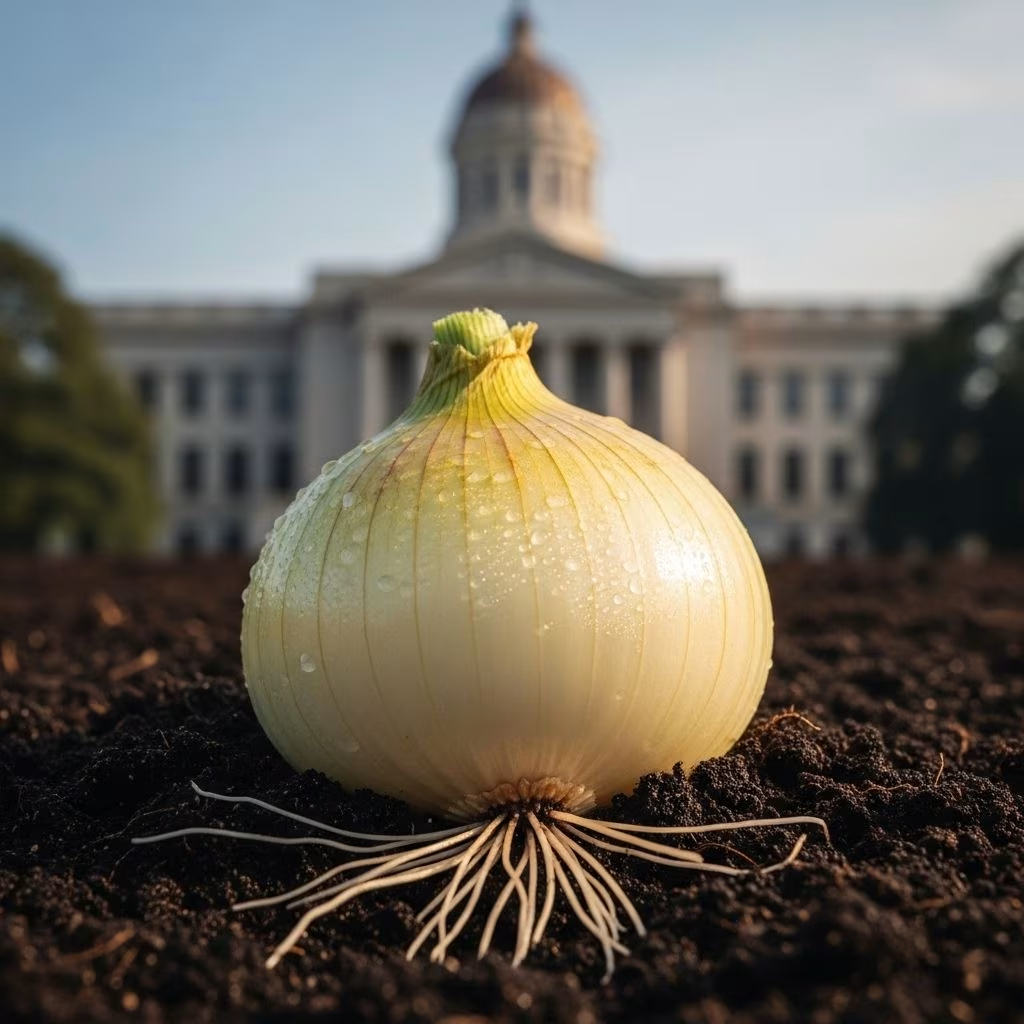
Few foods carry the weight of cultural identity, economic significance, and legal protection like Georgia’s Vidalia onion. Famous for its mildness and sweetness, this vegetable carries a history as rich as its flavor—a journey from an obscure Depression-era crop to a symbol of culinary pride, and eventually, a contentious legal battleground entangled with labor exploitation. This article delves deep into the Vidalia onion’s origins, its protected status, marketing triumphs, scandals, and ongoing labor reforms.
Origins: The Accidental Sweetness
The story of Vidalia onions begins in Toombs County, Georgia, in the early spring of 1931. Local farmer Moses Coleman was surprised when his onion crop lacked the typical hot bite. Instead, the onions tasted almost sweet—an unexpected result attributed to the region’s sandy, low-sulfur soil . Coleman sold the onions for $3.50 per 50-pound bag, an impressive premium during the Great Depression .
Word spread through farmers’ markets and local grocers, sparking curiosity and leading neighboring farmers to adopt Coleman’s methods. By the late 1940s, the onions—now called Vidalia onions by customers—gained a local reputation for their unique sweetness, owed not just to the soil but to painstaking, labor-intensive growing techniques that ensured their high quality.
From Local Curiosity to Legal Protection
The Vidalia onion’s rise to fame coincided with broader agricultural reforms. The New Deal’s Agricultural Adjustment Act provided critical support that encouraged Georgia’s truck farmers to expand their operations and experiment with new crops .
- 1930s–1960s: Slow but steady growth, expansion into regional grocery chains.
- 1970s: Marketing campaigns and onion festivals helped build national recognition .
- 1986: The Georgia Legislature passed the Vidalia Onion Act, establishing a 20-county production area, legally protecting the Vidalia name .
- 1989: Producers united to establish Federal Marketing Order No. 955, further codifying Vidalia’s status and organizing research and promotion efforts through the Vidalia Onion Committee .
- 1990: The Vidalia onion was declared the official state vegetable of Georgia .
Legal protection turned the Vidalia onion into a geographically-indicated agricultural product, akin to Champagne or Parmigiano-Reggiano. Only onions grown in the specified counties, meeting strict standards, may bear the Vidalia name.
Marketing the Sweet Onion
Georgia’s state-sponsored protection fueled the Vidalia onion’s transformation into an agribusiness powerhouse. Strategic partnerships with grocery chains, high-profile endorsements, and local celebration events played key roles:
- Piggly Wiggly Southern Inc.—the supermarket chain—built a distribution center in Vidalia in the 1960s .
- Former President Jimmy Carter famously sent Vidalia onions to the White House and enjoyed them with peanut butter crackers .
- The annual Vidalia Onion Festival became a major regional event, further cementing the onion’s importance in Georgia’s cultural landscape .
- Vidalia onions now enjoy nationwide—even international—recognition, thanks to marketing collaborations and enhanced storage technology.
As demand surged, producers adopted innovations like controlled atmosphere (CA) storage, borrowed from the apple industry, to keep onions fresh for up to six months. This allowed Vidalia onions to be marketed during the fall and holiday season, maximizing profits .
Production Challenges and Growth
The onion’s rise was not without complications. By the 21st century, Vidalia onions had become a significant economic force:
- 60 registered growers cultivate roughly 10,000 acres, producing an estimated 220 million pounds of Vidalia onions annually.
- Total value is estimated at $150 million—modest compared to corn or soybeans, but a major driver of local prosperity .
| Year | Key Development |
|---|---|
| 1931 | Moses Coleman discovers sweet onions in Toombs County |
| 1940s | Georgia builds Farmer’s Market in Vidalia; onions gain name |
| 1970s | National distribution, Onion Festivals begin |
| 1986 | Georgia Legislature passes Vidalia Onion Act |
| 1989 | Federal Marketing Order No. 955 established |
| 1990 | Vidalia onion named official state vegetable |
| 2020s | Operation Blooming Onion exposes labor abuses |
Despite the onion’s meteoric rise, production required intensive hand labor. Vidalia onions are fragile, bruise easily, and spoil quickly. Mechanized harvesting could not replace the toughness and precision of manual workers, leading growers to rely heavily on seasonal laborers.
Labor, Exploitation, and the H-2A Visa
Most Vidalia onion farmworkers are migrants, many from Latin America and the Caribbean, employed through the H-2A visa program. This federal program allows growers to sponsor foreign laborers, requiring the sponsor to provide payment, food, housing, and transportation .
Yet, as demand soared, so did reports of labor abuses:
- Some contracts contained ambiguous clauses—”et cetera”—allowing workers to be forced into jobs unrelated to onions and relocated without consent .
- Workers described grueling hours, wage exploitation, and threats, with some being moved to other states or forced to pick different crops.
- These practices, as defined by the Department of Justice, constituted labor trafficking .
The situation escalated when whistleblowers and advocacy groups highlighted that Vidalia’s economic success was shadowed by criminal exploitation—culminating in a federal investigation.
Operation Blooming Onion
In 2018, acting on a tip from a human trafficking hotline, federal authorities began investigating labor conditions in Georgia’s onion fields . The case centered on Maria Leticia Patricio—a matriarch in a transnational criminal organization—who, along with others, used farm labor contracts for exploitation and racketeering.
- Indictment: In November 2021, 24 individuals were indicted on charges of mail fraud, forced labor trafficking, money laundering, and witness tampering .
- Scale: Over seven years, false petitions were allegedly mailed for more than 71,000 migrant workers, illegally profiting the group by $200 million .
- Abuse: The investigation documented “modern-day slavery,” with reports of squalid living conditions, kidnapping, violent threats, and even deaths among farmworkers .
‘Operation Blooming Onion’ is considered one of the largest labor trafficking cases in U.S. history. At least 100 individuals were freed from the scheme, and the aftermath led to widespread calls for reform within the H-2A visa program .
Impact & Reforms
The fallout from Operation Blooming Onion has spurred advocacy efforts and reshaped how the Vidalia onion industry—and Georgia agriculture at large—deals with labor recruitment and worker protections:
- Federal agencies are re-examining H-2A visa policies.
- Growers face increased scrutiny and pressure to improve working conditions and contract transparency.
- The case ignited conversations about the ethical responsibilities of agribusinesses trading in high-value crops.
The Vidalia onion, once merely prized for its flavor, now carries a legacy of both triumph and tragedy—a product shaped by the interplay of law, labor, and land.
Frequently Asked Questions (FAQs)
Q: Why are Vidalia onions so sweet compared to other varieties?
A: Vidalia onions get their sweetness from the unique sandy, low-sulfur soils of Southeast Georgia, which reduce pungency and produce milder, sweeter onions .
Q: Where can Vidalia onions legally be grown?
A: Only onions grown in a specially defined 20-county region in Georgia—protected by state and federal law—can be marketed as Vidalia onions .
Q: What is the H-2A visa program, and why is it controversial?
A: The H-2A program allows U.S. farmers to hire temporary foreign laborers, but the system is vulnerable to abuse–as revealed by ‘Operation Blooming Onion’–with reports of wage theft, poor living conditions, and exploitation .
Q: What was Operation Blooming Onion and what did it expose?
A: It was a federal investigation into forced labor and criminal activity tied to labor recruitment in Georgia’s agricultural sector, exposing large-scale trafficking and pushing for visa reforms .
Q: How has the Vidalia onion industry responded?
A: The industry faces increased regulation, scrutiny, and pressure to ensure fair working conditions for farmworkers. Advocacy groups continue pushing for changes to the H-2A program to prevent future exploitation .
Conclusion
The journey of the Vidalia onion encapsulates the interplay of nature, ingenuity, law, and justice. As one of America’s best-loved vegetables, it brings with it not just sweetness, but a legacy of hard-won protection, clever marketing, and difficult truths about the labor that makes Georgia’s pride possible. The lessons learned from both its rise and its controversies continue to shape agriculture and labor policy across the region.
References
- https://bittersoutherner.com/feature/2022/blood-sweat-tears-vidalia-onions-shane-mitchell
- https://en.wikipedia.org/wiki/Operation_Blooming_Onion
- https://www.vidaliaonions.com/history/
- https://www.clarionledger.com/story/business/businessledger/2014/04/16/vidalia-onion-rule-keeps-unripe-off-shelves/7784943/
- https://www.dol.gov/newsroom/releases/whd/whd20171019-0
- https://www.ajc.com/news/not-sweet-fight-erupts-over-vidalia-onion/0sKgQFLLZUwaFVNBQCFgOM/
- https://www.onlineathens.com/story/news/state/2014/04/14/bitter-court-feud-over-sweet-vidalia-onions/15535362007/