Why Leaves Have Different Shapes and Sizes
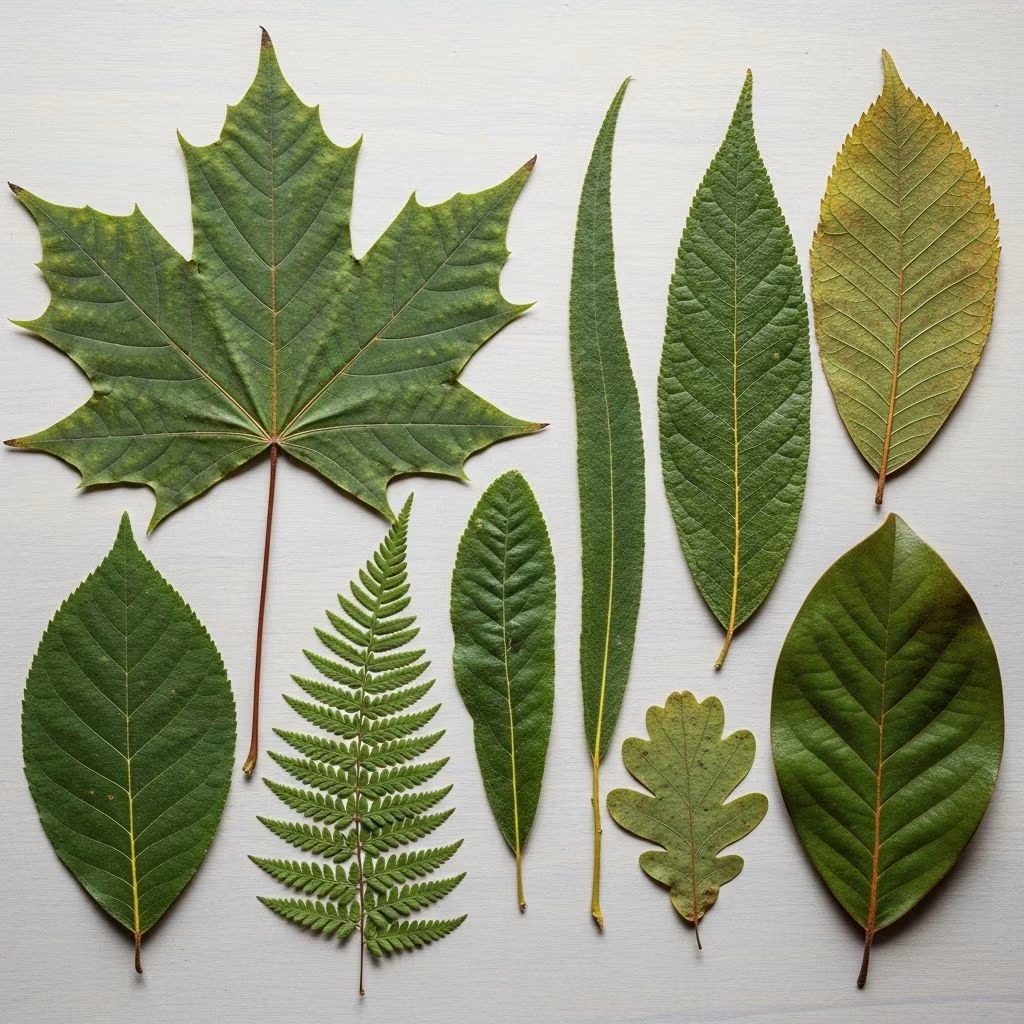
Leaves—nature’s solar panels—come in a kaleidoscope of shapes and sizes, from the broad expanse of a banana leaf to the slender spindle of a pine needle. While their beauty captivates our senses, the science behind their form reveals critical survival strategies shaped by evolution, climate, and genetics. This article explores why leaves look the way they do, examining the forces that mold their size and shape, and how plants adapt their foliage for maximum efficiency and survival.
Core Functions: Water, Sun, and Survival
Every leaf is a product of its environment, tailored to balance the need for water acquisition and sunlight absorption. Traditionally, scientists agreed that leaf size is governed by the limits of available water and the risk of overheating from the sun. Leaves collect sunlight for photosynthesis, but too much direct exposure threatens to burn out their photosynthetic machinery. Plants must find a balance where the leaf is large enough to gather energy but not so large that it loses water wearily or overheats.
- Water Availability: Leaves grow larger when water is plentiful but stay smaller in arid conditions.
- Sunlight Exposure: Direct sun restricts leaf size to prevent overheating, favoring smaller or thinner leaves in bright regions.
But recent studies reveal that leaf size isn’t just restricted by heat—it’s also limited by the risk of nighttime freezing. In regions where nights are cold, plants tend to develop smaller leaves to avoid energy loss and damage from frost.
Scientific Insights: The Role of Climate
- Australian researchers studied nearly 7,000 plant species and discovered that, globally, leaf size limits are more often determined by cold night temperatures than by daytime overheating.
- Over perhaps half the world’s land, leaves shun size for warmth, favoring smaller forms to avoid freezing.
- This dual constraint—from warmth in the day and cold at night—explains the variations in leaf sizes from tropical jungles to temperate forests.
As Ian Wright from Sydney’s Macquarie University describes: “Put the risk of freezing together with the risk of overheating, and you see the global pattern of leaf sizes.”
Family Matters: Why Shapes Are So Unique
While size can often be explained by climate, the shape of a leaf is a more complex story. Why does a fig tree have broad, wildly shaped foliage, while a fern sports finely divided fronds? According to research and expert opinion, the answer isn’t simply climate—it’s genetic heritage and evolutionary adaptation:
- Genetic Blueprint: Each species develops its own foliage type, passed down through long evolutionary histories.
- Species-Specific Adaptation: Shapes are refined to meet the demands of their environment—whether it’s maximizing sunlight, retaining moisture, or resisting pests.
The Penn State biology department explains: “The shape of a tree’s leaves is a response to the tree species’ long-term ecological and evolutionary histories.”
Table: Leaf Shapes in Common Tree Species
| Tree Species | Leaf Shape | Adaptation Purpose |
|---|---|---|
| Pine | Needle-like | Reduce water loss, minimize surface area |
| Banana | Large, broad | Maximize photosynthetic capacity, suited for wet climates |
| Maple | Lobed, broad | Intercept light efficiently, allow wind to pass through |
| Fig | Deeply lobed | Increase surface area, support shade tolerance |
| Fern | Fronded, divided | Maximize light in shaded forest understory |
Leaf Design: Sunlight, Structure, and Stomata
The design of a leaf is a functional response to environmental pressures. Every leaf must:
- Be open enough to capture sunlight for photosynthesis.
- Ensure its pores—known as stomata—can absorb enough carbon dioxide to fuel growth.
But even within these basic requirements, nature offers endless variations:
- Leaves with sharp angles may intercept less light during midday sun, shading themselves to prevent overheating.
- Rounder leaves intercept more light and have higher carbon gain, ideal for plants growing under a canopy or in diffuse light conditions.
Environmental Adaptation: Right Plant, Right Place
Each leaf is a snapshot of survival, specially designed for the pressures of its environment. A 2003 study from Macquarie University suggests that leaf style reflects function, with every plant fine-tuning its foliage to the specifics of local climate and terrain.
- Broad leaves proliferate in humid, shaded rainforests where maximum light capture is crucial.
- Narrow, needle-like leaves are common in cold or dry environments, conserving water and withstanding frost.
- Thick, waxy leaves serve arid zones, providing water storage and reducing evaporation.
For plants, getting this design exactly right can be a matter of life or death.
Leaf Change: Adaptation in Everyday Life
The adaptability of leaves isn’t just an outdoor phenomenon. Horticultural experience demonstrates how plants adjust their foliage in response to changes even within a human home:
- A weeping fig (Ficus benjamina), when moved from one room to another, may shed all its leaves and regrow new ones better suited to its new light and humidity conditions.
- The new foliage may be different in shape, thickness, and size—reflecting a rapid, situational adaptation.
This dramatic change underscores how leaves respond to environment, offering a live demonstration of plant flexibility.
Beauty and Function: Side-Effects of Perfection
While science has unraveled much of leaf function, the aesthetic diversity found in foliage often prompts the question: “Did nature design so many leaf shapes just for beauty?” The answer is a resounding no. Beauty is simply a side-product of functional perfection. Every variation is tuned for optimal survival—beauty is the accidental outcome of the race to thrive.
Summary Table: Factors That Influence Leaf Shape & Size
| Factor | Typical Impact on Leaves | Example Plants |
|---|---|---|
| Water Availability | Larger leaves in wetter environments; smaller in dry | Banana, palm |
| Sunlight Intensity | Smaller/thicker leaves in full sun; larger/thinner in shade | Pine, fern |
| Temperature (Nighttime) | Reduces leaf size to combat frost | Spruce, birch |
| Evolutionary History | Distinctive shapes passed down genetically | Fig, maple |
| Environmental Change | Foliage may change shape/size in new conditions | Weeping fig |
Frequently Asked Questions (FAQs)
Q: Why do some trees have needles instead of broad leaves?
A: Needle-like leaves, as seen in pines and spruces, help reduce water loss and withstand cold or dryness, making them ideal for harsh climates.
Q: Can two trees of the same species have different shaped leaves?
A: Yes, leaf shape and size can vary within a species due to local climate, soil, water availability, and even changing indoor environments.
Q: Do leaf shapes affect photosynthetic efficiency?
A: Absolutely. Leaf shape governs how much light is intercepted, how well the leaf can cool itself, and how efficiently it utilizes available CO2 for photosynthesis.
Q: Do leaves change shape during a plant’s lifetime?
A: Leaves produced in new environments—such as a plant moved indoors—may differ in shape, size, and thickness compared to those grown previously.
Q: Is leaf diversity primarily for beauty?
A: No, beauty is a side effect of functional adaptation. Leaf design evolves strictly for survival, with aesthetics being a fortunate consequence.
Conclusion: Nature’s Perfect Blueprint
The world’s dazzling array of leaf shapes and sizes mirrors the intricate dance between environment, evolution, and genetic inheritance. Each tiny change in form or structure represents countless adaptations aimed at survival. In understanding the story behind every leaf, we glimpse the wisdom of nature—functional perfection beautifully disguised as botanical art.