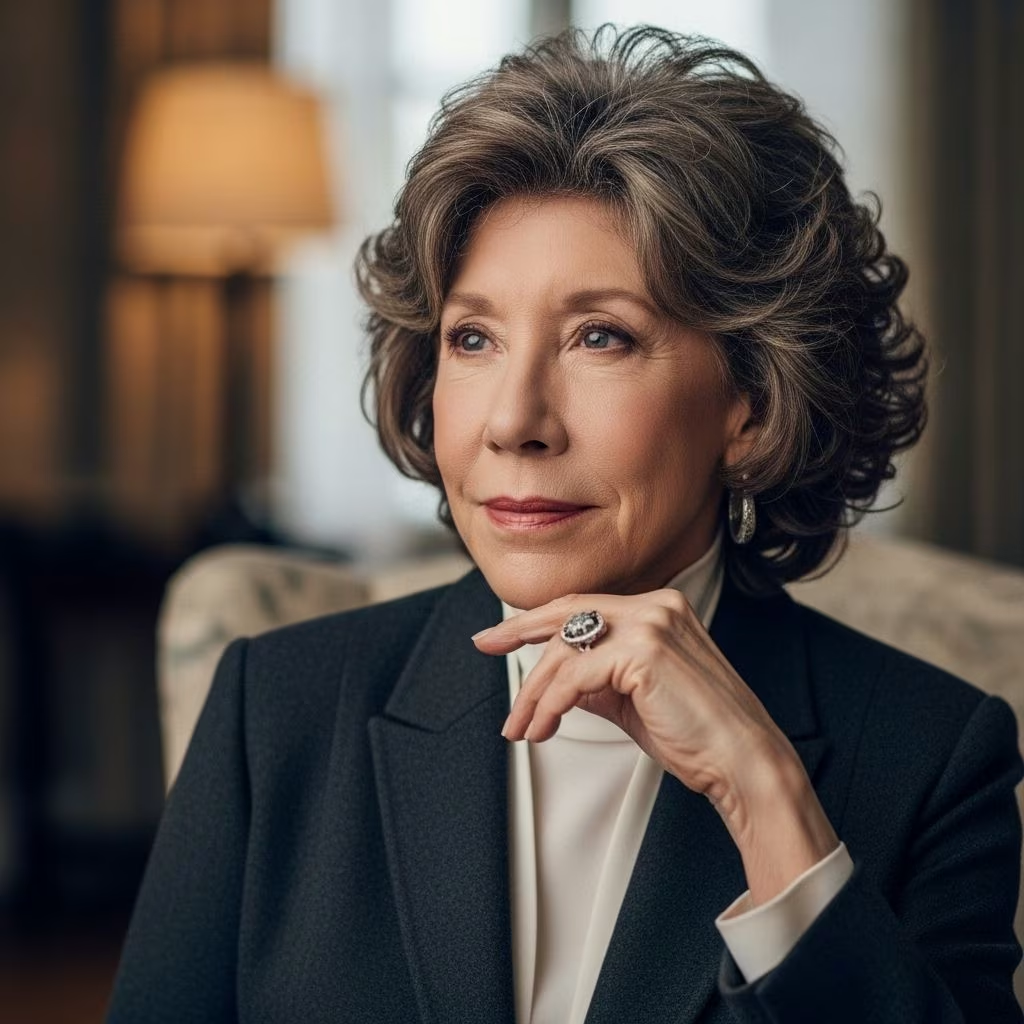
Why Lily Tomlin Never Had Children: A Life of Choice and Comedy
Lily Tomlin stands as one of comedy’s luminaries, celebrated for her fierce originality, trailblazing characters, and multi-decade partnership with writer and director Jane Wagner. Throughout her public life, Tomlin has attracted curiosity regarding her decision to remain childfree—a choice she has addressed with honesty, wit, and her trademark candor.
Below, we explore Tomlin’s thoughtful perspective on motherhood, the roots of her decision, her relationship, and her reflections on what it means to lead a life true to one’s self.
Defining a Life Beyond Motherhood
Though celebrities are often expected to follow traditional family paths, Lily Tomlin has always existed outside such molds. Over the course of her career, Tomlin’s decision not to have children has provoked interest and discussion—not just for her personal reasons, but for how she articulates them in a culture where motherhood is often seen as central to womanhood.
For Tomlin, motherhood was never an aspiration—a fact she has stated directly. In a 2015 interview with The Guardian, Tomlin said: “I mean, sometimes I think it would be nice to have somebody who looks like a replica of you in some fashion. But I don’t think it ever was an aspiration of mine.” Wagner, Tomlin’s wife and creative collaborator, confirmed her own ambivalence about parenthood in the same interview.
The couple’s practical and philosophical reasoning speaks to a broader dialogue about what it means to define one’s legacy beyond offspring.
Lily Tomlin and Jane Wagner: Partners in Life and Art
Tomlin and Wagner’s relationship, which began in the early 1970s and culminated in marriage in 2013, is one of Hollywood’s longest-standing unions. Both have been open about their mutual support and creative synergy. Their partnership is marked less by the trappings of family life and more by a shared devotion to art, comedy, and thoughtful living.
Notably, Tomlin and Wagner once briefly considered parenthood via Wagner’s nephew as a sperm donor, even joking about “bearing his child.” Tomlin later clarified that neither felt truly invested in that option: “I wouldn’t want to, but I could,” she mused—and ultimately, both agreed they were “so glad” they hadn’t pursued children, especially “when I think of the world now, I don’t want to even deal with having to raise a child.”
The Role of Choice and Personal Fulfillment
- Career Focus: Tomlin’s devotion to her craft, first in stand-up and later in television and film, played a central role in her choice. The demands and unpredictability of entertainment work, she has said, left little room for traditional parenting.
- Self-Knowledge: Tomlin admits candidly, “I don’t think I have the behavior” of a good mother—pointing to her own temperament and lifestyle as mismatched with the responsibilities and emotional commitments of raising children.
- Social Awareness: The comedian has spoken about her apprehension regarding raising children “in this world,” hinting at concerns over politics, culture, and environmental realities that influenced her and Wagner’s decision through the years.
- Daily Life: With a characteristic dash of humor, Tomlin has noted that she’s happy not to have the daily obligations parenthood requires: “I would have to get up and fix breakfast for the kids and all that. So in retrospect, we say every day, ‘I’m so glad we didn’t have any children.’”
Early Life: Roots and Original Aspirations
Born Mary Jean Tomlin in Detroit, Michigan, in 1939 to Lillie Mae Tomlin and Guy Tomlin, Lily grew up in a working-class household where humor was a means of survival and connection. Her family, originally from Paducah, Kentucky, instilled in her a resilience and independence reflected throughout her life choices.
Tomlin initially attended Wayne State University studying biology, signaling an early interest in medicine rather than performing arts. It was only after she took theater arts classes that she tapped into her comic and dramatic talents, a discovery that prompted her to leave college for the stage . As Tomlin’s career took off—first in Detroit and New York stand-up clubs, then on television’s “The Merv Griffin Show” and “Rowan & Martin’s Laugh-In”—her life trajectory diverged sharply from traditional expectations, emphasizing dedication to professional growth over the routines of family life .
Lily Tomlin’s Career: Artistry, Impact, and Autonomy
Lily Tomlin is celebrated not only for her irreverent wit but also for pioneering complex, multidimensional roles at a time when opportunities for women in comedy and acting were limited. Some career highlights include:
- 1975 – Nashville: Tomlin’s performance as Linnea, a gospel singer and mother to two deaf children, earned her an Academy Award nomination—ironically, positioning her as a maternal figure onscreen even as she chose not to be one offscreen .
- 1980 – 9 to 5: Starring opposite Jane Fonda and Dolly Parton, Tomlin’s portrayal of Violet Newstead challenged stereotypes of women in the workforce, blending comedy with pointed social commentary.
- Broadway Triumphs: Tomlin won a Tony Award for The Search for Signs of Intelligent Life in the Universe (1985), a collaboration with Wagner exploring identity, meaning, and connection outside the boundaries of conventional family structures.
- Recent Work: In Netflix’s Grace and Frankie, Tomlin’s character Frankie remains childfree, mirroring her real-life choices and resonating with new generations seeking alternative models of fulfillment .
Across these stage and screen achievements, Tomlin’s autonomy and commitment to craft have repeatedly taken precedence over family-building, setting an example for fellow artists and fans alike.
Societal Expectations and Personal Agency
Tomlin’s outspokenness about her decision not to have children has been especially meaningful given an era in which women—particularly those in the public eye—are routinely asked to justify their choices. By refusing to conform or offer apologies, Tomlin stands as a role model for self-actualization and the power of personal agency.
| Aspect | Traditional Expectation | Lily Tomlin’s Approach |
|---|---|---|
| Marriage | Early marriage, children expected | Long partnership, late marriage, childfree |
| Career vs. Family | Balancing both or prioritizing family | Primary focus on creative/professional life |
| Womanhood | Motherhood as central | Defined by individuality, art, and self-expression |
| Public Narrative | Explain any deviation from norm | Unafraid to state personal preferences |
FAQ: Lily Tomlin and Life Without Children
Q: Does Lily Tomlin have any children?
A: No, Lily Tomlin has never had children. She has openly discussed her reasons, emphasizing that motherhood was never a personal ambition and that she feels content with her choice .
Q: Has Lily Tomlin ever considered parenting?
A: Tomlin and Jane Wagner fleetingly considered the idea, even joking about involving Wagner’s nephew as a sperm donor, but both quickly decided it wasn’t right for them and have expressed relief in hindsight .
Q: Is Lily Tomlin married?
A: Yes, Tomlin married Jane Wagner in 2013 after a partnership spanning over four decades . Their creative collaboration is noted in theater and screen.
Q: How does Lily Tomlin view the idea of being a mother?
A: Tomlin has candidly stated that she doesn’t think she possesses the behavior or inclination required for motherhood, preferring independence and a lifestyle unfettered by parenting duties .
Q: What does Lily Tomlin say about raising children in today’s world?
A: She has remarked that she is grateful not to navigate the challenges of parenting in the current global climate, referencing social, cultural, and environmental changes .
Reflecting on a Childfree Life: Broader Implications
Lily Tomlin’s narrative is not just a personal one—it resonates within larger conversations about autonomy, authenticity, and alternative models of living. For many, her story offers:
- Validation: Affirmation that fulfillment and legacy are not limited by parenthood.
- Inspiration: A template for living in pursuit of creative or personal goals, rather than societal prescription.
- Visibility: Representation for childfree women in media, demonstrating the variety of ways to lead a full life.
- Honesty: Open discussion of ambivalence, uncertainty, and gratitude—traits that add dimension and realism to choices often oversimplified.
Legacy: Influence and Continued Relevance
Tomlin’s decisions—both professional and personal—have carved a unique legacy. She remains active in entertainment, acclaimed for roles that challenge, amuse, and provoke. In recent years, her impact has widened, mentoring younger artists and advocating for LGBTQ+ rights, women’s equality, and creative freedom. Her status as “childfree by choice” continues to inspire individuals across generations who seek permission to chart their own paths.
Key Takeaways
- Lily Tomlin’s decision not to have children was informed by personal preference, professional pursuit, self-awareness, and consideration of global circumstances.
- Her partnership with Jane Wagner demonstrates the richness possible in alternative family structures, with mutual support and shared values as fundamental.
- Tomlin’s candid discussions on this topic have broadened the conversation on women’s autonomy and the legitimacy of childfree lives.
- Her continued success validates that legacy and contribution can be measured in creativity, mentorship, and public discourse—not simply biological lineage.
Further Reading and Resources
- Interviews with Lily Tomlin and Jane Wagner in The Guardian
- Biographical profiles from IMDB, Wikipedia, and Biography.com
- Filmography, including Nashville, 9 to 5, The Search for Signs of Intelligent Life in the Universe, and Grace and Frankie
Embracing life as it suits you—rather than as others expect—is at the heart of Lily Tomlin’s story. Her reflections on a childfree existence invite ongoing discussions on personal happiness, relationships, and what it truly means to leave a lasting mark on the world.