


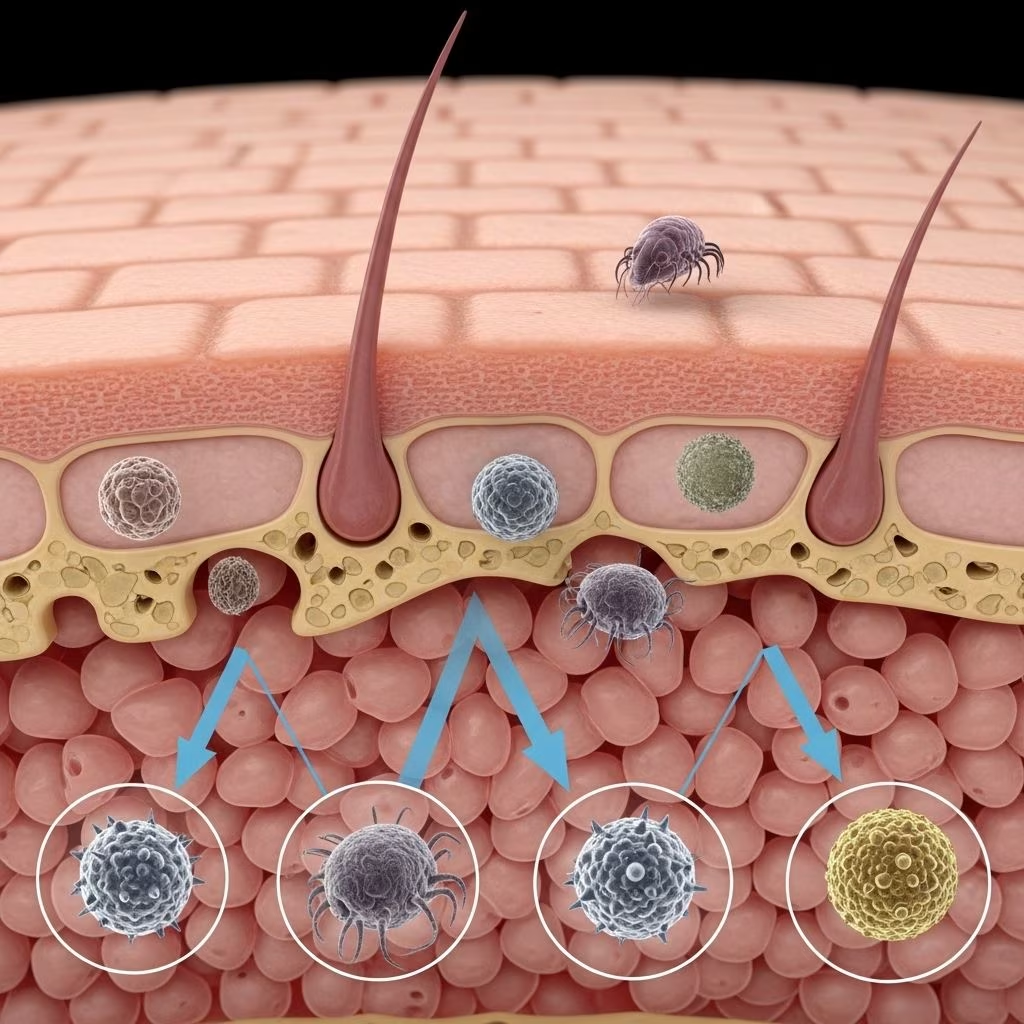
Airborne Allergens: Do They Increase Skin Permeability?
Skin acts as our primary interface with the environment, a critical barrier that guards against pathogens, pollutants, and allergens. Rising prevalence of allergic skin disorders has increased scientific attention towards the contributory role of airborne allergens and environmental pollutants. Can these inhalable particles breach the skin’s defenses, increasing skin permeability and exacerbating disease? This article reviews current evidence, explains mechanisms, and addresses practical implications for dermatological health.
Introduction: The Skin Barrier and Environmental Challenge
The outermost layer of human skin, the stratum corneum, forms an efficient shield against physical insults and biological intruders. However, exposure to airborne chemicals, particles, and allergens puts this barrier under continuous stress. Recent research confirms that not only do these agents trigger allergic reactions, but some also directly weaken barrier integrity, allowing deeper penetration of irritants and allergens .
Understanding Airborne Allergens
Airborne allergens include environmental proteins and particles that can trigger immunological reactions upon contact with the skin or respiratory mucosa. Common sources include:
- House dust mites
- Pollen (tree, grass, weed)
- Pet dander
- Cockroach proteins
- Mold spores
- Particulate matter (PM) pollution
Most studies have focused on the proteins from dust mites and pollens due to their high prevalence in allergic diseases, especially atopic dermatitis and eczema .
The Science of Skin Barrier Function
The skin’s barrier is multi-layered:
- Stratum corneum (SC): Outermost, rich in lipids, forms primary barrier.
- Tight junctions: Proteins within the epidermis (e.g., occludin, claudin, zona occludens-1) bind cells together, regulating permeability.
- Filaggrin: A key protein supporting structure and moisture retention.
Healthy skin resists most environmental exposures, but any alteration—genetic, inflammatory, or chemical—can lead to increased permeability . This increased permeability means particles, proteins, and pollutants can penetrate deeper, possibly triggering immune reactions or even systemic effects.
Mechanisms: How Airborne Allergens Increase Skin Permeability
Recent studies show several mechanisms through which airborne allergens and pollutants compromise the skin barrier:
- Proteolytic enzyme activity: Dust mite and cockroach proteins possess inherent protease activity (e.g., cysteine/serine proteases) that can disrupt tight junctions and degrade protective proteins in the skin, increasing permeability .
- Activation of skin receptors: Some allergens activate proteinase-activated receptors (PAR-2) on skin cells, increasing inflammation and compromising barrier recovery .
- Formation of reactive oxygen species (ROS): Particulate matter induces oxidative stress, damaging proteins and lipids in the SC, leading to greater barrier dysfunction .
- Disruption of tight junctions: PM and certain allergens degrade tight junction proteins like occludin, ZO-1, and claudin-1, which increases permeability to water and foreign materials .
- Altered immune responses: Penetration of allergens into deeper layers can trigger IgE-mediated immediate hypersensitivity reactions and T-cell mediated delayed reactions .
| Mechanism | Main Players | Effect on Barrier |
|---|---|---|
| Proteolytic enzymes | Dust mite, cockroach allergens | Disrupt proteins, delay barrier recovery |
| Receptor activation (PAR-2) | Airborne proteins | Triggers inflammation, slows repair |
| Oxidative stress (ROS) | Particulate matter | Damages lipids & proteins, increases permeability |
| Tight junction disruption | PM, pollutants | Cell-cell adhesion weakened, permeability rises |
Particulate Matter and Skin: Barrier Disruption
Particulate matter (PM)—including PM2.5, diesel exhaust, and urban dust—has emerged as a key factor in skin barrier dysfunction. Research highlights several findings:
- PM induces expression of inflammatory mediators (e.g., TNF-α), which causes deficiency in filaggrin, further weakening the skin’s barrier .
- Animal models (mice, porcine skin) show topical PM exposure degrades tight junction proteins and allows PM penetration into both healthy and compromised skin, with tape-stripped or diseased skin showing greater permeation .
- Engineered nanoparticles (diameter < 100 nm) have been observed to penetrate through the SC and even reach deeper layers under certain conditions .
The degree of PM penetration and subsequent impact on skin depend on particle size, aggregation, and existing skin health.
Diseases Associated with Impaired Skin Barrier
Increased skin permeability is linked to various dermatological and allergic conditions, including:
- Atopic dermatitis (AD): Patients exhibit baseline barrier impairment, making them susceptible to airborne allergen penetration .
- Contact dermatitis: Penetration of allergens and irritants initiates eczematous reactions, aggravating symptoms .
- Pollution-related skin aging and pigmentary disorders: Chronic pollutant exposure hastens photoaging and hyperpigmentation via barrier dysfunction and inflammation .
The altered barrier allows deeper entry of compounds, promoting inflammatory cascades, immune sensitization, and chronic symptoms.
Atopic Dermatitis: A Case Study
Atopic dermatitis (AD) is a prototype condition illustrating the link between airborne allergens and skin permeability:
- Patients with AD have genetically and acquired deficiencies in their skin barrier, including low filaggrin levels and defective tight junctions .
- Airborne proteins can penetrate the impaired barrier, worsening inflammation via IgE-mediated and delayed hypersensitivity reactions.
- Severity of AD correlates strongly with the level of sensitization to airborne allergens. For instance, children with severe AD are nearly twice as likely to test positive for dust mite, pollen, or pet allergens compared to those with mild disease .
- Application of allergens such as weed pollen and pet dander can provoke eczematous lesions when applied to air-exposed sites (face, neck, arms) in AD patients .
- Environmental proteins and PM further compromise already weakened barriers, increasing both water loss and allergen penetration .
These insights emphasize the importance of understanding and managing environmental triggers in patients with chronic skin disease.
Testing, Patterns, and Clinical Findings
Several diagnostic and observational approaches are used in clinical settings to identify and quantify the impact of airborne allergens and pollutants on skin permeability:
- Atopy Patch Testing (APT): Measures skin reactions to various airborne proteins. AD patients with air-exposed lesions are more likely to have positive results at lower allergen doses .
- TEWL (Transepidermal Water Loss): Indicates degree of barrier impairment. Higher TEWL aligns with increased permeability and disease severity .
- Biomarker analysis: Tracks changes in proteins like filaggrin, keratins, and tight junction molecules to assess barrier disruption .
These tests help differentiate between generalized or flexural AD and air-exposed eczema patterns, facilitating targeted intervention .
Prevention and Management Strategies
Protection against airborne allergens and polluted environments is crucial for maintaining skin health, especially in sensitive individuals. Key strategies include:
- Environmental controls: Use air filtration indoors, minimize exposure to sources like dust mites, pets, and pollens.
- Barrier repair creams: Formulations rich in ceramides, cholesterol, and free fatty acids help restore barrier integrity.
- Topical antioxidants: Provide additional defense against oxidative stress caused by airborne PM.
- Protective clothing and masks: Limit direct skin contact with environmental allergens and pollutants.
- Personal hygiene routines: Regular but gentle cleansing to remove particulate matter, without stripping natural lipids.
- Allergen avoidance and clinical guidance: Allergists and dermatologists can help identify triggers through history-taking and patch tests.
These steps are especially beneficial for individuals with chronic skin conditions like AD .
Frequently Asked Questions (FAQs)
Q: Do airborne allergens only affect individuals with pre-existing skin conditions?
A: While those with atopic dermatitis or eczema are most susceptible, airborne allergens and particulate matter can compromise the skin barrier function in healthy individuals as well, especially with prolonged or high-level exposures .
Q: Can pollution increase risk for skin infections?
A: Yes. Disrupted barrier integrity due to pollutant or allergen exposure allows easier penetration of microbes, increasing susceptibility to skin infections .
Q: Are indoor allergens as dangerous as outdoor pollutants?
A: Both indoor (e.g., dust mite, pet dander) and outdoor sources (e.g., pollen, urban PM) can cause barrier impairment and increase skin permeability. Their impact depends on concentration, duration of exposure, and individual sensitivity .
Q: What is the role of filaggrin in skin barrier integrity?
A: Filaggrin is an essential structural protein in the epidermis. Deficiency (genetic or induced, e.g., by PM2.5 exposure) impairs skin barrier, increasing permeability and predisposing to allergic disease .
Q: Can barrier repair treatment fully reverse allergen-induced permeability?
A: While barrier repair can improve skin resilience, ongoing exposure to airborne allergens and pollutants may still trigger flare-ups; comprehensive management requires allergen avoidance and therapy .
Summary and Key Takeaways
- Airborne allergens and particulate matter are increasingly recognized as direct disruptors of skin barrier, not just triggers of immunological reactions.
- Skin barrier dysfunction—manifested as increased permeability—is a central feature in allergic and inflammatory skin diseases (especially atopic dermatitis).
- Proteases, reactive oxygen species, and degraded tight junctions are key mechanisms through which allergens and pollutants compromise barrier integrity.
- Both healthy and diseased skin can be affected, with pre-existing barrier impairment amplifying allergen penetration and inflammation.
- Prevention through environmental control, barrier repair, and targeted treatment is essential for maintaining skin health in an era of rising environmental exposures.
Reference Sources
- PMC2921737: The Role of Airborne Proteins in Atopic Dermatitis
- PMC7382801: Impact of Airborne Particulate Matter on Skin
- JCI Insight: Particulate Matter Causes Skin Barrier Dysfunction
- Exploration Allergy: The search for still unknown pathomechanisms of allergy
- ProsperaBiotech Blog: Atopic Dermatitis and Pollen Allergy
- Wiley: Skin, Gut, and Lung Barrier Review
References
- https://pmc.ncbi.nlm.nih.gov/articles/PMC2921737/
- https://pmc.ncbi.nlm.nih.gov/articles/PMC7382801/
- https://www.explorationpub.com/Journals/eaa/Article/100948
- https://onlinelibrary.wiley.com/doi/10.1111/all.16092
- https://www.prosperabiotech.com/en/blog/pollen-allergy-and-dermatitis/
- https://insight.jci.org/articles/view/145185


