


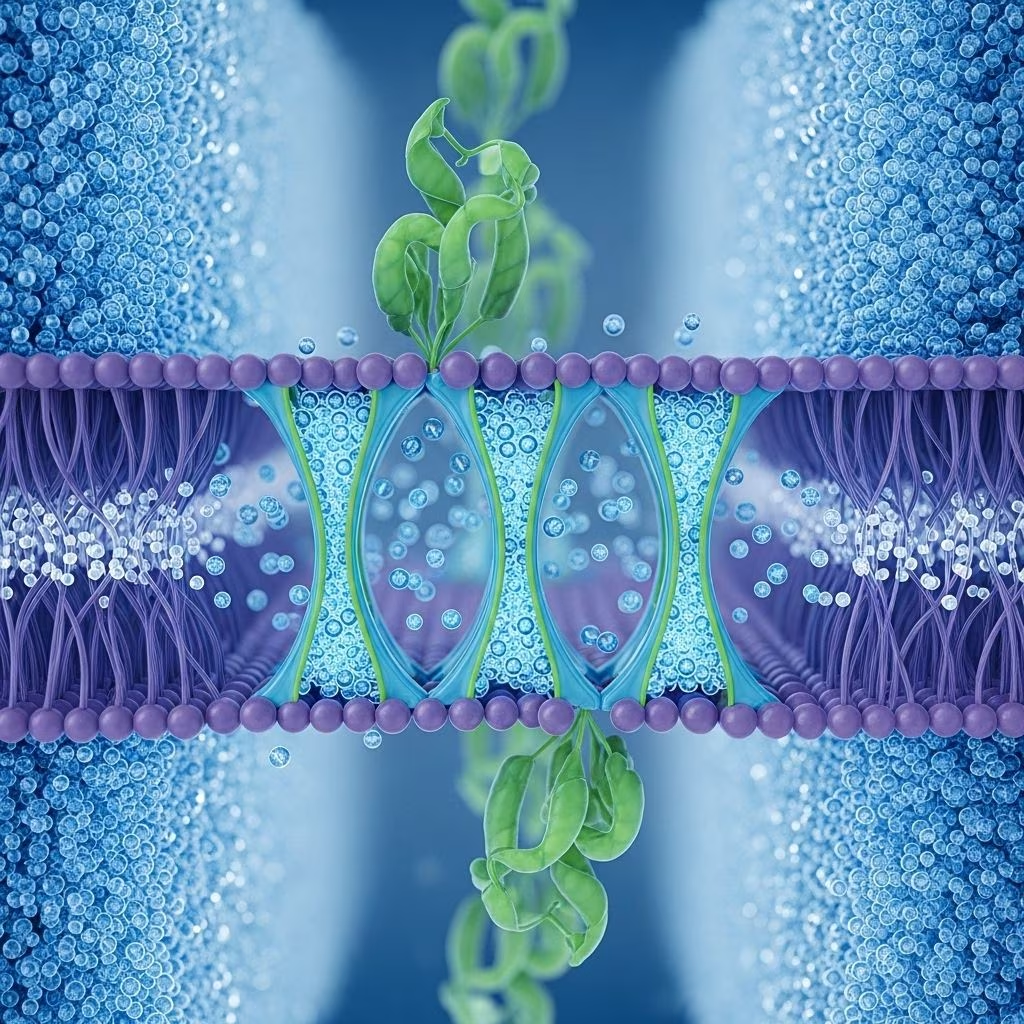
Aquaporins are crucial proteins embedded in the cellular membranes of nearly every living organism, facilitating the rapid and highly selective movement of water molecules while protecting cell integrity. Their discovery revolutionized our understanding of cell physiology, revealing the unseen passageways that allow life-sustaining water to flow across barriers that were once considered impermeable. This article explores the intricate details, biological significance, and far-reaching impact of aquaporins.
Introduction to Aquaporins
Life depends on water, and within every living cell, maintaining water balance is foundational to survival. Cell membranes, composed of hydrophobic lipid bilayers, naturally repel water and other polar molecules, restricting unmediated water movement. To overcome this barrier, cells employ specialized integral membrane proteins called aquaporins—selective water channels that allow water to flow in and out of cells at rates thousands of times faster than simple diffusion.
Aquaporins play a key role in:
- Regulating cell volume
- Facilitating osmoregulation
- Enabling secretion and absorption processes (e.g., saliva, sweat, urine)
- Maintaining tissue and organ function under varying physiological conditions
Discovery and Historical Background
For decades, biologists observed that cellular water movement was too rapid to be explained by diffusion through the lipid bilayer. Yet, the molecular identity of these ‘water pores’ was elusive until the late 20th century. In 1992, Peter Agre and colleagues isolated the first aquaporin protein (now called AQP1) from red blood cells, a breakthrough that led to Agre’s Nobel Prize in Chemistry in 2003. This discovery not only explained previous experimental results but also unveiled a large family of related proteins present from bacteria to humans.
Molecular Structure of Aquaporins
Aquaporins exemplify elegant biological design. Each aquaporin monomer:
- Comprises approximately 270–300 amino acids (~30 kDa)
- Features six transmembrane alpha-helices, arranged to span the lipid bilayer
- Contains two short helical loops with a highly conserved sequence motif: Asn-Pro-Ala (NPA)
- Folds into an “hourglass” shape, creating a narrow aqueous pore
- Is assembled as a homotetramer in the membrane, with four monomers (each with its own water pore) clustered together; in some models, a central fifth pore may form in the tetramer’s middle
Characteristics of the aquaporin pore:
- Extremely narrow (~2.8 Å in diameter), just wide enough for single-file water molecules
- Selective for water, excluding ions and many other solutes due to steric and electrostatic barriers
- Employs specific amino acids lining the pore to destabilize hydrogen-bonded water “chains,” preventing proton (H⁺) leakage
| Feature | Description |
|---|---|
| Monomer size | ~30 kDa (270-300 amino acids) |
| Structure | 6 transmembrane helices, 2 NPA motif-loops |
| Tetramer formation | 4 monomers assemble, each forms an independent water channel |
| Pore diameter | ~2.8 Å (angstroms), highly selective for water |
| Selectivity | Water and, in some subtypes, glycerol and small solutes |
How Aquaporins Work: Mechanisms of Water Transport
Aquaporins dramatically increase membrane permeability to water. They do not require energy (ATP); instead, they harness the principle of osmosis: water moves through aquaporin channels passively, from regions of low solute concentration to those of high solute concentration, following the osmotic gradient.
Key points of aquaporin function:
- Passive Transport: Water moves bidirectionally through aquaporins according to osmotic gradients, without energy input.
- High Specificity: The channel’s interior features prevent ions, including protons and most solutes, from passing through, preserving electrochemical gradients.
- Gating and Regulation: Aquaporins can be regulated via gene expression, trafficking, and post-translational modifications (e.g., phosphorylation), ensuring tight control of water movement.
- Transport of Other Small Molecules: Certain aquaporins (aquaglyceroporins) allow passage of glycerol and small uncharged molecules (sometimes even gases such as CO2 and NH3), but this is subtype-specific.
Types and Diversity of Aquaporins
Over a dozen aquaporin genes have been identified in humans and mammals (labeled AQP0 to AQP12). Each has distinct tissue distribution and physiological roles. In plants, even more aquaporin isoforms exist, reflecting their need for complex water management.
Classification of mammalian aquaporins:
- Orthodox Aquaporins: Water-selective (e.g., AQP1, AQP2, AQP4, AQP5)
- Aquaglyceroporins: Transport water and small solutes like glycerol (e.g., AQP3, AQP7, AQP9, AQP10)
- Superaquaporins: More distantly related, less characterized
Each isoform exhibits different cellular and tissue localization. For example:
- AQP1: Kidney, eye, lung, red blood cells, brain
- AQP2: Kidney collecting duct principal cells (regulated by vasopressin/antidiuretic hormone)
- AQP4: Brain (astrocytes), critical for water homeostasis in central nervous system
- AQP5: Salivary glands, lungs (airway surface fluid regulation)
- AQP3,7,9: Adipocytes, kidney, liver, skin (glycerol transport is notable in these)
Physiological Roles in the Animal Kingdom
Aquaporins are indispensable in maintaining water balance and enabling essential physiological processes throughout the animal kingdom:
- Renal Water Reabsorption: In the kidneys, aquaporins regulate the concentration of urine and the body’s water retention. AQP2, regulated by antidiuretic hormone, inserts into collecting duct membranes to reabsorb water, preventing dehydration.
- Neural Function: In the brain, AQP4 helps maintain water and ion balance, and is vital for resolving edema after trauma or stroke.
- Glandular Secretion: AQP5 and others facilitate production of saliva, tears, and airway surface liquid.
- Blood and Microcirculation: AQP1 in red blood cells aids rapid volume adjustments in response to changing osmotic conditions.
- Eye: Aquaporins contribute to lens transparency and intraocular pressure regulation.
- Adipose Tissue: Aquaglyceroporins like AQP7 regulate glycerol movement in fat metabolism.
Other Animal Functions
- Thermoregulation and sweat production
- Transport of some gases and small solutes (in certain subtypes)
- Skin hydration and barrier function
Aquaporins in Plants
Water management is even more critical in plants, necessitating a large and varied family of aquaporins. In plants, major aquaporin subfamilies include:
- PIP (Plasma membrane Intrinsic Proteins): Localized to plasma membrane, controlling cell-to-cell and root-leaf water flow
- TIP (Tonoplast Intrinsic Proteins): Located in the vacuolar (tonoplast) membrane, regulating vacuole water balance
- NIP (Nodulin26-like Intrinsic Proteins): Involved in uptake of small solutes including ammonia, boron, and silicon
- SIPs and XIPs: Other specialized plant aquaporin families
Key functions in plants:
- Facilitating root water uptake from the soil
- Driving transpiration—the process underlying evaporation of water from leaves, critical for cooling and nutrient transport
- Osmotic regulation in guard cells (controls opening/closing of stomata)
- Adapting to drought and salt stress
Plant aquaporins also manage responses to environmental stressors, impacting growth, crop yield, and resilience to harsh climates.
Aquaporin Dysfunction and Disease
Abnormal function or expression of aquaporins can lead to a variety of diseases and clinical conditions:
- Nephrogenic diabetes insipidus: Caused by mutations in AQP2, leading to large volumes of dilute urine and severe dehydration risk
- Brain edema: Altered AQP4 activity contributes to swelling after trauma or injury
- Sjögren’s syndrome (autoimmune dry mouth/eyes): Linked to AQP5 malfunction
- Cataracts: Associated with mutations in AQP0 in the eye lens
- Cancer: Aberrant aquaporin expression may be involved in tumor progression, angiogenesis, and metastasis
- Obesity/metabolic disturbances: Linked to aquaglyceroporin dysregulation
Infectious disease researchers are investigating aquaporins as possible drug targets, given their unique expression patterns and regulatory mechanisms.
Biotechnological and Medical Applications
The unique selectivity and efficiency of aquaporins have inspired a range of practical applications:
- Biomimetic Water Filters: Synthetic membranes incorporating aquaporin proteins are being developed for highly efficient water purification and desalination, outperforming traditional filters.
- Drug Development: Targeting aquaporins may offer novel therapies for edema, glaucoma, cancer, and kidney diseases.
- Transgenic Crops: Genetic modification of plant aquaporins aims to produce crops with improved drought resistance and nutrient efficiency, crucial for food security.
- Diagnostic Tools: Abnormal aquaporin expression in tissues shows promise as a biomarker for specific diseases.
Frequently Asked Questions (FAQs)
Q: What exactly are aquaporins?
A: Aquaporins are small, integral membrane proteins that form water-specific channels, allowing rapid and selective water transport across cell membranes.
Q: Why do cells need aquaporins if water can diffuse through the lipid bilayer?
A: While some water can passively diffuse through cell membranes, this process is extremely slow. Aquaporins increase water permeability by several orders of magnitude, enabling cells to adjust rapidly to osmotic pressures.
Q: Do aquaporins transport anything besides water?
A: Certain aquaporins (aquaglyceroporins) can also transport small uncharged molecules such as glycerol and, in some subtypes, gases like CO2 and NH3. However, the majority are strictly water-selective.
Q: Are aquaporins found in all living organisms?
A: Yes, aquaporins are present in nearly every form of life, from bacteria and plants to animals and humans, reflecting their fundamental importance to biology.
Q: Can aquaporins be modulated by drugs?
A: Pharmaceutical research is ongoing to develop drugs that can enhance or block aquaporin function—potentially treating conditions like brain edema, kidney diseases, or certain cancers.
Conclusion
From microscopic pores in cellular membranes to macroscopic effects on organism physiology, aquaporins are indispensable molecular machines. By enabling highly selective and regulated water movement, they maintain hydration balance, support critical processes in every kingdom of life, and unlock biotechnological innovations with far-reaching potential. As research continues to reveal the numerous roles and regulatory mechanisms of these remarkable proteins, aquaporins will remain at the forefront of cellular biology and applied science.
References
- https://pubmed.ncbi.nlm.nih.gov/10644652/
- https://biointerfaceresearch.com/wp-content/uploads/2021/04/20695837121.690705.pdf
- https://study.com/learn/lesson/aquaporins-function-channels-structure.html
- https://pmc.ncbi.nlm.nih.gov/articles/PMC3590904/
- https://www.labxchange.org/library/items/lb:LabXchange:df1e07ef:html:1
- https://study.com/learn/lesson/video/aquaporins-function-channels-structure.html


