


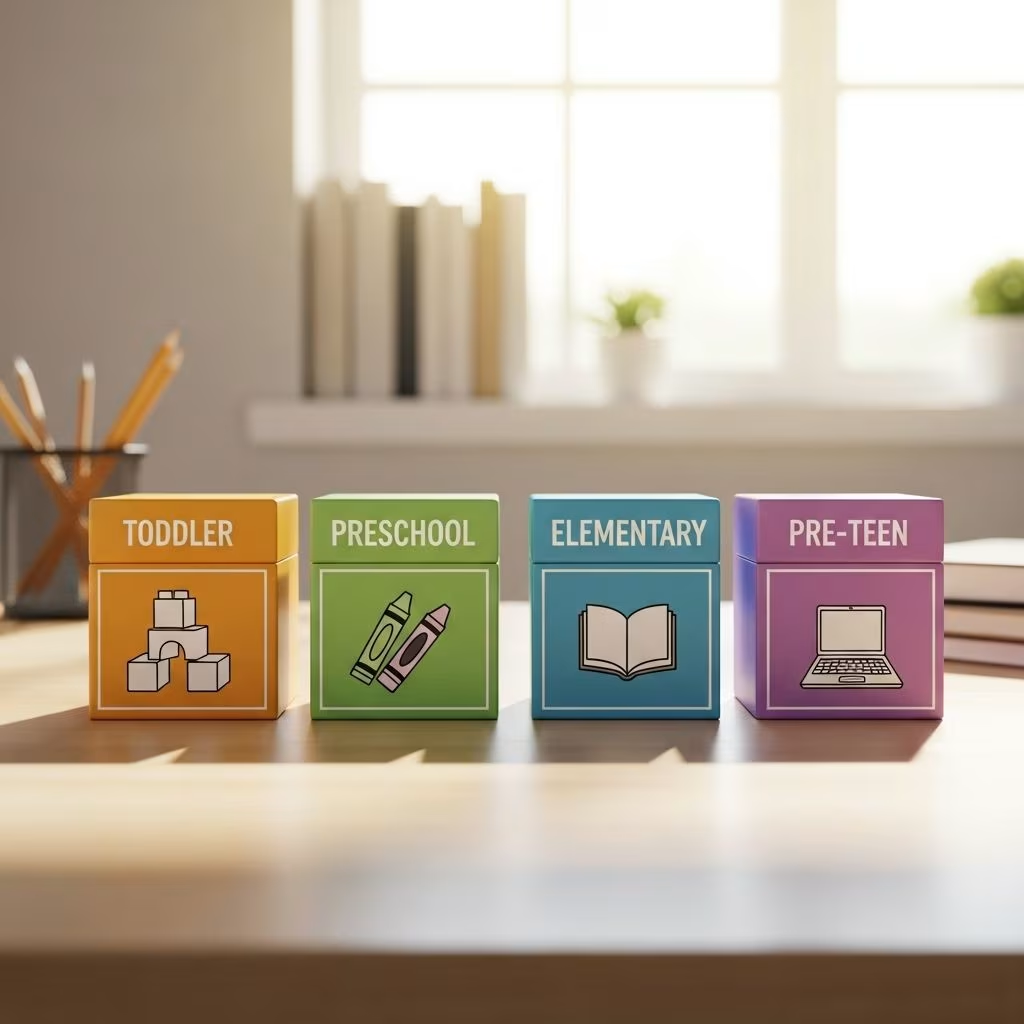
Block scheduling is a transformative approach to structuring the school day, increasingly popular among educators and families seeking deeper, less fragmented learning experiences for children. Unlike traditional scheduling methods that divide the day into several short periods, block scheduling organizes longer, dedicated “blocks” of time for focused learning, hands-on activities, and skill development. As educational research evolves, it is crucial to understand how block scheduling suits children at various developmental stages and how its strategies and outcomes should be tailored by age.
What Is Block Scheduling?
Block scheduling refers to reorganizing the school timetable into longer instructional segments—typically between 60 and 120 minutes per class—while reducing the number of transitions that students face during a single school day. This structure contrasts with traditional schedules, where periods last only 30 to 50 minutes, and students may experience six to eight classes each day.
The fundamental aim of block scheduling is to provide in-depth focus, reduce fragmented attention, and allow extended time for reflection, collaborative activities, and project-based learning. Common models include the “4×4” schedule (four classes per day, each lasting a semester) and the “A/B” or alternating day schedule (eight classes split over two days) .
Block vs. Traditional Schedules
| Feature | Block Scheduling | Traditional Scheduling |
|---|---|---|
| Class Period Length | 60-120 minutes | 30-50 minutes |
| Classes Per Day | 3-4 | 6-8 |
| Number of Subjects Handled Per Day | Fewer (deeper focus) | Many (fragmented attention) |
| Opportunity for Hands-On Learning | Higher | Lower |
| Homework Load Per Day | Reduced | Cumulative from many classes |
Core Benefits of Block Scheduling
- Promotes Cooperative and Project-Based Learning: Longer periods support collaborative projects, experiments, and deep discussions, encouraging teamwork and higher-order thinking .
- Allows Time for Reflection and Review: Students benefit from time to digest information, reflect, and consolidate learning before moving on .
- Reduces Stress and Cognitive Overload: Fewer transitions and subjects reduce the daily cognitive burden and homework load, contributing to lower stress levels .
- Enables Individualized and Deeper Instruction: Teachers have more opportunities for one-on-one support, differentiated instruction, and addressing varied learning styles .
- Improved Teacher-Student Relationships and Classroom Climate: Extended time together fosters stronger bonds and more positive classroom dynamics .
- Higher Engagement and Academic Performance: Some research suggests improved GPAs, higher college acceptance rates, and better retention with block models, especially for older students .
- Alignment with College/Work Schedules: Especially for high schoolers, block scheduling mirrors higher education and workplace structures, better preparing students for future transitions .
Potential Challenges
- Loss of Continuity: Subjects may not be revisited daily, potentially causing forgetfulness or gaps in sequential subjects like math or languages .
- Gaps Due to Absenteeism: Missing one block class often equals missing two (or more) traditional classes, making catch-up harder .
- Adjustment Period: Young children and even teenagers may initially struggle with maintaining focus for longer periods or organizing their study habits .
- Potential Fast-Paced Curriculum: Covering the same content in fewer sessions may feel rushed to some students, possibly disadvantaging those who need more repetition .
Designing Block Schedules by Age
The effectiveness of block scheduling depends not just on the model chosen but also on adapting block length, content, and structure to children’s developmental needs. Below are key insights for different age groups:
Preschool and Kindergarten (Ages 3–6)
- Block Length: Should not exceed 30–45 minutes for focused activities, interspersed with frequent breaks.
- Structure: Short blocks for reading, play-based learning, and group time; hands-on and movement-rich activities; unstructured time is essential.
- Focus: Skill-building through play, exploration, and social-emotional learning in a relaxed atmosphere.
Elementary School (Ages 6–11)
- Block Length: 45–60 minutes per subject or activity, with physical movement and variety between blocks.
- Structure: Literacy and numeracy blocks in the morning, creative arts or sciences in the afternoon; integrated project-based periods encourage thinking across subjects.
- Focus: Emphasis on multi-modal learning (visual, auditory, kinesthetic), movement, and social opportunities.
Middle School (Ages 11–14)
- Block Length: 60–90-minute blocks, ideally alternating between academic and elective or hands-on subjects.
- Structure: Mix of core academic blocks (English, Math, Science, Social Studies) and enrichment (art, music, technology, P.E.).
- Focus: Deeper inquiry, collaborative learning, more autonomy, and task-focused study times.
High School (Ages 14–18)
- Block Length: 75–120-minute blocks, fewer daily transitions, often following a 4×4 or A/B model.
- Structure: Intensive study in four subjects per semester, enabling concentrated learning, labs, and college-level or advanced coursework.
- Focus: Project-based work, research, presentation skills, in-depth exploration, and preparation for post-secondary environments.
Realistic Examples of Block Schedules (by Age Group)
Illustrating effective block schedules can help parents, teachers, and administrators understand how block scheduling can be tailored across age groups:
Example: Preschool/Kindergarten Block Schedule
- 8:30–9:00 – Arrival/Free Play
- 9:00–9:30 – Circle Time (Stories, Calendar, Sharing)
- 9:30–10:00 – Literacy/Reading Block
- 10:00–10:15 – Snack/Movement Break
- 10:15–10:45 – Creative Arts/Sensory Play
- 10:45–11:30 – Outdoor Play
- 11:30–12:00 – Math/Science Exploration
Example: Elementary School Block Schedule
- 8:00–8:45 – Morning Meeting/Literacy Block
- 8:45–9:30 – Math Block
- 9:30–10:00 – Recess
- 10:00–11:00 – Science/Social Studies Project Block
- 11:00–11:45 – Creative Arts (Music, Art, Drama)
- 11:45–12:15 – Lunch/Play
- 12:15–1:00 – Reading Groups/Individualized Learning
- 1:00–2:00 – Physical Education/Movement
- 2:00–2:30 – Reflection, Organization, Dismissal
Example: Middle School Block Schedule
- 8:00–9:30 – Block 1: English Language Arts
- 9:45–11:15 – Block 2: Math
- 11:15–12:00 – Lunch
- 12:00–1:30 – Block 3: Science (with labs)
- 1:45–3:15 – Block 4: Elective/PE/Technology
Example: High School Block Schedule (4×4 Model)
- 8:00–9:30 – Block 1: Advanced Biology (Lab Included)
- 9:40–11:10 – Block 2: English Literature
- 11:10–12:00 – Lunch
- 12:00–1:30 – Block 3: College Algebra
- 1:40–3:10 – Block 4: History or Elective
Best Practices and Parental Tips
- Observe and Adjust for Attention Spans:
- Young children may need shorter blocks and more breaks, while older kids can focus deeply for longer.
- Incorporate Movement:
- Even with block schedules, integrate physical activity to help with concentration and mood.
- Foster Reflection:
- Build in time for students to reflect, review, and discuss what they have learned at the end of each block .
- Keep Communication Open:
- Work with teachers to tweak the schedule as needed by your child’s evolving abilities and interests .
- Help Kids Develop Organization Skills:
- Longer learning periods mean more autonomy—use planners or visual schedules, especially with middle or high schoolers.
- Monitor Workload and Stress:
- Ensure that the promise of less daily homework is realized and intervene if children feel overwhelmed adjusting to block pacing .
Frequently Asked Questions
Q: Is block scheduling more effective than traditional scheduling for all ages?
A: Effectiveness varies by age and implementation. Younger children benefit from shorter, flexible blocks for play-based and hands-on learning, while older students gain more from in-depth study in longer blocks. Studies indicate positive impacts in middle and high school but highlight the need for developmentally appropriate adaptations for younger learners .
Q: What are the key signs that block scheduling is not working well for a child?
A: Signs may include increased restlessness, loss of focus before the block ends, worsening performance in sequential subjects, or apparent anxiety about longer classes. Adjusting block length or building in more movement can help.
Q: How can teachers maximize the value of a block schedule?
A: Innovative teaching methods, incorporating collaboration, hands-on activities, reflection, and variable pacing are essential. Avoid simply “stretching” a traditional lesson; instead, use extended time for deeper dives, experiments, discussions, and student-led inquiry .
Q: What if my child misses a day on a block schedule?
A: Absenteeism is more impactful in block models. Proactively request lesson summaries, assignment packets, or extra help—catch up promptly to prevent falling behind, especially in sequential courses .
Q: Does block scheduling prepare students for college or professional success?
A: Yes, for high school students in particular, block scheduling mirrors the structures found in many colleges and workplaces, offering practice in managing time, deep learning periods, and independent practice .
Conclusion
Block scheduling holds great promise across age groups when implemented with consideration for developmental needs. By focusing on fewer subjects at a time, allowing richer opportunities for reflection, and fostering supportive teacher-student relationships, block scheduling can boost academic achievement and reduce stress—if tailored wisely for each stage of childhood and adolescence.
References
- https://www.uopeople.edu/blog/what-is-block-scheduling/
- https://digitalcollections.dordt.edu/cgi/viewcontent.cgi?article=1160&context=med_theses
- https://www.maialearning.com/blog/block-versus-traditional-schedules-for-high-school-students
- https://files.eric.ed.gov/fulltext/ED521694.pdf
- https://www.aasa.org/resources/resource/the-effects-of-block-scheduling
- https://www.nea.org/nea-today/all-news-articles/are-block-schedules-stress-buster-students-need
- https://www.sj-r.com/story/lifestyle/2016/05/03/block-scheduling-has-many-benefits/31054545007/
- https://www.nbpts.org/blog/2016/11/03/why-more-high-schools-should-have-a-block-schedule/


