


Introduction
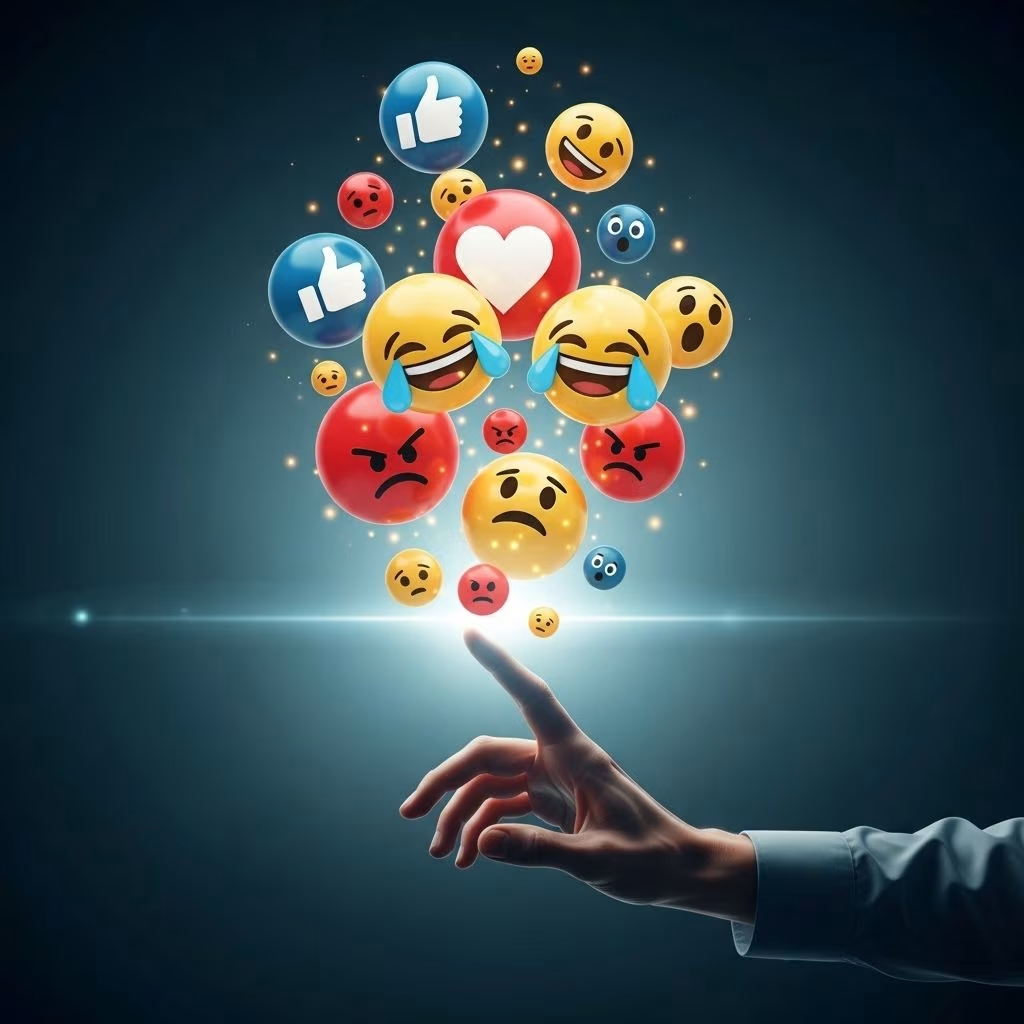
Digital communication has transformed the way humans express and interpret emotions, with emojis and reaction buttons rivaling—and occasionally replacing—words themselves. As social media platforms and messaging apps integrate these features, the quest to understand their impact on the emotional depth of online interactions has become crucial for designers, psychologists, and everyday users.
Evolution of Emojis and Reaction Buttons
Emojis originated in Japan during the late 1990s, visualizing feelings and ideas in bite-sized graphics. Over time, their design has grown more diverse, covering a range of facial expressions, objects, and symbolic gestures. Platforms like Apple, Google, and Twitter have expanded emoji libraries, prompting cross-cultural debates about meaning and representation.
Meanwhile, Facebook popularized reaction buttons in 2016, giving users the ability to demonstrate nuanced feelings beyond the solitary ‘Like’. Now, users can quickly register emotions with options such as love, haha, wow, sad, and angry, with platforms like LinkedIn and Slack adapting their own versions.
- Emojis offer granular expression for hundreds of emotional states.
- Reaction buttons enable quantifiable interpretation of group sentiment.
Mechanisms for Expressing Emotion Online
Face-to-face conversations depend heavily on non-verbal cues—tone, gestures, facial movements. In digital environments, these cues are absent, leading to misunderstandings or emotional flattening. Emojis and reaction buttons attempt to fill this void with visual proxies for emotion.
- Emojis function as non-verbal cues with rich emotional meanings, enabling concise emotional communication on the internet.
- Reaction buttons anchor emotions to content, structuring feelings into discrete selections and offering a simplified spectrum of engagement.
- These mechanisms address the limitations of text-only communication and support fast, accessible emotional expression.
Studies demonstrate that users tend to use emojis and reactions mainly in positive contexts, while negative emojis and reactions are less common but play important roles in signaling dissatisfaction or empathy.
The Psychology Behind Emojis and Reactions
Psychologists contend that emoji usage influences not only the sender but also the emotional state of the receiver. Jaeger and Ares (2017) found that most emojis express more than one emotion, allowing for layered meaning and emotional resonance.
- Emojis can amplify the tone of digital messages, strengthening the intended emotional impact.
- Reaction buttons facilitate quick affective feedback, helping users validate or contest content without lengthy replies.
- The presence of visual cues increases emotional engagement and memory retention during online communication.
Research on Facebook reactions shows that correlating reaction data can reveal patterns in collective emotion, such as a strong relationship between ‘sad’ and ‘angry’, or ‘love’ and ‘haha’. These correlations present opportunities for platforms to analyze group sentiment in real time.
| Reaction | Correlates Strongly With | Type of Correlation |
|---|---|---|
| Sad | Angry | Negative |
| Love | Haha | Positive |
| Wow | Love, Haha | Mixed/Positive |
Emotional Nuance and Ambiguity
Despite the expressive power of emojis and reactions, they are not without ambiguity. A smiley emoji can convey genuine happiness, sarcasm, nervousness, or even resignation. Reaction buttons, while mapping feelings into isolated categories, may oversimplify complex emotional responses.
- Emojis are inherently open to multiple interpretations due to cultural and contextual differences.
- In only about 25% of cases did study participants disagree on the sentiment expressed by an emoji, but this represents a notable minority.
- Reaction buttons oversimplify emotion into discrete entities, often failing to capture conflicting or blended feelings.
For instance, a Facebook ‘like’ does not distinguish between agreement, appreciation, or mere acknowledgment. Some users combine emojis to express irony—using a laughing face alongside a crying emoji, for example. The affordance of patterns in co-occurring reactions can hint at underlying, unrepresented emotional states.
Social Dynamics and Collective Emotion
On social media, reaction buttons support the aggregation of sentiment, translating individual responses into communal data points. This “metrification” of emotion allows platforms to assess what content moves audiences positively or negatively.
- Strong co-occurrence of negative reactions (sad, angry) can signal content triggering outrage, grief, or collective anxiety.
- Positive reaction clusters (love, haha) may point to uplifting or humorous content.
- Patterns in reaction data help platforms, brands, and creators tailor content and responses to audience emotion.
Visual cues and aggregate reaction data can foster solidarity among users, mobilizing collective action or support around social and political issues. For example, a flood of ‘sad’ reactions on a tragic news story can foster empathy, while ‘angry’ reactions may drive activism or protest.
Limitations of Emojis and Reaction Buttons
Mediating emotion through emojis and reaction buttons comes with distinct limitations. Scholars caution that these tools are not a replacement for deep conversation, but a supplement at best. Key limitations include:
- Ambiguity: Emotional meaning may be misinterpreted, especially across languages and cultures.
- Constraint: Users are restricted to a limited set of emotions, unable to express complex states like ambivalence, irony, or nuanced humor.
- Measurement Challenges: Attempts to metrify feelings presume emotions are discrete—whereas in reality, emotion may be fluid and multifaceted.
- Authenticity: The shortcut of visual emotional cues can lead to performative or shallow engagement, reducing opportunities for vulnerable, authentic connection.
Research points out the need for more qualitative approaches—such as interviews and behavioral observation—to understand actual emotional experiences behind emoji and reaction use. Physiological and psychological tools may offer more accurate emotional mapping in the future.
Future Directions and Ethical Considerations
As the role of emojis and reaction buttons expands, platforms must address evolving needs for nuanced, authentic emotional communication. Incorporating qualitative and biometric research could deepen understanding of true emotional impact. Designers may need to:
- Develop adaptive emojis and reactions based on context, culture, and communication history.
- Integrate customizable emotional feedback for richer, more personal expression.
- Balance data privacy with emotional analytics, avoiding manipulation through targeted emotional design.
- Promote emotional literacy, helping users interpret and use emojis and reactions responsibly.
Ethical considerations include the risk of emotional exploitation by brands, misinformation through misinterpreted reactions, and the blurring of genuine and performative affect online. Platforms must continually refine tools to support honest, meaningful emotional connection.
Frequently Asked Questions (FAQs)
Q: Can emojis and reaction buttons fully replace words in expressing emotion?
A: No. While emojis and reactions offer shortcuts and amplifiers for emotion, words remain essential for conveying complex, nuanced, or context-specific feelings.
Q: Why are negative emojis and reaction buttons used less frequently?
A: Users typically favor positive emoji and reactions due to social norms promoting upbeat engagement; negative reactions are reserved for strong disapproval or empathy, and may carry additional social weight.
Q: Do emojis mean the same thing across different cultures?
A: No. Emoji interpretation varies widely. For example, a thumbs-up is positive in some cultures, but offensive in others. Context and platform style play key roles in meaning.
Q: Can reaction button data reliably measure real-world emotions?
A: Reaction button data provides useful aggregate estimates of sentiment, but cannot measure complex, conflicting or deeply personal emotions accurately.
Q: What is the future of emotional expression in digital communication?
A: Future tools may combine qualitative case studies, customizable emojis, and biometric feedback to enhance authenticity and nuance. Greater emotional literacy and ethical safeguards will be essential.


