


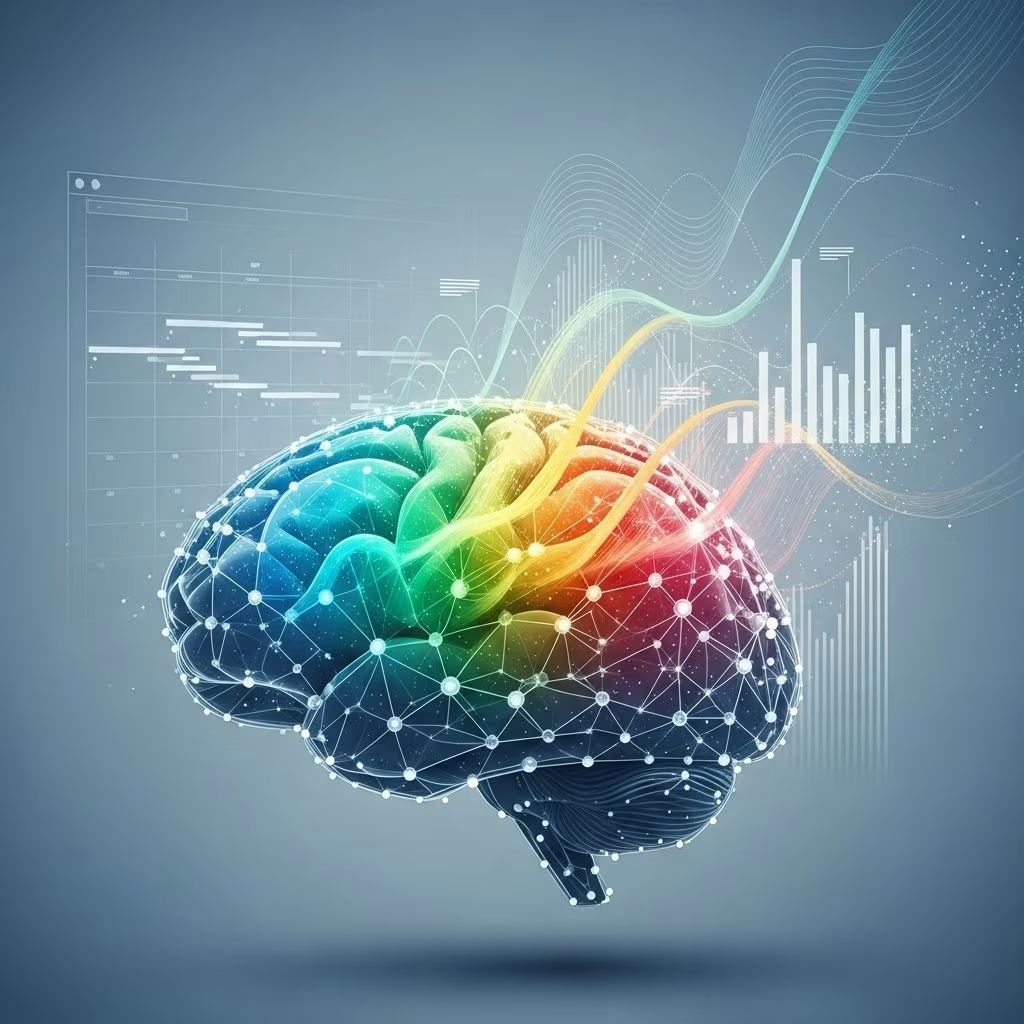
Planning for the future, whether in healthcare, business, or everyday life, depends heavily on understanding and anticipating human behavior and well-being. Predictive mood analysis, powered by data science and machine learning, has emerged as a potent tool to inform such planning, offering unprecedented insights into current and future emotional states. This article explores the science, technology, challenges, and practical applications of predictive mood analysis for effective planning in personal, clinical, and organizational domains.
Introduction: Predictive Mood Analysis
Predictive mood analysis refers to the use of computational techniques—most notably machine learning—to forecast an individual’s or a group’s future mood based on current and historical data. This approach draws from wearable device sensor readings, smartphone app data, and self-reported surveys to build insights that can drive more effective personal and organizational planning.
By anticipating mood fluctuations and stress levels, decision-makers can intervene earlier, optimize schedules, and implement proactive support mechanisms, thereby enhancing productivity, mental well-being, and overall effectiveness.
The Science of Mood Prediction
Mood prediction seeks to translate daily behaviors, physiological signals, and contextual information into accurate forecasts about future emotional states. Initial research in this area demonstrated modest success using traditional, generic machine learning models. However, studies have shown that personalized models—which account for individual differences—dramatically improve prediction accuracy.
Why Is Mood Prediction Difficult?
- Subjectivity: Moods are inherently subjective and can vary widely between individuals for the same set of circumstances.
- Data Complexity: The range of influencing factors—sleep quality, activity, weather, social interaction, biology—creates a highly multidimensional prediction problem.
- Temporal Fluctuations: Moods change throughout the day, influenced by both predictable and random external factors.
To address these challenges, modern approaches deploy multitask learning (MTL) and domain adaptation (DA), tailoring models to individual mood dynamics for enhanced performance. For example, by customizing model parameters to each person, researchers achieved significant improvements in predicting happiness, stress, and health.
Data Sources and Key Features in Mood Prediction
Developing accurate mood prediction models relies on integrating diverse datasets, often gathered unobtrusively and continuously. The main data sources include:
- Wearable Sensors: Devices like smartwatches and wristbands monitor physiological metrics, including heart rate variability, skin conductance, sleep patterns, and physical activity.
- Smartphone Usage: Patterns of social interaction (messaging, call frequency), app usage, location/GPS data, and daily rhythms.
- Self-Reported Surveys: Users report their mood, stress, and health, providing ground-truth labels for supervised learning.
- Contextual Factors: Weather data, time of day, and major life events are included to capture broader influences on emotional state.
Key Predictive Features
Research highlights certain features as robust indicators for mood prediction:
| Feature | Impact on Mood Prediction |
|---|---|
| Sleep Quality & Duration | Major predictor; irregular or poor sleep correlates with negative mood and increased stress |
| Physical Activity | Higher activity is often linked to positive affect; sedentary behavior is a risk for low mood |
| Social Interactions | Patterns of communication and social engagement predict mood shifts, particularly for depressive symptoms |
| Circadian Rhythms | Regular sleep/wake cycles and circadian stability buffer against mood swings |
| Digital Behavioral Phenotypes | Combinations of digital behaviors provide high-accuracy prediction of depression severity and mood changes |
Machine Learning Approaches to Mood Prediction
The core of predictive mood analysis is machine learning—transforming high-dimensional sensor and behavioral data into actionable forecasts.
Overview of Algorithms
- Random Forest (RF): An ensemble method often achieving high accuracy in predicting next-day mood and stress.
- Support Vector Machines (SVM): Effective for binary classification tasks in mood modeling.
- Neural Networks (NN) & Deep Learning: Used for non-linear relationships and complex feature sets, including personalized DNNs.
- Gaussian Processes (GP): Ideal for modeling uncertainty in time-series mood prediction, especially when adapted for individual baselines.
- K-Nearest Neighbors (KNN), Multilayer Perceptron (MLP): Used for variations of affect classification.
Model Personalization
Personalized models outperform generic approaches by adapting not just features but also baseline expectations to each individual. Techniques like multitask learning and domain adaptation enable these personalized predictions, resulting in up to 100% improvements over non-personalized baselines for mood, stress, and health prediction.
Applications in Effective Planning
Predictive mood analysis is revolutionizing planning across a range of fields by providing early warning and actionable insights:
Personal Life and Well-being
- Behavioral Modification: Individuals can adapt schedules and habits to stave off low mood periods.
- Preventative Mental Health: Early warnings enable proactive coping strategies, reducing the risk of depressive episodes or anxiety attacks.
- Enhanced Productivity: Planning demanding tasks during predicted high-mood periods boosts efficiency.
Clinical and Healthcare Applications
- Mental Health Monitoring: Enables remote, continuous surveillance of mood disorders, improving intervention timing in depression, bipolar disorder, and anxiety.
- Personalized Treatment: Clinicians can tailor therapies and appointments based on predicted mood states.
- Resource Allocation: Clinics can direct attention to high-risk individuals—especially in times of limited capacity.
Organizational and Workforce Planning
- Workforce Scheduling: Managers can schedule critical meetings or creative sessions aligned with employees’ predicted well-being peaks.
- Burnout Prevention: Early signs of negative mood trends in teams can prompt preventive support, reducing absenteeism and turnover.
- Crisis Management: Organizations can anticipate downturns in morale and intervene proactively.
Case Studies and Real-World Implementations
Personalized Mood Prediction with Wearables and Smartphones
MIT researchers enrolled 70 participants, collecting continuous data via wrist sensors and daily surveys over a month. Personalized deep learning models predicted individual happiness, stress, and health, showing a 50–100% improvement in accuracy over generic baselines. This allowed the system to better distinguish those at highest risk for declining mood and health.
Digital Behavioral Phenotypes in Clinical Populations
A study published in npj Digital Medicine used daily smartphone and wearable data to predict depression severity three weeks in advance. Using advanced idiographic models, they reduced prediction error by 65.7% compared to just using past symptom scores, demonstrating the power and feasibility of high-resolution digital mood monitoring in clinical contexts.
Real-Time Mood Forecasting in Mood Disorders
Machine learning models leveraging sleep/wake patterns, step counts, and light exposure have been used to accurately forecast imminent mood episodes in patients with mood disorders, empowering both patients and clinicians with early intervention options.
Challenges and Ethical Considerations
Data Privacy and Consent
- Sensitivity of Mood Data: Emotional data is deeply personal; misuse or breaches pose significant risks.
- Consent Management: Users must have clear choices about which data is collected and for what purposes.
Model Bias and Fairness
- Generalizability: Models trained on one population may not perform well in different demographic or cultural contexts.
- Bias Correction: Careful calibration is required to ensure models do not reinforce stigmas or misclassify vulnerable groups.
Technical and Practical Limitations
- Data Completeness: Gaps or inaccuracies in data collection (e.g., forgetting to wear a device) can reduce prediction reliability.
- Multi-Modal Integration: Combining diverse data streams (sensor, behavioral, contextual) is technologically complex.
- User Engagement: Maintaining high engagement in self-monitoring and reporting over the long term is challenging.
Future Trends and Innovations
- Passive Sensing Revolution: New devices will gather physiological and behavioral data with minimal user involvement, increasing coverage and reducing reporting fatigue.
- Integration with AI-based Interventions: Predictive models will not only forecast moods but trigger personalized interventions—reminders, digital therapy, or support resources—when needed.
- Expanded Use in Organizations: Companies will embed mood forecasting into wellness programs and HR planning.
- The Rise of Explainable AI: Stakeholders demand transparency in mood prediction models: why did the model forecast a negative mood, and which factors were most influential?
- Population Health Insights: Aggregated mood forecasts can guide public health planning, especially during crises affecting community mental health.
Frequently Asked Questions (FAQs)
Q: How accurate is predictive mood analysis?
A: Recent studies using individualized models and multi-feature data have achieved accuracy levels as high as 80% for depression severity and 81% for next-day mood prediction. Accuracy continually improves as more personalized and high-quality data is incorporated.
Q: What types of data are needed for effective mood prediction?
A: The most effective models typically integrate sleep, activity, physiological signals, smartphone usage, social interaction, and self-report data.
Q: Can predictive mood analysis be used without wearable devices?
A: While wearable data enhances accuracy, some studies have shown reasonable performance with smartphone app data, digital phenotypes, and self-report surveys alone, though holistic models yield the best outcomes.
Q: How are privacy and consent protected?
A: Ethical frameworks and regulatory guidelines insist on informed consent, anonymization, and secure data handling—though ongoing developments aim to enhance user control and data minimization.
Q: Where can predictive mood analysis be implemented?
A: The technology finds applications in personal wellness apps, clinical care settings for mental health monitoring, organizational HR departments, and public health research.
Predictive mood analysis is charting a path to more humane, responsive, and effective planning—helping individuals and organizations alike adapt to the dynamic landscape of human emotions and mental well-being.
References
- http://proceedings.mlr.press/v66/jaques17a/jaques17a.pdf
- https://www.nature.com/articles/s41746-024-01035-6
- https://pmc.ncbi.nlm.nih.gov/articles/PMC10131982/
- https://www.nature.com/articles/s41746-024-01333-z
- https://pmc.ncbi.nlm.nih.gov/articles/PMC11196304/
- https://www.siam.org/publications/siam-news/articles/predicting-mood-episodes-based-on-sleep-and-circadian-rhythm-features/


