


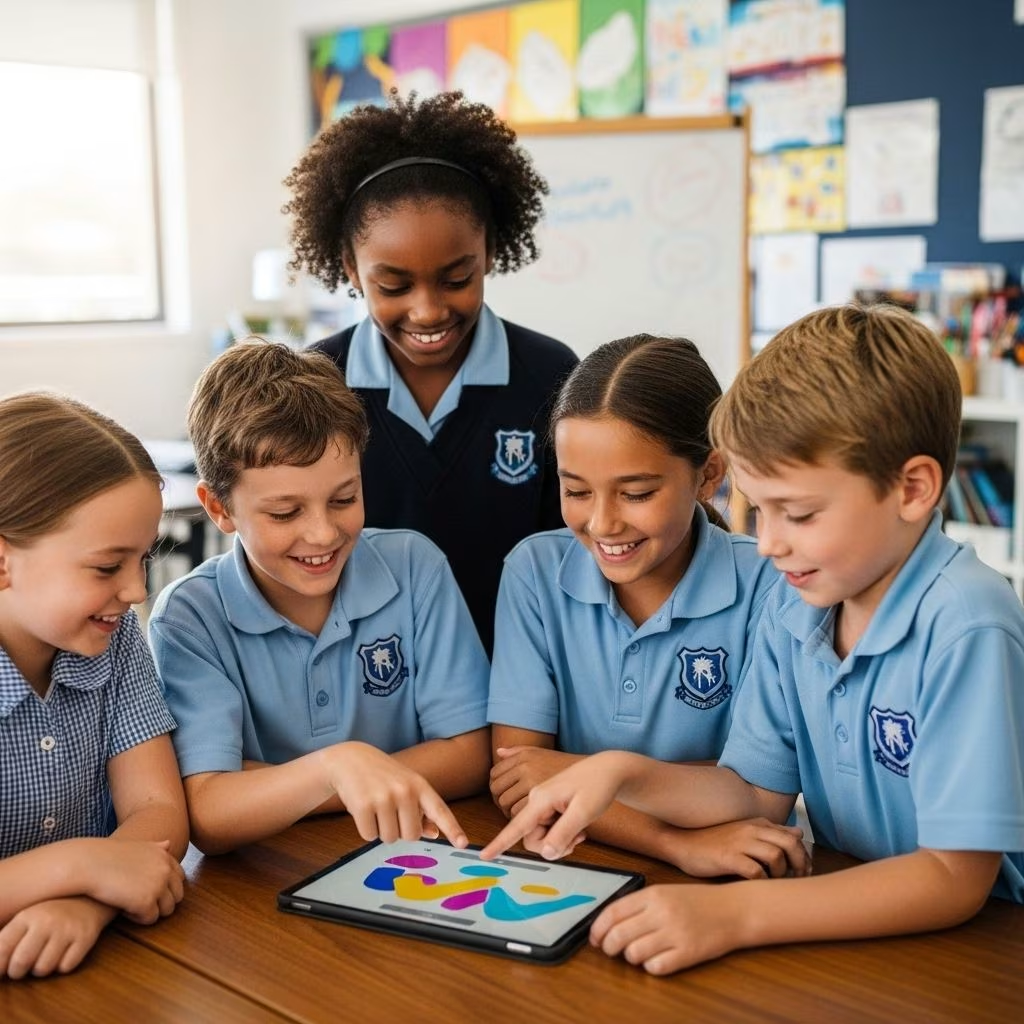
Smiling Mind App Review for Australian Schools
With the growing recognition of student mental health as a cornerstone for lifelong learning, Australian schools have increasingly looked to digital interventions to foster resilience, focus, and emotional skills. The Smiling Mind App, integrated with a comprehensive classroom-based program, stands out for its evidence-based approach, whole-school training, and engaging digital resources.
This article provides a detailed review of Smiling Mind’s implementation, evaluation, educator and student experiences, and its influence on school wellbeing culture.
Introduction
The Smiling Mind App and its broader schools program have emerged as pivotal resources for supporting mental health in Australian classrooms. With more than 730 schools participating in recent evaluations and tens of thousands of students and educators engaging with its curriculum, Smiling Mind offers structured mindfulness practices designed to improve focus, emotional regulation, and stress management.
This review analyses how Smiling Mind fits within contemporary educational strategies, highlights findings from recent evaluations (including ACER’s 2023 review), and considers user feedback to guide future adoption.
Background: The Mental Health Imperative in Schools
Mental health challenges among Australian youth have escalated in recent years, leading to increased disengagement, poorer academic outcomes, and negative life trajectories. Studies highlight a pressing need for effective, accessible social and emotional learning (SEL) programs in schools, especially in regional and disadvantaged communities.
Smiling Mind addresses this gap by providing digital tools and curriculum, aiming to bolster emotional resilience and foundational social capabilities among primary-aged children.
About Smiling Mind: Mission and Features
Launched as a not-for-profit in 2012, Smiling Mind focuses on delivering life-long mental wellbeing resources for schools, educators, families, and children. Its vision: “To help every mind thrive.”[10]
- Evidence-based digital curriculum aligned with the Australian Curriculum
- App-based meditation, mindfulness activities, and psychoeducation
- Supports educators through training, resources, and leadership modules
- Whole-school approaches to student wellbeing
- Not-for-profit status ensures accessibility for all demographics
The app and program are widely used: Nearly 50% of Australian educators report using Smiling Mind to foster mindfulness in their classrooms.
Program Structure and Delivery
The Smiling Mind Primary School Program delivers a fully digital series of modules for Years 1–6, blending mindfulness, SEL, and evidence-based psychological techniques. Implementation occurs in three main phases:
- Training school program “Champions” – key staff equipped to lead program delivery
- Whole-school staff training in mindfulness and wellbeing concepts
- Rollout and embedding of curriculum across classrooms
This staged model aims for sustainable change, integrating wellbeing practices into daily school routines.
Curriculum Integration and Mapping
Smiling Mind’s curriculum is mapped to the Australian Curriculum and endorsed within the Be You Programs Directory. Its modules address core personal and social capabilities recommended by national education standards:
- Self-awareness and self-management
- Social awareness and interpersonal skills
- Emotional regulation and resilience
Modules vary by age group, offering age-appropriate meditations, interactive activities, and group reflection prompts.
School Training and Implementation Models
Implementation typically involves a 12-month process:
- Initial training for designated school Champions
- Whole staff PD session
- Rollout in classrooms (guided by digital modules and app)
The program supports ongoing cycles of training and feedback, with tools to measure impact and self-reflection among staff and students.
App Features for Classrooms and Educators
The Smiling Mind App is available for free on major platforms and is designed for both independent and classroom use:
- Guided meditation and breathing exercises (tailored for age and group size)
- Short, activity-based modules focused on emotions, stress, and learning challenges
- Dashboard and reporting tools for educators
- Customizable content for different wellbeing themes (focus, resilience, gratitude, sleep, relationships)
- Offline access and simple user interface for ease of classroom use
Educators report that the app is quick to implement within lesson breaks and can be deployed flexibly throughout the school day.
Evidence Base and Recent Evaluation Findings
A strong evidence base undergirds Smiling Mind’s approach. Multiple large-scale independent evaluations have been conducted:
- ACER 2023 Evaluation: Over 730 schools, 11,635 surveys, rigorous analysis of impact and engagement
- NSW Dept. of Education Evaluation (2021): 445 schools, independent audit showing educator use and outcomes
- 2016 Randomised Controlled Trial: Deakin University/Insight SRC, positive findings in attention, self-regulation, and classroom climate
Key Evaluation Results (2023):
- 67% of student participants reported at least one helpful outcome (improved focus, ability to calm down)
- 88–90% of educators observed improvements in the classroom (better mental health knowledge among students, improved engagement)
- Enjoyment of Smiling Mind activities correlated with higher wellbeing outcomes; dislike correlated with lower wellbeing
- Continued implementation sustained impact across cohorts and school types
Evaluation limitations include variations in program version, cohort demographics, and length of exposure, which may influence outcomes.
Impact on Students
The core aim of Smiling Mind is to equip students with skills to manage stress, regulate emotions, and maintain focus on schoolwork.
- Students reported improved ability to talk about feelings and use techniques to quiet their minds
- 32% noted improved focus; 30% reported greater calm when worried
- Self-reported benefits include better social interactions, emotion regulation, and higher confidence in managing setbacks
Quotes from students and staff illustrate tangible classroom impacts:
“Students can talk about how they are feeling and use skills to quieten their minds.” – Principal, WA
“The modules were beneficial and easy to use and teach from. Excellent program.” – Principal, QLD
While measuring long-term change remains challenging, the correlation between program enjoyment and wellbeing underscores importance of engagement.
Educator Experiences and Observations
Educators are not only facilitators but also key beneficiaries of the Smiling Mind program:
- Positive improvements in classroom climate and student engagement
- Observed increases in students’ mental health knowledge and self-management capability
- High reported ease of use and flexible integration within lessons
- Opportunity for teacher wellbeing and self-care (many staff use the app personally)
Many schools note that Smiling Mind forms part of a proactive approach to creating safe, connected school communities.
Strengths and Limitations
{ “Strengths”: [ “Evidence-based and independently evaluated”, “Whole-school focus: staff and student benefits”, “Free, accessible digital resources”, “Flexible implementation models”, “Mapped to curriculum and simple to integrate” ], “Limitations”: [ “Impact may depend on school engagement and cohort characteristics”, “Some program versions differ across deployments”, “Long-term direct impact on wellbeing is still being studied” ]}
Comparison: Smiling Mind vs. Other Wellbeing Apps
{ “Feature Comparison”: [ { “Feature”: “Curriculum Integration”, “Smiling Mind”: “Mapped to Australian Curriculum”, “Other Wellbeing Apps”: “Varies by app; not always mapped” }, { “Feature”: “Evidence Base”, “Smiling Mind”: “Multiple independent evaluations; RCTs”, “Other Wellbeing Apps”: “Some have small studies; few RCTs” }, { “Feature”: “Whole-School Model”, “Smiling Mind”: “Champions, teacher training, ongoing support”, “Other Wellbeing Apps”: “Often focused on student only or app use” }, { “Feature”: “Accessibility”, “Smiling Mind”: “Free, not-for-profit, wide reach in Australia”, “Other Wellbeing Apps”: “Many require subscriptions or fees” }, { “Feature”: “Educator Support”, “Smiling Mind”: “Tailored PD, wellbeing resources for staff”, “Other Wellbeing Apps”: “Mixed; some focus on student content only” } ]}
Frequently Asked Questions (FAQs)
Q: Is Smiling Mind suitable for all age groups?
A: The Smiling Mind curriculum and app are designed primarily for primary students (Years 1–6) but contain modules for secondary learners, educators, families, and early learners. Content is age-appropriate and mapped to curriculum outcomes.
Q: Does Smiling Mind require extensive teacher training?
A: While whole-school professional development is recommended for best outcomes, the program is designed to be easy to integrate even for new users. “Champion” training and ongoing resources support staff at all experience levels.
Q: What are the main reported benefits for students?
A: Improved focus, better awareness of emotions, increased ability to regulate stress or worry, positive classroom relationships, and foundational mental health skills.
Q: Is the app free for schools and individuals?
A: Yes. Smiling Mind’s core app and digital modules are free. The organization remains committed to equitable access for all school communities.
Q: Can Smiling Mind be used outside the classroom?
A: Absolutely. The app supports family use, teacher self-care, and individual meditation practice beyond school hours.
Conclusion
Amid rising student wellbeing challenges, the Smiling Mind App and Schools Program stand out for their robust evidence base, whole-school engagement model, and commitment to accessible mental health resources. While ongoing research continues to refine understanding of long-term impacts, large-scale evaluations and user testimonials point to measurable benefits in focus, emotional regulation, and classroom engagement across diverse Australian contexts.
For schools seeking a sustainable, curriculum-aligned approach to student wellbeing, Smiling Mind is among the most trusted and transformative solutions available in Australia today.
References
- https://people.acer.org/files/693383/Evaluation%20of%20the%20Smiling%20Mind%20Primary%20School%20Program%202023.pdf
- https://education.nsw.gov.au/content/dam/main-education/student-wellbeing/mental-health-and-wellbeing/Smiling_Mind_NSW_Schools_Program_-_final_report_May_2021.pdf
- https://static1.squarespace.com/static/5a2f40a41f318d38ccf0c819/t/63f82d4765f78354a08cbede/1677208906423/SM_Smiling+Mind+Impact+Overview+V6.0+(4)+(1).pdf
- https://www.commonsense.org/education/reviews/smiling-mind
- https://apps.apple.com/au/app/smiling-mind-mental-wellbeing/id560442518
- https://people.acer.org/files/707931/Smiling%20Mind%20Evaluation%202021-2022_%20Effectiveness%20of%20the%20Smiling%20M.pdf
- https://espace.library.uq.edu.au/view/UQ:caf1121/UQcaf1121_OA.pdf
- https://pmc.ncbi.nlm.nih.gov/articles/PMC6588907/
- https://play.google.com/store/apps/details?id=com.smilingmind.app&hl=en_US
- https://rcvmhs.archive.royalcommission.vic.gov.au/Smiling_Mind_02.pdf


