


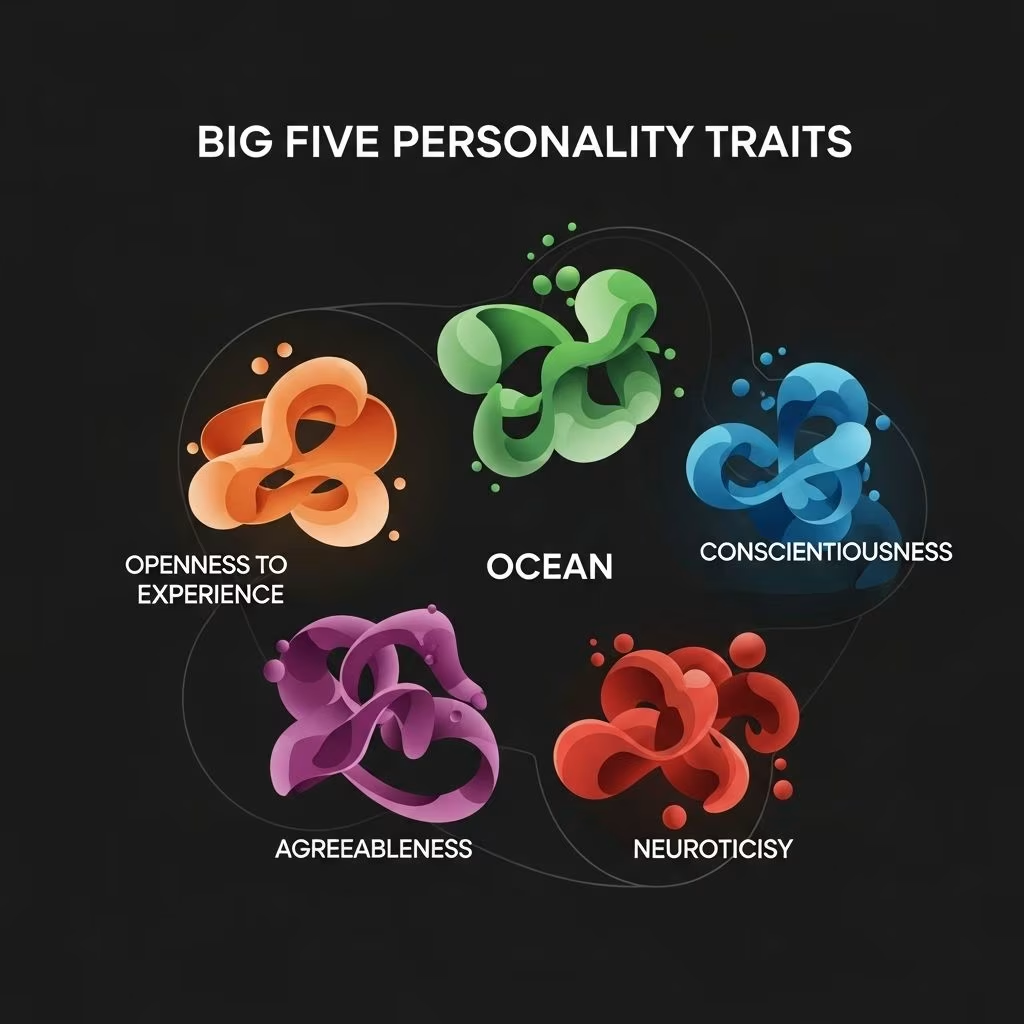
Personality shapes how we see ourselves and others, guiding thoughts, emotions, and behaviors across every area of life. Among the various models of personality structure developed in psychology, the Big Five Personality Traits—sometimes called the Five-Factor Model or OCEAN model—stands out as the most researched and widely accepted framework for understanding personality differences worldwide.
What Are the Big Five Personality Traits?
The Big Five Personality Traits model organizes personality into five broad dimensions, each representing a continuum between two extremes. These primary dimensions are:
- Openness to Experience – inventive/curious vs. consistent/cautious
- Conscientiousness – efficient/organized vs. easy-going/careless
- Extraversion – outgoing/energetic vs. reserved/solitary
- Agreeableness – friendly/compassionate vs. critical/uncooperative
- Neuroticism – sensitive/nervous vs. resilient/confident
This model arose from decades of psychological research, including extensive statistical analysis of how people describe themselves and others. It identifies most personality differences and underpins many psychological assessments and theories used today .
Dimensions of the Big Five
Each dimension reflects a spectrum ranging from low to high, not a binary categorization—people fall at various points along each trait’s scale.
Openness to Experience
Openness describes a person’s level of intellectual curiosity, creativity, and preference for novelty and variety. It is associated with imagination, insight, and a broad range of interests. People high in openness are:
- Imaginative and creative
- Open to trying new things
- Curious about the world
- Appreciative of art and adventure
Those low in openness tend to be more conventional, practical, and prefer routine over new experiences .
Conscientiousness
Conscientiousness refers to the tendency to be organized, dependable, self-disciplined, and goal-directed. High scorers are:
- Orderly and methodical
- Responsible and reliable
- Hardworking and persistent
- Good at planning and following through
People low in conscientiousness may be spontaneous and flexible, but can also be inefficient, careless, or unreliable .
Extraversion
Extraversion is the degree to which a person is outgoing, energetic, and enjoys social interaction. People high in extraversion are:
- Sociable and talkative
- Assertive and enthusiastic
- Draw energy from social situations
- Expressive and active
At the other end, introverts (low extraversion) are more reserved, need less external stimulation, and tend to enjoy solitary activities .
Agreeableness
This trait describes the extent to which a person is cooperative, warm, and considerate toward others. High agreeableness involves:
- Trusting and helpful attitudes
- Showing compassion and empathy
- Being generous and forgiving
- Seeking harmony in relationships
Low agreeableness may manifest as skepticism, competitiveness, or a tendency toward antagonism .
Neuroticism
Neuroticism reflects emotional stability and the tendency to experience negative emotions, such as anxiety, anger, or depression. Individuals with high neuroticism may be:
- Emotionally reactive and prone to mood swings
- Easily stressed or upset
- Self-doubting or insecure
- More likely to experience sadness or irritability
People low in neuroticism are generally calm, emotionally resilient, and able to withstand stress without becoming overwhelmed .
Facets and Nuances within Each Trait
The Big Five can be divided into more specific facets (sometimes called subtraits) that allow for deeper personality analysis. For instance:
- Openness: Imagination, artistic interests, emotionality, adventurousness, intellect
- Conscientiousness: Self-efficacy, orderliness, dutifulness, achievement-striving, self-discipline
- Extraversion: Friendliness, gregariousness, assertiveness, excitement-seeking, cheerfulness
- Agreeableness: Trust, morality, altruism, cooperation, modesty, sympathy
- Neuroticism: Anxiety, anger, depression, self-consciousness, immoderation, vulnerability
This facet-based analysis, adopted in more advanced personality inventories, enables richer descriptions and predictions of personal tendencies .
Origins and Development of the Big Five Model
The origins of the Big Five stem from lexical studies in the early to mid-20th century, in which researchers examined language to identify words commonly used to describe personality characteristics. Subsequent factor analysis of personality data revealed that five broad factors could explain most observed differences .
- Initially explored by D. W. Fiske in 1949, refined by later psychologists like Norman, Smith, Goldberg, and McCrae & Costa.
- The model’s five-factor structure has been validated across cultures and languages, confirming its robustness.
The Big Five’s empirical, data-driven basis distinguishes it from earlier models rooted primarily in theory or clinical observation.
How Are the Big Five Traits Measured?
Assessment of Big Five traits is commonly performed using standardized self-report questionnaires, including:
- NEO Personality Inventory (NEO-PI): Measures five traits and six facets for each.
- Big Five Inventory (BFI): A shorter measure widely used in research settings.
- International Personality Item Pool (IPIP): Free, public-domain items that assess the broad traits and subtraits.
Respondents typically rate the extent to which various statements or adjectives describe themselves, generating a comprehensive personality profile .
Continuity and Change: Are the Big Five Traits Fixed?
Personality traits show substantial stability over adulthood, but they are not entirely fixed. Evidence suggests:
- Traits are influenced by both genetic factors (heritability estimates around 50%) and environment.
- Major life events, social roles, and cultural influences can impact trait expression, especially during adolescence and early adulthood.
- People may shift gradually toward more conscientiousness and agreeableness, and less neuroticism as they age.
Nonetheless, the basic structure of the Big Five appears to persist throughout life .
The Big Five in Everyday Life: Implications and Uses
The Big Five framework provides practical insights into:
- Personal relationships: Explains compatibility, conflict, and preferred social environments.
- Workplace performance: Conscientiousness predicts job success, while extraversion can relate to leadership.
- Mental health and well-being: High neuroticism is linked to anxiety and depression; agreeableness to prosocial behavior.
- Education and creativity: Openness predicts artistic and intellectual pursuits.
Big Five Traits and Life Outcomes
| Trait | Positive Correlations | Potential Challenges |
|---|---|---|
| Openness | Creativity, adaptability, intellectual engagement | Vagueness, unconventional thinking, indecisiveness |
| Conscientiousness | Academic achievement, reliability, career success, healthful habits | Rigidity, perfectionism, workaholism |
| Extraversion | Social networks, positive emotions, leadership | Impulsivity, need for external stimulation, difficulty alone |
| Agreeableness | Harmony in relationships, prosocial behavior | Conflict avoidance, naivety, being overlooked |
| Neuroticism | Vigilance, critical thinking (in moderation) | Anxiety, mood swings, susceptibility to stress |
Limitations and Critiques of the Big Five Model
Despite its strengths, the Big Five is not without limitations:
- It does not capture all aspects of personality—traits such as honesty, humility, or spirituality may require separate models.
- Self-report inventories can be vulnerable to social desirability bias.
- Some critics argue the model’s reliance on factor analysis constrains more nuanced or culturally-specific traits .
- Personality is multi-faceted—attitudes, values, skills, and context also shape behavior, sometimes outside the scope of five broad factors.
Frequently Asked Questions (FAQs)
Q: What are the five main personality traits in the Big Five?
A: The Big Five personality traits are Openness to Experience, Conscientiousness, Extraversion, Agreeableness, and Neuroticism (sometimes abbreviated as OCEAN).
Q: Can my Big Five personality traits change over the course of life?
A: While your basic personality traits are generally stable, they can shift gradually due to major life experiences, personal growth, or social and cultural influences, especially in youth and early adulthood.
Q: How are the Big Five traits measured?
A: They are typically assessed with standardized questionnaires such as the NEO Personality Inventory or Big Five Inventory, where people report how much various statements describe them.
Q: Why is the Big Five model important?
A: The Big Five model helps explain personality differences, predict behavior, inform personal development, and is used in business, education, and clinical psychology due to its empirical foundation and wide applicability.
Q: Are the Big Five universally applicable across cultures?
A: Research suggests that the Big Five structure is largely consistent across different languages and cultures, making it a robust tool for global personality assessment.
Conclusion: The Lasting Relevance of the Big Five
The Big Five Personality Traits framework stands as the gold standard in understanding the broad structure of human personality. By organizing personality through openness, conscientiousness, extraversion, agreeableness, and neuroticism, it enables both individuals and professionals to better understand behavior, anticipate life outcomes, and work towards personal growth. Despite some limitations, the Big Five remains an indispensable tool in the study and application of personality psychology—bridging the scientific study of mind with the everyday realities of human experience.
References
- https://www.ebsco.com/research-starters/social-sciences-and-humanities/big-five-personality-traits
- https://www.simplypsychology.org/big-five-personality.html
- https://en.wikipedia.org/wiki/Big_Five_personality_traits
- https://www.equiscript.com/blog/deconstructing-the-big-five
- https://www.youtube.com/watch?v=IB1FVbo8TSs&vl=en
- https://positivepsychology.com/big-five-personality-theory/
- https://pmc.ncbi.nlm.nih.gov/articles/PMC6732674/
- https://www.psychologytoday.com/us/basics/big-5-personality-traits
- https://blog.flexmr.net/ocean-personality-types


