


Classical vs. Operant Conditioning: Understanding Two Key Learning Paradigms
Behavioral psychology is anchored in fundamental theories that explain how organisms—both human and non-human—learn from their environments. Among the most influential frameworks are classical conditioning and operant conditioning. Both describe ways that experience shapes our actions, emotions, and thinking, but they differ profoundly in methods, principles, and applications.
What Is Classical Conditioning?
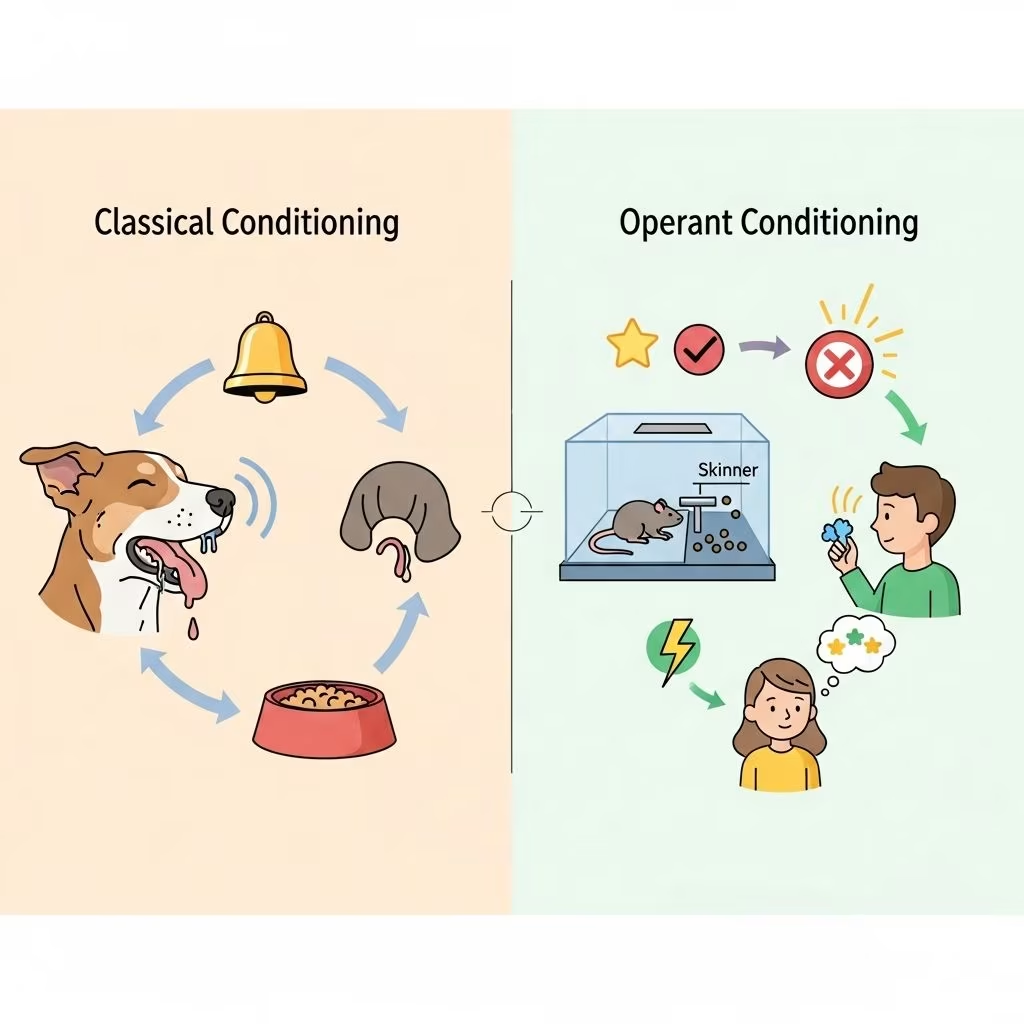
Classical conditioning, discovered by Russian physiologist Ivan Pavlov in the late 19th century, is a learning process that occurs through associations between an environmental stimulus and a naturally occurring stimulus. In Pavlov’s famous experiment, dogs learned to associate the sound of a bell (neutral stimulus) with food (unconditioned stimulus), resulting in the bell alone eliciting salivation (conditioned response).
- Stimulus precedes response: The learning occurs when a previously neutral stimulus comes to elicit an automatic (involuntary) response due to its association with a natural stimulus.
- Passive learning: The individual doesn’t consciously choose to respond; it is a reflexive reaction.
| Term | Definition |
|---|---|
| Unconditioned Stimulus (US) | Something that naturally elicits a response (e.g., food) |
| Unconditioned Response (UR) | Automatic reaction to the US (e.g., salivation) |
| Conditioned Stimulus (CS) | Previously neutral; when paired with US, elicits response (e.g., bell) |
| Conditioned Response (CR) | Learned reaction to CS (e.g., salivation at sound of bell) |
Notable Example
A person involved in a car accident might feel anxious when riding in a car later, as the vehicle (neutral stimulus) now elicits anxiety due to its association with the traumatic event (unconditioned stimulus).
What Is Operant Conditioning?
Operant conditioning, formalized by American psychologist B.F. Skinner in the early twentieth century, describes learning as a process shaped by consequences of behavior. Unlike passive classical conditioning, operant conditioning is active: individuals choose to perform (or avoid) behaviors based on history of rewards and punishments.
- Behavior precedes consequence: The learner emits a voluntary action, which is then either reinforced or punished.
- Active learning: The organism modifies behavior intentionally to achieve a preferred outcome or avoid discomfort.
| Consequence | Effect on Behavior |
|---|---|
| Positive Reinforcement | Addition of a pleasant stimulus increases behavior (e.g., praise, reward) |
| Negative Reinforcement | Removal of an unpleasant stimulus increases behavior (e.g., doing chores avoids nagging) |
| Positive Punishment | Addition of an unpleasant stimulus decreases behavior (e.g., reprimand) |
| Negative Punishment | Removal of a pleasant stimulus decreases behavior (e.g., loss of privileges) |
Notable Example
If a child cleans their room and receives praise (positive reinforcement), the child is more likely to clean their room again. Conversely, if a child is scolded for misbehavior (positive punishment), they’re less likely to repeat the misbehaving action.
Major Differences Between Classical and Operant Conditioning
- Nature of Behavior: Classical conditioning is focused on involuntary, automatic responses; operant conditioning involves voluntary, chosen behaviors.
- Learning Method: Classical conditioning is passive—organism responds reflexively; operant conditioning is active—the organism chooses its actions.
- Association: Classical conditioning links two stimuli (neutral and natural); operant conditioning links behavior and consequence.
- Timing: In classical conditioning, the association is formed before the behavior; in operant conditioning, reward or punishment occurs after the behavior.
- Extinction: Both can fade. In classical conditioning, repeated presentation of the conditioned stimulus without the unconditioned stimulus leads to extinction. In operant conditioning, absence of consequence (e.g., reward) leads to fading behavior.
| Aspect | Classical Conditioning | Operant Conditioning |
|---|---|---|
| Type of Response | Involuntary/reflexive | Voluntary/intentional |
| Learning Process | Association between stimuli | Association between behavior and outcome |
| Timing of Stimulus | Stimulus occurs before response | Consequence occurs after behavior |
| Extinction | Conditioned response fades if stimulus loses association | Behavior fades if consequence stops |
Historical Origins and Key Figures
- Ivan Pavlov (Classical Conditioning): Known for his work with dogs and salivation, Pavlov established the systematic study of conditioned reflexes.
- B.F. Skinner (Operant Conditioning): Developed operant boxes to measure and analyze voluntary behavior, building on Edward L. Thorndike’s “law of effect”—behaviors followed by favorable consequences are more likely to be repeated.
How Classical Conditioning Works
Classical conditioning relies on pairing a neutral stimulus with an unconditioned stimulus until the neutral stimulus alone triggers the response.
- Before conditioning: Only the unconditioned stimulus causes a response.
- During conditioning: Neutral stimulus is presented alongside the unconditioned stimulus repeatedly.
- After conditioning: Neutral stimulus becomes conditioned and elicits the response independently.
This process often explains many emotional reactions, phobias, and habits.
How Operant Conditioning Works
Operant conditioning focuses on how behaviors are influenced by their outcomes. There are four main ways:
- Positive reinforcement: Giving a reward—such as praise, treats, or privileges—to increase behavior.
- Negative reinforcement: Removing something unpleasant—such as nagging or pain—to encourage behavior.
- Positive punishment: Introducing an aversive stimulus—like scolding or fines—to decrease behavior.
- Negative punishment: Taking away a rewarding item—such as TV time or favorite toy—to reduce behavior.
Applications in Real Life
Classical Conditioning Applications
- Explains phobias and emotional responses (e.g., fearing dogs after a bite).
- Used in advertising to evoke positive associations (e.g., pairing a product with pleasant music or imagery).
- Medical and therapeutic settings to reduce anxiety or treat fears (systematic desensitization).
- Can impact consumer behavior and market response, such as associating brand logos or jingles with comfort or excitement.
Operant Conditioning Applications
- Shaping behavior in school and workplace through reward systems and penalties.
- Parenting—using praise, privileges, or time-outs to modify children’s actions.
- Animal training—dogs learn to sit or fetch through treats and verbal praise.
- Company culture development: Rewarding positive traits such as productivity or punctuality improves organizational atmosphere.
- Therapy for behavior modification and habit formation (e.g., breaking bad habits, improving routines).
Benefits and Limits of Each Approach
| Conditioning Type | Advantages | Limitations |
|---|---|---|
| Classical Conditioning |
|
|
| Operant Conditioning |
|
|
Impact in Business and Organizational Settings
Classical Conditioning in Business
- Helps understand consumer reactions and preferences (e.g., brand loyalty through repeated exposure).
- Guides marketing strategies by tapping into emotional associations (comfort, desire, happiness).
- Assists investors and managers in predicting market shifts due to collective emotional reactions.
Operant Conditioning in Business
- Promotes effective reward systems—bonuses, recognition—for desired employee behaviors.
- Reduces undesirable behaviors with fair penalties or corrective actions.
- Cultivates a positive work culture that encourages productivity, efficiency, and morale.
- Improves employee satisfaction through regular and consistent acknowledgment of good performance.
Frequently Asked Questions (FAQs)
What is the main difference between classical and operant conditioning?
Classical conditioning involves learning through association between stimuli, producing involuntary responses; operant conditioning involves learning via consequences that alter voluntary behavior choices.
Who are the key figures behind these theories?
Ivan Pavlov originated classical conditioning, while B.F. Skinner developed operant conditioning, building on the early work of Edward Thorndike.
Can both types of conditioning occur together?
Yes. Many behaviors involve elements of both—such as animal training, where an emotional association is paired with behavioral reinforcement.
How do the concepts of reinforcement and punishment work in operant conditioning?
- Reinforcement increases the likelihood of a behavior (positive or negative).
- Punishment decreases the likelihood of a behavior (positive or negative).
How do extinction and spontaneous recovery work?
In both classical and operant conditioning, extinction occurs when associations fade from lack of reinforcement or stimulus pairing. Spontaneous recovery describes the unexpected reappearance of a conditioned response after extinction.
Summary Table: Classical vs. Operant Conditioning
| Feature | Classical Conditioning | Operant Conditioning |
|---|---|---|
| Response Type | Involuntary | Voluntary |
| Learning Process | Stimuli association | Behavior-consequence association |
| Originators | Pavlov | Skinner, Thorndike |
| Application Scope | Emotions, habits | Behavior modification, motivation |
| Extinction Method | Unpairing stimuli | Removing reward/punishment |
Additional Resources
- PsyPost: Understanding Classical vs. Operant Conditioning
- Khan Academy: Classical and Operant Conditioning Explained
- YouTube: Peggy Andover on Conditioning
Conclusion
Understanding classical and operant conditioning offers crucial insights into how learning shapes emotional and voluntary behaviors. While both rely on association, they differ in timing, process, and the kind of responses triggered. Their principles underpin everything from behavior therapy and education to business strategies and everyday habit formation.
References
- https://www.psypost.org/understanding-classical-vs-operant-conditioning/
- https://www.choosingtherapy.com/classical-vs-operant-conditioning/
- https://www.indeed.com/career-advice/career-development/classical-vs-operant-conditioning
- https://www.youtube.com/watch?v=H6LEcM0E0io
- https://www.khanacademy.org/test-prep/mcat/behavior/learning-slug/a/classical-and-operant-conditioning-article
- https://www.scienceholic.org/post/classical-vs-operant-conditioning


