


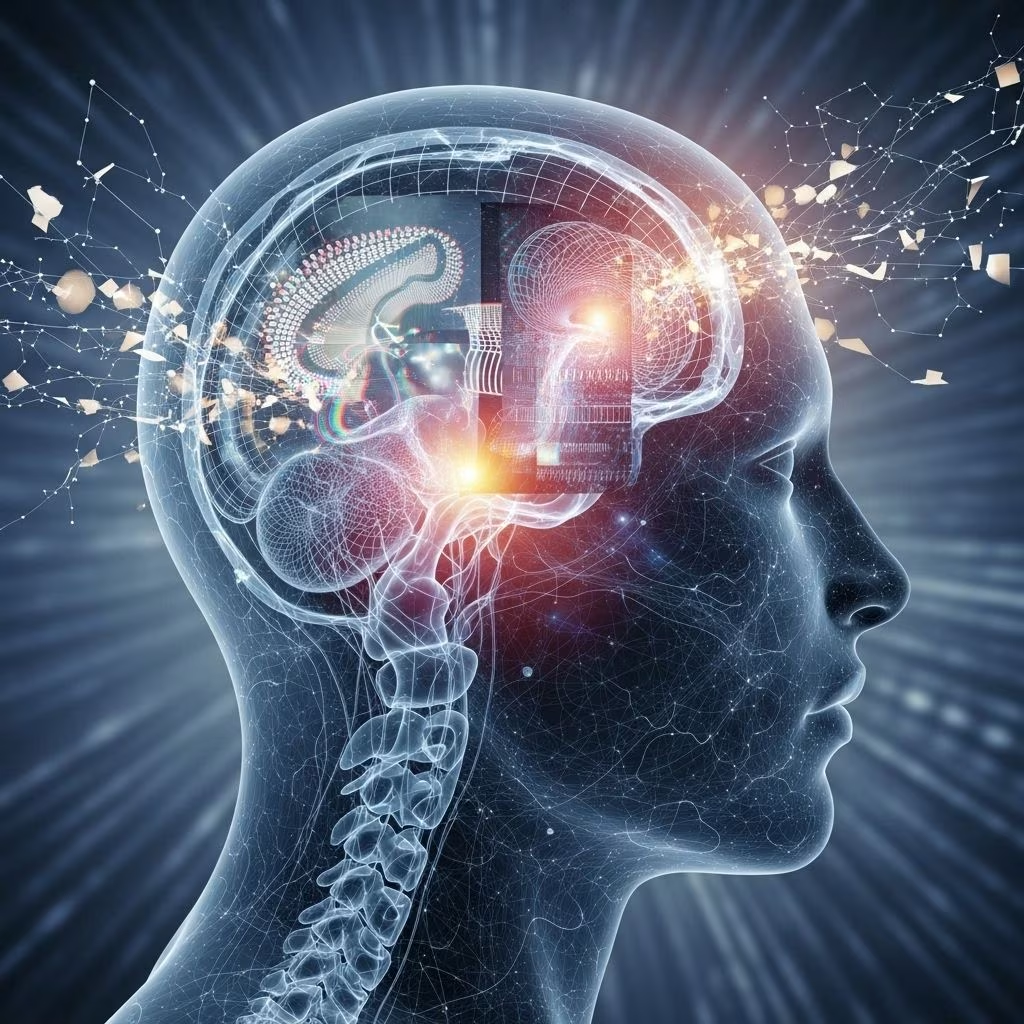
Cognitive Biases: The Invisible Forces Distorting Our Thinking
Every day, we rely on our brains to interpret information, make decisions, and solve problems. Yet, despite our best intentions and intelligence, our thinking is regularly influenced by cognitive biases—systematic patterns of deviation from norm or rationality in judgment. These biases shape the way we process data, evaluate information, and interact with the world, often leading us astray from objective truth.
Understanding Cognitive Bias
Cognitive bias refers to the tendency to think in ways that are not entirely rational, often due to limits in our mental processing, emotional influences, or shortcuts known as heuristics. These biases affect everyone, regardless of expertise or education, because they arise from basic mental processes designed to help us navigate complex environments quickly.
While these mental shortcuts are helpful for efficiency, they frequently produce judgment errors, especially when faced with uncertainty, ambiguity, or information overload.
A cognitive bias is not a mental illness or abnormal condition, but rather a built-in aspect of normal human thinking.
Where Do Biases Come From?
Cognitive biases stem from several sources, including:
- Evolutionary adaptations: Our brains evolved to filter information rapidly, favoring speed over accuracy.
- Heuristics: Simple rules of thumb or mental shortcuts used for swift decisions.
- Emotional factors: Feelings and moods can override logical reasoning.
- Social influences: Peer pressure, cultural norms, and collective beliefs reinforce biased thinking.
- Memory limitations: Our brains selectively remember information, sometimes distorting reality.
This combination of influences creates fertile ground for cognitive biases, which then distort how we perceive people, interpret events, and make decisions in everyday life.
Most Common Types of Cognitive Biases
There are dozens of identified cognitive biases, each with unique ways of distorting thought. Below are some of the most influential and well-researched types:
Anchoring Bias
Anchoring bias arises when people rely too heavily on the first piece of information (the “anchor”) they receive. This initial reference point shapes later judgments, even if it is arbitrary or unrelated.
- For example, in negotiations, the first offer sets the stage for later bargaining—even if the number is unrealistic.
- Anchoring affects how we estimate prices, forecast outcomes, and interpret statistics.
Availability Heuristic
The availability heuristic leads us to judge the frequency or probability of an event based on how easily examples come to mind.
This can cause overestimation of rare but dramatic events (like shark attacks) if they’re recently seen in the news or discussed in conversation.
- Media coverage and personal experience increase the “availability” of an event in our minds.
- Often results in risk misjudgment and poor decision-making.
Confirmation Bias
Confirmation bias drives us to seek out, interpret, and remember information that supports our existing beliefs, while ignoring or dismissing opposing evidence.
- This bias strengthens polarization, fuels echo chambers, and prevents open-minded analysis.
- Social media algorithms often reinforce this effect by showing users content aligned with their interests.
Halo Effect
The halo effect is the tendency for our impressions of one positive trait (such as attractiveness) to color our overall judgment of a person’s character.
- An attractive job candidate might be seen as smarter or more capable, regardless of actual ability.
- This bias is common in evaluations and hiring processes.
Framing Effect
The framing effect happens when decisions are influenced by how information or choices are presented, rather than just by the facts themselves.
- People tend to prefer options described using positive language (“90% success rate”) compared to identical options framed negatively (“10% failure rate”).
- Marketing, politics, and healthcare often rely on framing to sway opinions and choices.
Actor–Observer Bias
This bias leads us to explain our own actions based on external factors (“I failed because the test was hard”) but attribute others’ actions to their character (“They failed because they didn’t study”).
- Contributes to misunderstanding and conflict in social situations.
Baader–Meinhof Phenomenon (Frequency Illusion)
The tendency to notice something new, and then see it everywhere, is called the Baader–Meinhof phenomenon or frequency illusion.
- Once you’re introduced to a new word or concept, your mind becomes primed to detect it more often, even if its true prevalence hasn’t changed.
Belief Bias
Belief bias is the inclination to judge arguments based on how believable their conclusions seem, rather than the strength of supporting evidence.
- Leads to acceptance of poorly supported claims that fit personal beliefs, and skepticism towards solid arguments with counterintuitive conclusions.
Affect Heuristic
The affect heuristic describes how our current emotions drive quick assessments and choices, overriding logical analysis.
- Decisions made during high emotion (fear, anger, excitement) are particularly vulnerable to biased thinking.
- “Gut feeling” often triumphs over evidence and reason.
Representativeness Heuristic
This heuristic leads us to estimate probabilities by comparing them to existing mental prototypes or stereotypes.
- If something seems similar to a known example, we may overestimate its likelihood or cause.
- Often results in statistical errors, such as misunderstanding randomness or failing to account for base rates.
Other Notable Cognitive Biases
- Hindsight Bias: Events seem predictable after they occur, leading people to overestimate their ability to have foreseen the outcome.
- Fundamental Attribution Error: Overestimating others’ personal traits while underestimating situational factors influencing behavior.
- Bandwagon Effect: Adopting beliefs or behaviors because many others do, not because of independent evaluation.
- Planning Fallacy: Underestimating the time, costs, or risks required to complete a task, due to optimism and neglect of past experience.
- False Consensus Effect: Overestimating how much others agree with our views and preferences.
Real-World Impact of Cognitive Biases
Cognitive biases are not just theoretical concepts—they affect tangible real-world outcomes every day:
- Healthcare: Medical professionals may misdiagnose illnesses due to availability or anchoring biases.
- Business: Managers might stick with failing projects due to confirmation bias or fall victim to the planning fallacy.
- Personal Finances: Investment decisions can suffer from hindsight bias, anchoring, and affect heuristic.
- Relationships: Actor–observer bias, halo effect, and belief bias frequently shape our perceptions of partners, friends, and colleagues.
Table: Common Biases and Their Effects
| Bias | Main Effect | Typical Context |
|---|---|---|
| Anchoring | Relies on initial value for future judgments | Negotiations, pricing, forecasting |
| Availability Heuristic | Estimates probability based on ease of recall | Risk assessment, media reports |
| Confirmation Bias | Seeks out supporting evidence | Political opinions, debate, research |
| Halo Effect | One trait influences overall impression | Hiring, relationships, evaluations |
| Framing Effect | Choice depends on question framing | Marketing, policy, healthcare |
Why Do Cognitive Biases Persist?
Even when people recognize the existence of cognitive biases, they persist due to:
- Brain’s wiring: Deeply embedded neural shortcuts resist change.
- G.I. Joe Fallacy: Knowing about bias doesn’t reliably prevent it from influencing us.
- Social and cultural reinforcement: Groups and media reinforce prevailing biases.
- Emotional comfort: Biases often support beliefs and provide psychological reassurance.
Strategies to Counteract Cognitive Biases
While no one is immune to cognitive bias, conscious effort can reduce their negative impacts. Practical steps include:
- Slow down decision-making: Avoid snap judgments and give yourself time to reflect.
- Gather diverse perspectives: Seek input from people with differing backgrounds and opinions.
- Use data and evidence: Rely on objective information and statistics over personal impressions.
- Challenge your beliefs: Proactively look for evidence that goes against your favored conclusion.
- Frame choices carefully: Reword options in multiple ways to see how framing affects your judgment.
- Keep a decision journal: Record your reasoning and outcomes to spot patterns in your thinking.
For organizations, bias-reducing protocols and training can improve critical decisions, hiring, and conflict resolution. Technology such as AI algorithms may help correct some human biases, but can also introduce new ones.
Frequently Asked Questions (FAQs)
What is the difference between a cognitive bias and a logical fallacy?
A cognitive bias is an inherent tendency to think in a certain (often incorrect) way due to mental shortcuts or emotional influences. A logical fallacy is a flaw in the structure of reasoning within an argument. Biases are psychological; fallacies are errors in logic.
Are cognitive biases always negative?
Not always. While biases can lead to faulty decisions, some cognitive shortcuts (heuristics) improve efficiency and survival, especially when quick decisions are necessary or information is limited.
Can cognitive biases be eliminated?
Cognitive biases cannot be fully eliminated, but their impact can be minimized
References
- https://www.scribbr.com/research-bias/cognitive-bias/
- https://en.wikipedia.org/wiki/List_of_cognitive_biases
- https://thedecisionlab.com/biases
- https://www.simplypsychology.org/cognitive-bias.html
- https://www.hunimed.eu/news/list-of-common-cognitive-biases/
- https://www.hipeople.io/glossary/cognitive-bias
- https://health.clevelandclinic.org/cognitive-bias
- https://pollackpeacebuilding.com/blog/cognitive-biases-fuel-conflict/


