


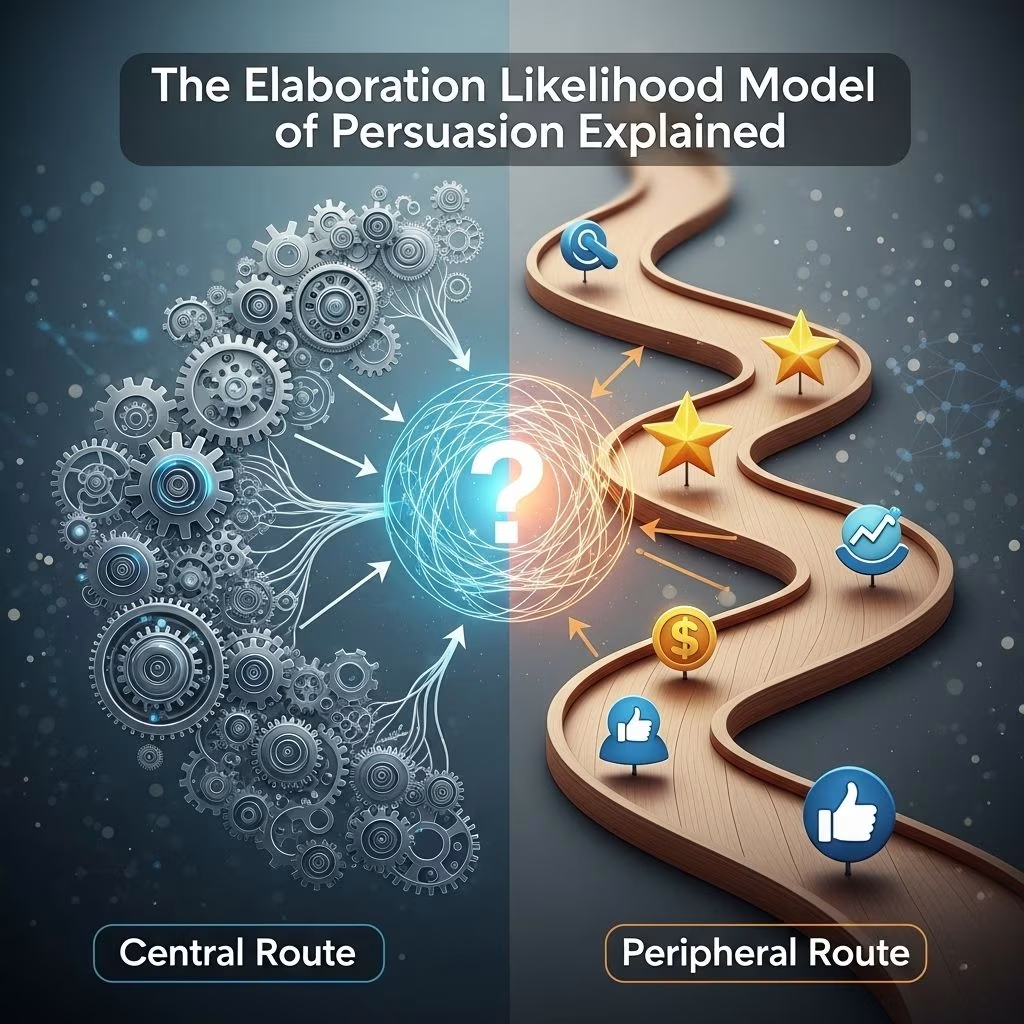
The Elaboration Likelihood Model of Persuasion
The Elaboration Likelihood Model (ELM) revolutionized the way psychologists understand persuasion and attitude change. Developed by Richard E. Petty and John Cacioppo in the early 1980s, the model proposes two primary routes to persuasion: the central route and the peripheral route. Each route represents a different way people process messages, leading to varying depth and durability of attitude change. For marketers, educators, and anyone seeking to influence attitudes or behaviors, understanding the ELM provides powerful insights into effective communication strategies.
Key Highlights
- The ELM is a dual process theory of attitude change, outlining central and peripheral routes to persuasion.
- The route taken depends on a person’s motivation and ability to process information.
- Central route processing leads to more enduring, resistant, and behavior-predictive attitude change.
- Peripheral route processing relies on superficial cues and leads to more temporary attitude shifts.
Understanding the Elaboration Likelihood Model
The Elaboration Likelihood Model was created to address inconsistencies in earlier persuasion research. Psychologists had long debated why certain persuasive tactics work in some situations but fail in others. Petty and Cacioppo recognized that the effectiveness of persuasive messages depends on how deeply individuals process information. Their model synthesizes decades of persuasion research, providing a flexible, general framework to understand when and why attitude change occurs.
What Is “Elaboration”?
“Elaboration” refers to the degree of cognitive effort someone invests in processing a persuasive message. High elaboration means careful, critical thinking about message content; low elaboration involves minimal cognitive effort. The likelihood of elaboration influences which route (central vs. peripheral) an individual uses to evaluate information.
The Central and Peripheral Routes
The ELM’s central tenet is that there are two main routes to persuasion:
- Central Route: Logic-driven and evidence-based, this route prevails when people are motivated and able to analyze arguments closely. Persuasion occurs through critical scrutiny of the message’s substance.
- Peripheral Route: This route is employed when individuals lack motivation or ability to process deeply. Attitude change results from superficial cues like attractiveness of the source, emotional appeal, or catchy slogans rather than message quality.
| Aspect | Central Route | Peripheral Route |
|---|---|---|
| Elaboration Level | High | Low |
| Cognitive Activity | Careful analysis | Minimal processing |
| Main Factors | Quality of arguments | Superficial cues (e.g., credibility, emotions) |
| Attitude Change | Durable, resistant | Temporary, prone to change |
| Behavior Prediction | Strong | Weak |
How the Elaboration Likelihood Model Works
Whenever someone encounters a persuasive message—whether a commercial, political speech, or a health campaign—the ELM predicts that the individual will process it using either the central or peripheral route. The selection is determined largely by two factors:
- Motivation — Is the topic personally relevant or important to the individual?
- Ability — Can the individual understand and process the message? This may depend on prior knowledge or cognitive capacity at the time.
High motivation and ability encourage the central route; low motivation or ability defaults to the peripheral route.
Central Route Processing
Central route processing involves sustained attention, active consideration of arguments, and often comparison with pre-existing beliefs. This processing style is generally more objective, leading to stronger and longer-lasting changes in attitude. People using the central route are less susceptible to distractions and outside influences, focusing on the merits of the argument itself. Examples of central route cues include complex data, logical reasoning, and well-supported evidence.
Peripheral Route Processing
Peripheral route processing occurs when distraction, disinterest, or lack of cognitive resources prevent deeper engagement with the message. Instead of evaluating the actual content, individuals are swayed by surface-level characteristics such as:
- Speaker’s attractiveness or credibility
- Emotional appeal of the message
- Catchy slogans or memorable visuals
- Social endorsements or celebrity support
Changes in attitude via this route are usually fleeting and highly context-dependent.
Factors Influencing Route Selection
Not everyone will process a persuasive message the same way. The model highlights several critical factors determining whether a person will use the central or peripheral route:
- Personal Involvement: Higher involvement means more likely central processing.
- Need for Cognition: Individuals with a strong “need for cognition” enjoy deep thinking and analysis, defaulting to the central route.
- Context: Distractions, stress, or lack of time favor peripheral processing.
- Prior Knowledge: Familiarity with the subject supports deeper processing of new messages.
- Message Clarity: Clear, comprehensible arguments encourage central processing if motivation is present.
Outcomes: Quality and Durability of Attitude Change
One of the most important contributions of the ELM is its distinction between the outcomes of central versus peripheral processing routes:
- Central route attitude change is stable, resistant to counter-arguments, and predictive of future behavior.
- Peripheral route attitude change is often superficial, fragile, and less likely to guide behavior over time.
Examples of the Elaboration Likelihood Model in Action
To better understand how the ELM works in real life, consider these scenarios:
- Advertising: A car ad featuring extensive statistics and safety data will appeal to viewers using the central route, while an ad with a celebrity endorsement and catchy jingle targets the peripheral route.
- Politics: An informed voter examines when a policy proposal offers logical arguments and detailed plans—a central route example. In contrast, voters swayed by a candidate’s appearance or charisma are following the peripheral route.
- Health Campaigns: Smokers may change their attitude toward quitting if they are engaged by hard-hitting medical facts (central route), whereas posters featuring attractive, healthy-looking models are peripheral cues.
Applications Across Fields
The ELM is widely used in fields such as:
- Marketing and Advertising — Designing campaigns that encourage central route processing can lead to greater brand loyalty, especially for high-involvement products.
- Health Communication — Messages about health risks or medical treatments benefit from high elaboration for lasting impact.
- Education — Teachers can present lessons engaging students’ prior knowledge and logical thinking to foster deep learning.
- Political Campaigns — Persuasive speeches, debate formats, and visual merchandising rely on both routes, depending on the audience and message context.
Strengths and Limitations of the Elaboration Likelihood Model
Like all psychological theories, the ELM has key strengths as well as some limitations:
- Strengths:
- Comprehensive explanation for variations in persuasion effectiveness.
- Flexible application to different audiences, topics, and media.
- Supported by extensive empirical research in various domains.
- Limitations:
- It can be difficult to predict which route an individual will choose because of personal and contextual fluctuations.
- Not all persuasive attempts fit neatly into one route or the other; sometimes both routes are active simultaneously.
- Some critics argue the model oversimplifies the complexity of human attitudes.
Designing Effective Messages Using ELM
To maximize persuasive impact, communicators should:
- Assess the audience’s motivation and ability — Are they likely to engage deeply?
- For motivated, knowledgeable audiences: Focus on strong, logical arguments and informative content.
- For less motivated or distracted audiences: Use vivid visuals, credible spokespeople, and appealing peripheral cues.
- Reduce distractions to enhance the possibility of central processing when desired.
Criticisms and Evolving Perspectives
While the ELM has become a dominant model for understanding persuasion, some scholars highlight its shortcomings:
- The distinction between central and peripheral routes is not always rigid—real-life persuasion can involve both to varying extents.
- Individual differences (e.g., need for cognition, prior attitudes) complicate the prediction of processing route and outcome.
- With new digital media, the dynamics of attitude change are evolving, prompting ongoing research and refinement of the ELM.
Frequently Asked Questions (FAQs)
Q: Who developed the Elaboration Likelihood Model?
A: Psychologists Richard E. Petty and John Cacioppo developed the ELM in the early 1980s.
Q: What is the main idea behind the Elaboration Likelihood Model?
A: The ELM posits that there are two main routes to persuasion—central and peripheral—depending on the individual’s motivation and ability to process information.
Q: Which route produces more lasting attitude change?
A: The central route, because it involves deep, thoughtful processing of message content.
Q: When is the peripheral route to persuasion effective?
A: The peripheral route is most effective when the audience is unmotivated, distracted, or lacks the ability to thoroughly process the message.
Q: How can communicators apply the ELM in practice?
A: By tailoring messages to either engage the audience deeply (central) or utilize cues like credibility, aesthetics, and emotions (peripheral), based on the situation and target audience.
References
- https://open.ncl.ac.uk/academic-theories/20/elaboration-likelihood-model/
- https://www.simplypsychology.org/elaboration-likelihood-model.html
- https://en.wikipedia.org/wiki/Elaboration_likelihood_model
- https://jackwestin.com/resources/mcat-content/theories-of-attitude-and-behavior-change/elaboration-likelihood-model
- https://www.khanacademy.org/test-prep/mcat/behavior/theories-of-attitude-and-behavior-change/v/persuasion-attitude-change-and-the-elaboration-likelihood-model
- https://www.youtube.com/watch?v=heE8m-bReDM
- https://socialsci.libretexts.org/Courses/Diablo_Valley_College/Persuasion_and_Critical_Thinking/12:_Persuasive_Theories_-_Elaboration_Likelihood_Model/12.01:_Elaboration_Likelihood_Model
- https://www.interaction-design.org/literature/article/elaboration-likelihood-model-theory-using-elm-to-get-inside-the-user-s-mind


