


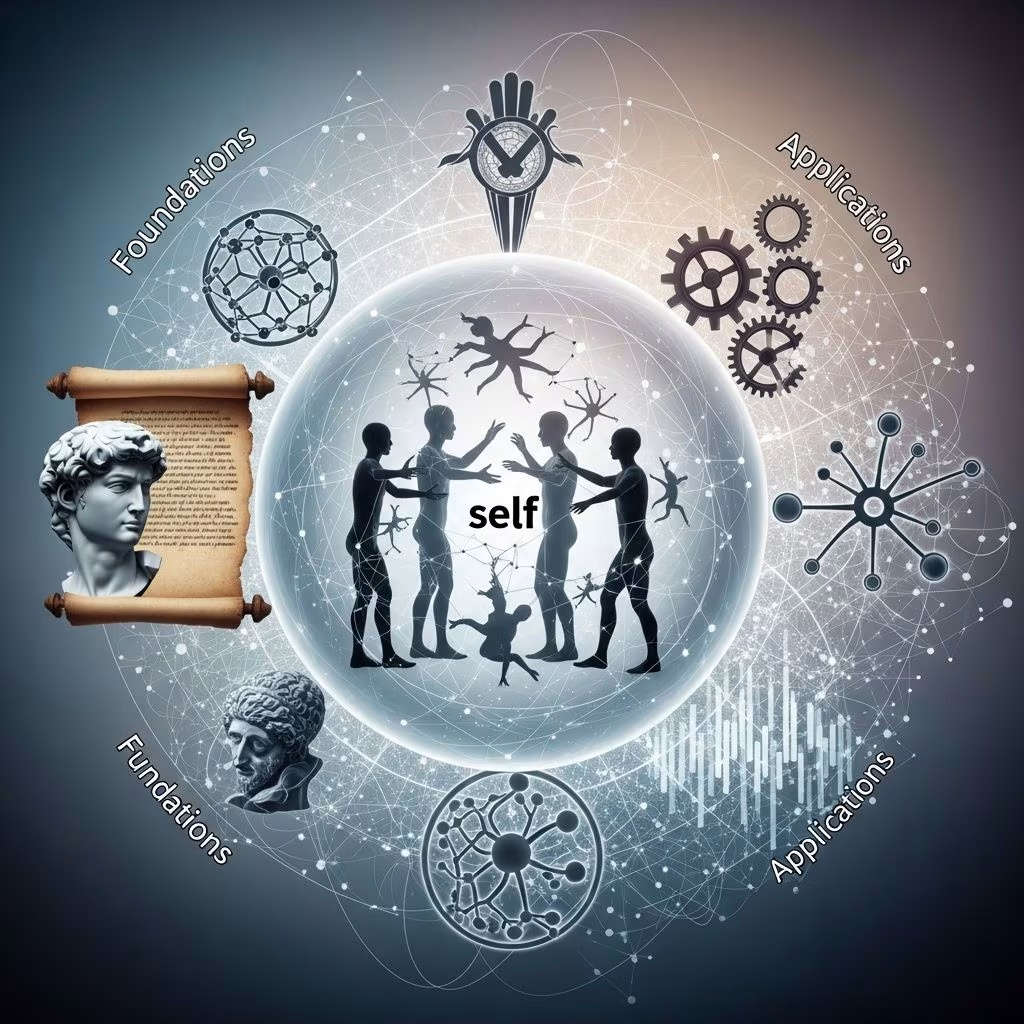
Object Relations Theory: An Overview
Object relations theory is a major branch of modern psychoanalysis that centers on the role of early relationships in shaping an individual’s personality, sense of identity, and emotional responses. Unlike classical Freudian psychoanalysis, which focuses on drives such as sexuality and aggression, object relations theorists assert that humans are primarily motivated by the fundamental need to relate to others and to form vital interpersonal connections.
What Does “Object” Mean in Object Relations Theory?
In this context, the term “object” refers not to a physical item but to significant people—generally, primary caregivers such as the mother, father, or another constant figure in early childhood. An “object” can also be a part of a person (such as a mother’s breast) or, more abstractly, the mental representations formed by the infant about themselves and others. These representations are dynamic and formed from subjective experiences, which may blend reality and fantasy.
Core Concepts of Object Relations Theory
- Objects: Significant others (or parts of them), internalized as mental representations.
- Object Relations: The complex internal relationship between the self and these internalized objects.
- Part Objects and Whole Objects: Infants initially relate to part objects (e.g., a nurturing breast); with maturation and a “good enough” environment, they integrate these into whole objects (the entire caregiver).
- Internalization: The subjective experience of early relationships is taken “inside,” forming blueprints for later interpersonal expectations.
- Fantasy vs. Reality: Internalized objects are mixtures of real interactions and the child’s fantasy, which helps explain differences in experiences among siblings.
Historical Development of Object Relations Theory
Object relations theory evolved in the early 20th century from Freudian psychoanalysis. Sigmund Freud used “objects” in his drive theory, viewing them as targets for satisfying biological impulses. However, later theorists transformed this into a “two-person” psychology, examining the actual relationships and their impact on growth and personality.
Key Contributors
| Theorist | Main Contribution |
|---|---|
| Melanie Klein | Founded object relations theory; emphasized early mother-infant relationship and introduced concepts such as “good” and “bad” objects. |
| Donald Winnicott | Explored how a “good-enough” environment and caregiver facilitate healthy integration of part objects into whole objects and autonomy. |
| Margaret Mahler | Focused on stages of separation-individuation and how early nurturing shapes identity. |
| Ronald Fairbairn | Studied the internal world of relationships and their role in mental health and pathology. |
Developmental Stages and Internalization
Object relations theory divides early development into phases, each marked by increasing complexity in the child’s internalized images, or representations, of themselves and others:
- Initial Attachment: The newborn experiences caregivers mainly in terms of their nurturing functions (e.g., the “good breast”).
- Splitting: Early representations may divide caregivers into “good” (comforting, nurturing) and “bad” (distressing, absent) objects.
- Integration: Given ongoing care, infants learn to reconcile opposing experiences (seeing that the same person can be both comforting and disappointing), leading to more realistic whole-object representations.
This internalization process provides the “blueprints” for future relationships, influencing self-worth, attachment styles, and interpersonal expectations.
Central Themes in Object Relations Theory
- Attachment and Separation: Early bonds form the foundation for identity and emotional well-being; difficulties in these processes can lead to lasting emotional struggles.
- Autonomy and Dependence: Healthy development means balancing the need for connection with the growth of independence.
- Emotional Processes: Feelings such as love, aggression, and longing for safety are at the core of object relations, influencing both conscious and unconscious dynamics.
Differences from Classical Freudian Theory
| Classical Freud | Object Relations |
|---|---|
| Focus on biological drives (sex & aggression) | Focus on interpersonal relationships |
| One-person psychology | Two-person psychology |
| Objects as drive targets | Objects as sources of connection, safety, and emotional blueprints |
| Motivation by reduction of tension | Motivation by need for attachment and intimacy |
Applications of Object Relations Theory in Therapy
Object relations therapy seeks to identify and reconstruct unhealthy internalized relationships that may be causing difficulties in current interpersonal functioning. Therapeutic goals include:
- Uncovering Early Mental Images: Bringing unconscious representations to awareness, particularly those affecting present relationships.
- Restoring Realistic Expectations: Helping clients differentiate current relationships from past maladaptive “blueprints” and develop healthier ways of relating.
- Improving Interpersonal Functioning: Enhancing the ability to form healthy, satisfying relationships by reorganizing internal object representations.
Common Techniques
- Interpretation of Transference: Observing how the client relates to the therapist as a reflection of earlier relational patterns.
- Exploration of Childhood Experiences: Examining formative bonds and how they shaped current beliefs and behaviors.
- Working Through Resistances: Identifying and addressing defensive barriers built around problematic internalized objects.
Who Practices Object Relations Therapy?
Object relations therapy is practiced by clinicians with training in psychoanalytic approaches, including psychologists, psychiatrists, and psychotherapists. It may also be integrated with other therapeutic modalities to support clients experiencing:
- Relationship difficulties
- Attachment disorders
- Personality disorders
- Chronic loneliness or self-esteem issues
Benefits and Limitations of Object Relations Therapy
| Benefits | Limitations |
|---|---|
|
|
Common Questions About Object Relations Theory
What is the main goal of object relations theory?
The primary goal is to understand how early relationships and their internalizations influence adult personality, emotional responses, and patterns of relating to others.
How is object relations theory different from Freud’s psychoanalysis?
Object relations theory focuses on interpersonal relations as the foundation of personality, whereas Freud’s psychoanalysis emphasized biological drives such as sexuality and aggression.
Who can benefit from object relations therapy?
People struggling with persistent relationship issues, attachment difficulties, or emotional pain rooted in early experiences often find this approach helpful.
Why does object relations theory emphasize the mother-infant relationship?
Early mother-infant interactions serve as the primary template for mental representations of self and others, which profoundly influence future relationships.
Can object relations change over time?
While early internalizations are powerful, later experiences, mature relationships, and therapeutic intervention can reshape these patterns for healthier outcomes.
Summary Table: Key Aspects of Object Relations Theory
| Aspect | Description |
|---|---|
| Objects | Significant people or parts of people internalized in early childhood |
| Internalization | Formation of mental representations, blending reality and fantasy |
| Transference | Re-enactment of early object relations in adult relationships |
| Splitting | Tendency to see objects as wholly good or bad before integration |
| Therapy Focus | Healing maladaptive patterns and fostering healthier relational templates |
Further Reading and Resources
- “Object Relations Theory: Benefits, Techniques & How it Works” – GoodTherapy
- “Melanie Klein and Object Relations Theory” – Simply Psychology
- “Object Relations Theory” – Psychodynamic Psychology
Frequently Asked Questions (FAQs)
Q: What is meant by an “internal object”?
A: An internal object is a mental image or representation of a significant person or part of a person, influenced by early relationship experiences and stored in the unconscious.
Q: Is object relations theory still used in therapy today?
A: Yes, object relations theory remains influential, particularly in psychodynamic and integrative forms of psychotherapy focused on deeper relational patterns.
Q: Can object relations theory explain personality disorders?
A: Many theorists believe that maladaptive internalized object relations contribute to the development and persistence of certain personality disorders, especially those involving identity and relationships.
Q: How long does object relations therapy typically last?
A: It often requires longer-term work to address deep-seated patterns, though the length varies depending on individual needs and goals.
Key Takeaways
- Object relations theory is a foundational psychoanalytic approach focusing on the critical influence of early relationships on personality and mental health.
- Objects are significant people (or parts of them) internalized as mental representations that serve as the basis for later relationship patterns.
- Therapy aims to uncover and reshape maladaptive internalized objects for improved interpersonal and emotional functioning.
References
- https://www.goodtherapy.org/learn-about-therapy/types/object-relations
- https://www.ebsco.com/research-starters/psychology/object-relations-theory
- https://www.simplypsychology.org/melanie-klein.html
- https://psychodynamicpsychology.com/object-relations-theory/
- https://en.wikipedia.org/wiki/Object_relations_theory
- https://dictionary.apa.org/object-relations-theory
- https://www.youtube.com/watch?v=2CkeE15B7PU


