


What Is Sensory Adaptation?
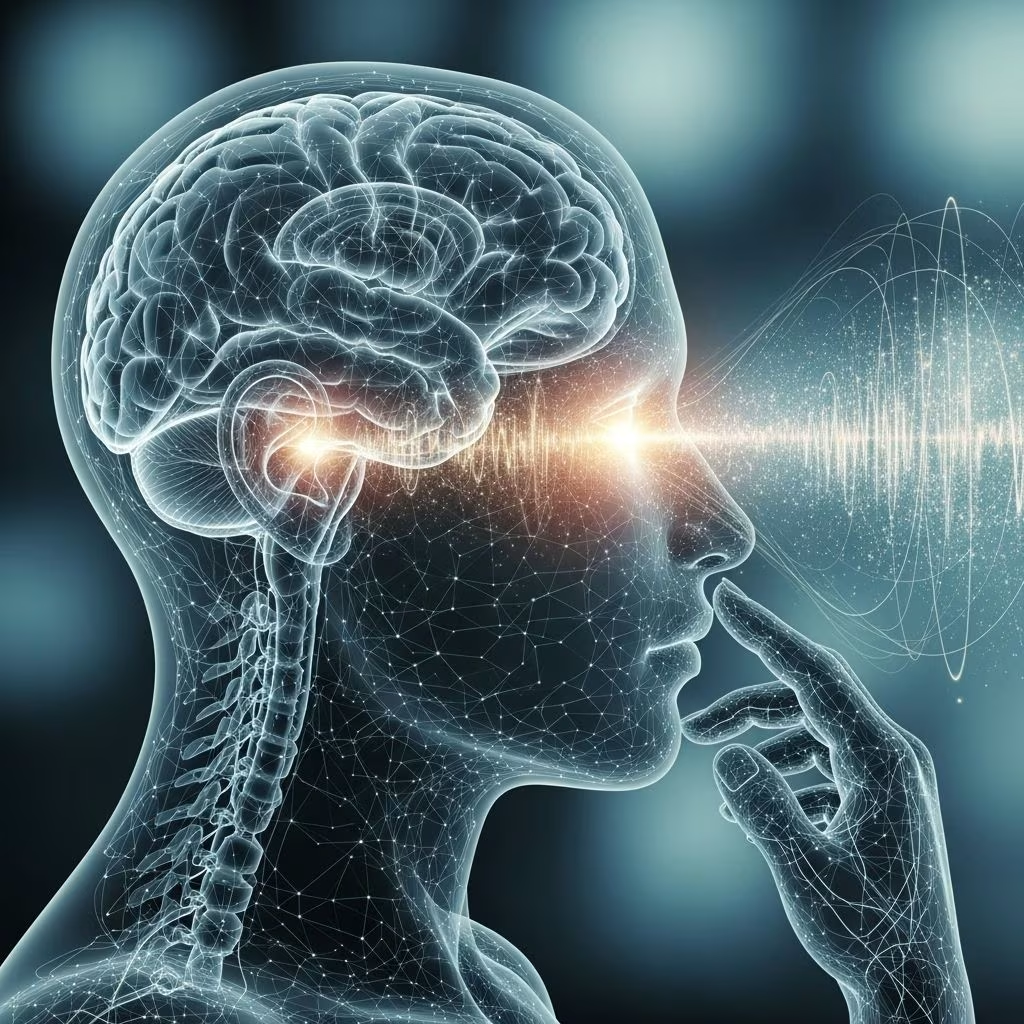
Sensory adaptation is the process by which our senses become less sensitive to a constant or unchanging stimulus over time. This vital phenomenon enables us to efficiently navigate our environment and focus on new, relevant information rather than being overwhelmed by persistent sensory input.
- Sensory adaptation occurs in all five senses: sight, hearing, touch, taste, and smell.
- It leads to a diminished response of our sensory organs and brain to constant exposure.
- The phenomenon helps us tune out background stimuli and manage our attention effectively.
Sensory adaptation is not only a psychological process but also a biological and neurological one. It occurs both consciously and subconsciously, with our brain constantly recalibrating the way it responds to consistent input.
How Does Sensory Adaptation Work?
The process of sensory adaptation involves receptors in our sensory organs—eyes, ears, nose, tongue, and skin—becoming less responsive after repeated or continuous exposure to a stimulus. Here’s a typical sequence:
- A new stimulus (such as a strong odor or loud noise) is detected by sensory receptors, which activate neurons in the brain.
- If the stimulus remains constant and unchanging, the receptors reduce their responsiveness and neurons fire less frequently.
- The brain gradually pays less attention to the stimulus, and the sensation fades into the background.
- This allows focus to shift to new, potentially important information and helps organisms prioritize sensory input for survival.
This process is sometimes called neural adaptation, reflecting its basis in changes at the cellular level in the nervous system.
Common Examples of Sensory Adaptation
Sensory adaptation manifests in everyday experiences across all our senses. Here are some representative examples:
- Touch: When you first put on a watch or ring, you feel it on your skin. Within minutes, the sensation fades as your touch receptors adapt.
- Smell: Entering a room with a strong odor is overwhelming at first, but soon you barely notice it as your nose becomes less sensitive to the smell.
- Taste: If you eat salty or sweet foods frequently, you may require stronger flavors over time to experience the same taste sensation.
- Hearing: A loud air conditioner in the background may be irritating when switched on, but after a short while, you stop noticing the sound.
- Vision: Unlike other senses, vision adapts differently. Our eyes can adapt to different levels of light or color but do not ‘turn off’ to constant visual stimuli in the same way as other senses.
Why Is Sensory Adaptation Important?
Sensory adaptation makes it possible for us to function effectively without being overwhelmed by continuous stimuli in our environment.
- Focus: It enables the brain to filter out unimportant background stimuli and concentrate on changes or novel stimuli that may be significant to survival or daily tasks.
- Resource Allocation: Sensory adaptation represents optimal allocation of our brain’s resources, avoiding overload and helping us attend to only the most relevant information.
- Comfort: Without adaptation, everyday experiences like persistent strong odors, constant noise, or the feeling of clothing on our skin would make it difficult to focus and function.
The Science and Neurology Behind Sensory Adaptation
Sensory adaptation is grounded in the workings of the nervous system. When sensory organs encounter a stimulus, they send signals to the brain via neural pathways. If the stimulus is sustained, the responsiveness of the sensory receptors is reduced, resulting in lower activity in the corresponding brain cells.
There are two main types of neural adaptation:
- Fast adaptation: Happens in milliseconds; for example, quickly adapting to continuous touch.
- Slow adaptation: Occurs over minutes, hours, or days and typically involves exposure to persistent stimuli such as recurring odors or ongoing noise.
| Sensory Type | Example | Time to Adapt |
|---|---|---|
| Touch | Feeling of wearing a watch | Seconds to minutes |
| Smell | Pungent kitchen odor | Minutes |
| Taste | Tasting salty food repeatedly | Hours to days |
| Hearing | Background noise (fan, AC) | Minutes to hours |
Adaptation may also involve changes in the brain’s attention mechanisms, allowing us to redirect our awareness toward new or urgent stimuli.
Stages of Sensory Adaptation
Sensory adaptation unfolds in several stages:
- Detection: Sensory organs detect a new stimulus and send a strong signal to the brain.
- Response: The brain attends to the stimulus actively while the sensation is new.
- Reduction: If the stimulus is continuous and unchanging, sensory receptors reduce their response, neural activity decreases, and attention shifts away.
- Transformation: After adaptation, organisms are poised to respond to new or changed stimuli rather than the ongoing background.
Main Causes of Sensory Adaptation
The primary drivers of sensory adaptation are:
- Changes in neural receptor cells: Receptors physically reduce their responsiveness to persistent stimuli.
- Stages of perceptual processing: Adaptation can occur very quickly or have a delayed onset depending on the nature and duration of the stimulus.
- Repeated exposure: The more frequently a stimulus is encountered, the faster and more profound the adaptation.
Researchers also cite the importance of adaptation for preventing sensory overload and for encoding environmental information efficiently.
Sensory Adaptation vs. Habituation
It’s important to distinguish sensory adaptation from habituation. While adaptation is a physiological response at the sensory receptor level, habituation is a psychological process involving a reduction in behavioral responses due to repeated exposure.
| Feature | Sensory Adaptation | Habituation |
|---|---|---|
| Occurs in | Sensory organs/receptors | Central nervous system (brain) |
| Change Type | Physiological/Neurological | Psychological/Behavioral |
| Stimulus Removal | Response recovers quickly | Response may remain reduced (unless reset) |
History of Sensory Adaptation Research
Sensory adaptation has been an active area of scientific inquiry since the 19th century, with pioneers like Hermann von Helmholtz and George M. Stratton laying the groundwork. Their studies revealed how adaptation provides clues to how our senses encode and represent stimuli, and how perceptual ‘aftereffects’ can inform our understanding of sensory processing.
Everyday Implications of Sensory Adaptation
Without sensory adaptation, daily life could become overwhelming—we would be constantly aware of every noise, scent, taste, and tactile sensation. Adaptation empowers us to manage our perceptions, focus on what matters, and ignore distractions.
- In the workplace: Adaptation helps employees tune out persistent office noises (like the hum of computers or HVAC) and remain productive.
- In social settings: Adaptation allows people to ignore background chatter and engage in one-on-one conversations.
- For safety: Adaptation can help firefighters or first responders ignore ongoing heat or sound in pursuit of identifying critical, changing information.
Potential Downsides & Limitations
While beneficial, sensory adaptation can sometimes have drawbacks:
- If the brain adapts to dangerous stimuli (such as chemical odors or gas leaks), people may overlook safety warnings.
- Sensory adaptation may also reduce enjoyment or detection of subtle flavors, scents, or sounds after prolonged exposure.
Frequently Asked Questions (FAQs)
Q: Which senses experience sensory adaptation?
A: Sensory adaptation occurs in all five senses—touch, taste, vision, hearing, and smell. The specifics vary by sense, but diminished sensitivity is a common outcome.
Q: What’s an example of sensory adaptation most people experience?
A: Common examples include getting used to the smell of a room, not feeling the watch on your wrist after putting it on, or ignoring the hum of your refrigerator.
Q: Is sensory adaptation the same as habituation?
A: No. Sensory adaptation is a physiological reduction in sensory receptor responsiveness, while habituation is a learned decrease in behavioral response driven by repetition.
Q: Why is sensory adaptation important for daily functioning?
A: It protects us from sensory overload and enables us to focus on important or changing information, improving comfort and attentional focus.
Q: How quickly does sensory adaptation happen?
A: The speed of adaptation depends on the type and intensity of stimulus, ranging from milliseconds for touch to hours or days for taste.
Key Takeaways
- Sensory adaptation is a process in which our senses become less sensitive to persistent stimuli, allowing us to focus on novel or changing information.
- All five senses participate in adaptation, but the rate and mechanism may vary.
- Research in psychology and neuroscience highlights sensory adaptation as essential for survival, attention, and emotional well-being.
- Everyday examples show adaptation helps minimize distractions and manage comfort.
- Understanding sensory adaptation demonstrates how our perception is flexible, active, and fundamentally shaped by our interaction with the environment.
References
- https://helpfulprofessor.com/sensory-adaptation-examples/
- https://study.com/academy/lesson/sensory-adaptation-definition-examples-quiz.html
- https://www.youtube.com/watch?v=c7WSgvZiXoA
- https://www.khanacademy.org/test-prep/mcat/processing-the-environment/sensory-perception/v/sensory-adapting
- https://pmc.ncbi.nlm.nih.gov/articles/PMC2084204/
- https://fiveable.me/key-terms/ap-psych/sensory-adaptation
- https://dictionary.apa.org/adaptation


