


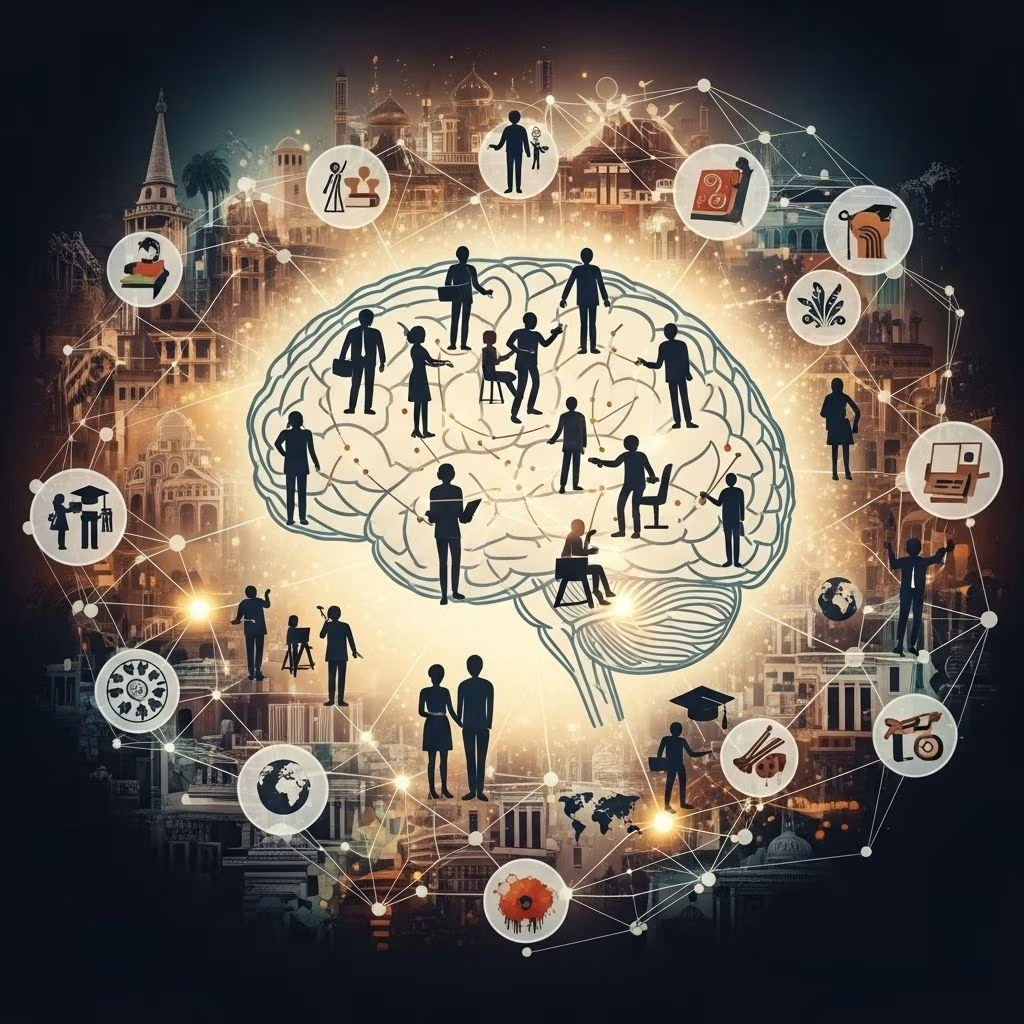
Sociocultural theory offers a powerful lens through which to examine how humans think, learn, and develop throughout life. Developed by Lev Vygotsky, this approach highlights the fundamental role of social interaction, cultural context, and language in shaping our cognitive abilities. The theory has profoundly influenced fields such as psychology, education, and child development, proposing that learning is never an isolated experience but deeply rooted in the shared practices of communities.
Overview of Sociocultural Theory
Sociocultural theory is a foundational concept in developmental psychology, emphasizing the importance of both social interactions and cultural influences on learning and cognitive growth. According to this framework, human development cannot be separated from the environment in which individuals are raised. From everyday conversations to classroom activities, the meanings, values, and cognitive tools provided within a culture serve as the scaffolding for mental growth .
- Developed by: Lev Vygotsky (Russian psychologist; early 20th century)
- Core assertion: Social and cultural contexts are essential for cognitive development.
- Scope: Applies to childhood learning, education, language acquisition, and societal norms.
Key Concepts in Sociocultural Theory
Central to sociocultural theory are several vital concepts that define how learning takes place within communities:
1. Social Interaction
Vygotsky posited that intellectual abilities originate in social contexts, not in isolation. Children (and adults) acquire knowledge and skills through collaborative activities with more knowledgeable individuals, such as parents, teachers, or peers .
- Learning as Dialogue: Through conversation and shared experiences, individuals construct meanings and develop cognitive tools.
- Role of Community: Participation in cultural practices shapes the way people think, learn, and interpret their world.
2. The Zone of Proximal Development (ZPD)
The Zone of Proximal Development refers to the gap between what a learner can do independently and what they can accomplish with guidance .
- Independent Level: Tasks the learner can perform alone.
- Assisted Level: Tasks achievable with the help of peers or adults (the ZPD).
- Potential Development: The upper boundary—skills the learner could achieve with further assistance and maturation.
The ZPD emphasizes the importance of scaffolding, or providing targeted support that enables learners to stretch beyond their current abilities. As competence increases, support is gradually withdrawn until mastery is achieved .
3. More Knowledgeable Other (MKO)
A More Knowledgeable Other is anyone—adult or peer—who has greater expertise or mastery of a task and can provide the guidance necessary for development .
- Examples: Parents, tutors, teachers, peers, or even tools (such as books or computers).
- Role: Model skills, provide feedback, and pose challenging questions to support learning within the ZPD.
4. Tools of Intellectual Adaptation
The cultural “tools” or strategies passed down in a society—such as language, counting systems, or mnemonic devices—significantly influence how people learn and process information. These tools are not universal but are specific to each culture and context .
- Physical Tools: Objects like calculators, books, or computers that support reasoning.
- Symbolic Tools: Language, mathematical notations, and various signs.
5. Language and Thought
Language plays a central role in sociocultural theory, serving as both a cultural tool and a means for cognitive growth.
- Social Speech: Communication with others, essential for learning early in life.
- Private Speech: Talking aloud to oneself, especially in children, to guide thinking and behavior.
- Inner Speech: Internalized private speech—self-regulation, reflection, and complex thought.
Vygotsky: Founder of Sociocultural Theory
Lev Vygotsky (1896–1934) was a Soviet psychologist whose pioneering ideas transformed the understanding of how children learn and develop. His work, largely unrecognized outside the Soviet Union until decades after his death, now stands as a major influence in childhood education and cognitive science .
- Argued that higher mental functions arise from social engagement, not innate ability.
- Believed that cultural and historical context fundamentally shape how children think.
- Suggested that teaching and learning should focus on providing meaningful social interactions within culturally relevant settings.
Application of Sociocultural Theory in Education
Sociocultural theory has had a marked impact on teaching, school curricula, and approaches to assessment. Here’s how it informs today’s educational practices:
- Collaborative learning: Group activities, peer tutoring, and cooperative projects mirror authentic social contexts for learning.
- Formative assessment: Evaluating not only what a student knows individually but also what can be achieved with guidance.
- Emphasizing dialogue: Teachers encourage students to articulate reasoning, question ideas, and co-construct knowledge.
- Scaffolding: Educators provide just enough help to move learners through their ZPD, then fade support as mastery increases.
- Cultural relevance: Instruction incorporates students’ backgrounds, languages, and traditions to increase engagement and meaning.
Cultural Tools and Cognitive Development
Each culture offers unique cognitive tools that shape how its members approach learning, remember information, solve problems, and interact with the world .
- Language systems: Impact not only communication but also memory, reasoning, and problem-solving strategies.
- Social norms: Dictate what behaviors, values, and skills are prioritized within a community.
- Art, symbols, music, and rituals: Provide alternative modes of expression, learning, and understanding.
The diversity of cultural tools means cognitive development is context-dependent; what is learned and how it is learned varies significantly around the world.
Internalization: From Social Experience to Individual Thought
According to sociocultural theory, learning involves the internalization of socially mediated experiences. New ideas or strategies initially appear in social contexts before gradually being absorbed and transformed into mental processes by the individual .
- Interaction: Knowledge is first co-constructed during dialogue or collaborative activity.
- Private Speech: Learners guide their own thinking and behavior through self-directed speech.
- Inner Speech: Over time, this private speech becomes silent inner dialogue, supporting self-regulation and higher-order cognition.
Scaffolding: Supporting Learning and Growth
Scaffolding is a teaching method derived from Vygotsky’s concepts, referring to temporary support structures that help learners complete tasks beyond their current skill level .
- Supports may include prompts, hints, modeling, structured activities, or using visual aids.
- As the learner develops independence, the support is gradually withdrawn.
- Effective scaffolding requires awareness of the learner’s needs and the flexibility to adjust support as skills improve.
Criticisms and Limitations of Sociocultural Theory
While influential, sociocultural theory is not without its critics. Some limitations and areas of debate include:
- Lack of specificity: Terms like ZPD can be difficult to define or measure precisely in real-world settings.
- Underestimating individual differences: By focusing on social context, personal agency or unique cognitive styles may be overlooked.
- Limited empirical validation: Some claims, particularly regarding the mechanisms of internalization, are challenging to test directly.
- Potential cultural bias: The theory, while emphasizing cultural diversity, may not account equally for all cultural variations or individual experiences.
Comparison: Sociocultural Theory vs. Other Developmental Theories
| Theory | Primary Focus | Key Concepts | Role of Social Interaction |
|---|---|---|---|
| Sociocultural (Vygotsky) | Social and cultural influences | ZPD, scaffolding, cultural tools | Essential for learning and development |
| Cognitive-Developmental (Piaget) | Stages of individual cognitive growth | Object permanence, schemas | Social interaction can prompt change, but not core mechanism |
| Behaviorist (Skinner, Watson) | Observable behavior and environmental stimuli | Reinforcement, conditioning | Minimized; learning seen as response to stimuli |
Impact of Sociocultural Theory on Modern Education
The practical application of sociocultural theory is evident in today’s education and parenting approaches:
- Student-centered learning environments encourage collaboration, dialogue, and exploration rather than passive absorption of facts.
- Cultural inclusivity promotes respect for diverse perspectives, languages, and experiences in the classroom.
- Dynamic assessment considers not only what children know independently but what they could achieve with support, influencing practices such as formative assessment and individualized instruction.
Frequently Asked Questions (FAQs)
Q: What is sociocultural theory in simple terms?
A: Sociocultural theory explains how a person’s growth and learning are directly influenced by their culture, language, and social environment. It stresses the importance of social relationships and cultural traditions in shaping who we become.
Q: Who developed sociocultural theory?
A: The theory was developed by Lev Vygotsky, a Russian psychologist, in the early 20th century.
Q: What is the zone of proximal development?
A: The Zone of Proximal Development (ZPD) is the gap between what a learner can do alone and what they can accomplish with guidance from someone more knowledgeable. It represents the area of optimal learning.
Q: How does sociocultural theory differ from Piaget’s theory?
A: While Piaget emphasized universal stages of individual cognitive growth, Vygotsky’s sociocultural theory focuses on the collaborative, cultural context of learning and the essential role of social interaction.
Q: What is scaffolding in sociocultural theory?
A: Scaffolding refers to providing just enough support so learners can accomplish tasks they initially find too difficult; as their skills improve, this support is gradually withdrawn.
Q: Why is language considered central in sociocultural theory?
A: Language acts as both a key cultural tool and a means of thinking. Through conversation, self-talk, and silent inner speech, language mediates learning and cognitive development.
Key Takeaways
- Sociocultural theory highlights how culture, language, and social interaction are crucial for cognitive growth.
- Originated by Lev Vygotsky, the theory introduced influential concepts like the zone of proximal development, scaffolding, and internalization.
- Has had a profound influence on education, advocating for collaborative and culturally relevant teaching practices.
- Recognizes learning as a deeply social and context-dependent process.
References
- https://study.com/academy/lesson/sociocultural-perspective-definition-examples-quiz.html
- https://www.structural-learning.com/post/sociocultural-theory
- https://www.ebsco.com/research-starters/education/sociocultural-theory
- https://www.simplypsychology.org/vygotsky.html
- https://www.mcw.edu/-/media/MCW/Education/Academic-Affairs/OEI/Faculty-Quick-Guides/Sociocultural-Theory-of-Cognitive-Development.pdf
- https://www.youtube.com/watch?v=gPKV2f7uDAo
- https://www.albert.io/blog/social-cultural-perspective-ap-psychology-crash-course/
- https://openbooks.library.baylor.edu/lifespanhumandevelopment/chapter/chapter-9-3-vygotskys-sociocultural-theory/
- https://en.wikipedia.org/wiki/Sociocultural_perspective


