


What Is Spontaneous Recovery?
Spontaneous recovery describes the surprising reappearance of a previously extinguished response after a period of apparent disappearance. In psychological terms, this means that a behavior believed to be ‘extinct’—that is, no longer occurring after consistent non-reinforcement—can reemerge unexpectedly, even after a substantial pause in exposure to the conditioned stimulus. This fascinating phenomenon has vital implications in how we understand learning, memory, and behavior change in both animals and humans.
The Roots of Spontaneous Recovery: Classical Conditioning and Ivan Pavlov
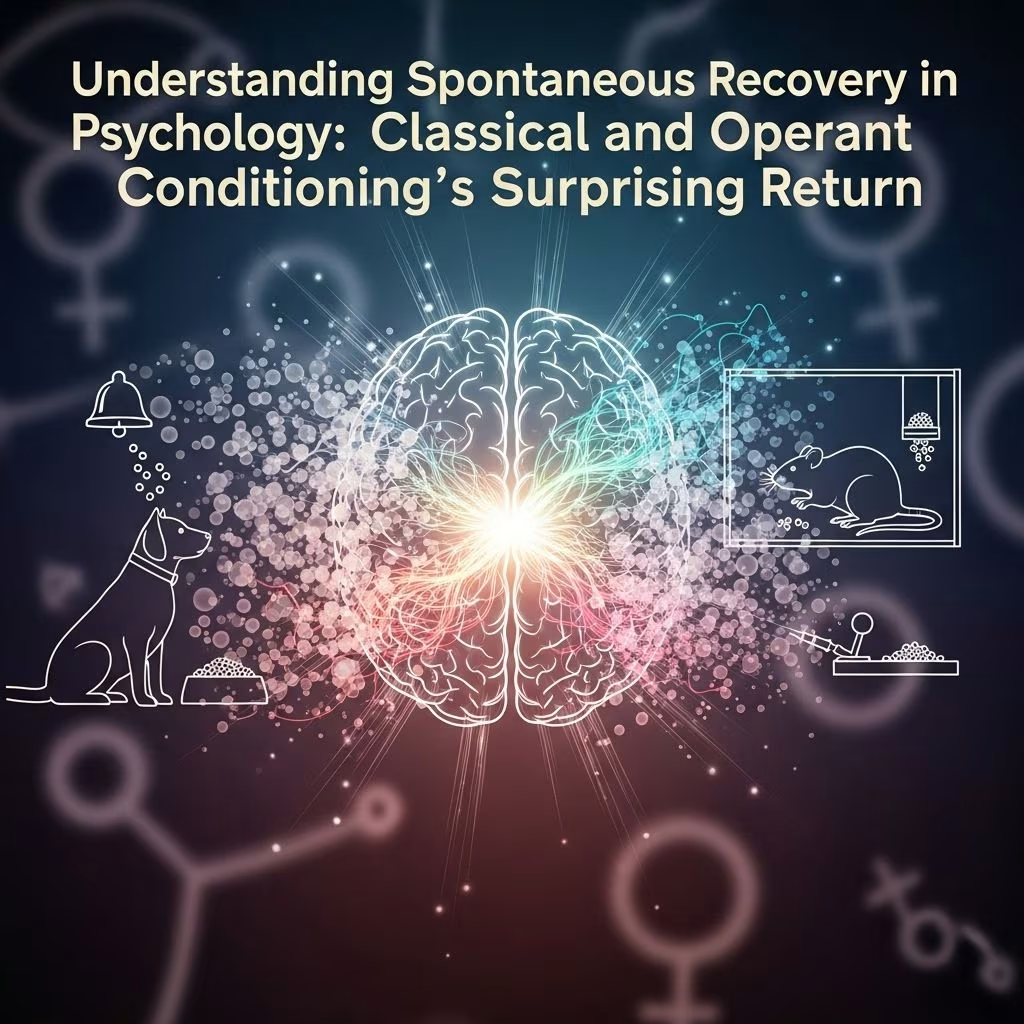
The concept of spontaneous recovery finds its origins in classical conditioning, most notably demonstrated by Ivan Pavlov’s experiments with dogs. Pavlov discovered that conditioned responses do not fade completely, even after repeated extinction trials. Instead, after a period of rest—where the conditioned stimulus (like a bell) was not presented—dogs would again demonstrate the salivation response to the bell, even without the presence of food. This return, though often weaker than the original response, is what we call spontaneous recovery.
- Conditioned Stimulus (CS): An initially neutral stimulus (e.g., a bell).
- Unconditioned Stimulus (US): A stimulus that naturally elicits a response (e.g., food).
- Extinction: When the CS is presented without the US repeatedly, leading to a decline in the conditioned response.
- Spontaneous Recovery: The reappearance of the conditioned response after a rest period following extinction.
How Pavlov Demonstrated Spontaneous Recovery
In his experiments, Pavlov conditioned dogs to salivate at the sound of a bell by repeatedly pairing it with food. When the bell rang without being followed by food, the salivation response eventually faded (extinction). However, after hours or even days without the bell, the dogs would spontaneously salivate again to the bell alone—though typically less intensely. This pattern revealed that extinction does not erase the learned association, but rather suppresses its expression. The dormant association can resurface, especially after rest.
Spontaneous Recovery in Operant Conditioning
While most associated with classical conditioning, spontaneous recovery is also observed in operant conditioning. In this framework, behaviors are shaped by their consequences (reinforcements or punishments). If a reinforced behavior stops being rewarded, it will typically decrease or ‘extinguish’ over time. However, after a pause or rest period, the behavior may reappear unexpectedly. This highlights a lasting trace of learning even after apparent extinction.
- Example: If someone consistently works hard and gets promoted (positive reinforcement), but then hard work is no longer rewarded, that effort may fade. Yet, after a break, motivation (the working-hard behavior) could resurface, especially if an unexpected reward happens again.
Mechanisms Behind Spontaneous Recovery: Why Does It Happen?
The mechanism behind spontaneous recovery lies in the brain’s memory systems. Extinction does not delete the original learning. Instead, it creates a new memory that inhibits the expression of the conditioned response. Over time, the inhibitory effect of extinction can weaken, allowing the original behavior to resurface spontaneously.
Key points:
- Extinction is suppression, not erasure: Original associations remain physiologically encoded.
- Time-dependent recovery: The likelihood and strength of spontaneous recovery often decrease with repeated cycles unless reconditioning (new reinforcement) occurs.
- Memory traces: Lingering neural patterns support the potential for dormant behaviors to return.
Extinction vs. Unlearning: The Importance of Spontaneous Recovery
One of the most important distinctions underscored by spontaneous recovery is the difference between extinction and unlearning:
- Extinction: Suppresses a behavior, but does not eliminate the underlying learning. The potential remains for the response to reappear spontaneously.
- Unlearning: Implies complete erasure from memory—something rarely achieved with conditioned responses.
Thus, spontaneous recovery demonstrates that while behaviors may appear eliminated, they may simply be dormant. This distinction is essential in behavioral therapy, habit formation, and understanding relapse.
Real-World Examples and Applications
Pavlov’s Dogs (Classical Conditioning Example)
- Bell (conditioned stimulus) + Food (unconditioned stimulus) ⟶ Salivation (conditioned response)
- Bell alone (repeated) ⟶ Salivation extinguishes
- After a rest, bell again ⟶ Spontaneous return of salivation
Human Behavior and Learning
- Trauma responses: A person may initially overcome a phobic response (such as fear of dogs) through exposure therapy, but after weeks or months, the fear response may reappear spontaneously under stress or by encountering a salient reminder.
- Habits and addiction: A former smoker who has been abstinent for a long period may suddenly feel a strong urge to smoke in a specific context, demonstrating spontaneous recovery of the craving.
- Childhood associations: Children conditioned to be excited by the sound of an ice cream truck may lose that response during winter, but suddenly feel excitement when hearing a similar tune months later.
Spontaneous Recovery vs. Extinction Burst vs. Spontaneous Remission
| Term | Definition | Key Feature |
|---|---|---|
| Spontaneous Recovery | Return of an extinguished response after a delay | Happens after rest without reinforcement |
| Extinction Burst | Temporary increase in response intensity after extinction begins | Occurs immediately after reinforcer is withdrawn |
| Spontaneous Remission | Sudden improvement in a psychological condition without intervention | Marked by absence of therapeutic input |
Why Is Spontaneous Recovery Important?
- Reveals persistence of learned associations: Even well-practiced extinction does not erase the original link between stimulus and response.
- Explains relapse in behavior: Helps therapists and patients understand why old behaviors or symptoms may return, informing more resilient treatment plans.
- Guides therapeutic interventions: Supports the use of booster sessions or periodic reinforcement to prevent relapse in phobias, addictions, or anxiety disorders.
Modern Applications: Therapy and Behavior Modification
Understanding spontaneous recovery is crucial in many real-world settings, especially in therapy and education.
- Behavioral therapy: Spontaneous recovery is considered in designing exposure or aversive treatments, with follow-up sessions to reinforce extinction.
- Habit reversal: Habit formation and breaking are seen as ongoing processes—periods of dormancy do not imply total absence of the undesired habit.
- Animal training: Trainers use knowledge of spontaneous recovery to reinforce desired behaviors consistently over time.
Factors Influencing Spontaneous Recovery
- Length of rest period: Longer periods between extinction and testing often yield stronger spontaneous recovery, up to a point.
- Number of extinction trials: The more complete the extinction process, the weaker the spontaneous recovery, although it rarely disappears entirely.
- Type of learning and individual differences: Some individuals or species show more robust spontaneous recovery depending on genetic, developmental, or environmental factors.
- Nature of the stimulus and context: Contextual cues can prime the recovered response, sometimes making it context-specific.
Limitations and Current Research Directions
Although spontaneous recovery has been widely documented, there remain questions about its underlying neural mechanisms and variability among individuals. New research looks at:
- The role of different brain regions in suppressing and reviving learned behaviors
- Genetic and developmental influences on the likelihood and strength of spontaneous recovery
- Impacts of stress, emotion, and environmental context on the return of extinguished behaviors
Frequently Asked Questions (FAQs)
Q: Does spontaneous recovery mean the behavior is permanently back?
A: No, spontaneous recovery typically results in a weaker response than before extinction, and repeated extinction trials after recovery make the response even less likely to return.
Q: How is spontaneous recovery different from relapse?
A: Spontaneous recovery is a specifically conditioned response returning after a delay without additional reinforcement. Relapse often refers more broadly to the return of any unwanted behavior or symptom, possibly influenced by stress, environment, or other factors.
Q: Can spontaneous recovery occur in humans as well as animals?
A: Yes, both laboratory animals and humans experience spontaneous recovery in learned behaviors, habits, and even phobia or addiction management.
Q: How can therapists use knowledge of spontaneous recovery to improve outcomes?
A: By anticipating possible reemergence of symptoms or behaviors, therapists can schedule booster sessions or additional support after extinction to help maintain progress and prevent relapse.
Key Takeaways
- Spontaneous recovery is the unexpected return of a previously extinguished learned response after a time lapse.
- It occurs in both classical and operant conditioning, demonstrating that extinction suppresses but does not erase learning.
- This phenomenon is crucial for understanding relapse, therapy planning, habit formation, and the resilience of learned associations.
- While the response returns, it generally diminishes with repeated recovery cycles, emphasizing learning’s complexity and persistence.
References
- https://study.com/academy/lesson/spontaneous-recovery-in-psychology-definition-examples-quiz.html
- https://www.betterhelp.com/advice/psychologists/what-is-spontaneous-recovery-psychology-definition-and-examples/
- https://en.wikipedia.org/wiki/Spontaneous_recovery
- https://fiveable.me/key-terms/ap-psych/spontaneous-recovery
- https://dictionary.apa.org/spontaneous-recovery
- https://pmc.ncbi.nlm.nih.gov/articles/PMC2742996/
- https://www.totalcareaba.com/autism/extinction-burst-vs-spontaneous-recovery


