


What Is Stimulus Generalization?
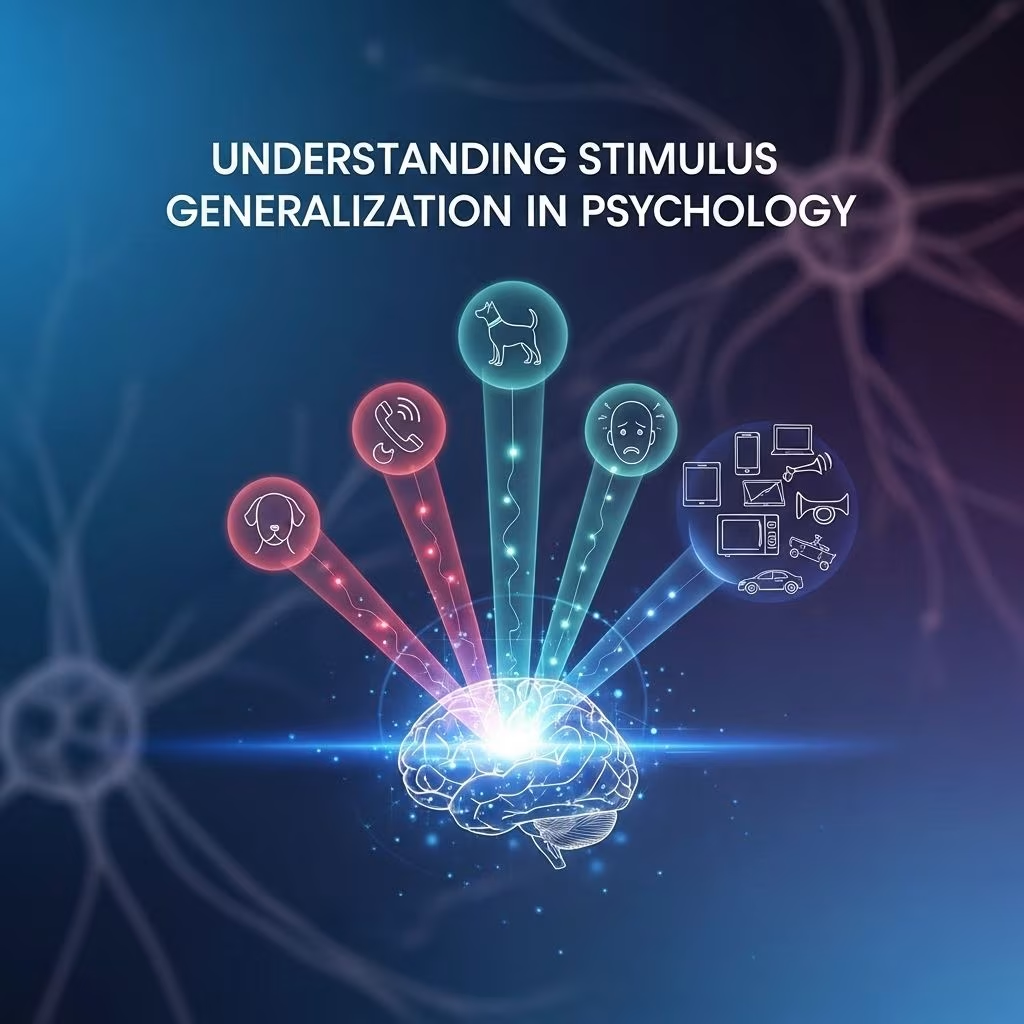
Stimulus generalization is a fundamental principle of behavioral psychology describing how a response learned for a specific stimulus can be triggered by other, similar stimuli. This concept highlights the way in which learning extends beyond the confines of its original context, enabling organisms to adapt quickly and efficiently to new situations that resemble previous experiences.
For example, a child who learns to be cautious around one breed of dog after being bitten may become wary of all dogs, or even other four-legged animals. This ability to respond to similar but not identical situations is crucial for everyday functioning, allowing responses to be broadly applied rather than requiring fresh learning for every slightly different scenario.
Historical Foundations and Psychological Background
The concept of generalization has its roots in the development of classical conditioning theory, initially explored by Ivan Pavlov in the early 20th century. Pavlov noted that dogs conditioned to salivate at the sound of a specific bell would also respond to bells with similar tones. This observation laid the theoretical groundwork for understanding how behaviors transfer between similar stimuli.
Behavioral psychologists have since extended this concept to operant conditioning and other domains, illustrating how generalization shapes behavior across a wide range of contexts—from phobias to social interactions and linguistics.
How Does Stimulus Generalization Work?
Stimulus generalization is observed when an organism produces a learned response not only to the original stimulus but also to new stimuli that are similar in some meaningful way. The degree of similarity required to elicit the response depends on the prior learning and context.
- Physical Similarity: The closer a new stimulus is to the original in terms of appearance, sound, or context, the more likely it is to evoke a generalization response.
- Conditioned Response: The emotional or behavioral reaction (such as fear, salivation, or vocalization) extends to the new, similar stimuli.
- Generalization Gradient: The strength of the response usually decreases as the similarity between the stimuli diminishes. This pattern is often illustrated as a generalization gradient—responses are strongest to stimuli most similar to the original and weaken as differences increase.
Examples of Stimulus Generalization
- Phobias and Fear: Someone bitten by a German Shepherd may develop a fear of all large dogs, or even small dogs, rather than just the original breed.
- Food Preferences: A person who enjoys a certain soda brand may find they also like other sodas with similar flavors or packaging.
- Language and Communication: Learning to say “hello” in therapy leads a child to greet others in various settings, not just the clinic.
- Academic Skills: A student who learns to solve a type of math problem in one format can apply the solution to problems presented differently but based on the same principle.
- Social Behaviors: Teaching a child to appropriately ask for help in one setting leads them to do so in other contexts, like home or at a playground.
Stimulus Generalization in Classical and Operant Conditioning
| Type of Conditioning | Description | Example |
|---|---|---|
| Classical Conditioning | A conditioned response is triggered not only by the learned stimulus, but also by new stimuli sharing similar features. | A dog trained to salivate at the sound of a bell may also salivate at similar chime sounds. |
| Operant Conditioning | A behavior reinforced in one situation occurs in other situations with similar cues or contexts. | A child rewarded for saying “please” to their teacher also says “please” to other adults or peers. |
Why Is Stimulus Generalization Important?
Stimulus generalization is essential for survival and efficiency. Without it, individuals would have to relearn behaviors in every new context, making adaptation slow and cumbersome. Generalization allows us to:
- Transfer skills and knowledge from one situation to similar settings.
- Quickly recognize and avoid potential threats (e.g., generalizing a learned fear to avoid similar dangers).
- Promote independence and functional living, particularly in therapeutic contexts where skills learned in therapy must apply in the real world.
- Select appropriate responses in novel situations, improving decision making and adaptability.
Stimulus Generalization vs. Stimulus Discrimination
While generalization fosters broad application of learning, discrimination is the process by which organisms learn to respond differently to stimuli that are distinct from the original cue. These concepts are complementary:
| Stimulus Generalization | Stimulus Discrimination |
|---|---|
| Responding similarly to a range of related stimuli. | Learning to distinguish between similar but different stimuli and responding only to the specific one. |
| “A child calls all four-legged animals ‘dog’.” | “The child learns to call only actual dogs ‘dog’, and cats ‘cat’.” |
| Promotes transfer of learning. | Promotes specificity and accuracy of response. |
Mechanisms and Measurement of Generalization
The most common way to measure stimulus generalization is to construct a generalization gradient—a visual representation showing responses to increasing variations of the conditioned stimulus. Typically:
- Responses are most vigorous to the original stimulus.
- As the new stimulus differs more from the original, the response weakens.
Peak shift is a related phenomenon, observed after discrimination training. Here, the strongest response may actually shift away from the original conditioned stimulus toward a more easily distinguishable variation.
Stimulus Generalization in Therapy and Applied Settings
Stimulus generalization is especially important in therapeutic settings, notably in Applied Behavior Analysis (ABA). In therapy, the ultimate goal is not just to teach a behavior in one context, but to ensure it occurs in many relevant situations outside the therapy environment. Key strategies include:
- Teaching with variety: Use multiple examples and situations during skill-training to promote generalization.
- Practicing in natural environments: Encourage application outside the clinic, such as at home, school, or in the community.
- Involving caregivers and peers: Engage others in the teaching process for broader skill practice.
- Gradually removing prompts: Fade support cues so individuals learn to respond independently.
For example, if a child learns to identify colors during structured therapy, efforts should be made to ensure they can name colors on objects in everyday settings—such as clothing, toys, and foods—instead of limiting their response to flashcards.
Practical Examples in ABA Therapy
- Communication Skills: Teaching a child to ask for help in therapy leads them to communicate needs at school or home.
- Self-care Routines: A behavior taught for brushing teeth in a clinic translates to independent brushing at home or on vacation.
- Social Interactions: Role-playing greeting behaviors in a session that are later applied with friends and family.
Benefits and Challenges of Stimulus Generalization
- Advantages:
- Simplifies adaptation across various contexts.
- Reduces the need for redundant training.
- Promotes flexible, creative use of learned skills.
- Challenges:
- Overgeneralization can lead to inappropriate responses (e.g., fearing all dogs after one negative experience).
- Failure to generalize limits the usefulness of learned behaviors in real life.
- Balancing generalization with discrimination is vital for effective learning.
Strategies to Promote Effective Generalization
- Use a wide range of teaching examples and materials.
- Rotate teaching settings and instructors to encourage response flexibility.
- Encourage practice in natural, real-world conditions.
- Reinforce generalized responses to maintain learning across settings.
- Monitor for overgeneralization and provide additional discrimination training as needed.
Frequently Asked Questions (FAQs)
What is the main difference between stimulus generalization and stimulus discrimination?
Stimulus generalization is the tendency to respond similarly to stimuli that are alike, while discrimination involves learning to respond differently to distinguishable stimuli.
Why is stimulus generalization important in behavioral therapy?
It ensures that skills acquired during therapy sessions are transferred to real-world situations, increasing the effectiveness and longevity of interventions.
Can stimulus generalization occur in both animals and humans?
Yes. The phenomenon is observed widely across species, from Pavlov’s dogs in classic experiments to human children learning social or academic skills.
What problems can arise from overgeneralization?
Overgeneralization may lead to inappropriate or exaggerated responses—such as unwarranted fears or incorrect labeling—requiring additional training to promote discrimination.
How can therapists promote better generalization of behaviors?
By varying teaching materials, practicing across environments, fading prompts, and providing opportunities to use new skills in real-life scenarios.
References
- https://www.ambitionsaba.com/resources/understanding-stimulus-generalization-in-therapy
- https://study.com/learn/lesson/stimulus-generalization.html
- https://www.magnetaba.com/blog/understanding-stimulus-generalization-in-therapy
- https://fiveable.me/key-terms/ap-psych/stimulus-generalization
- https://btexamreview.com/stimulus-generalization-and-response-generalization/
- https://www.adinaaba.com/post/stimulus-generalization-vs-response-generalization
- https://www.vocabulary.com/dictionary/stimulus%20generalization


