


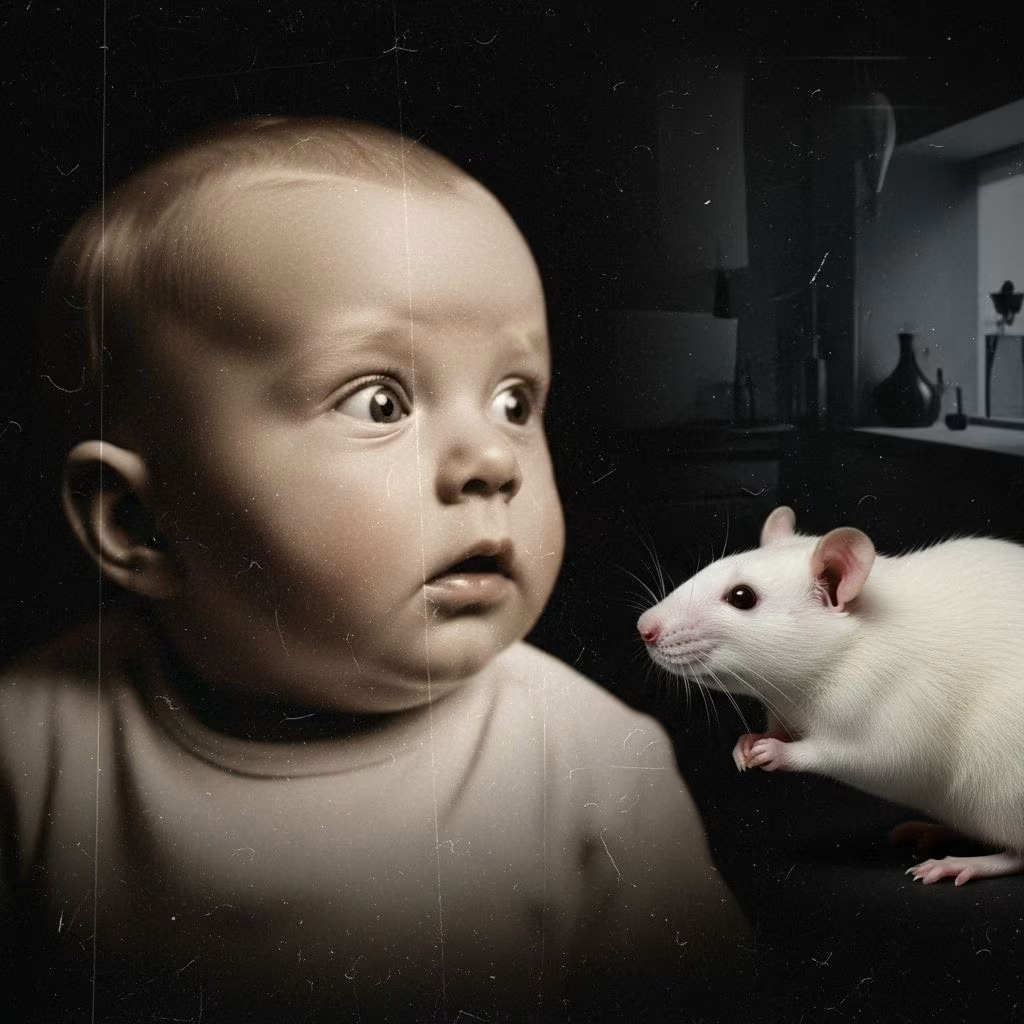
The Little Albert Experiment: Unraveling Human Fears Through Classical Conditioning
The Little Albert experiment spearheaded a transformation in psychological science, revealing how emotional responses such as fear can be learned by association. Conducted in the early 20th century by John B. Watson and Rosalie Rayner, this controversial study on a young child, later known as Little Albert, laid the foundation for behaviorism—one of psychology’s most influential schools of thought.
What Was the Little Albert Experiment?
The Little Albert experiment is a classic case of classical conditioning in humans, showing that emotional reactions, like fear, are not only innate but can also be shaped by environment and experience. The researchers set out to prove that it was possible to instill a fear of an originally neutral object through repeated associations with an unnerving stimulus.
- Date: 1920
- Researchers: John B. Watson and Rosalie Rayner
- Subject: Nine-month-old infant known as Albert B. (nicknamed Little Albert)
- Main Objective: Test if fear can be conditioned (learned) in a human child
- Theoretical Framework: Classical conditioning, originally explored by Ivan Pavlov in animals
Background: The Rise of Behaviorism
During the early 20th century, psychology was transitioning from introspection—studying inner thoughts and feelings—to focusing on observable behavior. John B. Watson, the father of behaviorism, believed that human behaviors could be trained and modified using external stimuli. With the Little Albert experiment, Watson sought to provide evidence that our emotional lives could be shaped in this objective, measurable way.
Who Were Watson and Rayner?
John B. Watson was a psychology professor noted for his work in learning and animal behavior. After earning his Ph.D., he promoted the idea that psychology should be as scientific and objective as other natural sciences, focusing solely on observable events. Rosalie Rayner, his graduate student, collaborated closely in conducting and documenting the Little Albert study.
- Watson’s influence: Established behaviorism as a dominant force in American psychology
- Rayner’s role: Assisted in experiment design, observation, and documentation
The Experiment: Step-by-Step
Initial Observations: Establishing Baseline Responses
At nine months, Little Albert was introduced to various stimuli—white rats, rabbits, monkeys, masks, and burning newspaper. He showed no fear of any of these items initially. The white rat, the central stimulus of the experiment, produced curiosity and play, not distress.
Conditioning Procedure: Pairing Rat With Loud Noise
To induce fear, Watson and Rayner paired the presence of the rat (neutral stimulus) with a loud, sudden noise (unconditioned stimulus). This noise—striking a steel bar with a hammer—naturally startled Albert, making him cry.
- Neutral stimulus: White rat (no prior fear response)
- Unconditioned stimulus (UCS): Loud bang (provoked fear naturally)
- Unconditioned response (UCR): Fear/crying in response to loud noise
- Conditioned stimulus (CS): White rat after repeated pairings with the noise
- Conditioned response (CR): Crying/fear upon seeing only the rat
The process involved several sessions:
- Albert was allowed to play with the rat—no fear observed
- Researchers created a loud bang directly behind him each time he reached for the rat
- After several repetitions, the sight of the rat alone caused Albert to withdraw and cry—even without the noise
Generalization of Fear: Beyond the Rat
Remarkably, Little Albert’s fear generalized to objects similar to the white rat. He began to display frightful reactions to:
- Other furry animals (rabbits, dogs)
- Fur coats
- Santa Claus masks (with white beard)
This finding suggested that once conditioned, a fear response could transfer to a broad range of related stimuli—a critical insight for understanding the formation of phobias.
Key Takeaways: What Did the Experiment Show?
- Emotional responses can be learned: The experiment demonstrated that emotion (like fear) is not always innate, but can be acquired through associative learning.
- Stimulus generalization: Learned fears may apply to similar objects, explaining the development and persistence of some phobias.
- Role of environmental influence: The findings underscored the power of experience and environment in shaping emotional development.
- Basis for behavior therapy: Understanding conditioned fear laid the groundwork for modern therapeutic techniques, such as exposure therapy for phobias.
Theoretical Implications: The Foundations of Behaviorism
The Little Albert experiment remains a cornerstone of behaviorism. Watson’s work, influenced by Pavlov, argued that psychology should study only observable, measurable behaviors, discarding introspective methods. He believed:
- All behaviors are the result of learning from environmental experiences
- Internal thoughts and feelings are irrelevant for scientific study
- Given the right stimuli, any behavior can be produced or extinguished
Watson’s bold claim, “Give me a dozen healthy infants…and I’ll guarantee to take any one at random and train him to become any type of specialist I might select,” reflects the strong environmentalist position that still provokes debate.
Ethical Criticisms and Controversy
The Little Albert experiment is as famous for its scientific contributions as for the profound ethical concerns it raised. Modern psychology regards it as a classic example of unethical research on vulnerable participants.
- No informed consent: Little Albert’s mother may not have been fully aware of the procedures or risks involved.
- Potential for long-term harm: The child was deliberately distressed and left the study with new fears—a violation of safeguarding principles.
- Lack of deconditioning: Researchers did not attempt to remove the conditioned fears after the experiment, leaving possible lasting effects on Albert’s well-being.
These concerns led to major changes in research ethics, including requirements for informed consent, the right to withdraw, and minimal harm to participants, especially vulnerable populations like children.
Legacy: Impact on Modern Research Ethics
- Sparked the creation of institutional review boards (IRBs) to protect research participants
- Introduced strict standards for working with children and non-consenting individuals
- Helped define boundaries for ethical psychological study
Identity of Little Albert: What Happened to Him?
For decades, the true identity and later life of “Little Albert” was unknown. Extensive investigation by psychologists and historians eventually identified him as Douglas Merritte. Tragically, Douglas died at age six from complications related to hydrocephalus, and there is no definitive record of whether his conditioned fears persisted.
Real-World Applications and Lasting Influence
Despite the ethical quandaries, the experiment’s findings have influenced numerous fields:
- Understanding phobias: Demonstrates how irrational fears may originate from a single traumatic event or conditioned experience.
- Behavioral therapy: Inspired methods such as systematic desensitization and exposure therapy for treating anxiety and phobias.
- Advertising: Showed how emotional responses can be conditioned, which Watson later leveraged in his advertising career.
- Parenting and education: Highlighted the importance of childhood environment in emotional and behavioral development.
Classical Conditioning: Explaining the Process
| Term | Definition | Application in Little Albert |
|---|---|---|
| Neutral Stimulus (NS) | Does not trigger a specific response initially | White rat |
| Unconditioned Stimulus (UCS) | Automatically triggers a response | Loud noise |
| Unconditioned Response (UCR) | Natural/reflexive response to UCS | Fear/crying |
| Conditioned Stimulus (CS) | Was neutral, now triggers response after pairing with UCS | White rat (after pairing) |
| Conditioned Response (CR) | Learned response to CS alone | Fear/crying at sight of rat |
Frequently Asked Questions (FAQs)
Q: What was the main goal of the Little Albert experiment?
A: To demonstrate that fear could be classically conditioned in a human child by repeatedly pairing a neutral stimulus (white rat) with an unconditioned stimulus (loud noise), producing a conditioned fear response.
Q: How did the experiment demonstrate stimulus generalization?
A: Little Albert’s conditioned fear response to the white rat extended to other similar, furry objects such as rabbits and fur coats, providing evidence that conditioned responses can generalize to similar stimuli.
Q: What are the ethical problems with this experiment?
A: The main ethical issues were the deliberate induction of fear in a young child without adequate consent, lack of procedures to remove the conditioned fear after the study, and the risk of possible long-term psychological harm.
Q: What impact did the Little Albert experiment have on psychology?
A: It provided strong evidence for the behaviorist perspective, shaped research on emotion and learning, and played a crucial role in developing both ethical standards for psychological testing and behavioral therapies still in use today.
Q: Was the conditioned fear ever removed from Little Albert?
A: There is no record that Watson and Rayner attempted to decondition Albert’s fears, leading to ongoing debate about the child’s subsequent well-being.
Summary and Legacy
The Little Albert experiment stands as a pivotal moment in psychology. It revealed that human fears could be learned and generalized through classical conditioning. Despite major ethical failings, the study’s core findings reshaped the landscape of psychological science. Today, it reminds us of both the opportunities and responsibilities inherent in psychological research—urging us to value both knowledge and the welfare of those who participate in our quest to understand the human mind.
References
- https://achology.com/general-interest/conditioning-fear-insights-from-the-little-albert-experiment/
- https://www.goodtherapy.org/blog/psychpedia/little-albert-experiment
- https://study.com/learn/lesson/little-albert-experiment-summary.html
- https://www.simplypsychology.org/little-albert.html
- https://en.wikipedia.org/wiki/Little_Albert_experiment
- https://www.apa.org/monitor/2010/01/little-albert
- https://www.youtube.com/watch?v=jpD9bxd76NA


