


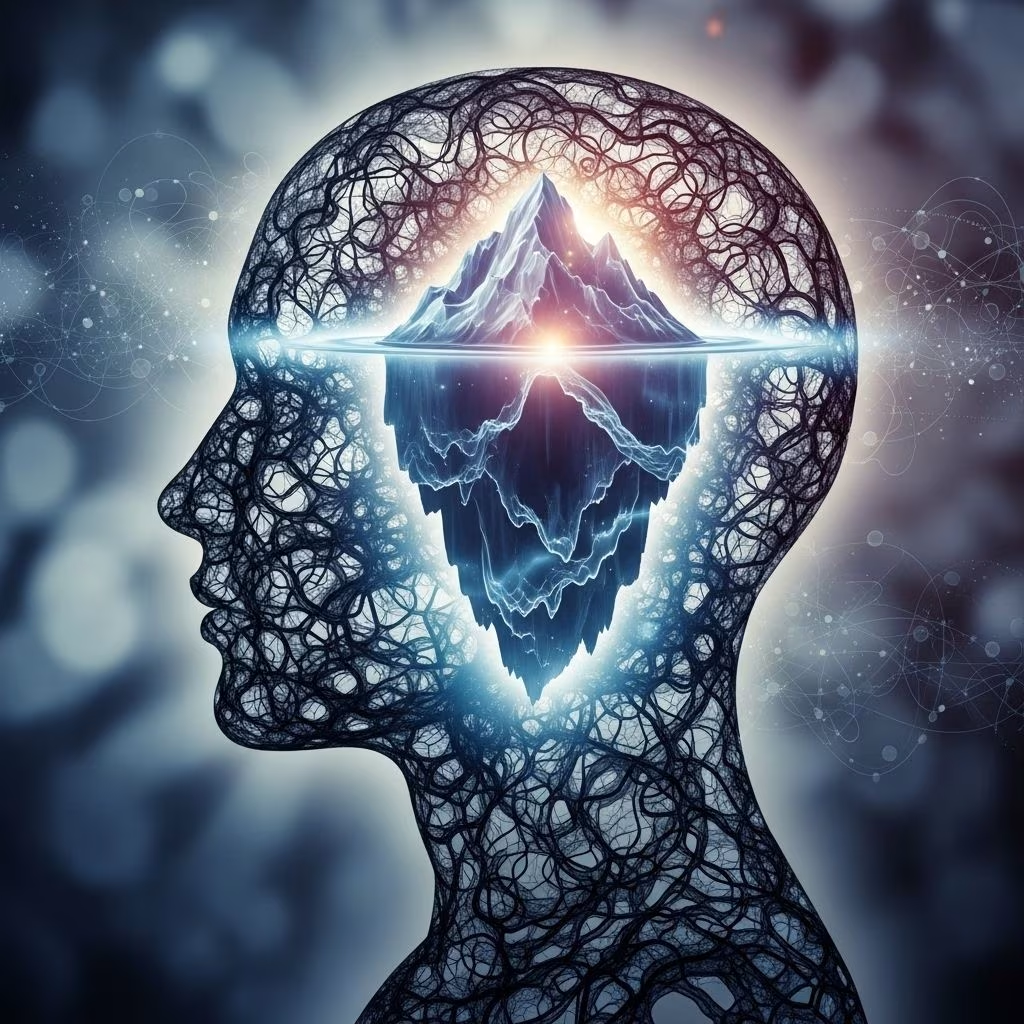
The unconscious mind has captivated psychologists, philosophers, and laypersons alike for centuries. Often described as the mental terrain lying beneath conscious awareness, the unconscious guides much of our thinking, feeling, and behaving—frequently beyond our control or even our recognition. From Sigmund Freud’s seminal theories to contemporary debates, the unconscious remains both an essential and enigmatic aspect of human psychology.
What Is the Unconscious Mind?
The unconscious mind refers to the mental processes, desires, memories, and emotions that exist outside of conscious awareness, yet continue to influence our thoughts and actions substantially. Largely inaccessible through introspection, it operates behind the scenes, shaping behaviors and even physical symptoms in ways individuals may never realize. While consciousness involves active, deliberate thought, the unconscious involves automatic, hidden processes that can include:
- Forgotten memories
- Repressed desires
- Primitive instincts
- Implicit knowledge and biases
These elements are typically barred from conscious recognition through various mental mechanisms, most notably repression. According to Freud, the unconscious plays a far greater role in governing our behaviors than we might suspect, acting as a repository for feelings and impulses too anxiety-provoking or threatening to enter awareness.
The History and Development of the Unconscious Mind
While some aspects of unconscious processing have always existed within philosophy and literature, it was the work of Sigmund Freud in the late 19th and early 20th century that brought the idea of the unconscious into mainstream psychology. Freud viewed the mind as having different “territories” or regions, each holding specific functions and characteristics.
Freud’s Topographical Model
- Conscious: Thoughts and perceptions currently within our awareness.
- Preconscious: Material not presently in awareness but accessible upon reflection.
- Unconscious: Material actively barred from awareness, typically by the process of repression.
Freud developed tools like free association, dream analysis, and examination of slips of the tongue (“Freudian slips”) to uncover unconscious content in his patients.
Freud’s Structural Model: Id, Ego, and Superego
Freud later expanded his theory through the “structural model,” which divides the mind into three parts:
| Structure | Description | Role in the Unconscious |
|---|---|---|
| Id | Primitive, instinctual drives for pleasure and survival. | Entirely unconscious; operates on the pleasure principle. |
| Ego | Rational, mediating part balancing id and superego. | Mostly conscious, but has unconscious elements. |
| Superego | Internalized morals and societal rules. | Spans conscious, preconscious, and unconscious. |
Manifestations of the Unconscious Mind
The unconscious reveals its influence in subtle and sometimes dramatic ways. Freud argued that various psychological symptoms, behaviors, and even physical ailments could have unconscious roots. Examples include:
- Dreams: Often symbolic, they can express unconscious desires or conflicts.
- Freudian slips: Mistakes in speech that reveal hidden feelings or thoughts. For example, saying “the member from Hell” instead of “Hull” during irritation.
- Neurotic symptoms: Anxiety or hysteria can arise from unresolved unconscious conflicts.
- Defense mechanisms: Strategies like repression, denial, and projection to keep disturbing unconscious content from surfacing.
The Unconscious in Modern Psychology
Although Freud’s ideas remain influential, modern research offers a more nuanced picture. Cognitive psychology, social cognition, and neuroscience have contributed to understanding the unconscious as a complex, action-driven system—not merely a “shadow” of consciousness. Contemporary views suggest:
- The unconscious mind is flexible, capable of guiding behavior independently.
- Unconscious processes can be sophisticated, extracting meaning from stimuli beyond awareness.
- Unconscious action often precedes conscious reflection, suggesting its role in primary decision-making.
Despite advances, scientific controversies abound. Some researchers equate unconscious processing with subliminal perception and argue its powers are minimal. Others maintain that unconscious mechanisms are robust, impacting daily life profoundly.
How Does the Unconscious Affect Our Lives?
The unconscious continually shapes our experiences in a variety of ways:
- Implicit biases: Prejudices or preferences formed unconsciously, influencing choices without deliberate awareness.
- Automatic behaviors: Actions performed routinely, such as driving or typing, without conscious thought.
- Emotional reactions: Knee-jerk responses and gut feelings can have unconscious origins.
- Creativity and problem-solving: Sudden insights or “aha moments” often arise from the unconscious processing of information.
Defense Mechanisms: Protecting the Conscious Mind
Defense mechanisms are unconscious processes that protect individuals from uncomfortable thoughts or emotions. Common mechanisms include:
- Repression: Pushing distressing memories or feelings out of conscious awareness.
- Denial: Refusing to accept reality to avoid emotional pain.
- Projection: Attributing one’s own undesirable feelings to others.
- Displacement: Shifting emotional responses from their original source to a safer substitute.
These mechanisms are essential for psychological well-being, but can lead to unhealthy behaviors when overused.
Evidence and Critique
Freud’s concept of the unconscious faced criticism over the years. Skeptics argued that his models relied too much on subjective interpretation and lacked empirical rigor. However, other approaches—such as the study of implicit learning and automatic processing—increasingly support the existence of mental operations outside awareness.
Key points in the debate include:
- Is the unconscious “dumb,” as some cognitive psychologists suggest, or is it complex and purposeful?
- Can the unconscious truly be accessed and interpreted through dreams and slips, or are these phenomena overinterpreted?
- How do unconscious processes relate to phenomena like hypnosis, trances, and subliminal messaging?
Common Misconceptions About the Unconscious Mind
- The unconscious is not simply “inactive.” It actively contributes to decision-making, learning, and perception.
- Not every unconscious process is pathological—many are essential to daily functioning and survival.
- Unconscious does not mean “uncontrollable”—with awareness and therapeutic tools, some unconscious patterns can be changed.
Frequently Asked Questions (FAQs)
Q: What is the main difference between unconscious and subconscious?
A: The unconscious refers to mental processes and material that are completely inaccessible to conscious awareness, often due to repression. The subconscious, on the other hand, contains information that can become conscious with effort or the right cue.
Q: Can people access their unconscious thoughts?
A: Direct access is rarely possible, but the unconscious often shows itself through dreams, Freudian slips, art, and associations explored in therapy.
Q: Does everyone have an unconscious mind?
A: Yes, virtually all theories of psychology agree that unconscious processes are a fundamental part of mental life, even if the definition and mechanisms vary.
Q: Is the unconscious mind always negative?
A: No, while it can contain disturbing or anxiety-provoking materials, the unconscious also stores learned skills, positive emotional responses, and creativity.
Q: Can unconscious motives be changed?
A: Therapy and self-awareness can bring some unconscious motives to light, allowing for change in behavior and emotional responses over time.
Key Takeaways
- The unconscious mind is a powerful, complex region of the psyche driving behavior, feelings, and thought outside conscious awareness.
- Freud’s psychoanalytic theory highlights its role in neurotic symptoms, dreams, and defense mechanisms, while modern psychology expands its definition and mechanisms.
- Despite controversies, ongoing research underscores the unconscious as central to understanding why we act and feel as we do.
References
- Unconscious mind – Wikipedia
- Simply Psychology: Freud’s Theory of the Unconscious Mind
- Fiveable: Unconscious Mind
- PMC: The Unconscious Mind
- Psychology Today: Unconscious
- Cambridge Dictionary: Unconscious Mind
- Study.com: Freud & the Unconscious Mind
References
- https://en.wikipedia.org/wiki/Unconscious_mind
- https://www.simplypsychology.org/unconscious-mind.html
- https://fiveable.me/key-terms/ap-psych/unconscious-mind
- https://pmc.ncbi.nlm.nih.gov/articles/PMC2440575/
- https://www.psychologytoday.com/us/basics/unconscious
- https://dictionary.cambridge.org/us/dictionary/english/unconscious-mind
- https://study.com/learn/lesson/video/unconscious-mind-psychology.html


