The remarkable abilities of dogs have been harnessed by humans for centuries, but few applications are as specialized and crucial as cadaver detection. These extraordinary canines, also known as human remains detection (HRD) dogs, possess the unique capability to locate deceased individuals in various environments and conditions. Their work plays an essential role in criminal investigations, disaster response, search and rescue operations, and bringing closure to families of missing persons.
The Science Behind Canine Scent Detection
Dogs possess an olfactory system that is fundamentally different from humans, making them ideal candidates for detection work. While humans have approximately 5 million olfactory receptors in their noses, dogs have between 125 million to 300 million, depending on the breed. This biological advantage allows them to detect scents at concentrations nearly 100,000 times lower than what humans can perceive.
The canine nose is designed specifically for scent detection. When a dog inhales, air flows into two separate pathways: one for breathing and another dedicated entirely to scent analysis. This specialized anatomy allows dogs to continuously sample odors even while exhaling, creating an uninterrupted flow of scent information to their brain. The olfactory bulb in a dog’s brain, which processes smell information, is proportionally 40 times larger than in humans, enabling them to distinguish between complex scent mixtures and identify specific target odors.
Different dog breeds demonstrate varying levels of olfactory capability based on the number of olfactory receptors and single nucleotide polymorphisms (SNPs) in their genomes. Research into the genetics of canine olfaction has revealed that olfactory receptor genes play a crucial role in scent identification, with certain breeds showing enhanced detection capabilities due to their genetic makeup.
Understanding Decomposition Odor
When training cadaver dogs, handlers focus on teaching the animals to recognize the specific chemical compounds released during human decomposition. The decomposition process produces hundreds of volatile organic compounds (VOCs), but two chemicals in particular serve as primary training targets: cadaverine and putrescine. These diamines are produced as proteins break down during the early stages of decomposition and create the distinctive odor associated with death.
Using cadaverine and putrescine as foundational scent markers, pioneering trainers like Andy Rebmann developed methods to teach dogs to recognize the complete scent profile of human remains. Rebmann trained his first body dog, Rufus, to distinguish the scent of death from all other environmental odors, establishing protocols that would become standard practice in the field.
The complexity of cadaver detection work requires dogs to recognize human remains in various states of decomposition, from fresh remains to skeletal material that may be decades or even centuries old. This means training must encompass exposure to a wide spectrum of decomposition odors, including whole bodies, tissue fragments, bone, blood, and even microscopic particles.
The Training Process for Cadaver Dogs
Training a cadaver dog is an intensive, time-consuming process that requires countless hours of investment and specialized knowledge. The journey typically begins with careful selection of appropriate candidates, as not every dog possesses the temperament, drive, and focus necessary for this demanding work.
Selection and Foundation Skills
Before any scent training begins, prospective cadaver dogs must undergo rigorous evaluation to assess their suitability for the work. Trainers look for dogs with high prey drive, strong motivation, confidence in various environments, and the ability to maintain focus despite distractions. Environmental stability is one of the most critical foundation skills—the dog must be virtually “bulletproof” when it comes to working comfortably in challenging operational environments.
Foundation training includes confidence-building exercises, obedience work both on and off leash, agility training to navigate difficult terrain, exposure to various surfaces and footing, acclimation to loud noises and chaotic environments, and nighttime training sessions. These skills ensure that when the dog is deployed in an actual search scenario, environmental factors won’t interfere with its ability to focus on scent detection.
Scent Imprinting and Recognition
Once foundation skills are solid, trainers begin the process of imprinting dogs to target odors. This involves systematic exposure to human decomposition scent over an extended period, allowing the dog to learn to recognize and distinguish this specific odor from all others in the environment. The nature of cadaver work presents unique challenges in the training process, as obtaining appropriate training aids is considerably more complex than in other detection disciplines.
Training programs have shifted significantly from aversive methods to positive reinforcement approaches, which research has shown to be more effective in developing reliable detection dogs. Modern training emphasizes rewarding the dog for correct responses rather than punishing mistakes, creating enthusiastic, confident working dogs with strong motivation to search.
Dogs are exposed to training aids that represent the full spectrum of human decomposition, including synthetic training aids that replicate decomposition chemistry, actual human tissue samples obtained through legal channels and medical donation programs, whole body donations at forensic research facilities, aged skeletal material, blood and fluid samples, and burned tissue to prepare for fire-related scenarios.
Developing the Trained Final Response
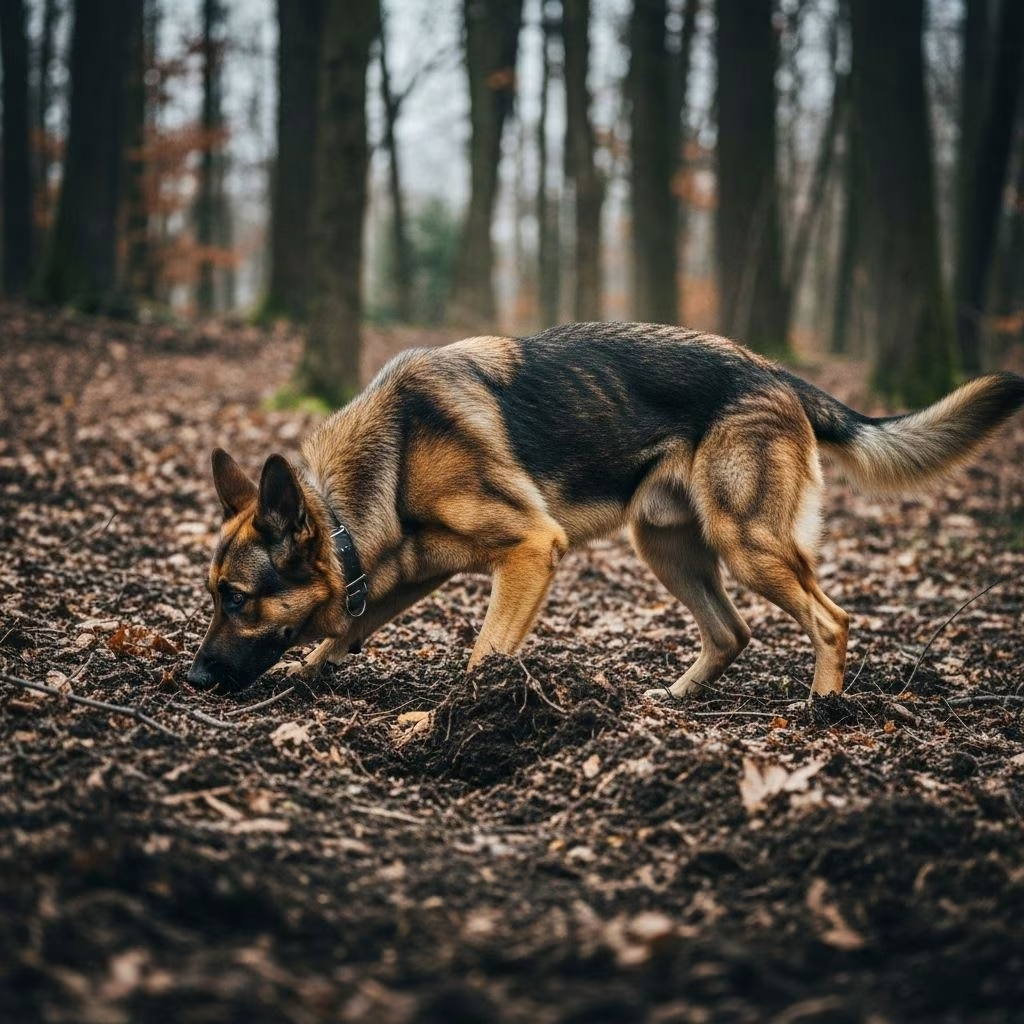
A critical component of cadaver dog training is establishing a clear trained final response (TFR)—the specific behavior the dog performs when it locates the target odor. The operational environment plays a significant role in determining what type of alert is most appropriate. Most land-based cadaver dogs are trained to provide an active alert, such as barking, scratching, or a combination of both at the source of the odor. This clear indication allows handlers to pinpoint the location with precision.
For water search dogs, passive alerts such as sitting or lying down are often more practical, as the dog typically works from a boat and needs to remain stable and balanced. The handler must be able to read subtle changes in the dog’s body language and behavior that indicate scent detection, even before the dog provides its final trained response.
Operational Deployment of Cadaver Dogs
Human remains detection dogs can be deployed in numerous scenarios where individuals are presumed deceased. Their unique capabilities make them invaluable tools across various fields and situations.
Disaster Response and Mass Casualty Events
In the aftermath of natural disasters such as earthquakes, hurricanes, or tornados, cadaver dogs help locate victims buried under rubble from collapsed buildings. Similarly, following terrorist attacks or industrial accidents, these dogs work tirelessly to find remains and help with victim identification and recovery efforts. Their ability to cover large areas quickly and detect remains under significant debris makes them essential assets in these tragic circumstances.
Criminal Investigations
Law enforcement agencies regularly utilize cadaver dogs in homicide investigations where remains may have been concealed or disposed of in remote locations. Dogs can search vast outdoor areas, buildings, vehicles, and even waterways to locate evidence. Their alerts can establish probable cause for more intensive forensic investigation of specific locations, potentially providing critical evidence in criminal prosecutions.
Search and Rescue Transitions
When missing person cases extend over significant time periods, or when live-find search and rescue dogs have been unsuccessful in locating an individual, the operation may transition to recovery mode. Cadaver dogs then take over to search areas where the missing person may have succumbed to environmental conditions, injury, or medical emergencies. This transition, while difficult emotionally, is important for providing families with answers and closure.
Water Search Operations
Specially trained water cadaver dogs work from boats to detect remains submerged in lakes, rivers, ponds, and other bodies of water. These dogs detect scent particles that rise through the water column and reach the surface, alerting to the location below. This specialized discipline requires additional training for both dog and handler in marine environments and safety protocols.
Historical and Archaeological Applications
Beyond modern search scenarios, cadaver dogs have proven valuable in archaeological investigations and locating historic graves. They can detect skeletal remains that may be decades or centuries old, helping researchers, historians, and communities locate and document burial sites. This application has been particularly important in locating unmarked graves and forgotten cemeteries.
Accuracy and Reliability in the Field
The effectiveness of cadaver dogs as forensic tools has been demonstrated through numerous studies and real-world deployments. Research indicates that properly trained HRD dogs offer several distinct advantages in locating human remains: exceptional accuracy in discriminating human decomposition odor from animal remains and other organic material, remarkable speed in covering large search areas compared to manual search methods, thoroughness in detecting even minute quantities of remains or tissue fragments, and versatility in working across diverse terrains and environmental conditions.
Studies have shown that cadaver dogs can detect human remains buried at significant depths, locate remains underwater, and identify microscopic quantities of decomposition odor. Their accuracy rates in controlled studies consistently exceed 90% when dogs are properly trained and certified, handlers are experienced and skilled in reading their dogs, and environmental conditions are favorable for scent detection.
However, several factors can affect cadaver dog performance in the field. Weather conditions, particularly wind, temperature, and humidity, significantly impact scent dispersal and detection. Terrain complexity, vegetation density, and ground cover can make searches more challenging. The age and condition of remains affect the strength and characteristics of detectable odor. Handler skill in reading subtle behavioral changes and managing the search strategy is crucial, and the dog’s physical condition, focus, and motivation level all play important roles.
Best Practices and Considerations
Professional organizations and forensic experts have established guidelines for utilizing cadaver dog teams effectively in operational scenarios. These best practices help ensure reliable results and proper documentation of findings.
Teams should be routinely trained on a wide spectrum of human decomposition odor to maintain their skills and reliability. Handlers must provide detailed reports and maps documenting all areas of interest, including locations where the dog showed behavioral changes, areas where trained final responses occurred, and regions that were cleared during the search. This documentation proves essential for follow-up investigation and potential legal proceedings.
Multiple dog teams are often deployed in critical searches to provide independent verification of alerts. When one dog indicates a location, having a second team confirm the finding increases confidence in the result. This redundancy has become standard practice in many high-profile investigations and disaster response operations.
Continuing education and certification programs ensure that both dogs and handlers maintain proficiency throughout their careers. Organizations like the Scientific Working Group on Dog and Orthogonal detector Guidelines (SWGDOG) have established training recommendations and standards for substance detector dogs, including those trained in human remains detection for both land and water environments.
Challenges and Limitations
Despite their remarkable capabilities, cadaver dogs and their handlers face several challenges in operational deployments. Understanding these limitations is important for setting appropriate expectations and interpreting results correctly.
False alerts can occur due to environmental contamination, animal remains in advanced decomposition, handler cuing (unconscious signals from the handler influencing the dog), or high-stress environments affecting the dog’s behavior. While properly trained dogs maintain high accuracy rates, no detection method is infallible, and alerts must be confirmed through additional investigative methods.
The emotional toll on handlers should not be underestimated. Working repeatedly with human remains and in tragic circumstances requires significant mental resilience and access to support resources. Many cadaver dog handlers work as volunteers in addition to their regular careers, dedicating personal time and resources to training and operational deployments.
Legal and ethical considerations surrounding the use of cadaver dogs in criminal investigations continue to evolve. Courts have generally accepted cadaver dog alerts as probable cause for further investigation, but the admissibility of such evidence varies by jurisdiction and circumstances. Proper documentation, handler credentials, and dog certification records prove essential when findings may be challenged in legal proceedings.
The Future of Cadaver Detection
Ongoing research continues to enhance our understanding of canine olfaction and improve training methodologies. Scientists are working to identify the complete chemical profile of human decomposition at various stages, which could lead to more effective training aids and improved detector dog performance. Advances in understanding canine cognition and learning theory inform more effective training approaches that reduce training time while improving reliability.
The establishment of forensic research facilities, such as the Forensic Osteology Research Station (FOREST) at Western Carolina University, provides controlled environments where cadaver dog teams can train with actual human remains under professional supervision. These facilities offer invaluable opportunities for handlers to expose their dogs to full decomposing bodies and various decomposition stages, significantly enhancing training realism and effectiveness.
Collaborative efforts between forensic anthropologists, canine behavior scientists, law enforcement agencies, and professional dog trainers continue to refine best practices and advance the field. Multi-level training programs, such as the tiered certification system implemented at Western Carolina University, provide progressive skill development opportunities for handlers at different experience levels.
Frequently Asked Questions
Q: How long does it take to train a cadaver dog?
A: Training a cadaver dog typically requires 12 to 18 months of intensive work before the dog is ready for operational deployment. However, training is an ongoing process throughout the dog’s working career, with regular practice sessions and continuing education to maintain proficiency and reliability.
Q: Can cadaver dogs distinguish between human and animal remains?
A: Yes, properly trained cadaver dogs can discriminate between human and animal decomposition odor. The chemical profiles of decomposition differ between species, and dogs are specifically imprinted on human decomposition scent during training, allowing them to ignore animal remains during searches.
Q: What breeds make the best cadaver dogs?
A: While various breeds can be trained for cadaver detection, common choices include German Shepherds, Belgian Malinois, Labrador Retrievers, Golden Retrievers, and Border Collies. The individual dog’s temperament, drive, and trainability matter more than breed alone. Mixed breed dogs can also excel in this work when they possess the necessary characteristics.
Q: How old can remains be and still be detected by cadaver dogs?
A: Cadaver dogs have successfully located skeletal remains that are decades or even centuries old. While older remains produce weaker odor signatures, well-trained dogs can still detect the residual scent markers present in aged bone and surrounding soil contamination from decomposition.
Q: Are cadaver dog alerts admissible in court?
A: Cadaver dog alerts are generally accepted as probable cause for further investigation and search warrants. The admissibility of such evidence in court varies by jurisdiction and depends on factors including the dog’s training records, certification status, handler qualifications, and proper documentation of the search. Courts typically view cadaver dog alerts as investigative tools rather than definitive proof.
Q: How deep underground can cadaver dogs detect remains?
A: Cadaver dogs have detected remains buried several feet underground, with documented alerts on remains 12 to 15 feet deep in favorable conditions. Factors affecting detection depth include soil composition, moisture content, time since burial, air permeability of the soil, and environmental conditions at the time of the search.
References
- https://scholarworks.sjsu.edu/cgi/viewcontent.cgi?article=1124&context=themis
- https://blackhillsk9.com/cadaver-dogs-guide/
- https://www.wcu.edu/WebFiles/PDFs/Users_Guide_To_Cadaver_Dogs_Paul_Martin.pdf
- https://www.akc.org/expert-advice/family-dog/cadaver-dogs-how-canine-noses-help-find-dead-bodies/
- https://www.criminaljustice.ny.gov/missing/findthem/docs/Types%20of%20Search%20Dogs.pdf
- https://progressivecanines.com/cadaver-detection-dog-training/