The Miniature American Shepherd represents one of the most fascinating success stories in modern dog breeding. What began as a quest to develop smaller working shepherds in California during the late 1960s evolved into a distinct breed that captured the hearts of dog enthusiasts across North America. This compact herding dog, standing under 18 inches tall, combines the intelligence, versatility, and work ethic of larger shepherds in a more manageable package, making it ideal for both ranch work and family companionship.
The journey to official recognition was neither straightforward nor simple. It involved decades of dedicated breeding, the formation and reformation of multiple breed clubs, negotiations with major kennel organizations, and even a controversial name change that continues to spark debate within the breeding community. Understanding this history provides crucial insights into the breed’s characteristics, purpose, and the passionate community that advocated for its recognition.
The Origins: California’s Small Shepherds
The Miniature American Shepherd’s story begins in California during the late 1960s, when breeders started working with small, unregistered dogs that were believed to be Australian Shepherds. These foundation animals were carefully selected for their diminutive size while maintaining the active character, intelligence, and herding instincts that made their larger counterparts so valuable to ranchers and farmers. The breeders’ vision was clear: create a dog that possessed all the working ability of a full-sized Australian Shepherd but in a more compact, easily transportable form.
By the mid-1970s, these breeding programs had achieved remarkable success, and the breed had reached its current desired size range. The dogs proved themselves capable workers despite their smaller stature, demonstrating that herding ability wasn’t necessarily correlated with size. Ranchers appreciated having dogs that could ride in truck cabs, accompany them to livestock shows, and serve as house companions while still performing serious work when needed.
The genetic foundation of these early Miniature American Shepherds combined what was described as two-thirds old Travis lines with one-third Australian Shepherd lines. This careful linebreeding helped establish consistent type, temperament, and working ability while maintaining the smaller size that distinguished these dogs from their full-sized relatives.
Early Recognition and Registry Development
The first significant milestone in the breed’s formal recognition came in 1980 when the National Stock Dog Registry (NSDR) began registering these small shepherds. At this time, they were known as Miniature Australian Shepherds, a name that seemed natural given their heritage and appearance. The NSDR provided the breed with legitimacy and a paper trail documenting pedigrees, which would prove essential for future recognition efforts.
During the late 1980s and early 1990s, the Miniature Australian Shepherd gained significant popularity across the United States. Owners and breeders showcased their dogs with various rare-breed organizations, including the Rare Breed Kennel Club of Southern California (RBKC), where they competed in conformation shows beginning around 1989-1990. These venues provided important opportunities for breeders to evaluate their stock against a standard and for the public to become acquainted with the breed.
The breed’s growing popularity created a need for more organized support and promotion. Breeders and owners recognized that without a dedicated parent club, the Miniature Australian Shepherd lacked the cohesive structure necessary to guide its development and protect its interests within the broader dog fancy.
Founding the First Parent Breed Club
In 1990, a group of dedicated enthusiasts took the crucial step of forming the Miniature Australian Shepherd Club of the USA, known by its acronym MASCUSA. The founding board of directors included Kathy Croswhite (later Croswhite-Munson), Jeanine Perron, Florence Toombs, Susan Sinclair, and Richard VanBurkleo. These pioneers understood that establishing a formal organization was essential for gaining broader recognition and ensuring the breed’s future.
Croswhite-Munson played a particularly important role in the club’s formation. Having acquired her foundation stock—a 15-inch-tall Mini from two-thirds old Travis lines and one-third Australian Shepherd lines—in the 1980s, she recognized the need to promote small Aussies under 18 inches tall while maintaining the integrity and credibility of the Australian Shepherd heritage. She recruited as many Australian Shepherd breeders as possible to lend legitimacy to the effort and asked her friend Jeanine Perron at a horse show to help establish the breed club.
MASCUSA was formally incorporated in 1993, solidifying its legal standing. One of the organization’s most notable early achievements was gaining recognition from the American Rare Breed Association (ARBA), which provided a nationally recognized conformation show venue. This recognition represented a significant step forward, giving Miniature Australian Shepherd owners access to structured competition and evaluation.
The Name Change Controversy
The path to major kennel club recognition proved far more complicated than the breed’s founders might have anticipated. In 1993, the same year MASCUSA was incorporated, the American Kennel Club officially recognized the Australian Shepherd. This development created an unexpected obstacle for the Miniature Australian Shepherd community.
The AKC had a longstanding policy of not accepting size varieties of already established breeds. Since the Australian Shepherd was now an AKC-recognized breed, and because the United States Australian Shepherd Association (USASA)—the AKC parent breed club for Australian Shepherds—did not wish to recognize the Miniature Australian Shepherd as a legitimate size variety, the Mini Aussie faced significant roadblocks to AKC recognition.
In 1993, the AKC asked MASCUSA to change its name because “Miniature Australian Shepherds” could no longer participate under their chosen name as it was deemed too similar to that of an AKC-affiliated breed. Consequently, the Miniature Australian Shepherd was temporarily renamed the North American Shepherd, and MASCUSA became the North American Miniature Australian Shepherd Club of America (NAMASCUSA).
This period, spanning the next 15 years, saw numerous clubs formed, reorganized, and sometimes disbanded as the community struggled to reach consensus about the emerging breed’s direction. The Miniature Australian Shepherd Club of America (MASCA) was established as a second registry for Mini Aussies and remains currently active, though it no longer accepts dogs registered as Miniature American Shepherds with the AKC. The community remained divided over how best to proceed and what sacrifices, if any, were acceptable to achieve major registry recognition.
The Path to AKC Recognition
Eventually, enough members of NAMASCUSA became interested in obtaining separate AKC recognition, prompting them to approach the American Kennel Club directly. What followed were complex negotiations involving three parties: NAMASCUSA, the AKC, and USASA. These discussions ultimately produced a compromise that allowed the breed to enter the AKC while addressing the concerns of all stakeholders.
The agreement reached between these organizations established that the Miniature Australian Shepherd would enter the AKC under a new breed name: Miniature American Shepherd. NAMASCUSA, reorganized once again as MASCUSA (Miniature American Shepherd Club of the USA), would serve as the parent breed club within the AKC structure. This name change was designed to differentiate the breed from the Australian Shepherd while acknowledging its American development.
In May 2011, the breed was accepted into the AKC Foundation Stock Service (FSS) program under its new designation. The first Miniature American Shepherds were registered into the AKC FSS program in June 2011. Importantly, these were the same dogs with the same pedigrees that had previously been registered as Miniature Australian Shepherds through various other registries, including NSDR, ASDR, MASCA, NAMASCUSA, and IMASC.
To facilitate the transition, the AKC allowed AKC-registered Australian Shepherds to transfer over to the Miniature American Shepherd registry for a period of three years, provided their owners felt they were better served by the new classification. This provision helped expand the gene pool and provided options for owners of smaller Australian Shepherds.
Full AKC Recognition and Beyond
After four years in the Foundation Stock Service, the Miniature American Shepherd achieved a historic milestone. On July 1, 2015, the breed moved into the AKC Breed Register under the Herding Group, becoming the AKC’s 186th recognized breed. This full recognition meant that Miniature American Shepherds could now compete at AKC conformation shows, earn championships, and participate in all AKC events on equal footing with other recognized breeds.
The Miniature American Shepherd Club of the USA became the official AKC Parent Club for the breed, taking on responsibility for maintaining the breed standard, promoting responsible breeding practices, and organizing specialty shows and events. Doris Keller-Ross served as club president during this crucial transition period.
The breed standard for the Miniature American Shepherd incorporated a few changes from the Australian Shepherd breed standard, reflecting the unique characteristics and requirements of the smaller dog. These modifications ensured that judges and breeders had clear guidelines specific to the Miniature American Shepherd rather than simply evaluating them as smaller versions of Australian Shepherds.
International recognition followed relatively quickly. In September 2019, the Fédération Cynologique Internationale (FCI), the world’s largest international federation of kennel clubs, also recognized the Miniature American Shepherd. This recognition opened doors for the breed in countries around the world and validated its status as a distinct breed on the global stage.
The Ongoing Division Within the Community
Despite these achievements, the Miniature Australian Shepherd community remains divided over the compromises made to achieve AKC recognition. Many breeders and owners continue to use the original name “Miniature Australian Shepherd” and remain affiliated with registries like MASCA rather than transitioning to the AKC’s Miniature American Shepherd designation.
The debate centers on several key issues. Some believe the name change was unnecessary and erased important connections to the breed’s Australian Shepherd heritage. Others argue that the compromise was essential for gaining the legitimacy, protections, and opportunities that come with AKC recognition. Still others maintain that the breed functions perfectly well outside the AKC system and that the restrictions and requirements of AKC registration impose unnecessary limitations.
Interestingly, the AKC still allows Miniature American Shepherds to breed to Miniature Australian Shepherds, acknowledging the genetic continuity between the two groups despite the different names and registries. This provision helps maintain genetic diversity while accommodating breeders who work with dogs from multiple registries.
The Breed’s Purpose and Character
Throughout all the organizational changes and naming controversies, the essential character and purpose of the Miniature American Shepherd has remained constant. These dogs were developed as small herding and working dogs, and in many areas and kennel clubs, they continue to be used as working breeds in competitions.
The original breeders’ stated purpose was to produce an Australian Shepherd under 17 inches who had the heart, intelligence, and drive to work stock, yet be small enough to travel easily to stock shows and serve as a house dog. This dual-purpose vision has been remarkably successful. Modern Miniature American Shepherds excel in herding trials, agility competitions, obedience work, and various other dog sports while also serving as beloved family companions.
The breed maintains the active character and intelligence that made it valuable to ranchers. These are not merely decorative dogs scaled down for convenience; they are genuine working animals with serious capabilities. Their smaller size simply makes them more versatile and accessible to a broader range of owners, including those living in urban or suburban environments who might not have the space or resources for a full-sized herding dog.
Breed Standard and Physical Characteristics
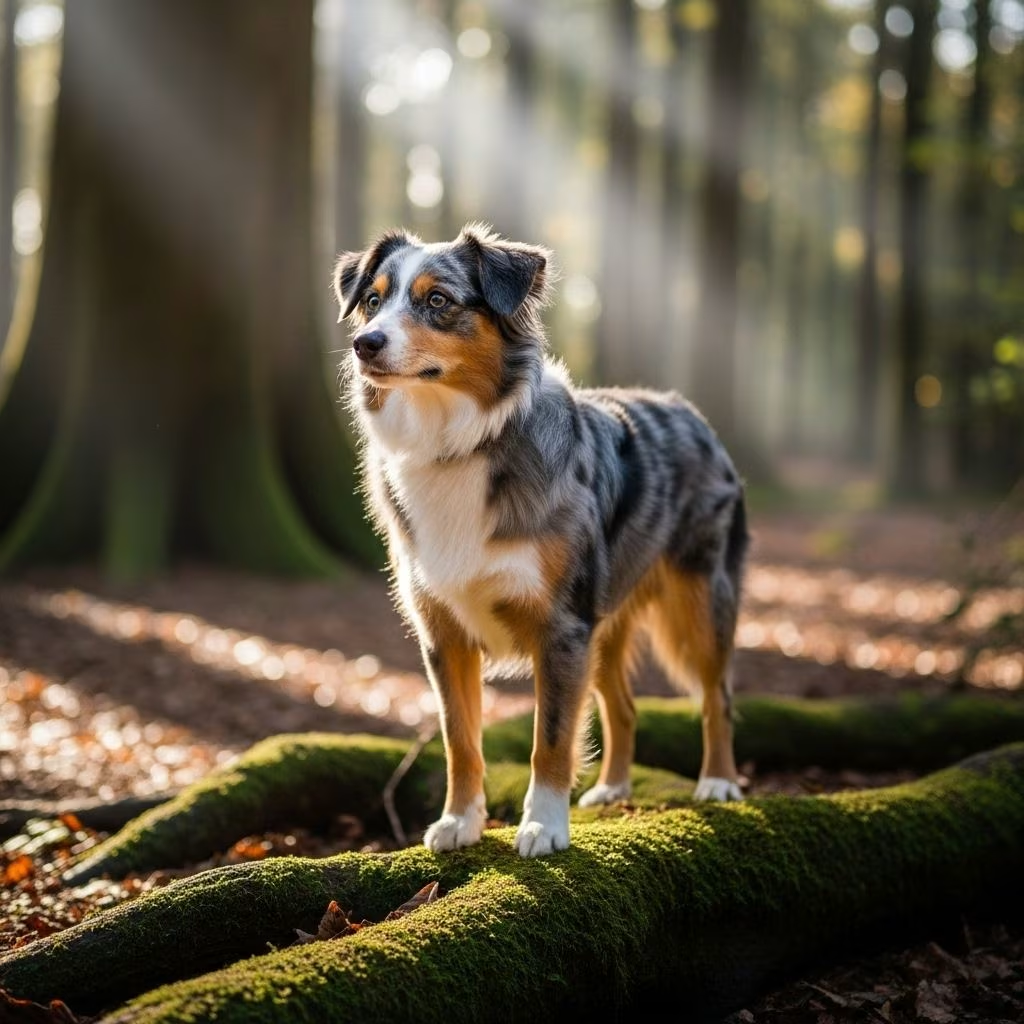
The Miniature American Shepherd breed standard defines these dogs as standing under 18 inches tall at the shoulder, with males typically ranging from 14 to 18 inches and females from 13 to 17 inches. Despite their compact size, they are solidly built and well-balanced, exhibiting the structure necessary for serious work.
The breed comes in several color varieties, including black, blue merle, red, and red merle, all with or without white markings and/or tan points. Their medium-length coat is weather-resistant and requires regular grooming but is not excessively high-maintenance. The tail may be naturally bobbed or docked to a length not to exceed three inches.
Temperamentally, Miniature American Shepherds are known for their intelligence, trainability, and strong desire to please. They form deep bonds with their families and can be reserved with strangers, making them excellent watchdogs despite their size. Their herding instinct remains strong, and they may attempt to herd children, other pets, or even moving objects like bicycles or cars if not properly trained and supervised.
Looking to the Future
The Miniature American Shepherd’s history demonstrates both the challenges and rewards of developing and establishing a new breed in the modern era. The process required persistence, compromise, and sometimes controversial decisions that continue to generate debate within the breeding community.
Today, the breed enjoys recognition from major kennel clubs around the world and has a growing population of dedicated enthusiasts. Whether competing in herding trials, excelling in agility courses, working as therapy dogs, or simply serving as intelligent and active family companions, Miniature American Shepherds prove daily that their founders’ vision was sound.
The breed’s future looks bright, with responsible breeders working to maintain health, temperament, and working ability while gradually expanding the gene pool. The ongoing dialogue between different registries and organizations, though sometimes contentious, ultimately benefits the breed by ensuring that multiple perspectives inform breeding decisions and that genetic diversity is preserved.
As the Miniature American Shepherd continues to grow in popularity, maintaining the qualities that made the breed special—intelligence, trainability, working ability, and sound temperament—will be essential. The history of this breed serves as a reminder that recognition and popularity bring both opportunities and responsibilities, and that the decisions made today will shape the breed for generations to come.
Frequently Asked Questions
Q: What’s the difference between a Miniature American Shepherd and a Miniature Australian Shepherd?
A: They are essentially the same dogs with different names due to registry politics. The AKC recognizes them as Miniature American Shepherds, while other registries continue to use the original name Miniature Australian Shepherd. The dogs share the same heritage and characteristics.
Q: When did the Miniature American Shepherd receive full AKC recognition?
A: The breed moved into the AKC Breed Register under the Herding Group on July 1, 2015, becoming the AKC’s 186th recognized breed after spending four years in the Foundation Stock Service.
Q: Why was the breed name changed from Miniature Australian Shepherd?
A: The name change was required because the AKC does not accept size varieties of already established breeds, and the Australian Shepherd was already AKC-recognized. The compromise allowed the breed to gain AKC recognition under the name Miniature American Shepherd.
Q: Where did the Miniature American Shepherd originate?
A: The breed was developed in California during the late 1960s by breeding small, unregistered dogs thought to be Australian Shepherds, with the goal of creating a smaller working shepherd that maintained intelligence and herding ability.
Q: Can Miniature American Shepherds still be bred to Miniature Australian Shepherds?
A: Yes, the AKC still allows Miniature American Shepherds to breed to Miniature Australian Shepherds, acknowledging the genetic continuity between the two groups despite different registry names.
Q: Are Miniature American Shepherds good working dogs?
A: Yes, despite their smaller size, Miniature American Shepherds maintain the intelligence, drive, and herding instinct of larger shepherds. They continue to be used as working breeds in competitions and on farms and ranches.
References
- https://www.mascgb.co.uk/history
- https://showsightmagazine.com/purebred-miniature-american-shepherds-the-back-story/
- https://en.wikipedia.org/wiki/Miniature_American_Shepherd
- https://www.mockingbirdhillkennel.com/mini-american-shepherds/
- https://www.akc.org/expert-advice/dog-breeds/miniature-american-shepherd-history/
- https://www.akc.org/dog-breeds/miniature-american-shepherd/
- https://www.akc.org/expert-advice/lifestyle/fun-facts-miniature-american-shepherd/
- https://akc.tv/episode?id=517