20 Weird and Wonderful Facts About Venus: Earth’s Hot Twin
Venus, the second planet from the Sun, has captivated astronomers and scientists for centuries. While it’s often called “Earth’s twin” due to similarities in size and density, the resemblances stop there. This hellish world is profoundly alien, with unearthly temperatures, crushing atmospheric pressures, and bizarre planetary behaviors. In this article, we dive into 20 of the strangest facts that make Venus a true stand-out in our solar system.
1. Venus Has a Rich History
Venus has fascinated sky-watchers since ancient times. Named after the Roman goddess of love and beauty, it shines so brightly in the sky that many civilizations tracked its movements. The Babylonians, Greeks, Mayans, and Chinese all recorded observations and made myths about Venus, sometimes viewing it as two separate entities—the Morning Star and the Evening Star—before realizing both were the same planet.
2. The Pressure’s On!
The atmosphere of Venus is incredibly thick, composed mainly of carbon dioxide with clouds of corrosive sulfuric acid. The air pressure at Venus’s surface is a staggering 92 times that of Earth’s, equivalent to the pressure found 900 meters (3,000 feet) underwater. This immense pressure would instantly crush a human or a spacecraft not specifically engineered for it.
3. It’s Just Like Earth (Well, Sort Of)
In mass and diameter, Venus closely mirrors Earth. Both are rocky planets, with Venus’s diameter at about 95% that of Earth. However, Venus has no liquid water and a toxic, dense atmosphere, making the similarities more superficial than structural.
- Diameter: 12,104 km (7,521 miles)
- Comparison to Earth: Similar size, radically different surface conditions
4. Venus Has Many Phases
Like the Moon, Venus shows phases when viewed from Earth. Through a telescope, you can see Venus waxing or waning crescents, or as a ‘full’ planet. These phases were observed by Galileo in 1610, providing critical support for the Copernican, Sun-centered model of the solar system.
5. Transits Are Very Rare
A “transit of Venus” occurs when the planet passes directly between Earth and the Sun, appearing as a small dot crossing the solar disk. These events come in pairs eight years apart, but each pair is separated by more than a century. The last transits occurred in 2004 and 2012, and the next won’t happen until 2117.
6. It’s Hellishly Hot
Venus is the hottest planet in the solar system, with an average surface temperature of about 465°C (869°F)—hotter even than Mercury, despite being further from the Sun. This is due to a runaway greenhouse effect from its thick carbon dioxide atmosphere, which traps heat with extreme efficiency.
7. Venusian Volcanicity
Venus boasts more volcanoes than any other planet. Over 1,600 major volcanoes dot the surface, and many more are too small to be counted. Most are dormant, but evidence suggests that at least a few may still be active. Spacecraft have observed transient hot spots and changes in surface topography signaling recent lava flows.
- Largest volcano: Maat Mons
- Recent activity: Hot spots detected by ESA’s Venus Express
8. No Companion
Unlike Earth, Venus has no moons—nor dos it possess ring systems like Saturn. Its solitary nature remains a subject of curiosity among planetary scientists.
9. Life in the Clouds?
Venus’s surface is totally uninhabitable, but its upper cloud layers—where temperatures and pressures are more Earth-like—have intrigued astrobiologists. Some studies suggest that microbial life might be able to survive in these acidic clouds, though this remains speculative and unproven. Periodic detection of mysterious chemicals, such as phosphine, have sparked debate about possible biosignatures.
10. A Day Feels Like a Year
A single day on Venus (the time to complete one rotation) lasts about 243 Earth days. Strangely, its year—the time to orbit the Sun—is only 225 Earth days long. This means a day on Venus is longer than a year!
11. ‘Backwards’ Rotation
Venus spins in the opposite direction to most planets in our solar system, a phenomenon known as retrograde rotation. If you stood on Venus, you’d see the Sun rise in the west and set in the east—the opposite of Earth. Astronomers still debate why Venus rotates this way; theories include massive ancient collisions or tidal forces.
12. What the Future Holds
Venus remains a key target for planetary research. NASA, the European Space Agency, and even private organizations have missions planned to study its atmosphere, surface, and geological history. These missions aim to unlock the mysteries of its runaway greenhouse effect and volcanic activity, and to search for potential signs of life.
13. Turning Back the Clock
Studying Venus helps scientists understand not just another world, but also the past and potential future of Earth’s own climate. The planet serves as a cautionary tale of runaway greenhouse warming and the effects of atmospheric change.
14. Loss of a Magnetic Feeling
Unlike Earth, Venus lacks a global magnetic field. Scientists hypothesize that its slow rotation and internal heat distribution might be related. This absence leaves its atmosphere far more vulnerable to solar wind stripping.
15. It Has Had Many Spacecraft Visitors
More than 40 spacecraft from several nations have visited Venus. The Soviet Union led the charge with their Venera program, achieving the first successful landings on another planet. The U.S., the European Union, and Japan have also sent orbiters and probes to study Venus’s blistering surface and thick clouds.
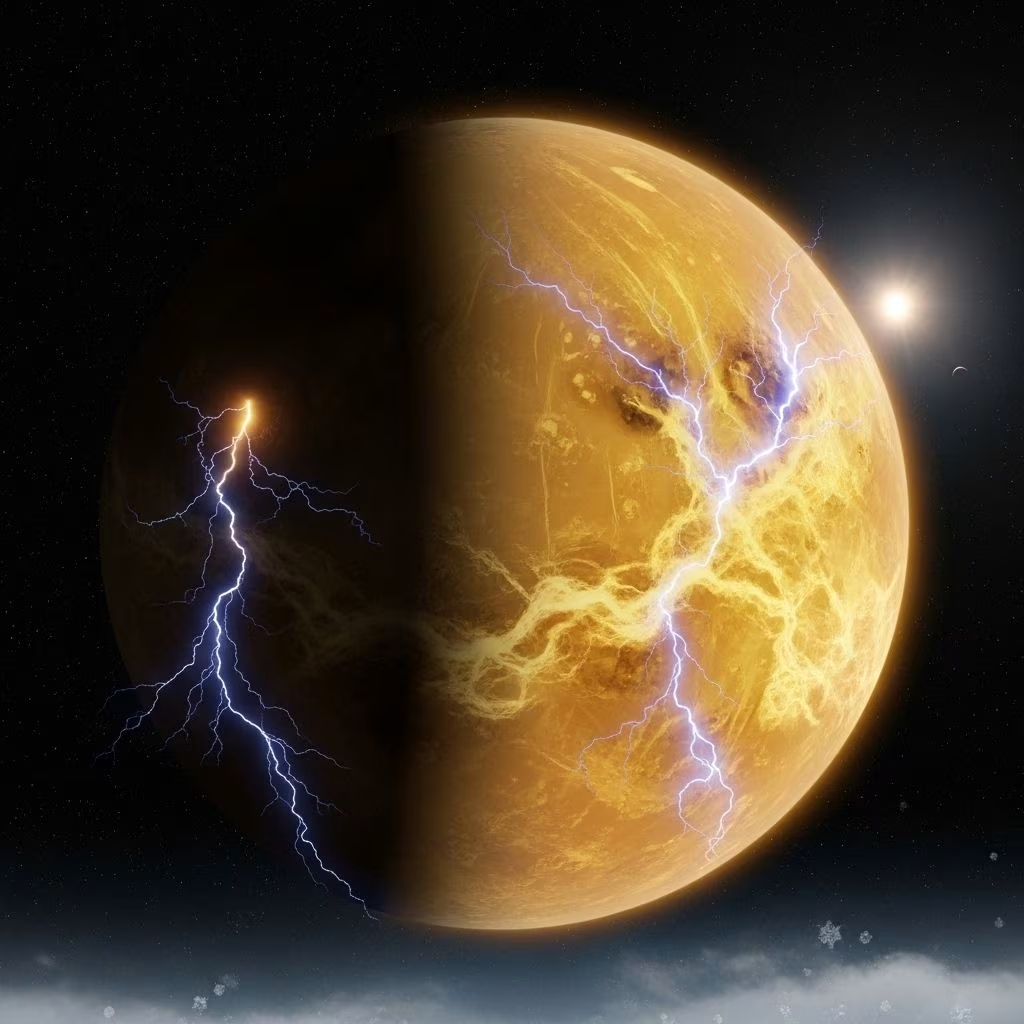
16. Case of the Missing Lightning
Earth-like lightning was once thought to exist on Venus. Spacecraft repeatedly tried (and sometimes claimed) to detect it, but evidence remains inconclusive. Some scientists believe lightning may exist, but if so, it is much rarer (and stranger) than on Earth.
17. Soviet Success at Venus
The Soviet Venera program marked many firsts: the first human-made spacecraft to enter another planet’s atmosphere, the first landing, and the first images from Venus’s surface. Several Venera landers survived Venus’s fierce conditions—if only for a short time—and returned crucial data.
18. Shining Bright in the Sky
Venus is the third brightest object in the sky after the Sun and Moon and is easily visible to the naked eye. It’s often called the “Morning Star” or the “Evening Star,” depending on its position relative to the Sun. At times, it appears so luminous it casts a faint shadow on dark nights.
19. A Source of Shadows
Venus is so brilliant that under ideal dark conditions, it can cast detectable shadows on Earth’s surface—unique among all planets. This phenomenon is rare and best seen away from city lights when Venus is near its maximum brightness.
20. Weird Winds
Venus’s upper atmosphere is swept by hurricane-force winds, racing at speeds over 360 kilometers (224 miles) per hour—much faster than the planet itself rotates. This phenomenon, called super-rotation, is still poorly understood and is a major puzzle for planetary atmospheric scientists.
Comparison Table: Earth Versus Venus
| Feature | Earth | Venus |
|---|---|---|
| Diameter | 12,742 km | 12,104 km |
| Length of Day | 24 hours | 243 Earth days |
| Surface Temperature | Average 15°C (59°F) | ~465°C (869°F) |
| Atmospheric Pressure | 1 bar | 92 bars |
| Main Atmospheric Gas | Nitrogen/Oxygen | Carbon dioxide |
| Moons | 1 | 0 |
Frequently Asked Questions (FAQs)
Q: Why is Venus hotter than Mercury, even though it is further from the Sun?
A: Venus’s thick carbon dioxide atmosphere traps heat in an extreme greenhouse effect, making its surface temperature hotter than Mercury’s despite being farther from the Sun.
Q: Can humans ever visit Venus’s surface?
A: Current technology cannot protect humans from Venus’s crushing pressure and searing heat. Most missions focus on the upper atmosphere or orbit, where conditions are less hostile.
Q: Has any probe survived on Venus?
A: Yes, several Soviet Venera landers transmitted images and data from the surface, surviving for up to two hours before succumbing to the hostile environment.
Q: Could there be life on Venus?
A: While the surface is utterly inhospitable, some scientists speculate that life could exist in Venus’s upper cloud layers, where conditions are milder—a topic of active research and debate.
Q: Why does Venus spin backwards?
A: Venus’s retrograde rotation may be due to tidal forces, massive ancient impacts, or complex atmospheric effects, but the exact reason is still unknown.
Key Takeaways
- Venus is similar in size to Earth but radically different in surface and atmosphere.
- It possesses extreme surface heat, immense pressure, and thick clouds of sulfuric acid.
- Venus spins backward, has no moons, and exhibits some of the most extreme weather in the solar system.
- Its study reveals invaluable information about planetary evolution, atmosphere, and climate processes.
References
- https://www.space.com/15988-venus-planet-weird-facts.html
- https://www.britannica.com/list/5-weird-facts-about-venus
- https://science.nasa.gov/venus/venus-facts/
- https://www.rmg.co.uk/stories/space-astronomy/interesting-facts-about-venus
- https://www.space.com/15979-venus-weirdest-planet-facts.html
- https://en.wikipedia.org/wiki/Venus
- https://spaceplace.nasa.gov/all-about-venus/en/
- https://www.youtube.com/watch?v=D9YFPiIAmoA
- https://www.youtube.com/watch?v=7QBxfSIK_fA
- https://www.funkidslive.com/learn/top-10-facts/top-10-facts-about-venus/
- https://www.worldatlas.com/space/10-fascinating-facts-about-venus.html
- https://www.jameswebbdiscovery.com/universe/100-fascinating-facts-about-planet-venus
- https://revolutionized.com/interesting-planet-venus-facts/
- https://www.astronomy.com/science/weird-object-venus/
- https://www.awpnow.com/main/2023/06/23/12-fun-facts-about-venus-that-will-blow-your-mind/
- https://www.britannica.com/place/Venus-planet
- https://space-facts.com/venus/