The Andromeda constellation is one of the most recognized star patterns in the night sky, immortalized by ancient myths and prized by stargazers for its dazzling stars and proximity to the colossal Andromeda galaxy. Whether you are a beginner stargazer or a seasoned astronomer, Andromeda offers a rich tapestry of science, history, and legend to explore.
Overview: The Majesty of Andromeda
Located in the northern celestial hemisphere, the Andromeda constellation is one of the 88 modern constellations and among the 48 original star patterns cataloged by the famed Greco-Roman astronomer Ptolemy in the 2nd century CE. Spanning over 722 square degrees, it is one of the largest constellations, more than 1,400 times the apparent area of the full moon, and occupies a prominent position in the autumn sky for observers in the Northern Hemisphere.
- Right Ascension: 22h 57.5m – 2h 39.3m
- Declination: +53.19° to +21.68°
- Best Viewing Months: September to February
- Latitude Range: Visible from most of the northern hemisphere and up to about 40° south latitude
The Myth of Andromeda: The Chained Maiden
The constellation’s name and legend hail from Greek mythology. Andromeda was the daughter of Queen Cassiopeia and King Cepheus, rulers of ancient Ethiopia. According to myth, Queen Cassiopeia boasted that her daughter was more beautiful than the Nereids, sea nymphs. In response to this hubris, Poseidon sent the monstrous Cetus to ravage the kingdom.
To appease the wrathful gods, Andromeda was chained to a rock as a sacrifice. Just as Cetus approached, the hero Perseus arrived, slew the monster, and rescued Andromeda. The story was immortalized among the stars, with constellations named after nearly every character — Andromeda, Perseus, Cepheus, Cassiopeia, and Cetus — carving out a mythological neighborhood in the autumn sky.
Alternative Cultural Interpretations
- Chinese Astronomy: The stars of Andromeda form parts of four distinct constellations; their interpretations are rooted in local legend and astrology.
- Hindu Mythology: Another tradition associates stars in Andromeda with distinct myths and stories.
- Arab Astronomers: Identified overlapping constellations, including a prominent representation of a fish, whose ‘nose’ coincides with the Andromeda Galaxy.
Locating Andromeda in the Night Sky
Andromeda is neighbored by the constellations Pegasus (recognized by the Great Square), Cassiopeia (marked by its W shape), Perseus, Lacerta, Triangulum, and Pisces. The brightest stars of Andromeda form a long, curving chain between Pegasus in the south and Perseus in the north.
- To find Andromeda, start at the Great Square of Pegasus. The northeastern corner star, Alpheratz, marks Andromeda’s head and serves as a key anchor point.
- From Alpheratz, trace a chain of moderately bright stars (Mirach and Almach) that sweep away from the Square towards the neighboring constellation Perseus.
Major Stars of Andromeda
Andromeda’s stars shine with their own legends and scientific significance. Among more than 100 named stars, three command special attention:
| Star | Bayer Designation | Features |
|---|---|---|
| Alpheratz | Alpha Andromedae | Brightest in the constellation; blue-white binary also part of Pegasus’ Great Square |
| Mirach | Beta Andromedae | Red giant; marks Andromeda’s girdle; easily visible to the naked eye due to its brightness and hue |
| Almach | Gamma Andromedae | Colorful binary star; a favorite for amateur telescopes and double star enthusiasts |
- Delta, Pi, Mu, and Omicron Andromedae: Trace the rest of the princess’s celestial outline.
Star Chains and Neighboring Asterisms
Andromeda’s stars are often depicted as outlining the body and chains of the mythical princess. However, the interpretation of which specific stars form Andromeda’s head, body, and chains varies among sky atlases and cultures.
Deep-Sky Objects in Andromeda
Few constellations can rival the wealth of celestial treasures contained within Andromeda’s boundaries. From the spectacular Andromeda Galaxy to lesser-known nebulae and galaxies, stargazers are rewarded with numerous wonders.
The Andromeda Galaxy (Messier 31, M31)
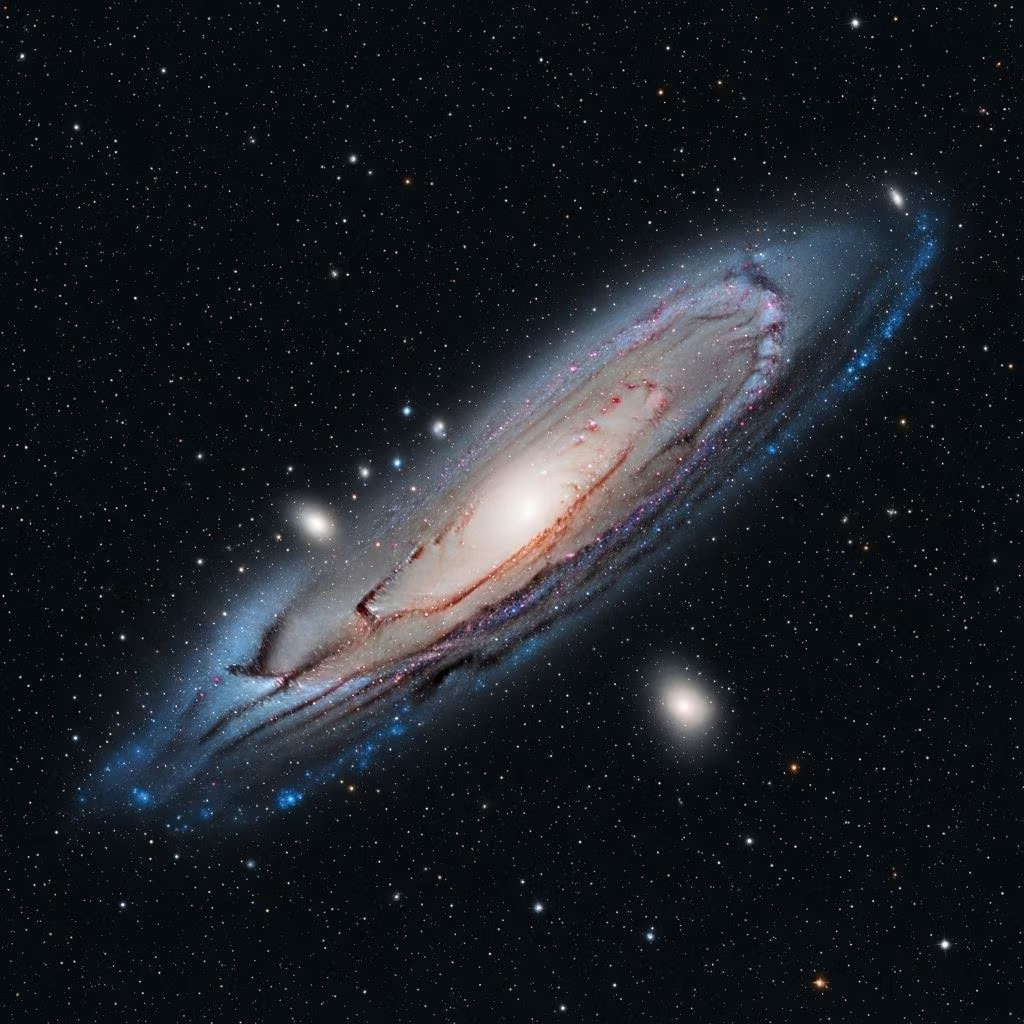
M31 is one of the brightest and most studied objects in the night sky, visible to the naked eye as a faint, misty patch even from moderately dark suburban skies. It is the closest spiral galaxy to our own Milky Way, lying about 2.5 million light-years away from Earth.
- Appears as an elongated blur, best seen through binoculars or a small telescope.
- Larger than the Milky Way, the Andromeda Galaxy is expected to collide and merge with our galaxy in approximately four billion years.
- Has several companion galaxies: Messier 32 (M32) and Messier 110 (M110), both faint elliptical galaxies, are visible in telescopic views near M31.
Other Deep-Sky Objects
- NGC 891: An edge-on spiral galaxy located within Andromeda, visible in amateur telescopes.
- Blue Snowball Nebula (NGC 7662): A planetary nebula appearing as a hazy, bluish disk through telescopes.
Observation Tips: When and How to See Andromeda
Stargazing enthusiasts can easily locate Andromeda during autumn months when it stands high overhead in northern skies.
- Best time: September through February, especially around midnight local time.
- Look for the Great Square of Pegasus as a starting point, and identify Alpheratz to trace Andromeda’s form.
- City dwellers may need binoculars to spot fainter stars or the Andromeda Galaxy, while dark rural skies reveal Andromeda in all its glory to the unaided eye.
- The constellation is not visible, or always below the horizon, for most locations south of 40° south latitude.
Historical and Modern Significance
Andromeda was among the earliest cataloged constellations, with roots stretching back to ancient Greece and its legendary texts like Ptolemy’s Almagest. Early depictions showed the princess bound with chains, with specific stars allocated as her head and body, though the details have changed through the ages.
Through history, Andromeda’s cultural role expanded beyond Greek influence:
- In the 18th century, some European star charts briefly included the now-defunct constellation Honores Friderici, made from parts of Andromeda and Lacerta.
- Today, the International Astronomical Union (IAU) officially recognizes Andromeda, defined by precise modern boundaries and the abbreviation And.
Meteor Showers: The Andromedids
Every November, observers may see an occasional streak of light radiating from Andromeda. This is the Andromedid meteor shower, generally a weak display but of historical importance, as it produced spectacular showers in the 19th century before subsiding to less frequent and lower-rate activity.
Notable Facts and Figures
- Area: 722 square degrees (among the largest constellations)
- Stars: Over 100 visible with the naked eye in dark skies
- Messier Objects: 3 (M31, M32, M110)
- Neighboring Constellations: Perseus, Pisces, Cassiopeia, Pegasus, Lacerta, Triangulum
Table: Key Stars of Andromeda
| Name | Designation | Magnitude | Type | Notes |
|---|---|---|---|---|
| Alpheratz | Alpha Andromedae | 2.07 | B8 subgiant / binary | Shared with Pegasus’ Square |
| Mirach | Beta Andromedae | 2.06 | Red giant (M0) | Color visible to the eye |
| Almach | Gamma Andromedae | 2.16 | Binary (K3 primary) | Striking color contrast in telescopes |
The Andromeda Galaxy: A Closer Look
Messier 31 (The Andromeda Galaxy) is the nearest major spiral galaxy to our Milky Way and anticipated to merge with it billions of years from now. Its magnitude makes it the brightest extragalactic object visible to the naked eye, and its companions (M32, M110) provide rich observational targets.
- Distance: ~2.5 million light-years from Earth
- Diameter: Roughly 220,000 light-years
- Features: Spiral arms, star-forming regions, numerous globular clusters
The galaxy appears as a faint smudge from suburban skies, but dark rural locations reveal its full elongated beauty. A small telescope shows hints of structure while larger instruments can reveal dust lanes and globular clusters.
FAQs About the Andromeda Constellation
Q: What is the easiest way to locate the Andromeda constellation?
A: Start from the Great Square of Pegasus; identify Alpheratz at the corner and trace the chain of stars leading away to the northeast and then east, outlining the constellation.
Q: Is the Andromeda Galaxy visible without a telescope?
A: Yes, under dark skies free from light pollution, the Andromeda Galaxy appears as a small, dim fuzzy patch to the unaided eye.
Q: What myth is associated with Andromeda?
A: The constellation commemorates the princess Andromeda, who was chained and nearly sacrificed to the monster Cetus before being saved by Perseus, as told in Greek mythology.
Q: What is the best time of year to see Andromeda?
A: Andromeda is most prominent from September to February, reaching its highest point in the northern hemisphere autumn evenings.
Q: How far away is the Andromeda Galaxy?
A: The Andromeda Galaxy is approximately 2.5 million light-years from Earth.
Summary: Why Andromeda Captivates
From ancient mythology to modern astronomical research, the Andromeda constellation stands as a celestial bridge between humanity’s storied past and its scientific curiosity. Featuring some of the sky’s brightest stars, an entire neighboring galaxy within its borders, and a place in multiple world traditions, Andromeda is more than just a collection of stars — it is a living tapestry reflecting our wonder at the universe above.
References
- https://www.space.com/15590-andromeda-galaxy-m31.html
- https://www.constellation-guide.com/constellation-list/andromeda-constellation/
- https://en.wikipedia.org/wiki/Andromeda_(constellation)
- https://www.space.com/152-andromeda-galaxy-visible-eagle-eye-skywatchers.html
- https://theskylive.com/sky/constellations/andromeda-constellation
- https://en.wikipedia.org/wiki/Andromeda_Galaxy
- https://science.nasa.gov/asset/hubble/andromeda-constellation/
- https://space.fandom.com/wiki/Andromeda
- https://science.nasa.gov/mission/hubble/science/explore-the-night-sky/hubble-messier-catalog/messier-31/
- https://www.britannica.com/place/Andromeda-Galaxy
- https://sleepopolis.com/education/the-story-of-andromeda-the-constellation/
- https://freestarcharts.com/andromeda
- https://www.starregistry.com/constellation-name/andromeda/
- https://starcitizen.tools/Constellation_Andromeda
- https://www.youtube.com/watch?v=-OF8Ryy9kQw
- https://www.constellation-guide.com/andromeda-galaxy-messier-31-m31-ngc-224/
- https://www.britannica.com/place/Andromeda-constellation
- https://theplanets.org/constellations/andromeda-constellation/