Apollo 13: Survival Against the Odds
In April 1970, the Apollo 13 mission set out to achieve what would have been the third human landing on the Moon. Instead, it became one of the most extraordinary survival stories in the history of space exploration. Faced with an unprecedented crisis, the astronauts and engineers at NASA demonstrated extraordinary ingenuity and teamwork, transforming a near-catastrophe into a triumphant rescue.
Quick Facts About Apollo 13
- Launch Date: April 11, 1970
- Crew: Jim Lovell (Commander), Jack Swigert (Command Module Pilot, replacing Ken Mattingly), Fred Haise (Lunar Module Pilot)
- Mission Objective: Third human Moon landing, Fra Mauro region
- Incident: Oxygen tank explosion on April 13, forcing an abort of the lunar landing
- Return: Safely splashed down in the Pacific Ocean on April 17
Mission Overview
Apollo 13 began as a routine and highly anticipated lunar mission. Originally, its crew included Jim Lovell, Fred Haise, and Ken Mattingly. Just days before launch, Mattingly was replaced by Jack Swigert due to possible exposure to measles—an early instance of health protocols affecting a spaceflight crew.
The mission objective was a landing in the Fra Mauro region of the Moon, where Lovell and Haise would have explored lunar geography that was deemed critical for advancing NASA’s understanding of moon geology.
Key Mission Timeline
| Date & Time | Event |
|---|---|
| April 11, 1970 | Launch of Apollo 13 aboard Saturn V from Kennedy Space Center |
| April 13, 1970 | Oxygen tank explosion—”Houston, we’ve had a problem” |
| April 14, 1970 | Course corrected for emergency return trajectory |
| April 15-16, 1970 | Critical life-support and course corrections using lunar module |
| April 17, 1970 | Safe splashdown in Pacific; rescue of crew |
“Houston, We’ve Had a Problem”: The Explosion
On the third day of the mission, with the spacecraft nearly 200,000 miles from Earth, a routine activation of a fan inside an oxygen tank resulted in a dangerous short circuit. The oxygen tank exploded, damaging the service module and venting the precious life-supporting oxygen into space. The now-famous call to Houston—”Houston, we’ve had a problem“—marked the beginning of the mission’s crisis.
- Loss of oxygen: Both service module oxygen tanks ruptured, leaving only the lunar module’s resources for survival.
- Immediate effect: Lunar landing canceled; all efforts shifted to saving the crew.
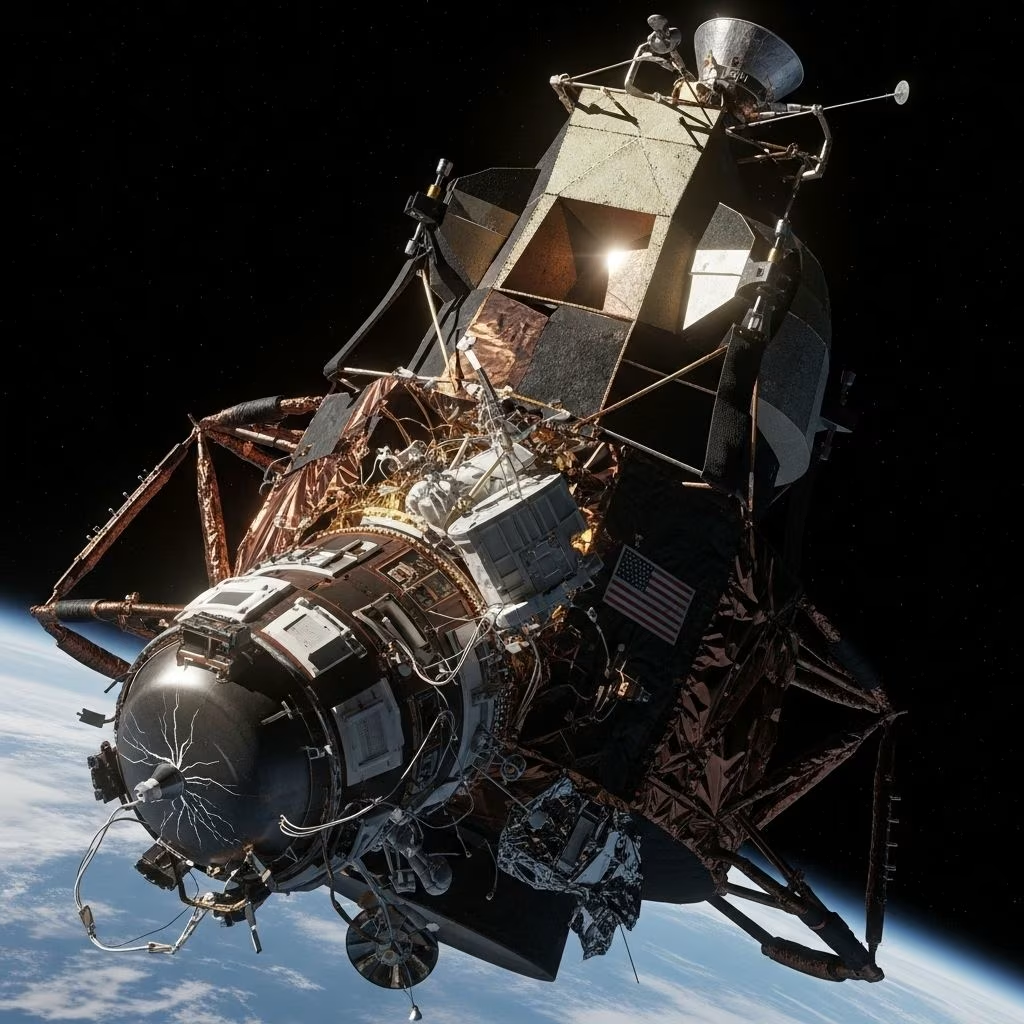
The explosion’s force was so violent that, upon eventual separation of modules, a large portion of the spacecraft’s exterior was found blown away, exposing internal wiring and insulation. Astronaut Jim Lovell would later describe the damage, noting that “one whole side of that spacecraft [was] missing…Looks like a lot of debris is just hanging out of the side near the S-band antenna”.
Improvisation and Survival: Life in the Lunar Module
With the command module critically damaged, the astronauts retreated into the lunar module Aquarius, which was designed for only two people for two days. The trio was forced to improvise:
- Water rationed: Each astronaut received only six ounces per day, risking dehydration.
- Cold conditions: With power strictly conserved, cabin temperatures dropped to near 3°C (38°F), and humidity condensed into droplets covering the walls and equipment.
- Carbon dioxide threat: Both lander and ship used lithium hydroxide for CO2 removal, but the canisters were incompatible in shape. Mission control devised a makeshift adapter using “plastic bags, cardboard, and duct tape”—an ingenious fix that saved the crew from CO2 poisoning.
Despite limited food, water, and power, the astronauts—guided by flight controllers—managed to convert the lunar module into an unlikely lifeboat, conducting critical maneuvers that would set a safe return course to Earth.
Trajectory Corrections & Navigation
With their original flight plan shattered, the Apollo 13 team had to rely on “free-return trajectory”—using the Moon’s gravity to slingshot the spacecraft back toward Earth. This required multiple engine burns:
- Three major burns: Performed using the lunar module engine instead of the intended command module. These corrected their course and ensured the spacecraft reentered Earth’s atmosphere at a survivable angle.
- Manual calculations: Lovell famously used the Moon itself as a navigational reference, guiding the damaged ship through critical orientation checks.
Did Apollo 13 Land on the Moon?
No—the Moon landing was aborted after the explosion. Instead, the astronauts swung around the far side of the Moon, capturing iconic photographs of the lunar surface but never landing.
Return, Reentry, and Splashdown
By April 17, Apollo 13 had returned to Earth’s region of gravitational influence, about 348,064 km (216,277 miles) from the surface. Final course corrections were made before the dramatic reentry:
- Jettisoning modules: The service module was separated first, revealing the damage. The lunar module was then detached, forcing a previously untested module configuration for reentry.
- Odyssey reactivated: The crew powered up life-support in the command module Odysseus (after days of shutdown) for the final descent.
- Atmospheric entry: Despite concerns that the explosion had compromised the heat shield, Apollo 13 survived the fiery plunge through Earth’s atmosphere.
- Splashdown location: Safely landed in the Pacific Ocean, near Samoa, at 1:07 pm EST, April 17, six days after launch.
Astronauts Jim Lovell, Jack Swigert, and Fred Haise suffered no lasting ill effects, though the ordeal had tested their resilience and resourcefulness to the limit.
Investigation and Lessons Learned
The explosion resulted from a design change in 1965—increasing the heater voltage in the oxygen tanks from 28 to 65 volts. The switches had not been updated for this higher voltage, damaging the tank during a ground test prior to launch. This overlooked error culminated in the catastrophe during flight.
- Major findings: NASA added a third, independent oxygen tank and extra emergency battery power to all following Apollo spacecraft.
- Enhanced safety protocols: Procedures for crew selection, equipment testing, and contingency planning were reviewed and improved.
- Impact on future missions: Apollo 14 benefitted directly from these lessons, succeeding in its lunar landing.
Notable Innovations from Apollo 13
- Lithium hydroxide canister adapter—the “mailbox”—a legendary example of quick-thinking engineering.
- Manual navigation: Lovell’s use of lunar landmarks and improvisation was studied for future emergencies.
- Emergency power management: New planning introduced for extended power-downs and conservation strategies.
Cultural Legacy and Public Perception
Apollo 13 is often called “a successful failure.” The phrase encapsulates NASA’s ability to rescue a crew against all odds. The mission became a symbol of human ingenuity and the spirit of teamwork.
- Popular media: The story was immortalized in books and in the 1995 film “Apollo 13,” starring Tom Hanks as Jim Lovell.
- Public engagement: Millions followed the gripping suspense of the return live on TV and radio.
- Engineering pride: The mission is referenced in technical courses and aerospace education, emphasizing creativity under pressure.
Comparison: Apollo 13 vs. Other Apollo Missions
| Mission | Main Objective | Outcome | Legacy |
|---|---|---|---|
| Apollo 11 | First crewed Moon landing | Successful moonwalk and return | “One giant leap” quotation; global impact |
| Apollo 12 | Lunar science and technology | Successful second landing | Improved lunar geology; tested tech |
| Apollo 13 | Third lunar landing (aborted) | Life-threatening disaster averted | “Successful failure”; model rescue |
| Apollo 14 | Lunar geology, Fra Mauro | Successful landing, new safety | First after safety upgrades |
13 Interesting Facts About Apollo 13
- The well-known phrase “Houston, we’ve had a problem” was spoken by Jack Swigert, not Jim Lovell as depicted in the film.
- The lunar module Aquarius acted as a lifeboat, although it was never intended to play this role.
- Crew consumed only one-fifth the normal water ration, risking kidney issues.
- The crew used duct tape, cardboard, and plastic bags to jury-rig lifesaving devices.
- Service module explosion turned the spacecraft into a floating “raincloud,” with condensation everywhere during reentry.
- Mission control’s round-the-clock problem-solving saved the crew’s lives.
- Despite power-downs, communication with Houston never ceased.
- The splashdown sequence required perfect timing; error could have meant fatal heat shield failure.
- Crew was recovered near Samoa, six days after launch.
- The explosion was traced to a preflight test error involving voltage mismatches in the oxygen tank heaters.
- Apollo 13’s astronauts suffered from cold but had no lasting health issues.
- Public fascination with the mission led to one of the highest television audiences at the time.
- Apollo 13’s mail-box CO2 adapter is on display at the Smithsonian.
Frequently Asked Questions (FAQs)
Q: What caused Apollo 13’s accident?
A: The accident was caused by a short circuit during a routine operation in one of the service module’s oxygen tanks, which led to an explosion due to an overlooked electrical upgrade.
Q: Did anyone die during Apollo 13?
A: No—the expertise and improvization of NASA flight control and the astronauts ensured all crew returned safely, despite life-threatening conditions.
Q: What was the intended landing site?
A: Apollo 13 aimed for the Fra Mauro region of the Moon, considered highly important for lunar science.
Q: How did the Apollo 13 crew survive?
A: Survival was possible due to the lunar module’s life-support, strict water and power rationing, and a creative fix for the CO2 filter issue, all coordinated by NASA mission control.
Q: What changes did NASA make after Apollo 13?
A: New Apollo missions included a third oxygen tank, additional battery power, and rigorous cross-verification of all systems to avoid similar accidents.
References & Resources
- NASA’s official Apollo 13 page provides mission transcripts and detailed analysis.
- National Air and Space Museum displays key Apollo 13 hardware.
- Encyclopedia entries (Britannica, Wikipedia) offer further historical context.
References
- https://www.nasa.gov/missions/apollo/apollo-13-mission-details/
- https://en.wikipedia.org/wiki/Apollo_13
- https://www.britannica.com/topic/Apollo-13-mission
- https://www.nasa.gov/mission/apollo-13/
- https://www.lpi.usra.edu/lunar/missions/apollo/apollo_13/
- https://airandspace.si.edu/explore/stories/apollo-missions/apollo-13
- https://www.planetary.org/space-missions/apollo-13
- https://stargazersclubwa.com.au/13-facts-you-may-not-know-about-apollo-13/
- https://www.bellmuseum.umn.edu/blog/a-successful-failure-a-brief-history-of-the-apollo-13-mission/
- https://en.wikipedia.org/wiki/Apollo_program
- https://www.spaceline.org/united-states-manned-space-flight/apollo-mission-program-facts-sheet-index/apollo-13-fact-sheet/
- https://study.com/academy/lesson/apollo-13-history-mission-crew.html
- https://spacecenter.org/apollo-13-virtual-exhibit/
- https://www.spaceflighthistories.com/post/apollo-13
- http://www.astronautix.com/a/apollo13.html
- https://factfile.org/10-facts-about-apollo-13
- https://www.youtube.com/watch?v=MdvoA-sjs0A
- https://sciowa.org/upl/downloads/library/apollo-13-fact-sheet.pdf
- https://solarviews.com/eng/apo13.htm