Halley’s Comet: Past, Present, and the Promise of Its Dazzling Return
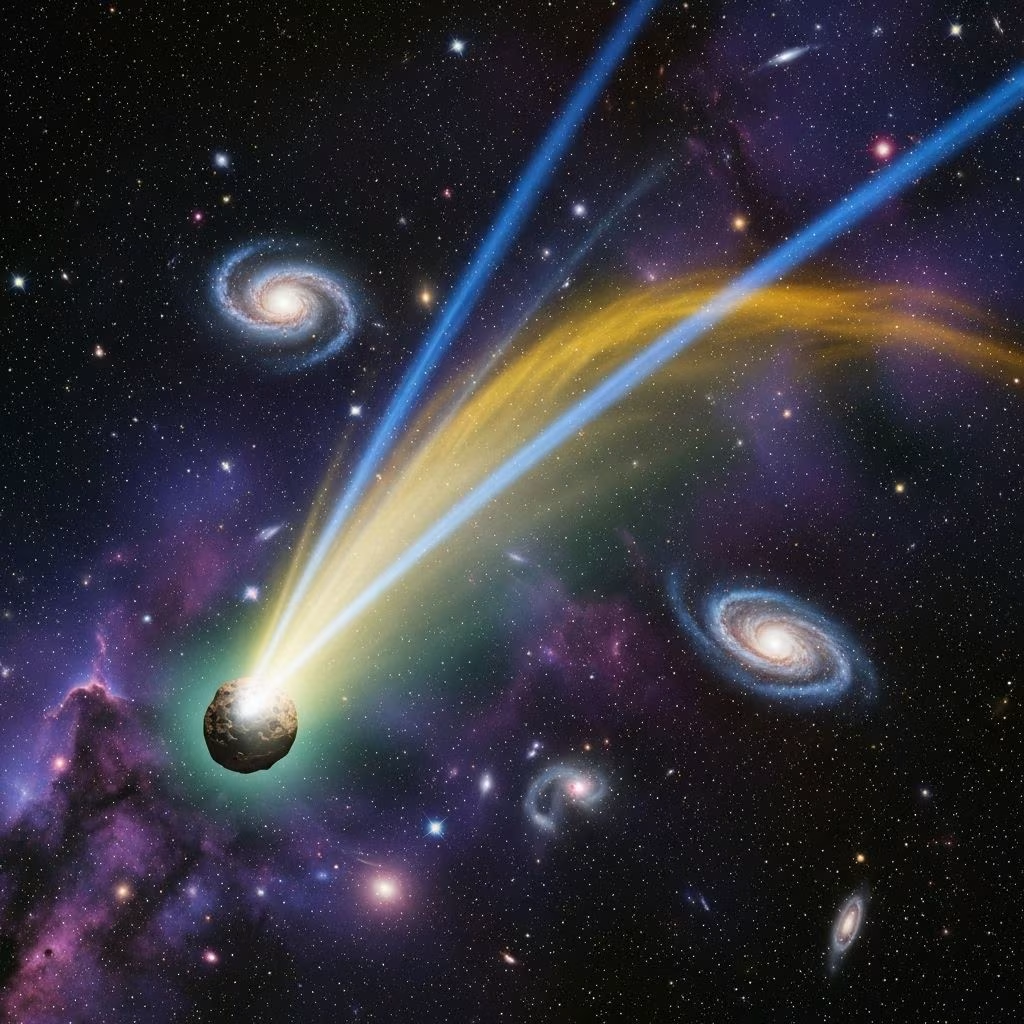
Halley’s Comet, perhaps the most celebrated comet in recorded history, has once again reached a pivotal moment in its cycle. As of December 8, 2023, Halley’s Comet arrived at aphelion—its farthest point from the Sun—before beginning its 38-year return journey that will culminate in a spectacular apparition in 2061. This article explores the comet’s remarkable orbital journey, what has just occurred, and what to expect for the 2061 apparition.
Halley’s Epic Orbit: An Overview
Halley’s Comet, officially known as 1P/Halley, is distinctive as the only naked-eye comet that returns within a single human lifetime and has been regularly documented since antiquity. Its pathway through our solar system is a vast elliptical orbit, carrying it from the cold fringes of the solar system to a close pass of the Sun and back out again.
- Orbital period: Roughly every 75 – 76 years.
- Perihelion: The closest point to the Sun; the last occurred on February 9, 1986.
- Aphelion: The farthest point from the Sun, reached on December 8, 2023.
- Next perihelion: Due in summer 2061.
This orbital path brings Halley closer to the Sun than Venus at perihelion, and farther than Neptune at aphelion, ensuring its journey is both majestic and extreme.
The 2023 Aphelion: A Turning Point
On December 8, 2023, at 8 p.m. Eastern Time (0100 GMT December 9), Halley’s Comet reached its furthest extent from the Sun—known as aphelion. At this moment:
- It was 3.27 billion miles (5.26 billion km) from the Sun.
- This placed it about 472.2 million miles (759.8 million km) beyond Neptune’s orbit—the farthest known planet from the Sun.
- The last aphelion occurred in April 1948.
After nearly 38 years spent moving away from the Sun since the 1986 perihelion, Halley’s crossing of aphelion marks the beginning of its long inbound journey—one that will see it accelerate as it heads back toward the inner solar system.
Orbital Speed at Extremes
| Orbital Location | Speed (Miles/Second) | Speed (KM/Second) | Speed (Miles/Hour) |
|---|---|---|---|
| Aphelion (Dec 2023) | 0.565 | 0.909 | 2,034 |
| Perihelion (Feb 1986) | 33.77 | 54.52 | 121,572 |
This incredible variation in velocity is governed by Kepler’s second law of motion: objects in orbit move fastest at perihelion (closest approach) and slowest at aphelion (farthest point).
Historical Records: Humanity’s Fascination with Halley
Halley’s Comet is renowned not just for its brilliance, but for its appearance throughout human history.
- The earliest recorded sighting dates to 240 BCE in Chinese chronicles.
- The comet was confirmed as periodic by Edmond Halley in 1705, who predicted its return—a landmark achievement in astronomy.
- It has inspired awe, scientific study, and even fear across civilizations from Ancient Rome to the Middle Ages and the modern world.
With every return, Halley’s Comet leaves a mark on humanity’s shared memory and scientific understanding of the cosmos.
What’s Next: The Journey Toward 2061
Now that Halley’s Comet is rounding the distant end of its orbit and turning sunward, its inward journey will pick up pace, though slowly at first. Here’s what lies ahead:
- Acceleration: Its orbital velocity will gradually increase as it approaches the Sun.
- Visibility: The comet will not be visible from Earth for decades, as it is too distant and faint until it nears the inner solar system.
- Next apparition: Expected in 2061, when it reaches perihelion.
Comparing 1986 and 2061 Returns
| Aspect | 1986 Apparition | 2061 Predicted Apparition |
|---|---|---|
| Season (Northern Hemisphere) | Winter/Early Spring | Late Spring/Summer |
| Sun & Earth Relative Position | Comet on far side of Sun (for Earth viewers) | Comet on same side as Earth, in full view |
| Expected Brightness | Relatively dim, hard to spot | 10x brighter than 1986, much more prominent |
| Best Viewing | Mainly Southern Hemisphere | Favors Northern Hemisphere initially, then Southern |
2061’s return is shaping up to be a ‘mirror image’ of the 1986 event—this time placing the comet in a much better location for Earth observers during its closest approach.
The Science: Why Halley’s Orbit Is Unique
Halley’s Comet belongs to a rare category of short-period comets, defined by their orbital period of less than 200 years. What makes Halley special?
- It has a retrograde orbit, meaning it orbits the Sun in the opposite direction to most planets.
- The inclination of its orbit is steep—about 162 degrees to the ecliptic (the Sun’s apparent path in the sky).
- It is the only short-period comet visible to the naked eye from Earth.
Halley’s passage fuels not only scientific inquiry but also meteor showers: each year, Earth passes through debris ejected from Comet Halley, resulting in the Eta Aquarid (May) and Orionid (October) meteor showers.
What to Expect for 2061: Observing Halley’s Return
Skywatchers and astronomers have much to look forward to in 2061, when Halley’s Comet makes its much-anticipated return:
- Brilliant Display: Predictions suggest that Halley will appear at least 10 times brighter than during its 1986 apparition.
- Northern Hemisphere View: In late spring and early summer, the comet will be well-placed for morning sky observers in the Northern Hemisphere.
- Shifting Visibility: As Halley traverses its path, it will move into the evening sky and become increasingly prominent in more southerly latitudes.
- August Evenings: For mid-northern latitudes, look for Halley low in the west-northwest sky in early August evenings.
If you were born after 1982, statistical life expectancy gives you a promising chance of witnessing this cosmic spectacle. The apparition of 2061 will offer an unmistakable, awe-inspiring comet in the night sky, visible even to the naked eye under the right conditions.
Frequently Asked Questions (FAQs) About Halley’s Comet
Q: What exactly is aphelion, and why is it significant for Halley’s Comet?
A: Aphelion is the point in the comet’s orbit farthest from the Sun. For Halley’s Comet, reaching aphelion in December 2023 signals the beginning of its journey back into the inner solar system after nearly 38 years moving away from the Sun.
Q: When will Halley’s Comet next be visible from Earth?
A: Halley’s Comet will next be visible in 2061, with the best observing opportunities occurring in late spring and summer, especially from the Northern Hemisphere.
Q: How bright will Halley’s Comet appear in 2061?
A: Forecasts indicate the comet will be at least 10 times brighter than during its 1986 return, making it an excellent target for both amateur and professional astronomers.
Q: What causes Halley’s change in speed along its orbit?
A: Halley’s velocity is fastest when near the Sun (perihelion) due to the Sun’s gravitational pull, and slowest at aphelion. This variation follows Kepler’s second law, which dictates that an object in orbit sweeps out equal areas in equal times.
Q: Is Halley’s Comet related to any meteor showers?
A: Yes! Dust and debris left by Halley’s Comet create the Eta Aquarid meteor shower in May and the Orionid meteor shower in October each year, as Earth passes through its historic trail.
Tips for Future Observations
- Plan ahead: 2061 may seem far off, but major astronomical events warrant early preparation.
- For best viewing, seek dark skies away from city lights during the months leading up to and following Halley’s perihelion passage.
- Follow announcements from astronomical societies and major observatories for detailed timing and ideal viewing locations.
- If you miss Halley in 2061, it will be another 76 years before its next return—marking it as a once-in-a-lifetime event for most people alive today.
Further Readings and Resources
- International Astronomical Union: For updates on cometary returns and orbital data.
- Planetariums and observatories: Many will host special events and public observing sessions around Halley’s return.
- Meteor shower calendars: The Eta Aquarid and Orionid showers are annual reminders of Halley’s cosmic journey.
Conclusion: Halley’s Comet Binds Past and Future
The return and cycles of Halley’s Comet bridge the distant past with the promise of future wonder. As it accelerates toward the Sun for its 2061 display, Halley’s Comet continues to inspire humanity—demonstrating the beauty, predictability, and profound reach of celestial mechanics across the centuries. For those who will witness its next spectacle, Halley offers the rarest of astronomical gifts: a link across generations, tethered by the rhythms of the cosmos.
References
- https://en.wikipedia.org/wiki/Halley’s_Comet
- https://www.space.com/halleys-comet-return
- https://science.nasa.gov/solar-system/comets/1p-halley/
- https://starwalk.space/en/news/halleys-comet
- https://www.popsci.com/science/halleys-comet-coming-back/
- https://theskylive.com/halley-info
- https://www.abramsplanetarium.org/Programs/CaseForCometHalley2061.pdf
- https://en.wikipedia.org/wiki/Comet_Halley
- https://www.amsmeteors.org/meteor-showers/meteor-shower-calendar/
- https://www.universalcompendium.com/tables/science/ast/hc.htm
- https://www.space.com/halleys-comet-return&rut=f65b3143e7fe15442377c6103907d4c1fdb354b323052ea6f08722c5e357aefc
- https://phys.org/news/2023-12-halley-comet-sun.html
- https://www.pas.rochester.edu/~blackman/ast104/halley.html
- https://www.newsmagazineweekly.com/science/halleys-comet-last-seen-date-when-it-returns/
- https://starwalk.space/en/news/upcoming-comets
- https://futurism.com/the-byte/halleys-comet-returning