Inside Uranus: Composition, Structure, and Mysteries of an Ice Giant
Uranus, the seventh planet from the Sun, stands out among the giants of our solar system for both its unique tilt and for the chemical peculiarities that define its atmosphere, inner mantle, and core. This detailed guide explores the planet’s composition, the structure of its cloud layers, how its atmosphere produces its striking bluish hue, and addresses lingering mysteries surrounding its coldness and climate. Drawing on decades of space science, primarily from the Voyager 2 flyby, we follow the clues hidden within the cold, distant world of Uranus.
Quick Facts About Uranus
- Diameter: 50,724 km (third-largest in the solar system)
- Average Distance from Sun: 2.87 billion km
- Orbital Period: 84 Earth years
- Rotational Tilt: 98 degrees; it essentially rolls on its side
- Atmospheric Temperature Minimum: 49K (−224°C / −371°F) – the coldest in the solar system
- Discovered: 1781 by William Herschel
The Ice Giant’s Distinct Identity
Unlike Jupiter and Saturn, Uranus is often referred to as an “ice giant.” This term reflects the fact that much of its interior and atmosphere is composed of “ices” — volatile compounds such as water, ammonia, and methane — rather than just hydrogen and helium. While it shares some similarities with Neptune, Uranus’s internal heat, atmospheric activity, and chemical makeup give it a unique personality among the giant planets.
Chemical Composition: More Than Just Gas
Uranus’s atmosphere and bulk interior differ sharply from Jupiter and Saturn. Key components and their relative abundances are as follows:
| Component | Proportion (by Volume/Mass) | Role/Effect |
|---|---|---|
| Hydrogen (H2) | ~82–83% | Major atmospheric and bulk constituent |
| Helium (He) | ~15% | Atmospheric, close to solar abundance |
| Methane (CH4) | 2–3% (at 1.3 bar) | Gives blue-green color, creates clouds and haze |
| Water (H2O) | <1% (deep layers) | Major constituent of the mantle (as ice) |
| Ammonia (NH3) | <1% (deep layers) | Forms deep clouds, mantle ice |
| Hydrogen Sulfide (H2S) | Trace in deep clouds | May form clouds beneath visible tops |
| Hydrocarbons (C2H6, etc.) | Trace in upper atmosphere | Products of methane photolysis |
Methane, in particular, plays a primary role in Uranus’s appearance. Methane molecules absorb red light wavelengths, reflecting blue and green, and thereby result in Uranus’s distinctive cyan or aquamarine tint. This compound accounts for roughly 2% of the atmospheric composition beneath the main cloud decks but exists in much smaller quantities farther aloft because low temperatures cause it to freeze out.
Atmospheric Layers: From Troposphere to Thermosphere
The atmosphere of Uranus is divided into several key layers, each marked by extreme cold, variable compositions, and distinct cloud structures:
- Troposphere (−300 to ~50 km altitude; pressure: 100 – 0.1 bar): The densest layer, where weather and the planet’s main clouds reside.
- Stratosphere (~50–4,000 km; pressure: 0.1 – 10−10 bar): Contains thin hazes and photochemical products.
- Thermosphere & Exosphere (4,000 km upward): Hotter, extremely tenuous outer envelope, extending far into space.
Each layer contains specific features that define Uranus’s observable disk from Earth and contributed observations from close-range, such as those by Voyager 2 in 1986.
Main Cloud Layers of Uranus
| Cloud Layer | Main Constituents | Approximate Depth |
|---|---|---|
| Methane (CH4) | Methane ice crystals | ~1.2 bar (upper troposphere) |
| Hydrogen Sulfide (H2S) & Ammonia (NH3) | Hydrogen sulfide/ammonia clouds | 3–10 bar (deeper troposphere) |
| Ammonium Hydrosulfide (NH4SH) | Ammonium hydrosulfide clouds | 20–40 bar |
| Water (H2O) | Liquid or ice water clouds | 50+ bar (deepest, unseen) |
Only the top two layers have been observed directly. Below them, the existence and properties of clouds are deduced from models of temperature, pressure, and chemistry applying known physics.
Why Uranus Looks Blue-Green: The Role of Methane
What causes Uranus’s blue-green color? The answer lies with methane gas, which strongly absorbs red and infrared light. When solar radiation hits Uranus, methane within the upper atmosphere soaks up red wavelengths while blue and green photons scatter back more efficiently, giving the planet its aquamarine appearance. This is similar to Neptune, which is even richer in atmospheric methane but distinguished by higher cloud activity.
Photochemistry and Trace Compounds
Solar ultraviolet rays interact with methane in Uranus’s upper atmosphere, triggering chemical reactions that break apart methane molecules and form a medley of hydrocarbons such as ethane (C2H6), acetylene (C2H2), methylacetylene (CH3C2H), and diacetylene (C2HC2H). These substances exist as thin hazes above the main clouds, produced via photolysis. Additionally, traces of carbon monoxide, carbon dioxide, and water vapor are present much higher up, likely delivered by comet impacts and micrometeoroids.
The Interior of Uranus: Ice, Rock, and Low Heat
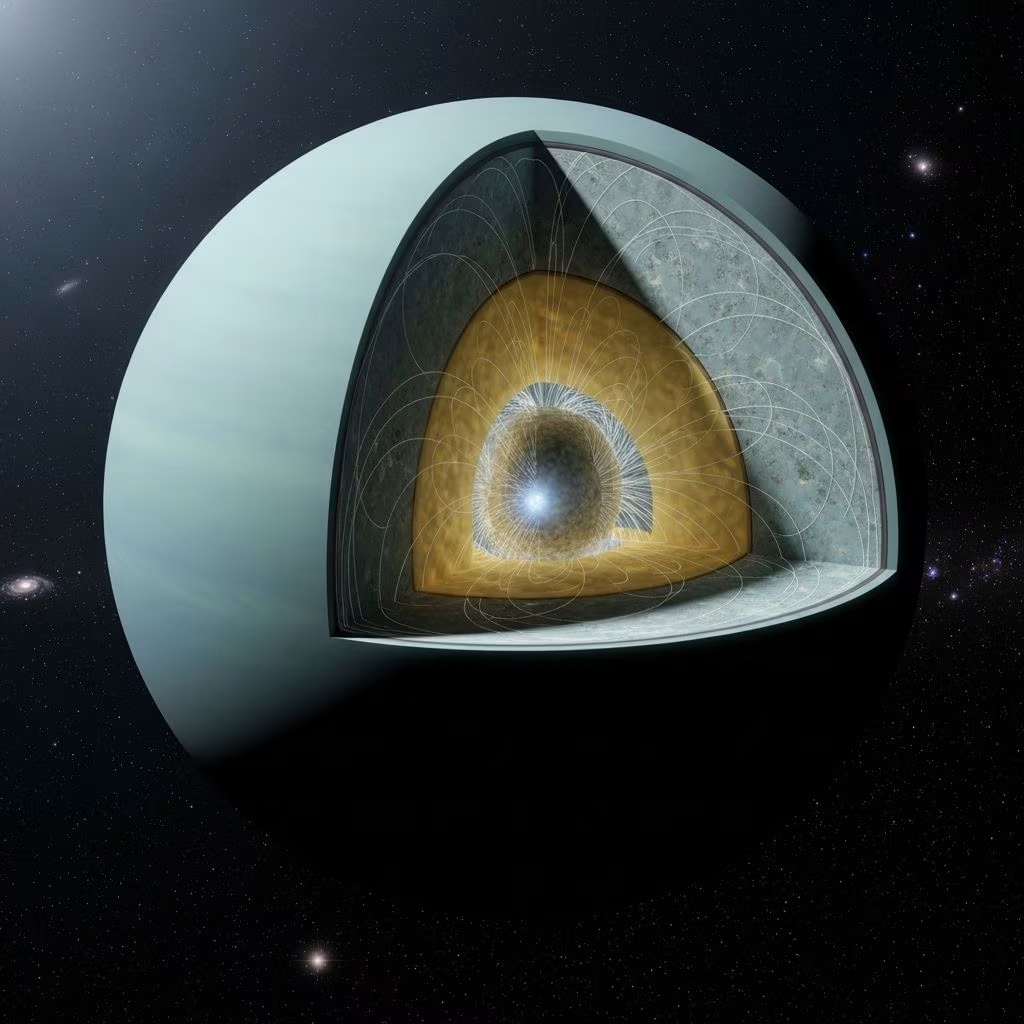
Beneath the frigid atmosphere, Uranus’s bulk structure is a subject of ongoing research. By using spacecraft data, theoretical modeling, and observations of gravity fields and magnetic alignment, scientists have derived the following layered structure:
- Rocky Core: Dense materials comprising less than 20% of the planet’s radius, likely silicates and metals.
- Icy Mantle: Making up roughly 60% of Uranus’s volume, this zone consists of water, ammonia, and methane ices under extreme pressure and temperature. The composition also contributes to the planet’s magnetic field via electrical conductivity in these ices.
- Hydrogen-Helium Envelope: The outermost layer, essentially the atmosphere, surrounding the mantle and core.
A cross-section would show a relatively small rocky core, surrounded by a deep mantle, and crowned with the gaseous outer envelope. Most of the planet’s mass thus lies not in gas, but in these “ice” elements – a distinctive trait that divides Uranus (and Neptune) from Jupiter and Saturn.
Climate and Atmospheric Activity
Uranus is infamous for its unusual climate features:
- Lowest minimum atmospheric temperature among planets (49K).
- Zones of rapid winds; peak speeds reach up to 900 km/h (560 mph) at cloud tops.
- Oddly featureless appearance, with occasional bright tropospheric clouds and ephemeral polar caps that change with the seasons.
- Extremely low internal heat: Uranus emits virtually no excess energy into space, unlike Jupiter, Saturn, or Neptune.
The reasons behind these peculiarities remain unclear. Some astronomers think that a massive ancient collision may have expelled much of Uranus’s original heat, leaving it far colder than theoretical models expect. The sluggish convective motions within its interior reinforce this theory and may explain the relative scarcity of dynamic weather systems visible from space.
How We Know: Missions, Observations, and Looking Ahead
Our picture of Uranus’s composition and structure comes from a combination of:
- Telescopic Spectroscopy: Earth-based and space telescopes have analyzed Uranus’s reflected sunlight, decoding signature absorption patterns indicating the presence of methane and other compounds.
- Voyager 2 (1986): This NASA spacecraft performed the sole flyby, measuring atmospheric profiles, wind speeds, and magnetic fields, and revealing much about its clouds and interior.
- Future Missions: As of 2025, the Uranus Orbiter and Probe mission is scheduled to launch in 2031, promising detailed atmospheric analysis and new insights once it arrives in the 2040s.
Uranus Compared to Jupiter and Saturn
| Property | Uranus | Jupiter | Saturn |
|---|---|---|---|
| Atmospheric H2/He Ratio | ~83/15% | ~89/10% | ~96/3% |
| Visible Clouds | Methane, H2S, NH3 | Ammonia | Ammonia, Ammonium Hydrosulfide |
| Main Mantle | Icy (water, ammonia, methane) | Metallic hydrogen | Metallic hydrogen |
| Core | Rocky/metallic; small | Rocky/metallic; moderate | Rocky/metallic; moderate |
| Internal Heat Output | Very low | High | High |
| Primary Color | Blue-green | Red-orange | Pale yellow-gold |
FAQ: Uranus’s Composition and Atmosphere
Q: Why is Uranus called an “ice giant” if it’s not made of ice we see on Earth?
A: The “ice” in ice giant refers to volatile molecules such as water, ammonia, and methane, which are found as solids or super-pressurized fluids deep inside these planets—very different from frozen lakes on Earth.
Q: What gives Uranus its unique color?
A: Methane gas in Uranus’s atmosphere absorbs red wavelengths of sunlight and reflects blue-green, creating the planet’s aquamarine hue.
Q: How is Uranus’s atmosphere different from Jupiter and Saturn?
A: While all three have thick hydrogen-helium atmospheres, Uranus contains a greater proportion of ice-forming compounds below its clouds, and its extreme cold affects atmospheric chemistry and weather patterns.
Q: Has any probe ever entered Uranus’s atmosphere?
A: No, but NASA’s Voyager 2 performed a close flyby in 1986. The upcoming Uranus Orbiter and Probe, launching in the 2030s, aims to deliver a descent probe for direct atmospheric sampling.
Q: Why is Uranus so cold compared to other giants?
A: Unlike Jupiter, Saturn, and Neptune, Uranus emits virtually no internal heat, likely due to a turbulent past collision that expelled much of its primordial energy. This leaves only weak solar heating to warm its atmosphere.
In Summary
Uranus is a planetary paradox: an icy world with a featureless face, an atmosphere hiding in plain sight, and an enigmatic interior that challenges the boundaries of solar system science. With its unique chemistry, layered clouds, and mysterious absence of internal heat, Uranus remains a compelling target for future exploration and scientific discovery.
References
- https://www.space.com/18708-uranus-atmosphere.html
- https://en.wikipedia.org/wiki/Uranus
- https://en.wikipedia.org/wiki/Atmosphere_of_Uranus
- https://www.space.com/3136-uranus-data-sheet.html
- https://www.ebsco.com/research-starters/science/uranuss-interior
- https://spaceplace.nasa.gov/all-about-uranus/en/
- https://www.popularmechanics.com/space/solar-system/a60472455/uranus-neptune-methane-ice/
- https://spaceref.com/science-and-exploration/the-composition-of-uranus-atmosphere/
- https://www.ebsco.com/research-starters/chemistry/uranuss-atmosphere
- https://spacemesmerise.com/blogs/planets/unlocking-the-secrets-of-uranus-atmosphere-composition
- https://spacemesmerise.com/en-in/blogs/planets/unlocking-the-secrets-of-uranus-atmosphere-an-in-depth-look-at-its-chemical-composition
- https://globaldatabase.ecpat.org/pdf/sign-pdf-form/Sitewide:C3K0/_pdfs/uranus_composition.pdf
- https://spaceaustralia.com.au/blogs/news/ask-arse-what-is-up-with-uranus
- https://lovethenightsky.com/what-is-uranus-made-of/
- https://astrophotographylens.com/blogs/astro/what-is-uranus-atmosphere-made-of
- https://starwalk.space/en/news/facts-about-uranus
- https://science.nasa.gov/uranus/facts/