Asteroids are ancient rocky relics that illuminate the solar system’s history, connect us to planetary formation, and pose both scientific opportunity and existential risk. This article explores what asteroids are, how they formed, their types, discovery, famous examples, collision risks, and the expanding frontier of human exploration.
What Are Asteroids?
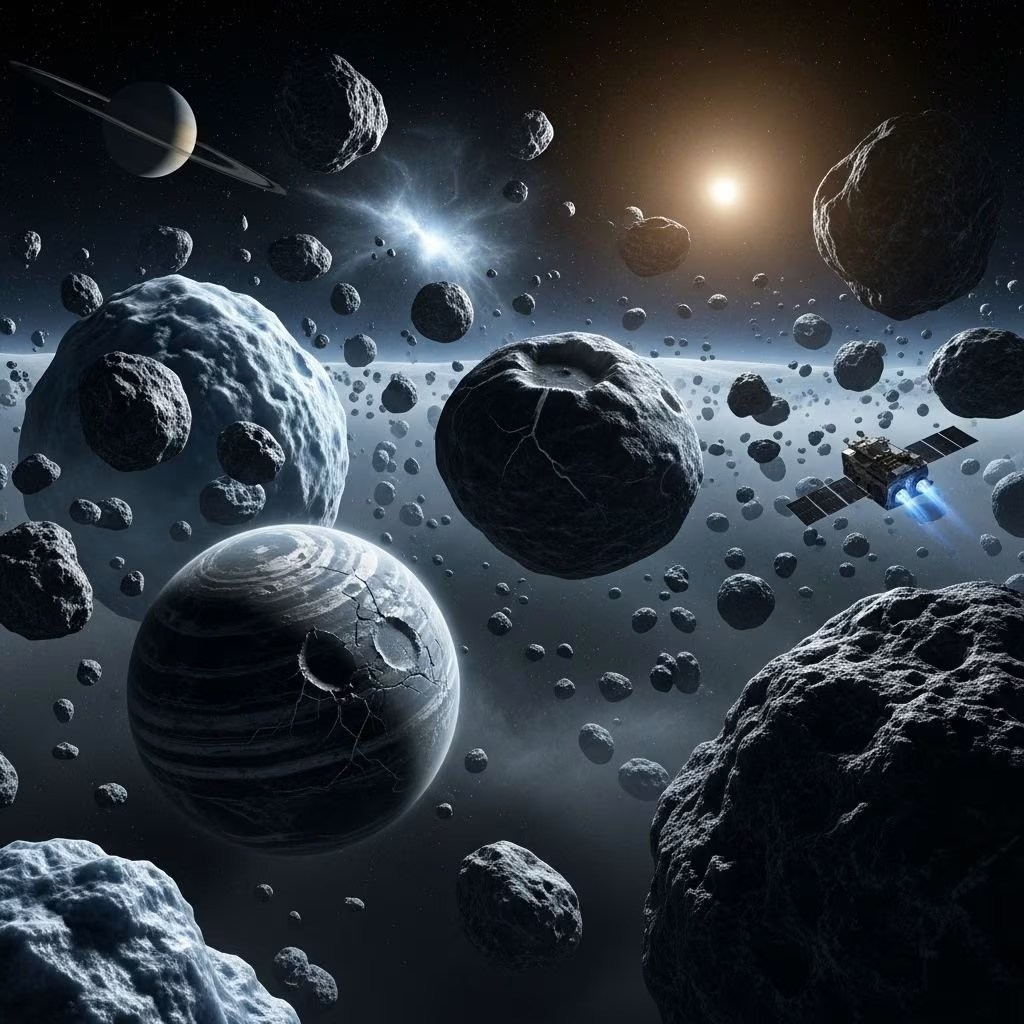
Asteroids are small, rocky bodies that orbit the Sun, mostly found in the region between Mars and Jupiter known as the asteroid belt. They are remnants from the solar system’s formation, typically composed of rock, metal, and sometimes organic compounds.
- Asteroids range in size from just a few meters to hundreds of kilometers across.
- Unlike planets, asteroids are not spherical due to their small mass and weak gravity.
- Most asteroids do not have atmospheres and are irregularly shaped.
Asteroids differ from comets in that they are primarily rocky or metallic, while comets are icy and develop tails when close to the Sun.
Origins: Asteroid Formation and the Early Solar System
The story of asteroids begins about 4.6 billion years ago, as the solar system formed from a solar nebula—a swirling cloud of gas and dust. Asteroids represent leftover building materials from this formative era. Here’s how the process unfolded:
- The solar nebula began to cool, and microscopic particles condensed from vapor.
- These tiny grains stuck together, forming larger aggregates called planetesimals.
- Planetesimals are the building blocks of planets, but in certain zones, notably between Mars and Jupiter, planetary formation was disrupted by massive gravitational influences.
- Repeated collisions among planetesimals led not to the formation of a single planet, but to a swarm of independently orbiting fragments—the asteroid belt.
Gravitational tugs, especially from the giant planet Jupiter, stirred up the asteroid-forming zone, preventing accumulation into a full-fledged planet and fostering a dynamic environment of collisions, disruptions, and fragmentations. Over billions of years, these processes have continued, creating the vast variety of asteroid shapes and sizes seen today.
Asteroid Belt: The Solar System’s Debris Field
The asteroid belt is an expansive region between 2.1 and 3.3 astronomical units (AU) from the Sun, sitting between the orbits of Mars and Jupiter. It contains the largest concentration of asteroids, though they are widely spaced apart.
- Originally, this belt may have contained enough mass to form one or more planets, but Jupiter’s gravitational pull disrupted this process.
- Today, the belt holds millions of objects, but their combined mass is less than 5% that of Earth’s Moon.
- The largest inhabitants—such as Ceres and Vesta—are planetary embryos left over from this turbulent history.
Beyond the Asteroid Belt
Not all asteroids reside in the asteroid belt. Some can be found closer to the Sun (Near-Earth Asteroids), while others share orbits with Jupiter (Trojans) or exist farther beyond Neptune (Trans-Neptunian Objects).
Types of Asteroids: Composition and Classification
Asteroids are primarily classified by their composition—what they are made of—which reflects where in the solar system they formed and the conditions at their birth:
- C-type (carbonaceous) asteroids:
Make up about 75% of known asteroids. Contain a high amount of carbon, giving them a dark appearance. Found mostly in the outer asteroid belt. - S-type (silicaceous) asteroids:
Account for about 17% of asteroids. Composed mostly of silicate (rocky) materials and nickel-iron. Brighter than C-types and dominate the inner belt. - M-type (metallic) asteroids:
Mainly consist of nickel and iron. Occur primarily in the middle region of the asteroid belt.
| Type | Composition | Location |
|---|---|---|
| C-type | Carbon-rich, dark material | Outer belt |
| S-type | Silicate and nickel-iron | Inner belt |
| M-type | Metallic (nickel, iron) | Central belt |
Other rare types include D-types (very dark, possibly organic-rich), E-types (high in enstatite), and V-types (basaltic, associated with Vesta).
Discovery of Asteroids
Asteroids remained unseen for most of human history due to their relative darkness and small size. The search for planets between Mars and Jupiter in the early 19th century led to the breakthrough discovery of asteroids.
- 1801: Italian astronomer Giuseppe Piazzi discovered Ceres, the first and largest known asteroid—now classified as a dwarf planet.
- Subsequent discoveries by astronomers such as Heinrich Olbers added Pallas, Juno, and Vesta.
- By the mid-1800s, hundreds had been found; today, hundreds of thousands of asteroids have been cataloged, with millions believed to exist.
Advances in telescope technology and digital sky surveys have continually accelerated asteroid discovery rates.
Famous Asteroids and Their Characteristics
- Ceres: The largest object in the asteroid belt—about 940 km (580 miles) across; now considered a dwarf planet. Ceres is differentiated, with a rocky core and icy mantle, and may conceal subsurface water ice.
- Vesta: At 525 km (326 miles) in diameter, Vesta shows evidence of volcanic activity and is thought to have a layered structure similar to terrestrial planets.
- Pallas and Hygeia: Other prominent asteroid belt residents with sizes exceeding 400 km in diameter.
Many smaller asteroids have also become famous as the targets of spacecraft missions or as sources of meteorites that have fallen to Earth.
Near-Earth Asteroids: Potential Hazards and Benefits
Not all asteroids stay in the main belt. Some are nudged by gravitational interactions or collisions and approach the inner solar system as Near-Earth Asteroids (NEAs). These objects cross or approach Earth’s orbit, occasionally posing a threat.
- Potential Hazard: Large NEA impacts can have severe biological and climatic consequences. The most famous impact, about 66 million years ago, contributed to the extinction of the dinosaurs.
- Smaller NEA impacts, like the 2013 Chelyabinsk meteor in Russia, can still cause significant damage at a local scale.
- Ongoing sky surveys track NEAs to estimate risks and prepare for potential deflection missions.
- Potential Resources: NEAs may offer abundant sources of metals, water, and other materials for future space industry and exploration.
Asteroids and Meteorites: Connection to Earth
When asteroid fragments survive passage through Earth’s atmosphere and land on the surface, they are called meteorites. These specimens have provided priceless scientific insights:
- Meteorites have been dated as some of the oldest materials in the solar system, supporting models of planetary formation.
- Primitive meteorites contain organic molecules and water-bearing minerals, suggesting that asteroids may have contributed key ingredients for life to early Earth.
Human Exploration of Asteroids
Asteroids have captivated not just astronomers but also engineers and mission planners. Scientific and technological exploration of asteroids has accelerated in past decades:
- Galileo (1991): The first spacecraft to fly by and photograph an asteroid, Gaspra, during its journey to Jupiter.
- NEAR Shoemaker (2000-2001): The first mission to orbit and land (albeit hard) on asteroid Eros, yielding sharp close-ups and compositional data.
- Hayabusa (2005) and Hayabusa2 (2018-2020): Japanese missions that collected samples from asteroids Itokawa and Ryugu, respectively, and returned them to Earth.
- OSIRIS-REx (2020-2023): A NASA mission that retrieved samples from the near-Earth asteroid Bennu for detailed laboratory analysis.
These missions have revolutionized our understanding of asteroids’ structures, surfaces, and chemistry, and have taught engineers how to land, anchor, and sample from bodies with virtually no gravity.
Asteroid Deflection and Earth Protection
The potential hazard of NEA impacts has spurred research into methods for asteroid deflection and planetary defense:
- Tracking and early warning: Global networks and sky surveys seek to discover and chart trajectories of potentially hazardous asteroids.
- Kinetic impactor missions: NASA’s DART mission (2022) successfully altered the trajectory of the asteroid moonlet Dimorphos via deliberate impact—the first demonstration of asteroid deflection technology.
- Other concepts include gravity tractors, laser ablation, or even nuclear explosives as last resorts.
International collaboration and coordinated response plans are essential, as asteroid impacts are a global threat best addressed collectively.
Frequently Asked Questions (FAQs)
Q: Why are most asteroids found in the asteroid belt?
A: The asteroid belt formed in a region of the solar system where Jupiter’s gravity prevented accretion into a larger planet, leaving behind a population of rocky and metallic bodies.
Q: What is the difference between an asteroid, a meteoroid, and a meteorite?
A: Asteroids orbit the Sun, mostly in the asteroid belt. Meteoroids are smaller fragments of asteroids or comets. Meteors are meteoroids that enter the Earth’s atmosphere and glow from friction (often called “shooting stars”). Meteorites are meteors that survive the journey to the Earth’s surface.
Q: Could asteroids ever be used for mining or resource extraction?
A: Yes, the metallic content and presence of water in certain asteroids have sparked considerable interest in asteroid mining for future space industry and the support of long-term human missions.
Q: How are asteroids named?
A: Traditionally, asteroid discoverers submit proposed names, which are then approved by the International Astronomical Union. Most receive a number and a unique name referencing mythological figures, scientists, or cultural icons.
Q: What is the largest asteroid?
A: Ceres is the largest and most massive asteroid, measuring about 940 km (580 miles) in diameter; it has been reclassified as a dwarf planet.
Conclusion: Asteroids and the Frontier of Space Science
Asteroids are windows into the solar system’s primordial past—a testament to the era before planets formed. They are natural fossils, rich with information about the conditions that governed Earth’s own birth and evolution. As technology advances, asteroids — once distant dots of light — have become targets for sophisticated exploration and, possibly, new economic opportunities.
Our growing capacity to analyze, visit, and even potentially redirect asteroids is unlocking new ways to safeguard Earth and to expand humanity’s reach through the cosmos.
Key Facts at a Glance
- The asteroid belt lies mainly between Mars and Jupiter (2.1 to 3.3 AU from the Sun).
- Ceres, the largest asteroid, has achieved dwarf planet status.
- Asteroids are mostly irregular in shape; only the largest approach sphericity due to self-gravity.
- Solar system formation dynamics—especially Jupiter’s gravitational influence—shaped the asteroid belt.
- Ongoing missions and sky surveys seek to understand, exploit, and protect against asteroids, reflecting their dual role as scientific resource and planetary threat.
References
- https://science.nasa.gov/asteroids-comets-meteors/facts/
- https://en.wikipedia.org/wiki/Asteroid
- https://www.youtube.com/watch?v=wpbVAGEf9nE
- https://www.dlr.de/en/research-and-transfer/projects-and-missions/hayabusa2/asteroids-the-remains-of-planetary-building-materials
- https://asteroidday.org/resources/asteroid-learning/learn-asteroids-and-the-formation-of-the-solar-system/
- https://news.clemson.edu/clemson-astrophysicists-tell-us-about-asteroids-and-whether-we-need-to-worry/
- https://en.wikipedia.org/wiki/Formation_and_evolution_of_the_Solar_System
- https://science.nasa.gov/solar-system/asteroids/facts/
- https://atlas.fallingstar.com/asteroid-intro.php
- https://www.mpia.de/5641119/news_publication_16668835_transferred
- https://www.lpi.usra.edu/exploration/education/hsResearch/asteroid_101/Formation_Physical%20Properties_Asteroids.pdf
- https://www.skyatnightmagazine.com/space-science/asteroid-belt-facts-formation
- https://www.youtube.com/watch?v=stLyZ7f1yTM
- https://meteorites.asu.edu/meteorite-origins
- https://www.planetary.org/worlds/asteroids-comets-small-worlds
- https://www.amnh.org/exhibitions/permanent/the-universe/planets/formation-of-our-solar-system
- https://study.com/learn/lesson/asteroid-origins-facts-composition.html
- https://science.howstuffworks.com/asteroid-belt.htm
- https://www.encyclopedia.com/science/technology-magazines/how-asteroids-and-comets-formed