


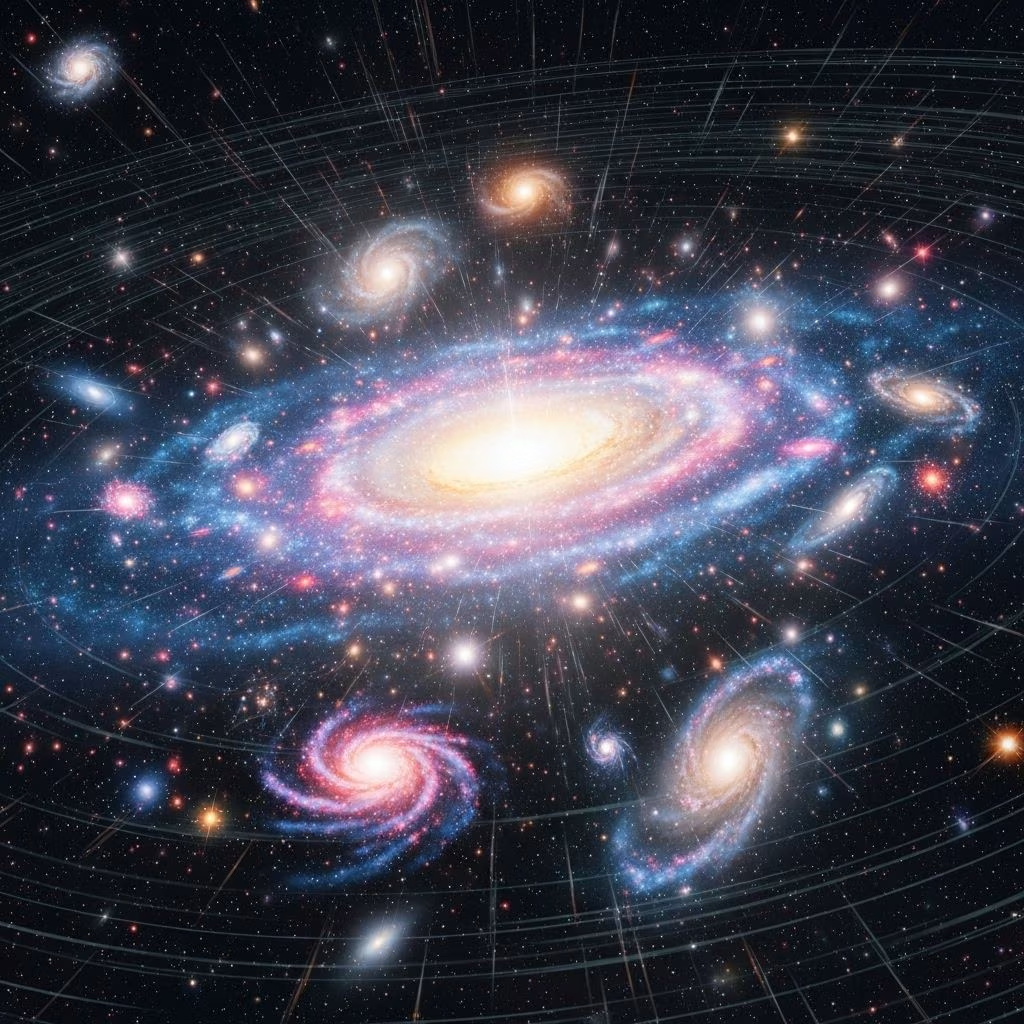
What Is the Big Bang Theory?
The Big Bang Theory is the leading scientific explanation for the emergence and evolution of the universe as we know it. It proposes that the universe originated nearly 13.8 billion years ago from a state of extremely high density and temperature, and has been expanding ever since. This framework not only accounts for the distribution of galaxies and matter but also explains fundamental phenomena observable throughout the cosmos.
The Science Behind the Universe’s Beginning
According to the Big Bang Theory, the entire universe was once compressed into a minuscule point, often called a singularity, with infinite heat and density. Then, in a fraction of a second, a massive expansion event occurred. This was not an explosion in space, but rather an expansion of space itself. In this formative moment, known as the Big Bang, both space and time were born. The universe began to cool rapidly, allowing matter and energy to interact and form the basic building blocks of everything we observe today.
- Age of Universe: Estimated to be about 13.8 billion years.
- Singularity: Point of infinite density where conventional physics breaks down.
- Expansion: Space itself is expanding; distant galaxies are moving away from us.
Historical Background and Development
The modern era of cosmology began in the early 20th century as astronomers and physicists sought to understand the large-scale structure of the universe. Critical milestones mark the development of the Big Bang Theory:
Edwin Hubble and the Expanding Universe
In the 1920s, Edwin Hubble observed that distant galaxies are receding from Earth in all directions. This phenomenon, now known as Hubble’s Law, provided initial evidence that the universe is expanding, which supports the idea of a dynamic, rather than static, cosmos.
- Doppler Redshift: Light from galaxies shifts toward red as they move away, measured by their spectral lines.
- Implication: The farther a galaxy, the faster it appears to recede, indicating a uniform expansion.
Discovery of the Cosmic Microwave Background
In 1964, Arno Penzias and Robert Wilson accidentally detected a faint, persistent background radiation while working at Bell Labs. This cosmic microwave background (CMB) is a relic of the universe’s earliest, hottest moments. The discovery provided strong empirical support for the Big Bang Theory.
- Uniform Temperature: The CMB is remarkably uniform but has tiny fluctuations that seeded galaxy formation.
- Confirmation: The CMB matches predictions for the cooled remnants of hot, early universe radiation.
Core Principles and Phases of the Big Bang
The Big Bang Theory outlines several key phases in the universe’s evolution, explaining how the cosmos transitioned from initial chaos to the structured universe we observe today.
Chronology of Cosmic Events
| Time After Big Bang | Event | Description |
|---|---|---|
| < 1 second | Inflation | Universe undergoes extremely rapid expansion, smoothing out irregularities. |
| 1 second | Formation of basic particles | Protons, neutrons, and electrons form as universe cools. |
| 3 minutes | Nucleosynthesis | Atomic nuclei (mainly hydrogen and helium) are formed. |
| 380,000 years | Recombination | Electrons combine with nuclei to form atoms; CMB is released. |
| Several hundred million years | First stars and galaxies | Gravity pulls matter together, initiating star and galaxy formation. |
Formation of the Universe’s Structure
After the early moments, the universe continued to expand and cool. With enough time, gravity caused regions of slightly higher density to collapse, forming the first stars and galaxies. Over billions of years, galaxies clustered into larger structures, such as clusters and superclusters, giving rise to the cosmic web observed in deep-space surveys.
Key Evidence Supporting the Big Bang
The Big Bang Theory is supported by multiple, independent lines of evidence both observational and theoretical:
- Redshift of Distant Galaxies: Almost all galaxies are observed moving away from Earth, indicating ongoing expansion.
- Cosmic Microwave Background: Uniform background radiation is interpreted as heat leftover from the early universe.
- Elemental Abundances: The predicted and observed proportions of hydrogen and helium in the universe closely match Big Bang nucleosynthesis models.
- Large-scale Structure: The distribution and clustering of galaxies trace the growth of initial quantum fluctuations into the structures we see today.
Still Open Questions and Mysteries
Despite its wide acceptance, the Big Bang Theory does not answer all questions about the universe’s origins and fate. Some key mysteries remain:
- What caused the Big Bang? What, if anything, existed before the Big Bang is still unknown. The laws of physics break down at the singularity.
- Inflation: The extremely rapid expansion in the universe’s first fractions of a second isn’t fully explained—its triggering mechanism and underlying physics remain speculative.
- Dark Matter and Dark Energy: Roughly 95% of the universe is composed of material and energy we cannot see directly—these components’ true natures are undetermined.
- The Fate of the Universe: Whether the universe will expand forever, halt, or eventually collapse in a “Big Crunch” depends on properties of dark energy and cosmic geometry still under investigation.
Alternative Theories and Challenges
While the Big Bang Theory remains the standard model, several alternative or supplementary models have been proposed over the years:
- Steady State Theory: Argued that the universe is eternal and unchanging on a large scale, and new matter is continually created as the universe expands. This view lost favor after the discovery of the CMB.
- Oscillating Universe: Suggests the universe undergoes endless cycles of expansion and contraction (“Big Bang” followed by a “Big Crunch”).
- Multiverse and Cyclic Models: Some recent theories propose our universe is just one of many in a broader multiverse, or that bang/crunch cycles repeat indefinitely.
The Fate of the Universe
What ultimately happens to the universe depends largely on the amount of matter, the influence of dark energy, and the geometry of space-time. Leading scenarios include:
- Continued Expansion: If dark energy drives acceleration eternally, the universe will keep expanding, cooling, and becoming emptier—a “Big Freeze.”
- Big Crunch: If there is enough matter to slow expansion and reverse it, the universe might collapse back into a singularity.
- Big Rip: If dark energy grows stronger over time, it could eventually tear apart galaxies, stars, planets, and even atoms.
What Came Before the Big Bang?
One of the biggest open questions in cosmology is what, if anything, existed “before” the Big Bang. According to current physics, time and space themselves began with the Big Bang, making the question highly speculative. Some theories propose:
- No ‘Before’: Time itself started at the Big Bang; asking what came before is meaningless according to some interpretations.
- Quantum Cosmology: The universe may have originated from a quantum fluctuation in a ‘vacuum’ or higher-dimensional space.
- Inflationary Multiverse: Some scenarios envision a ‘multiverse’—a much larger cosmos where our Big Bang was just one among countless others.
- Cycles: In cyclic universe models, our “Big Bang” may have been the result of the collapse of a previous universe.
Big Bang Theory and Modern Cosmology
The Big Bang Theory has profoundly influenced not just astronomy and physics but also philosophy and our sense of place in the cosmos. It is the foundation of cosmic science and the launchpad for ongoing discoveries about the universe’s deepest mysteries.
Major Discoveries Linked to the Big Bang
- Discovery of Cosmic Acceleration: Surveys of distant supernovae reveal that the universe’s expansion is accelerating, attributed to ‘dark energy.’
- Mapping the Cosmic Web: Large-scale surveys show that galaxy clusters align in vast filaments and sheets, tracing the early universe’s density fluctuations.
Frequently Asked Questions (FAQs)
Q: Does the Big Bang describe an explosion?
A: Not in the conventional sense. The Big Bang was an expansion of space itself, not an explosion of matter into empty space.
Q: What evidence most strongly supports the Big Bang Theory?
A: The cosmic microwave background radiation, the expansion of the universe as observed by galaxy redshifts, and the relative abundances of light elements are the strongest lines of evidence.
Q: What came before the Big Bang?
A: According to current physics, time and space began at the Big Bang. Some hypotheses suggest quantum events or previous universes, but these remain speculative.
Q: Will the universe expand forever?
A: Observations suggest the universe’s expansion is accelerating, so it may continue expanding indefinitely unless new forces or phenomena are discovered.
Q: Are there alternative theories to the Big Bang?
A: Alternatives include the steady-state model and various cyclic models, but none are as widely supported by evidence as the Big Bang Theory.
Q: How do scientists study the early universe?
A: Through observations of the CMB, galaxy surveys, simulations, and experiments probing fundamental particles and energies.
Summary: The Ongoing Quest
The Big Bang Theory stands as the central, unifying explanation for the origin and evolution of the cosmos. With every new discovery—be it cosmic background echoes or glimpses of the universe’s first galaxies—scientists probe deeper into its beginnings and ultimate fate.
- The theory revolutionized our understanding of the universe’s age, structure, and destiny.
- Major mysteries remain, notably the nature of dark matter, dark energy, and the very first moments of existence.
- The story of the universe is still unfolding, offering ever more profound mysteries with each scientific advance.
References
- https://www.space.com/25126-big-bang-theory.html
- https://www.space.com/8066-big-bang-solid-theory-mysteries-remain.html
- https://en.wikipedia.org/wiki/Big_Bang
- https://iarjset.com/wp-content/uploads/2023/11/IARJSET-NCSTCS-56.pdf
- https://www.astronomy.com/science/the-science-behind-the-big-bang-theory/
- https://spaceplace.nasa.gov/big-bang/en/
- https://phys.org/news/2015-12-big-theory.html
- https://www.ebsco.com/research-starters/physics/big-bang-theory-overview
- https://www.britannica.com/science/big-bang-model
- https://www.encyclopedia.com/science-and-technology/astronomy-and-space-exploration/astronomy-general/big-bang-theory
- https://study.com/academy/lesson/big-bang-theory-lesson-for-kids-definition-facts-timeline.html
- https://science.nasa.gov/universe/the-big-bang/
- https://byjus.com/free-ias-prep/big-bang-theory/
- https://study.com/academy/lesson/big-bang-theory-of-the-universe-definition-lesson-quiz.html
- https://astronomyexplained.com/what-is-the-big-bang-theory-how-did-our-universe-begin/
- https://universewatcher.com/the-big-bang-theory-explained/
- http://patrickgrant.com/BBWiki.htm
- https://www.academicblock.com/science/physics-of-the-universe/big-bang-theory


