Black Holes, General Relativity, and the Gravity Paradox
\n
Black holes are among the most enigmatic and extreme phenomena in our universe. They serve as laboratories for exploring the fundamental laws of physics, testing the limits of Einstein’s general relativity, and confronting us with puzzles that force scientists to rethink the nature of space, time, and reality itself[13].
\n\n
What Are Black Holes?
\n
Black holes are regions in space where gravity is so intense that nothing — not even light — can escape their pull. They are formed when massive stars collapse under their own gravity, crushing matter into a singular point known as a singularity. The boundary beyond which no escape is possible is called the event horizon.
\n
- \n
- Event Horizon: The invisible surface around a black hole where escape velocity equals the speed of light.
- Singularity: The point of infinite density at the center of a black hole where known laws of physics break down.
- Formation: Usually results from the collapse of a massive star after it has exhausted its nuclear fuel.
\n
\n
\n
\n
Black holes come in different categories, including stellar-mass black holes (a few times the mass of our Sun), supermassive black holes (millions to billions of times Sun’s mass), and more exotic objects like primordial black holes potentially formed soon after the Big Bang.
\n\n
The Role of General Relativity
\n
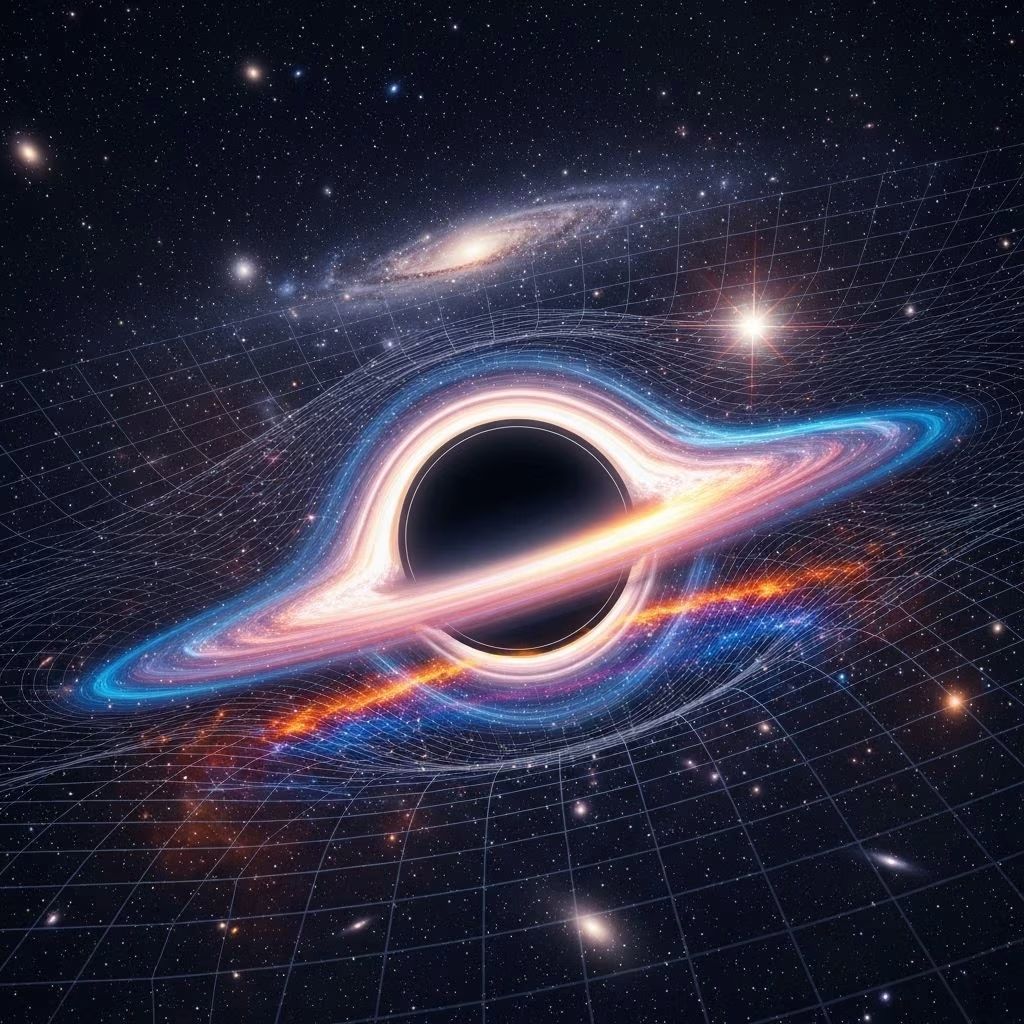
Einstein’s general relativity revolutionized our understanding of gravity by linking it to the curvature of space-time. Instead of gravity being a force, it emerges from the geometry of four-dimensional space-time, which is warped by mass and energy. Black holes are direct consequences of this theory: when matter collapses beyond a critical threshold, it deforms space-time so much that a region with no return — the event horizon — is formed.
\n
- \n
- Einstein’s Equations: Predict the existence of black holes and describe their properties.
- Schwarzschild Solution: The simplest black hole, non-rotating and uncharged, with a perfectly spherical event horizon.
- Kerr and Reissner-Nordström Solutions: Describe rotating and electrically charged black holes.
\n
\n
\n
\n\n
The Formation Process: From Star to Black Hole
\n
Imagine a massive star finishing its lifecycle:
\n
- \n
- As nuclear fusion ceases, the star can no longer support itself against gravity.
- The core collapses, compressing matter into an ever-denser state.
- Once its radius falls below the Schwarzschild radius, a black hole forms, and the event horizon appears.
- Anything passing the event horizon is irretrievably pulled toward the singularity.
\n
\n
\n
\n
\n
Within the black hole, Einstein’s equations indicate that all paths — even for light — point inexorably toward the singularity, where density becomes infinite and space-time curvature diverges[12].
\n\n
The Singularity Paradox: When Physics Breaks Down
\n
The singularity is a profound peculiarity of black holes. It represents a region where general relativity itself ceases to function; curvature becomes infinite, and predictions are impossible[14]. Physicists call this the singularity paradox — a sign that our theories are incomplete.
\n
- \n
- Infinite Density: The singularity squeezes matter and energy into a space with zero volume.
- Space-Time Breakdown: Conventional physics, including Einstein’s field equations, provide no reliable predictions here.
- Catastrophic for Science: If singularities truly existed, we couldn’t use physics to predict the future from present data[14].
\n
\n
\n
\n
Most experts believe that singularities reveal the limits of general relativity and highlight our need for a deeper, quantum theory of gravity[12][14].
\n\n
Proposed Solutions: Beyond General Relativity
\n
Theoretical physicists have suggested modifications to general relativity that could smooth out singularities, transforming them from points of infinite curvature into highly curved, but regular, regions of space-time[14]. Some approaches include:
\n
- \n
- Quantum Gravity: Seeks to unite general relativity and quantum mechanics, potentially resolving singularities at Planck scale.
- String Theory: Suggests that matter is composed of tiny strings, smoothing out point-like singularities.
- Loop Quantum Gravity: Proposes a discrete structure to space-time, replacing singularities with quantum bridges.
\n
\n
\n
\n
For now, no theory has been experimentally verified, but advances — such as the imaging of black hole event horizons and the detection of gravitational waves — continue to provide crucial clues about the nature of gravity and the interior structure of black holes.
\n\n
Black Holes as Cosmic Laboratories
\n
Because black holes amplify gravitational effects to their extreme, they allow scientists to test general relativity and probe physics in ways that are impossible elsewhere in the universe. Observations of phenomena near black holes have repeatedly confirmed predictions such as:
\n
- \n
- Light bending and gravitational lensing by intense gravity.
- Frame-dragging effects due to rotating black holes.
- Energy extraction from rotating (Kerr) black holes via the Penrose process.
\n
\n
\n
\n
The historic Event Horizon Telescope imaging of the black hole M87 provided stunning confirmation of Einstein’s predictions for event horizons and gravitational shadows.
\n\n
The Black Hole Information Paradox
\n
Another puzzle is the black hole information paradox, rooted in the tension between quantum mechanics and general relativity. Stephen Hawking revealed that black holes should emit \”Hawking radiation,\” slowly evaporating over time, which could seemingly erase information about their original contents.
\n
- \n
- Quantum Mechanics: States that information can never be destroyed.
- General Relativity: Implies information may be lost at the singularity.
- Hawking Radiation: A theoretical process where black holes emit energy and eventually disappear.
\n
\n
\n
\n
This paradox remains unresolved, driving research into quantum gravity and spurring debates about the nature of reality itself.
\n\n
Comparing Black Holes to Newtonian Gravity
\n
| Feature | Newtonian Gravity | General Relativity |
|---|---|---|
| Gravity | Force acting at a distance | Curvature of space-time |
| Black Holes | Escaping mass possible (theoretically) | No escape once inside event horizon |
| Singularities | Not included | Inevitable at core of black holes |
| Predictions | Fails under extreme gravity | Accurate under intense gravity (except singularity) |
\n\n
Recent Advances and Ongoing Mysteries
\n
- \n
- Event Horizon Telescope: Provided the first direct image of a black hole’s shadow, confirming Einstein’s predictions.
- Gravitational Waves: Detected from black hole mergers, offer new means of probing strong gravity.
- Exotic Black Hole Types: Recent work hints at new categories, such as those formed in the early universe.
- Theoretical Modifications: Ongoing research seeks to refine Einstein’s equations to resolve singularities and unify gravity with quantum physics[14].
\n
\n
\n
\n
\n\n
Frequently Asked Questions (FAQs)
\n
What is a black hole?
\n
A black hole is a region where gravity is so strong that not even light can escape. It forms when massive matter collapses, creating a singularity surrounded by an event horizon.
\n
What is the event horizon?
\n
The event horizon is the boundary around a black hole beyond which nothing, not even light, can escape. It marks the point of no return.
\n
Why do singularities represent a problem for physics?
\n
Singularities are points of infinite density where physical laws, including Einstein’s equations, break down, meaning science loses predictive power within them[12][14].
\n
Can black holes die?
\n
Black holes may slowly evaporate through Hawking radiation, but this process is very slow. The precise end-state of black holes remains one of the largest unsolved mysteries in physics[13].
\n
How do scientists study black holes?
\n
- \n
- Telescope imaging of event horizons (like M87).
- Observations of stellar motion around supermassive black holes.
- Detection of gravitational waves from merging black holes.
- Theoretical simulations and mathematical modeling.
\n
\n
\n
\n
\n
Is there a solution to the singularity paradox?
\n
No established solution exists yet, but theories like quantum gravity, string theory, and modified general relativity seek to resolve the paradox[14]. Discovery of experimental evidence supporting one of these could revolutionize our understanding of the cosmos.
\n\n
Conclusion: Black Holes at the Frontier of Science
\n
Black holes remain at the heart of modern physics, challenging our understanding of gravity, space, time, and quantum mechanics. While general relativity elegantly describes their behavior outside the event horizon, the singularity at their core defies prediction and reveals the edges of our knowledge. Through the study of black holes — and the paradoxes they present — scientists continue to push the boundaries and search for a deeper, unified theory of reality.
\n
References
- https://www.astronomy.com/science/black-holes-test-the-limits-of-einsteins-relativity/
- https://projecteuclid.org/journals/communications-in-mathematical-physics/volume-25/issue-2/Black-holes-in-general-relativity/cmp/1103857884.pdf
- https://en.wikipedia.org/wiki/Black_hole
- https://sites.pitt.edu/~jdnorton/teaching/HPS_0410/chapters/black_holes/index.html
- https://www.cfa.harvard.edu/research/science-field/einsteins-theory-gravitation
- https://en.wikipedia.org/wiki/Black_hole_information_paradox
- https://eventhorizontelescope.org/einsteins-theory-can-explain-black-hole-m87
- https://pweb.cfa.harvard.edu/research/science-field/einsteins-theory-gravitation
- https://news.uchicago.edu/explainer/black-holes-explained
- https://www.youtube.com/watch?v=NSqT594RVWQ
- https://jila.colorado.edu/~ajsh/courses/astr5770_21/grbook.pdf
- https://plato.stanford.edu/entries/spacetime-singularities/
- https://www.space.com/black-holes-general-relativity-gravity
- https://www.livescience.com/physics-mathematics/quantum-physics/einsteins-equations-need-to-be-refined-tweaks-to-general-relativity-could-finally-explain-what-lies-at-the-heart-of-a-black-hole
- https://www.damtp.cam.ac.uk/user/tong/gr/grhtml/S6.html
- https://nhsjs.com/2024/understanding-black-hole-under-the-lens-of-the-general-relativity/