


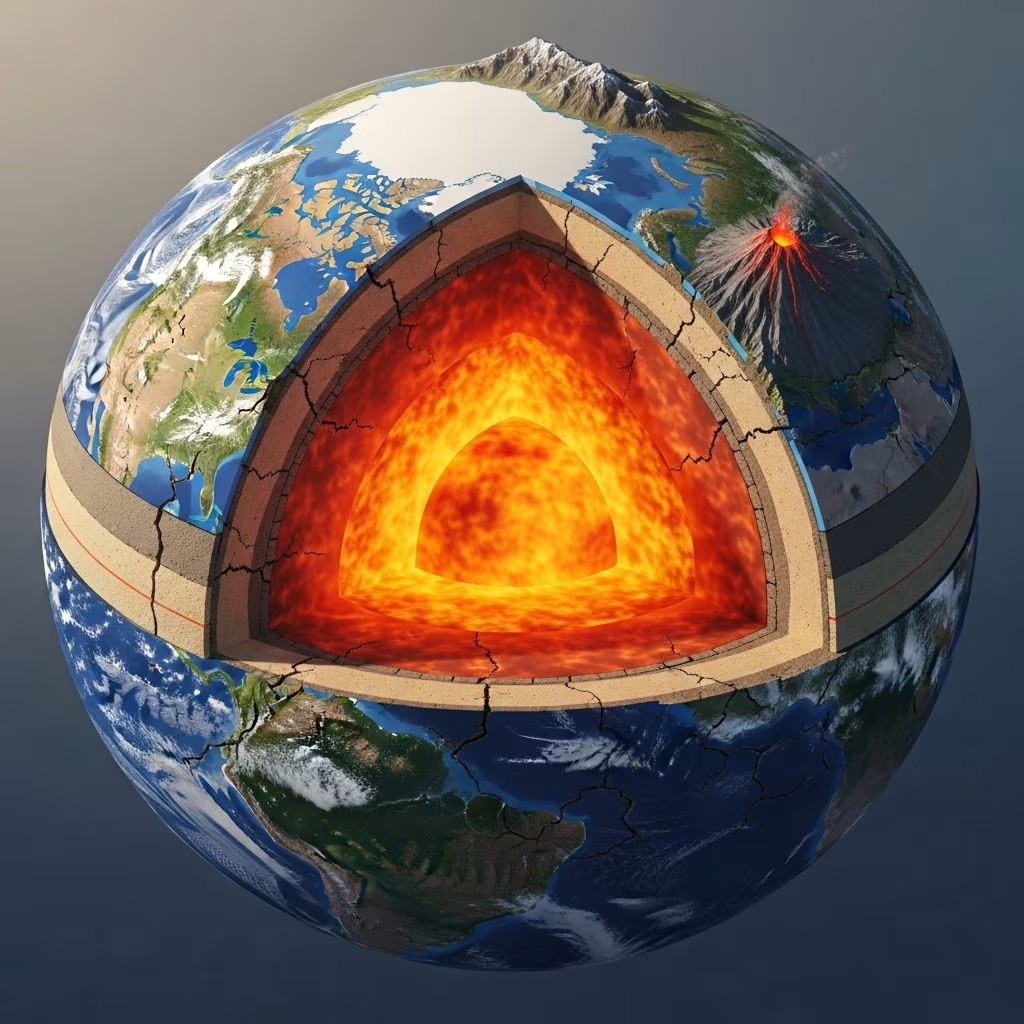
Lithosphere: Earth’s Rigid Outer Layer
The lithosphere defines Earth’s hard, outermost shell, acting as the structural foundation upon which continents, oceans, and landforms exist. Understanding its composition, boundaries, and dynamic processes is essential to comprehending the planet’s geology, its ever-changing landscapes, and the intricate interplay between living things and the planet itself.
What is the Lithosphere?
The lithosphere refers to the rigid, brittle layer of rocks and minerals that encompasses both the crust and the uppermost section of the mantle. This layer is crucial to the overall structure of Earth, directly underlying the atmosphere and hydrosphere, and supports the biosphere above.
Its name derives from the Greek lithos (stone) and sphaira (sphere), emphasizing its stony composition and enveloping nature.
The lithosphere is defined not only by its material makeup but by its mechanical behavior—unlike deeper layers that can deform slowly and flow, the lithosphere fractures and breaks under stress, producing earthquakes and shaping continents.
Lithosphere in Earth’s Layered Structure
Earth is built from multiple concentric layers, each with distinct properties. These can be described by their chemical composition and by their physical (mechanical) characteristics:
| Layer | Composition | Mechanical Property |
|---|---|---|
| Core | Mostly iron | Liquid outer, solid inner core |
| Mantle | Silicate rocks, iron, magnesium | Solid but flows very slowly |
| Crust | Rocks (granite, basalt) | Brittle, solid |
| Lithosphere | Crust + uppermost mantle | Brittle, rigid |
| Asthenosphere | Upper mantle | Plastic, able to flow |
The lithosphere thus comprises the entire crust (continental and oceanic) and the cool, rigid uppermost mantle. Beneath it lies the asthenosphere, a region where rocks are warmer, less rigid, and able to flow; this distinction is crucial for plate tectonics.
The Structure and Thickness of the Lithosphere
- Average Thickness: About 100 kilometers (62 miles), but varies by location.
It’s thinnest beneath young, hot ocean floors and thickest under ancient continental shields and mountain ranges. - Boundaries:
- Upper boundary: Earth’s surface—where it meets the atmosphere and hydrosphere.
- Lower boundary: The asthenosphere, which is more ductile.
- Temperature Gradient: Cooler and more rigid near the surface; gets hotter and more flexible as depth increases.
Composition: What Is the Lithosphere Made Of?
The lithosphere consists mainly of rocks and minerals found in two main subdivisions:
- Crust: The uppermost portion, including all surface land and seabed. It’s made of lighter minerals (continental crust: granite, oceanic crust: basalt and gabbro). The crust is what people and ecosystems interact with daily.
- Upper Mantle: The topmost, cooler part of the mantle beneath the crust. More magnesium and iron, less silica than the crust.
Most common elements:
- Silicon (Si)
- Oxygen (O)
- Iron (Fe)
- Magnesium (Mg)
- Aluminum (Al)
- Sodium (Na)
- Potassium (K)
Continental vs. Oceanic Lithosphere:
- Continental lithosphere is thicker, less dense, composed mainly of granite and other felsic rocks.
- Oceanic lithosphere is thinner, denser, and made predominantly of basalt and gabbro. It usually forms at ocean ridges and is recycled back into the mantle at subduction zones.
Plate Tectonics: The Dynamic Lithosphere
One of the defining features of the lithosphere is that it is segmented into tectonic plates—large slabs of rock that slowly move over the asthenosphere. These plates include both continental and oceanic lithosphere and are responsible for the globe’s dynamic surface changes.
- Major Plates: Seven large plates constitute most of Earth’s surface, including the Eurasian, African, North American, South American, Antarctic, Pacific, and Indo-Australian plates.
- Smaller Plates: Several minor plates also exist, such as the Nazca, Cocos, and Caribbean plates.
Plate movement results from thermal convection currents in the underlying mantle and leads to various geological phenomena:
- Earthquakes: Occur when stress causes the brittle lithosphere to rupture.
- Volcanism: Magma from the mantle can breach the crust through plate boundaries.
- Mountain Building: Collision and compression at convergent boundaries create mountains.
- Seafloor Spreading: New oceanic lithosphere forms at mid-ocean ridges.
- Subduction: Old oceanic lithosphere sinks back into the mantle at trenches.
Boundaries and Plate Interactions
| Type of Boundary | Description | Geological Result |
|---|---|---|
| Divergent | Plates move apart | Forms new crust, mid-ocean ridges |
| Convergent | Plates move toward each other | Subduction zones, mountain ranges |
| Transform | Plates slide past each other | Earthquakes, San Andreas Fault |
Lithosphere’s Role in Earth’s Spheres
Earth’s system is divided into multiple “spheres” that interact at every level. The lithosphere is tightly linked to:
- Atmosphere: Provides gases through volcanic outgassing; landforms control weather patterns.
- Hydrosphere: Rock weathering affects water chemistry; shapes river valleys and ocean basins.
- Biosphere: Supplies nutrients and minerals; creates habitats and supports soil formation.
The lithosphere governs landforms, the flow of water, soil development, and the distribution of life. Its movement over geological time shapes evolution and climate, making it a keystone in planetary science.
Resources and Human Interaction
- Minerals and Ores: The lithosphere is the source of metals (iron, copper), building materials, and gemstones.
- Soil Formation: Weathering of the lithosphere produces soils needed for agriculture and ecosystems.
- Energy: Coal, oil, and gas originate from lithospheric rocks containing ancient organic matter.
- Geological Hazards: Earthquakes, volcanic eruptions, landslides—all hazards linked to lithospheric processes.
How Do Scientists Study the Lithosphere?
- Seismology: Measuring earthquake waves reveals thickness, composition, and structure.
- Drilling and Sampling: Deep drilling yields direct samples for analysis.
- Remote Sensing: Satellites track landform changes and plate movements over time.
- Geological Mapping: Surface observations help interpret deeper lithospheric processes.
Lithosphere on Other Planets
While Earth’s lithosphere is the most studied, other planets (such as Mars and Venus) have lithospheres as well. Their structure and activity differ, but the general concept remains—a rigid outer shell atop a more ductile interior. Studying extraterrestrial lithospheres sheds light on planetary evolution and helps compare geological processes across the solar system.
Frequently Asked Questions (FAQs)
What is the lithosphere made of?
The lithosphere is composed predominantly of silica-rich rocks (containing silicon and oxygen), iron, magnesium, aluminum, sodium, and potassium—forming the crust and uppermost mantle.
How thick is the lithosphere?
On average, the lithosphere is about 100 km (62 miles) thick. Its thickness varies: it’s thinnest beneath oceans and thickest beneath continents and mountains.
What is the difference between lithosphere and asthenosphere?
The lithosphere is rigid and brittle, forming tectonic plates, whereas the asthenosphere is partially molten, plastic, and flows, allowing tectonic plates to move atop it.
How does the lithosphere interact with other Earth spheres?
The lithosphere provides minerals to the biosphere, shapes water flows in the hydrosphere, and influences atmospheric patterns through topography and volcanism.
What are tectonic plates?
Tectonic plates are large segments of the lithosphere that float and move atop the softer asthenosphere, causing phenomena like earthquakes, mountain building, and volcanism.
Can the lithosphere change or move?
Yes. Lithospheric plates constantly shift due to mantle convection beneath, leading to the recycling of oceanic crust and shifting continents over millions of years.
Key Takeaways
- The lithosphere is Earth’s rigid outer shell, encompassing crust and upper mantle.
- Divided into tectonic plates, it governs the planet’s surface dynamics—earthquakes, volcanism, and mountain building.
- Vital for resources, soil formation, and life itself, the lithosphere interacts continuously with the biosphere, atmosphere, and hydrosphere.
- Its study is essential for understanding geological hazards, planetary evolution, and sustainable use of Earth’s resources.
References
- https://en.wikipedia.org/wiki/Lithosphere
- https://www.dggv.de/en/portfolio/1-2-structure-of-the-lithosphere/
- https://courses.lumenlearning.com/suny-geophysical/chapter/the-composition-and-structure-of-earth/
- https://byjus.com/physics/lithosphere/
- https://en.wikipedia.org/wiki/Earth’s_crust
- https://www.slideshare.net/slideshow/structure-and-composition-of-lithosphere/31678028
- https://csmgeo.csm.jmu.edu/geollab/fichter/platetect/earthlitho.html
- https://www.gsi.ie/en-ie/education/our-planet-earth/Pages/The-Earth-structure.aspx
- https://study.com/academy/lesson/the-lithosphere-definition-composition-quiz.html
- https://geo.libretexts.org/Courses/Lumen_Learning/Physical_Geography_(Lumen)/05:_Plate_Tectonics/5.03:_The_Composition_and_Structure_of_Earth
- https://allen.in/social-science/lithosphere
- https://www.ssag.sk/studovna/files/Lithosphere-Structure-of-the-Earth.pdf
- https://www.e-education.psu.edu/earth109/node/870
- https://chem.libretexts.org/Bookshelves/Environmental_Chemistry/Geochemistry_(Lower)/01:_The_Earth_and_its_Lithosphere/1.01:_Composition_and_Structure_of_the_Earth
- http://230nsc1.phy-astr.gsu.edu/hbase/Geophys/earthstruct.html
- https://pubs.usgs.gov/gip/dynamic/inside.html
- https://www.britannica.com/science/lithosphere
- https://www.vedantu.com/physics/lithosphere
- https://eclipse23.com/blogs/eclipse-education/the-layers-of-the-lithosphere


