On the night of August 23, 2025, skywatchers and astronomy enthusiasts around the globe will experience a remarkable, though almost invisible, celestial event: the rise of a Black Moon. Although you won’t spot anything unusual in the sky—indeed, you won’t see the moon at all—the rarity and the deeper meaning behind this lunar phase makes it a night of scientific and cultural significance. This comprehensive guide will explain what the Black Moon is, why it occurs, what skywatchers can (and can’t) expect, and how this event fits into the broader tapestry of lunar cycles and celestial phenomena.
What Is a Black Moon?
The term Black Moon is not officially recognized by astronomers, but it has captured the popular imagination and become part of modern skywatching folklore. The phrase itself is inspired by the well-known ‘Blue Moon,’ which refers to rare or unusual lunar cycles. There are several commonly accepted definitions of a Black Moon, but in 2025, the key meaning relates to its occurrence within a specific season:
- Seasonal Black Moon: The third new moon in a season that contains four new moons instead of the typical three. Seasons are defined by the periods between solstices and equinoxes.
- Monthly Black Moon: Occasionally, the term refers to the second new moon in a single calendar month (this happens about every 29 months).
- Other Definitions: In rare cases, a Black Moon can be used to describe the absence of a new moon in a calendar month (only possible in February) or the absence of a full moon in a month.
For August 23, 2025, the Black Moon is a seasonal Black Moon, and it will be the third new moon out of four appearing between the summer solstice and the autumnal equinox .
When and Where to Experience the August 2025 Black Moon
The new moon—marking the Black Moon—will reach its precise phase at 2:06 a.m. EDT (06:06 GMT) on August 23, 2025 (11:06 p.m. PDT on Friday, August 22, 2025, for those on the West Coast). At this moment, the Moon will be located in the constellation Leo, positioned just about one degree north of the Sun as observed from Earth .
- Date: Saturday, August 23, 2025
- Time of New Moon: 2:06 a.m. EDT (06:06 GMT), 11:06 p.m. PDT (Friday)
- Constellation Position: Leo
- Moon’s Position: About 1° north of the Sun
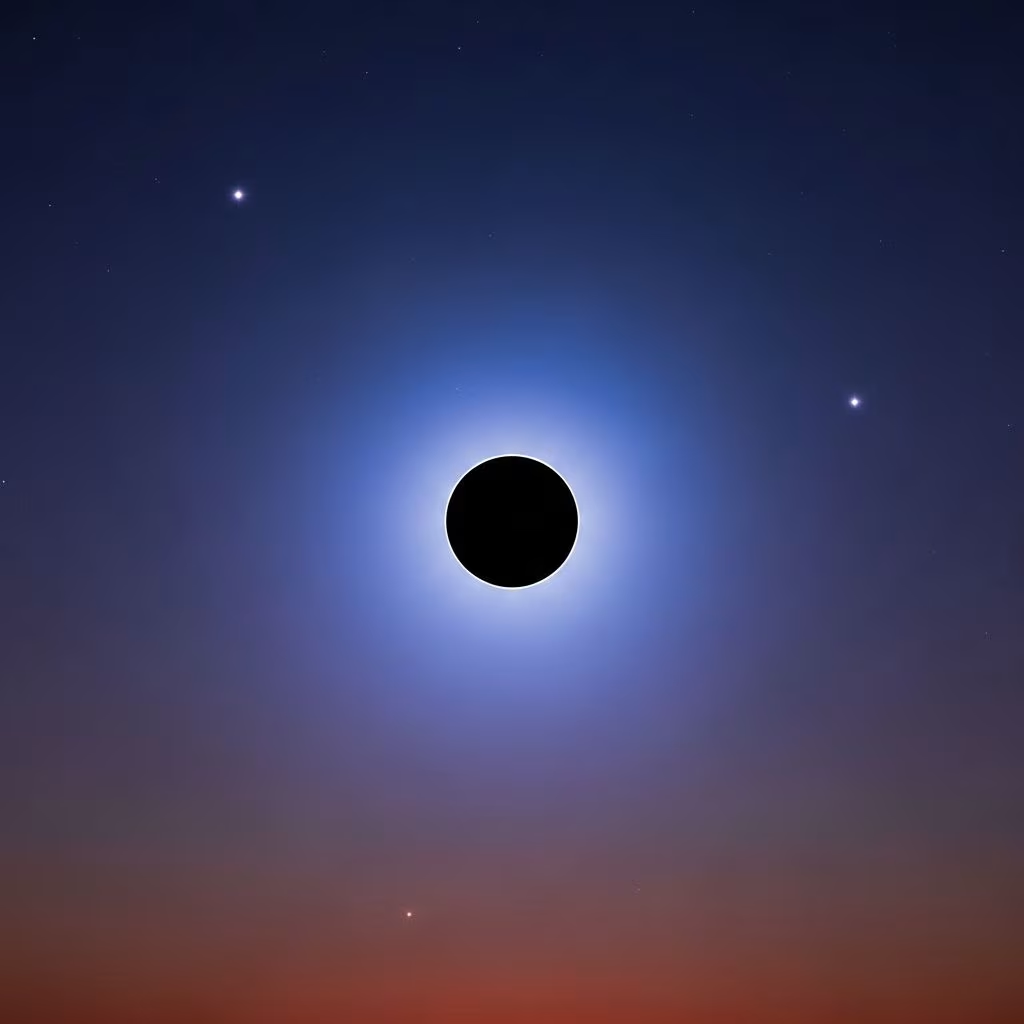
Unlike a supermoon or a lunar eclipse, the Black Moon will be entirely invisible; new moons always rise and set alongside the Sun, and during this phase, the side of the Moon illuminated by sunlight faces away from Earth . That means there will be no glowing lunar silhouette in the sky—only deep, profound darkness throughout the night.
The Science Behind the Black Moon
To appreciate the Black Moon, it helps to review some basic lunar science. The lunar month—the time it takes for the Moon to complete one cycle of phases from new moon to the next new moon—lasts about 29.5 days. Our standard seasons are defined by the Earth’s orbit around the Sun and last approximately three months each. As these periods are not perfectly synchronized, the lunar phases sometimes don’t fit evenly into a season.
Normally, each season contains three new moons. However, roughly every 33 months, a season contains four new moons. In those rare seasons, the third new moon is deemed a Black Moon .
- Lunar Cycle: 29.5 days (new moon to new moon)
- Reasons for the Black Moon: Misalignment of the lunar and solar calendar systems creates seasons with four new moons instead of three.
- Frequency: Black Moons (defined seasonally) occur about once every 33 months.
The last occurrence of a seasonal Black Moon was on May 19, 2023. After the August 2025 event, another will not occur until several years later .
Why “Black” and What Does It Mean?
The mystery behind the term lies in its contrast with the Blue Moon. While ‘blue’ conjures images of the rare and unexpected, ‘black’ refers to the moon’s complete invisibility during the new phase. The moon’s dark, unilluminated face, hidden by the Sun’s glare, creates the deepest darkness in the lunar cycle, blanketing the night sky in unbroken shadow .
- No Moon Glow: The night of a Black Moon is one of the darkest, as there is no visible lunar light to compete with stars or deep-sky objects.
- Skywatchers’ Advantage: This darkness offers the perfect backdrop for astronomical observations.
Other Definitions and Black Moon Variations
Although the Black Moon of August 2025 is defined seasonally, alternate definitions periodically come into play:
- Second New Moon in a Month: Much like the popular ‘Blue Moon’ (the second full moon in a calendar month), some refer to the second new moon in a calendar month as a Black Moon. This only occurs every 29 months.
- No Full Moon or New Moon in a Month: A rare calendar phenomenon where February may have neither a new moon nor a full moon, also described as a Black Moon.
These additional interpretations add to the allure and folklore surrounding the phrase.
How Often Do Black Moons Occur?
| Black Moon Type | Frequency |
|---|---|
| Seasonal (3rd of 4 new moons in a season) | About every 33 months |
| Second new moon in a month | Every 29 months |
| Absence of new/full moon in a month | Rare (only in short months like February) |
Why Is the Black Moon Important for Skywatchers?
For both professional astronomers and starg izing hobbyists, the most pronounced effect of a Black Moon is the exceptional darkness it brings to the night. With no light reflecting off the Moon’s surface, the sky becomes the ideal canvas for observing faint celestial objects:
- Enhanced Stargazing: The absence of moonlight allows fainter stars and nebulae to stand out better than on nights with a moon.
- Astronomy Imaging: Astrophotographers often take advantage of dark new moon nights to capture deep-sky targets without interference from bright moonlight.
- Milky Way Viewing: The Black Moon’s darkness offers some of the year’s best opportunities to view and photograph the Milky Way’s central band (especially from dark-sky preserves).
What Else Is Happening in the Sky?
In 2025, the Black Moon also coincides with some intriguing planetary alignments and deep-sky viewing opportunities. While the Moon is shrouded from view, stargazers will have a chance to witness:
- Bright Planets: Mars and Venus may be visible in the predawn sky, depending on local conditions.
- Constellations: With the Moon in Leo during its new phase, this constellation will be nearly hidden, but others such as Virgo, Libra, and Scorpius may be prominent in the overnight sky.
- Meteor Showers: Though no major meteor showers peak precisely on August 23, the dark skies are still ideal for catching any late meteors.
Check astronomical calendars for your location to pinpoint planets and deep-sky objects at their best.
Why Can’t You See the Black Moon?
One of the paradoxes of the Black Moon is its invisible nature. Here’s why:
- Moon’s Position: At new moon, the Moon passes almost directly between Earth and Sun. The side facing us is entirely shadowed, while the bright side faces away into space.
- Solar Proximity: The Moon is so close to the Sun’s apparent position in the sky that its dim outline is rendered invisible to the naked eye.
- Daylight & Glare: Even if the Moon could be seen, it would rise and set with the Sun, further obscured by daylight.
Folklore, Myths, and Modern Meaning
Unlike eclipses or supermoons, Black Moons are a relatively recent addition to lunar lore, gaining traction in popular culture and online discussions over the past few decades. While Black Moons do not have ancient myths attached to them, they inspire:
- Speculation & Rumor: Sometimes misunderstood as omens, although no scientific predictions attach special meaning to them.
- Interest in Astronomy: Their rarity sparks curiosity and inspires new skywatchers.
- Special Events: Planetariums and astronomy clubs may host stargazing nights or workshops to take advantage of the dark skies.
Tips for Observing the Night Sky During the Black Moon
- Head to a location far from artificial lights for the darkest sky possible.
- Use star maps or astronomy apps to locate seasonal constellations and planets.
- Bring binoculars or a small telescope for enhanced views of star clusters, nebulae, and galaxies.
- If you’re an astrophotographer, set up a wide-angle camera to capture the Milky Way or time-lapse shots of constellations.
Frequently Asked Questions (FAQs)
Q: Will I be able to see the Black Moon?
No, the Black Moon is a new moon, meaning it is invisible from Earth as its illuminated side faces away from us. The night is darker than usual, enhancing the visibility of stars.
Q: Why is the August 2025 Black Moon considered rare?
This is a seasonal Black Moon, the third out of four new moons in a single season—a phenomenon that happens only about once every 33 months..
Q: What’s special about the night sky during a Black Moon?
The absence of moonlight creates optimal conditions for deep-sky observation, making stars, nebulae, and the Milky Way stand out dramatically..
Q: How often do Black Moons happen?
Depending on the definition, Black Moons occur every 29 to 33 months..
Q: Can a Black Moon affect tides or human behavior?
While new moons do cause slightly higher tides (spring tides), the Black Moon itself has no special gravitational or psychological effects—it’s primarily a calendrical and observational rarity..
Key Takeaways
- Event: Black Moon (seasonal definition)
- Date: Saturday, August 23, 2025
- Visibility: Completely invisible to the eye, but noticeable by the darkness it brings to the night sky.
- Significance for Stargazers: Ideal night for deep-sky observation and astrophotography.
- Rarity: Happens once every 33 months by the current seasonal definition.
Whether you’re a professional astronomer or a casual night-sky watcher, the Black Moon of August 23, 2025 is a celestial reminder of the wonders and complexities of lunar and seasonal cycles—proof that sometimes, the most extraordinary events are those you can’t see at all.
References
- https://www.space.com/stargazing/new-moon-of-august-2025-brings-a-rare-black-moon-and-a-close-mars-encounter
- https://www.space.com/stargazing/a-rare-black-moon-rises-with-the-sun-on-aug-23-2025-heres-what-to-expect
- https://news.northeastern.edu/2025/08/20/black-moon-event-august-23-explained/
- https://www.astronomy.com/observing/the-sky-today-saturday-august-23-2025/
- https://www.northjersey.com/story/news/2025/08/22/what-time-is-tonights-new-moon-when-is-august-black-moon-to-watch-tonight-see-rare-new-moon-today/85777942007/
- https://www.timeanddate.com/news/astronomy/black-moon-2025
- https://www.timeanddate.com/eclipse/2025
- https://www.youtube.com/watch?v=VtG0dvZCj_k
- https://nasaspacenews.com/2025/08/the-black-moon-of-august-23-2025-a-rare-cosmic-wonder/
- https://www.youtube.com/watch?v=sn69sjKU9Ac
- https://www.sortiraparis.com/en/news/in-paris/articles/331737-black-moon-this-august-23-what-is-it-and-how-to-enjoy-it
- https://news.ssbcrack.com/new-moon-on-aug-23-marks-rare-seasonal-black-moon-ahead-of-total-solar-eclipse-in-2044/
- https://www.astronomy.com/the-sky-this-week/the-sky-this-week-from-august-22-to-29-2025/
- https://ts2.tech/en/rare-black-moon-rising-aug-23-a-vanishing-moon-brings-the-darkest-night-of-summer/