


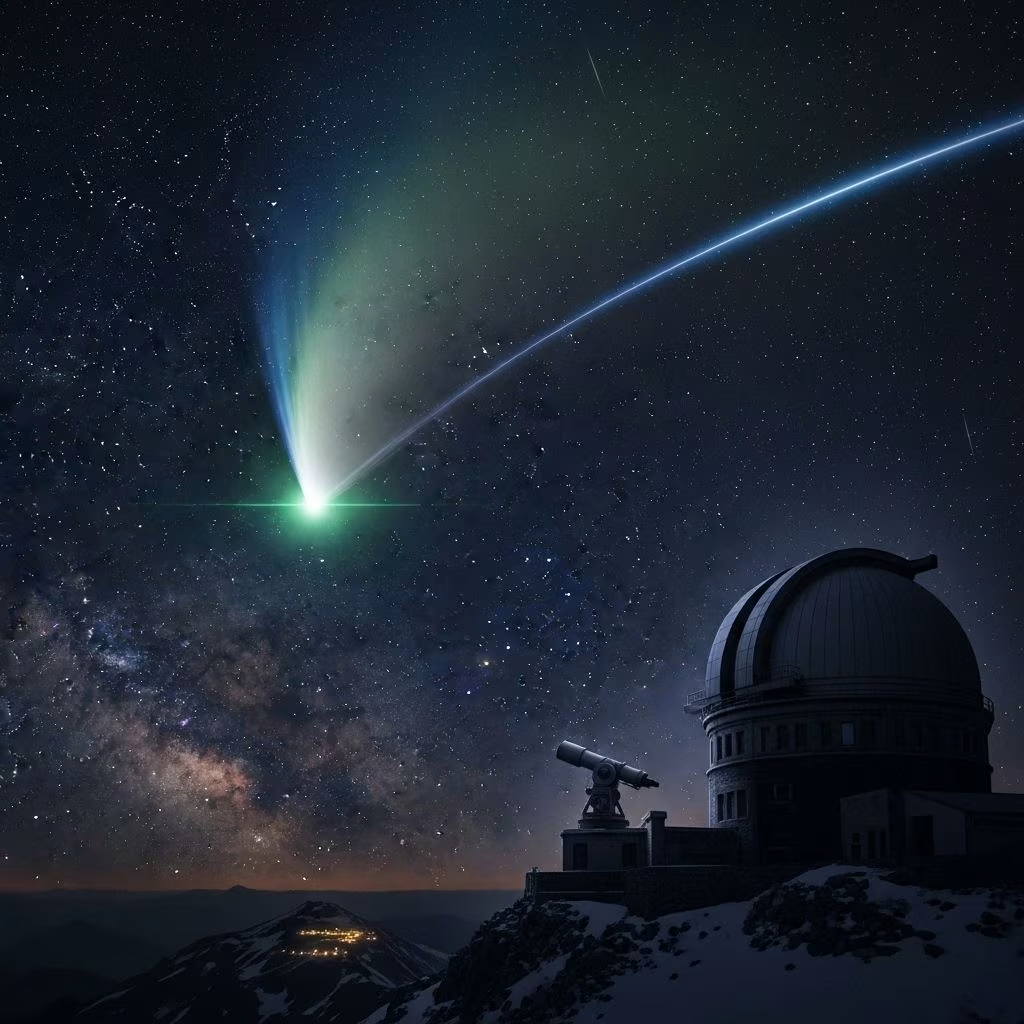
Halley’s Comet: The Solar System’s Most Famous Wanderer
Halley’s Comet—officially 1P/Halley—is arguably the most recognizable and storied comet in human history. With its brilliant sweeps across Earth’s skies roughly every 76 years, Halley’s Comet has illuminated both our literal and scientific horizons, cementing its status as a cosmic icon that links ancient civilizations with modern space science.
What is Halley’s Comet?
Halley’s Comet is a short-period comet—an icy, dusty body that revisits the inner solar system on a predictable orbit every 74–79 years. It is unique as the only comet regularly visible to the naked eye within a human lifetime and has been observed, recorded, and anticipated over centuries.
- Official name: 1P/Halley
- Comet type: Short-period (less than 200-year orbital period)
- Orbital period: About 76 years
- Last perihelion (closest to Sun): 1986
- Next expected perihelion: 2061
Quick Facts Table
| Characteristic | Value |
|---|---|
| Diameter | ~11 km (6.8 miles) |
| Length of Day (rotation) | 2.2 Earth days |
| Length of Year (orbit) | 76.1 Earth years |
| Brightness (at peak) | Often visible to naked eye |
The Discovery and Name of Halley’s Comet
Comets were once seen as one-off, mysterious visitors—until English astronomer Edmond Halley (1656–1742) revolutionized our understanding. In 1705, Halley used Isaac Newton’s laws of gravitation and planetary motion to analyze historical cometary appearances. He identified that the comets observed in 1531, 1607, and 1682 were in fact the same object returning in a regular cycle.
Halley predicted its next appearance in 1758—a forecast triumphantly confirmed after his death, and the comet was named in his honor.
- Historical significance: First recognized periodic comet
- Named for: Edmond Halley, who predicted its return
- Designation “P”: Denotes a periodic comet
Historical Sightings Through the Ages
Halley’s Comet is threaded through both ancient records and human culture:
- Ancient China: Earliest confirmed observation dates back to 240 BCE.
- Bayeux Tapestry: Depicts Halley above the 1066 Battle of Hastings.
- Ancient Rome and the Middle Ages: Often seen as omens or divine portents in chronicles and chronicles.
- Modern Era: Scientific observations intensified after Halley’s prediction and successful 1758 return.
By the mid-20th century, the comet’s periodicity was so well known that anticipation of its 1986 appearance sparked global excitement and scientific missions.
The Orbit of Halley’s Comet
Halley follows an elongated, elliptical orbit, swinging it from the inner solar system near the Sun, then out beyond the orbit of Neptune before returning again. This journey defines its periodic return and governs its visibility from Earth.
- Perihelion: Halley’s closest approach to the Sun (roughly every 75–76 years).
- Aphelion: The orbit’s far end—more than 35 astronomical units (AU) from the Sun, well beyond Neptune’s path.
- Retrograde Orbit: Halley moves opposite the direction of most planets—one of only a few short-period comets to do so.
Its changing distance and speed as it travels mean it is only visible near perihelion, when both sunlight and proximity make it bright enough to spot with the unaided eye.
Orbit Characteristics Table
| Parameter | Value |
|---|---|
| Perihelion Distance | 0.587 AU (astronomical units) |
| Aphelion Distance | 35.1 AU |
| Orbit Type | Retrograde, elliptical |
| Inclination | 162.3° to the ecliptic |
Structure and Composition: What Halley’s Comet Is Made Of
Scientific missions in 1986 forever changed our understanding of comets, especially Halley’s nucleus and tail formation:
- Dirty Snowball Hypothesis: Confirmed that comets have a mixture of volatile ices (water, carbon dioxide, carbon monoxide, ammonia) and dust particles.
- Comet Structure: The nucleus is a lumpy, irregular conglomerate about 15 km long and 8 km wide, shaped somewhat like a peanut or potato. Its average diameter is estimated at 11 km.
- Coma and Tail Formation: As Halley nears the Sun, the rising temperatures cause ices to vaporize—sublimate—releasing gas and dust to form a glowing coma and, under solar wind pressure, a stunning tail that may stretch over 100 million km into space.
- Surface Features: Spacecraft images revealed a nucleus with dark, rocky surface, craters, ridges, and jets of material.
- Low Density: With a density of roughly 0.55 g/cm³, Halley is thought to be a loose pile of building blocks rather than a solid body.
Spacecraft Encounters: The Halley Armada of 1986
Halley was the first comet ever visited by spacecraft, as an international fleet (“Halley Armada”) assembled for the 1986 perihelion. This included:
- ESA’s Giotto: Achieved closest flyby (596 km from nucleus), sending back detailed photos and data.
- Soviet Vega 1 and Vega 2: Provided measurements of shape, size, and outgassing activity.
- Japan’s Suisei and Sakigake: Measured solar wind and atomic composition.
- ICE (International Cometary Explorer): Studied solar wind interactions with the comet’s tail.
This armada provided the first close-up images of a comet nucleus and measurements crucial to modern cometary science, from surface composition to dust jets and plasma tails.
Halley’s Physical and Chemical Mysteries
Data from 1986 spacecraft missions and telescope observations revealed:
- Nucleus Composition: Dominated by dust and rocky materials with only partial icy composition.
- Surface Activity: Jet-like vents send out geysers of gas & dust when sunlit.
- Variable Rotation: Although early studies suggested a 7.4 day rotation, spacecraft data indicate a more complex tumble, with a principal period around 53 hours.
- Coma Chemistry: Water vapor is the main component, along with CO, CO₂, methane, ammonia, traces of organic compounds, and sunlight-driven ions (making the tail visible).
Halley exemplifies the belief that comets are repositories of pristine material from the solar system’s formation—holding secrets to the early planetary building process.
Halley’s Legacy: Meteors on Earth
Halley’s Comet is responsible for two annual meteor showers on Earth:
- Eta Aquarids: Occur each May as Earth passes through Halley’s debris trail.
- Orionids: Peak in October, also caused by dust left behind by Halley.
During each shower, tiny fragments from Halley streak through Earth’s atmosphere, producing many bright meteors.
Halley’s Comet in Popular Culture and Science
Few astronomical objects have had the cultural and scientific influence of Halley’s Comet. It has been recorded in:
- Ancient Chinese, Babylonian, and medieval European chronicles
- Classical Western art (famous tapestries, woodcuts, and paintings)
- Superstitious lore, omens, and literary references
- Modern science fiction and children’s literature as a symbol of cosmic adventure
The 1986 return, though less visually spectacular than hoped, nonetheless inspired a generation of astronomers, students, and skywatchers around the globe.
What Happens to Halley Over Time?
Comets are not eternal. With each solar pass, Halley loses several meters of material from its nucleus, eventually dimming and losing its famous tails. Scientists estimate that most periodic comets may survive about 1,000 orbits before exhausting their volatile components and becoming dark, inert space rocks or disintegrating entirely.
- Halley has been in its current orbit for at least 16,000 years and so far shows few signs of major depletion.
Looking Forward: Halley’s Next Return
After vanishing into the farthest reaches of its orbit, Halley is now journeying back toward the inner solar system and will reach perihelion again in mid-2061. When it does:
- It will appear brightest in the Southern Hemisphere but also visible from the north.
- Astronomers expect it to be noticeably brighter than its 1986 apparition, possibly even rivaling nearby stars for several weeks.
Future generations will have an unprecedented opportunity to coordinate Earth- and space-based observations, with decades to prepare advanced instruments for the mighty comet’s next close approach.
Frequently Asked Questions (FAQs)
Q: When will Halley’s Comet return?
A: Halley’s Comet will return to the inner solar system and reach its closest point to the Sun in mid-2061. Stargazers can expect its most visible displays for weeks before and after perihelion.
Q: Why is Halley’s Comet so famous?
A: Halley’s Comet is the only known short-period comet routinely visible to the naked eye and was the first whose return was accurately predicted, revolutionizing our understanding of cometary motion and history.
Q: What was discovered during the 1986 spacecraft flybys?
A: Spacecraft from Europe, the Soviet Union, Japan, and the US revealed detailed images of Halley’s dark, lumpy nucleus, measured outgassing jets, and confirmed a mix of rocky and icy composition.
Q: What causes Halley’s tail and coma to appear?
A: As Halley nears the Sun, solar heat vaporizes its surface ices, creating streams of gas and dust that are illuminated by sunlight, stretching into tails by the solar wind.
Q: Is Halley’s Comet responsible for meteor showers?
A: Yes. The Orionid (October) and Eta Aquarid (May) meteor showers both occur when Earth passes through debris from Halley left on previous orbits.
Further Reading & Observing Halley’s Comet
- Mark calendars for May (Eta Aquarids) and October (Orionids) meteor showers, both tied to Halley’s debris.
- Follow astronomical organizations for observing guides in the years leading to 2061.
Halley’s Comet remains one of the solar system’s enduring wonders, inviting us all to marvel at our cosmic heritage—and to cherish the night sky that connects generations across millennia.
References
- https://en.wikipedia.org/wiki/Halley’s_Comet
- https://science.nasa.gov/solar-system/comets/1p-halley/
- https://www.space.com/halleys-comet-return
- https://www.space.com/comets.html
- https://www.space.com/11340-skywatching-southern-hemisphere-stars-halleys-comet.html
- https://www.space.com/5802-strange-comet-explains-mystery.html
- https://www.space.com/25194-cosmos-recap-comet-space-facts.html
- https://www.space.com/25180-capturing-comet-halley.html
- https://www.space.com/20958-meteor-shower-halleys-comet-sunday.html


