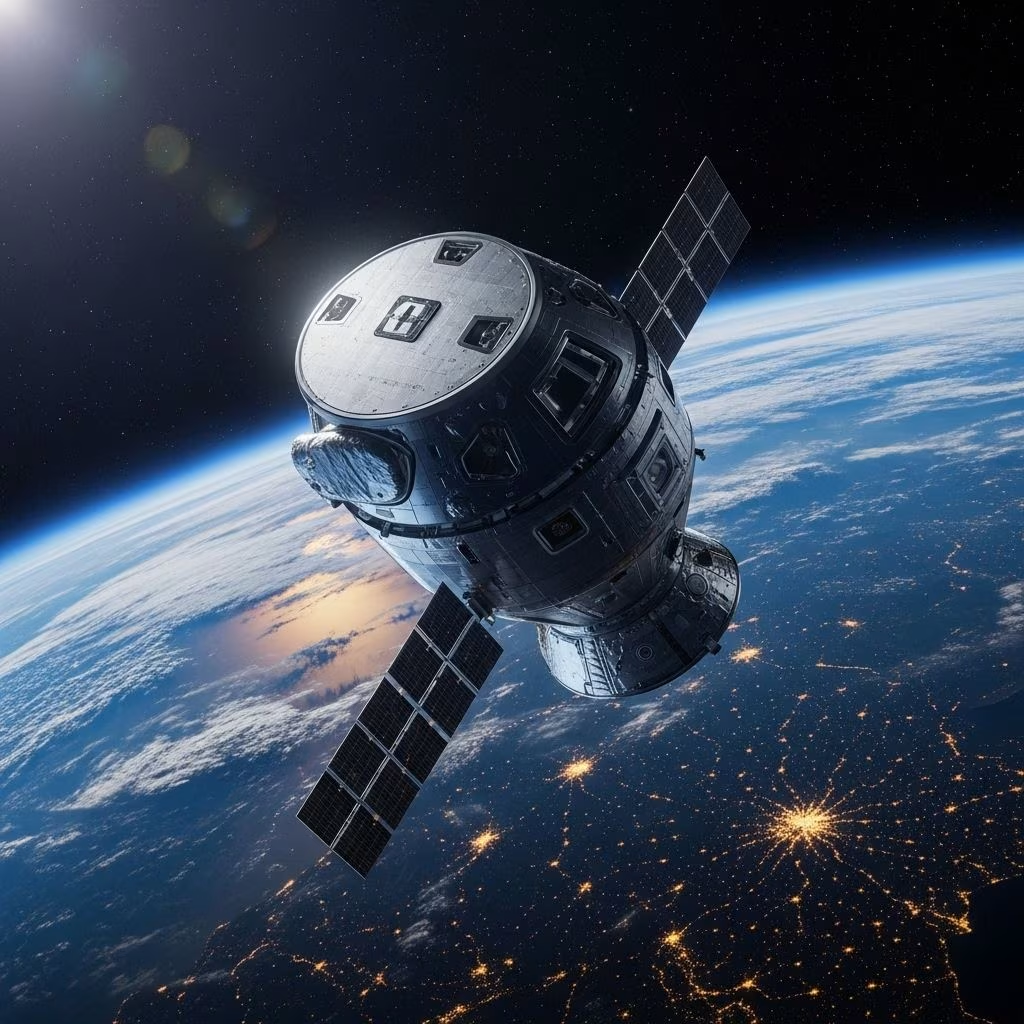
Boeing Starliner: Saga of Crew Return, Delays, and the Future
The Boeing Starliner program has been at the center of NASA’s commercial crew initiatives, facing both triumphs and setbacks on its journey to deliver astronauts safely to and from the International Space Station (ISS). The recent mission, involving an unexpected and extended crew stay, new technical challenges, and strategic decisions about the vehicle’s future, highlights the complexities of human spaceflight and the growing pains of commercial space partnerships.
Overview: Commercial Crew and Starliner’s Ambition
The Boeing CST-100 Starliner is one of NASA’s flagship commercial crew vehicles, developed under the agency’s Commercial Crew Program to provide routine transit to the ISS. Built by Boeing and launched on an Atlas V rocket, Starliner can accommodate up to seven astronauts but typically carries four for NASA missions. Its development was fueled by a $4.2 billion NASA contract, running in parallel with SpaceX’s lower-cost (at $2.6 billion) Crew Dragon. Starliner’s journey has been fraught with repeated technical and managerial setbacks, shifting its operational debut years beyond the original 2017 target date.
The Crew Mission: Timeline and Milestones
- Initial Launch Attempts
The crewed Starliner test flight, known as Boeing Crew Flight Test (Boe-CFT), was first scheduled for 2017 but experienced repeated delays due to technical and organizational hurdles. - Successful Launch
The actual launch occurred on June 5, 2024, with NASA astronauts Barry “Butch” Wilmore and Sunita “Suni” Williams aboard. The rocket lifted off from Cape Canaveral, Florida, after multiple earlier scrubs: an oxygen valve issue and a ground control computer failure caused delays on May 7 and June 1, respectively. Further delays were attributed to persistent helium leaks in Starliner’s service module. - ISS Arrival
Despite these hurdles, Starliner docked with the ISS, marking a major milestone a year after its first docking and underscoring the significance of the mission for Boeing and NASA.
Technical Complications and Critical Decisions
Once docked, the mission faced greater trouble. Thruster anomalies that emerged during Starliner’s approach to the ISS were deemed too risky by NASA for a standard crewed return. Investigations also highlighted recurring helium leaks in the propulsion system. As a result, NASA made the unprecedented decision not to return the crew via Starliner at the scheduled time.
- Helium Leaks
The most persistent problem, compromising both efficiency and reliability of the service module’s propulsion system. Issues were present before the launch and only intensified after docking with the ISS. - Thruster Malfunctions
Malfunctions during critical altitude and repositioning maneuvers forced mission managers to reassess Starliner’s immediate suitability for astronaut return.
NASA and Boeing’s deliberations stretched over two months, weighing safety, public scrutiny, and the reputational implications for the Commercial Crew Program. Ultimately, the agency deemed it too risky to use the Starliner for crew return on this flight. Instead, on September 7, 2024, the Starliner was undocked from the ISS and landed in the New Mexico desert without any astronauts aboard.
How the Astronauts Returned: Leveraging SpaceX
A contingency plan was enacted to ensure crew safety and mission completion:
- The Crew Return
Wilmore and Williams returned to Earth on SpaceX Crew-9 on March 18, 2025, marking a first-of-its-kind scenario in the U.S. commercial crew era where one provider’s transport vehicle brought back astronauts launched by another. - Asset Recovery
Starliner’s successful uncrewed landing demonstrated partial functionality, yet failed to clear the significant technical issues necessary for future crewed certification.
Timeline of the Boeing Starliner Mission
| Date | Event |
|---|---|
| 2014 | NASA awards Boeing a $4.2 billion contract to develop Starliner |
| 2017 | Starliner original operation target; first flight delayed |
| Dec 2019 | First uncrewed Orbital Flight Test; partial failure |
| May 2022 | Second uncrewed Orbital Flight Test; completes mission |
| June 5, 2024 | First crewed flight launches (Wilmore, Williams) |
| June 2024 | ISS docking; thruster malfunctions and helium leak discovered |
| Sept 7, 2024 | Uncrewed Starliner returns to Earth |
| Mar 18, 2025 | Astronauts return on SpaceX Crew-9 |
Implications for Boeing, NASA, and the Crew Program
- Budget Overrun
By 2025, Boeing’s Starliner had exceeded its allotted budget by over $2 billion on top of the original fixed-price contract. This raised concerns within NASA leadership and among the public about the cost-effectiveness and reliability of commercial partnership models. - Comparative Performance
SpaceX’s Crew Dragon, which has been launching and returning astronauts reliably, provided a striking contrast. Its role as the fallback for Starliner’s crew return further cemented SpaceX’s standing as the more dependable commercial crew partner (to date). - Crew Safety and Protocols
New precedents were set for contingency operations and cross-provider astronaut rescue, prompting discussions about how commercial spacecraft will be coordinated for ISS service in the coming years.
Future of the Starliner Program: Delays and Uncertainties
After the uncrewed return, NASA and Boeing announced that the next Starliner flight would not occur until no earlier than late 2025, with early 2026 being more likely. Critical technical issues must be resolved and the vehicle recertified for crew operations. There is also a strong likelihood, favored by astronaut Suni Williams and echoed by NASA, that Starliner’s next flight will be an uncrewed demonstration—an additional hurdle before any further crewed missions can be considered.
- Certification Pending
All future Starliner launches remain contingent upon system certification and resolution of identified technical faults. - Role in NASA’s Crew Rotation
With no other U.S. spacecraft besides SpaceX’s Crew Dragon certified for regular crew transport, enduring delays in Starliner’s operation strain ISS crew rotation plans and heighten dependency on SpaceX. - Boeing’s Commercial Prospects
The delays, compounded by budget overruns and highly public technical failures, cast uncertainty on Boeing’s ability to remain a major commercial partner for crewed space transportation.
Boeing Starliner vs. SpaceX Crew Dragon: Feature Comparison
| Feature | Boeing Starliner | SpaceX Crew Dragon |
|---|---|---|
| Developer | Boeing | SpaceX |
| NASA Contract Value | $4.2 billion | $2.6 billion |
| Crew Capacity | Up to 7 | Up to 7 |
| Operational Status (2025) | Not certified, delays ongoing | Certified, regular ISS flights |
| Number of Crewed Flights | 1 attempted; no safe crew return | Multiple, with successful crew return each time |
| Launch Vehicle | Atlas V (United Launch Alliance) | Falcon 9 (SpaceX) |
| Main Technical Setbacks | Helium leaks, thruster malfunctions | No major return-threatening failures as of 2025 |
Expert Voices and Crew Perspectives
NASA astronauts and project insiders have weighed in on the best path forward for Starliner. Sunita Williams, who spent the extended ISS stay due to the spacecraft’s issues, told Reuters that “flying an uncrewed Starliner flight as its next trip to space would be the logical thing to do.” This sentiment is echoed by NASA mission planners, reflecting a cautious, safety-first approach after such a high-profile mission anomaly.
Lessons Learned and Innovations Prompted
- Cross-Provider Crew Operations
The spacelight community learned valuable lessons about redundancy and cooperation. The use of SpaceX Crew-9 as a rescue craft sets pragmatic standards for future collaborations among commercial providers. - Public Transparency and Scrutiny
NASA’s open communication about Starliner’s technical issues and its decision to not risk astronaut safety drew praise for transparency—even as it drew attention to the competitive gap between providers. - Crew Morale and Adaptability
Wilmore and Williams’ adaptability during the long wait on the ISS was noted as a testament to astronaut professionalism and training, as well as the need for robust contingency planning in future missions.
Frequently Asked Questions (FAQs)
Q: Why did NASA and Boeing choose not to return the crew on Starliner?
A: Thruster malfunctions and persistent helium leaks in the service module made a crewed return unsafe. After assessment, NASA and Boeing determined the risks of attempting to return astronauts on Starliner outweighed the benefits, prompting the use of SpaceX Crew-9 for crew retrieval.
Q: Will Boeing Starliner fly again with astronauts?
A: Not before a successful uncrewed demonstration and recertification. NASA and Boeing have yet to decide definitively, but technical issues must be conclusively fixed before future crewed missions can resume.
Q: What happens to the Starliner spacecraft following its uncrewed return?
A: The spacecraft will undergo in-depth investigation and refurbishment. Only after thorough analysis and resolution of the technical issues might it fly again, starting with another uncrewed flight.
Q: How did Wilmore and Williams adapt to their extended stay?
A: The astronauts contributed to ongoing ISS operations, supported science experiments, and participated in contingency planning for their eventual return via SpaceX’s spacecraft, demonstrating the flexibility required in long-duration missions.
Q: What does the Starliner situation mean for NASA’s commercial crew future?
A: The incident highlighted the need for multiple, reliable commercial providers for ISS crew transport. It may influence future contract structures and prioritization of safety and technical readiness in human spaceflight partnerships.
Looking Forward: The Path Ahead for Starliner and NASA
NASA’s commercial crew model is designed to encourage competition and innovation, but the Starliner case underscores both the promise and risks involved. Starliner’s struggle to achieve full operational status, despite vast investment, underscores the challenges of complex crew-rated spacecraft development. Moving forward, Boeing and NASA are committed to resolving defects, recertifying the system, and eventually returning to crewed operations. However, SpaceX will remain the backbone of American ISS crew rotation for the foreseeable future.
References
- https://www.nasa.gov/news-release/nasa-decides-to-bring-starliner-spacecraft-back-to-earth-without-crew/
- https://abcnews.go.com/US/timeline-boeings-starliner-mission-left-nasa-astronauts-aboard/story?id=119867727
- https://spaceflightnow.com/2025/06/07/further-delays-of-starliners-next-flight-mark-anniversary-of-its-first-crewed-space-station-docking/
- https://en.wikipedia.org/wiki/Boeing_Starliner
- https://www.boeing.com/space/starliner
- https://en.wikipedia.org/wiki/Boeing_Crew_Flight_Test
- https://www.nasa.gov/blogs/commercialcrew/2025/03/27/nasa-boeing-prepare-for-starliner-testing/
- https://www.space.com/space-exploration/human-spaceflight/boeing-starliner-astronauts-will-return-to-earth-in-march-2025-after-new-nasa-spacex-delay
- https://www.space.com/space-exploration/international-space-station/doghouse-days-of-summer-boeings-starliner-wont-fly-again-until-2026-and-without-astronauts-aboard
- https://aiaa.org/2025/03/28/nasa-boeing-to-begin-testing-starliner-for-next-flight-targeted-for-early-2026/
- https://aiaa.org/2025/03/20/nasa-to-continue-pursuit-of-boeing-starliner-certification/
- https://www.boeing.com/space/starliner/launch/index.html
- https://www.youtube.com/watch?v=r1foPbY5qzQ
- https://abcnews.go.com/US/timeline-boeings-starliner-mission-left-nasa-astronauts-aboard/story?id=119867727&rut=3e63c480bc04675eebae5d34551150f3cbd17cc27f6343c629889325db0772bb
- https://www.businessinsider.com/nasa-boeing-starliner-launch-late-2025-2024-10
- https://phys.org/news/2025-03-nasa-newly-astronauts-fly-boeing.html
- https://www.youtube.com/watch?v=iiYeGn10UU4
- https://orbitaltoday.com/2025/03/21/nasa-prepares-boeing-cst-100-starliner-for-another-test-after-crew-9s-troubled-mission/