


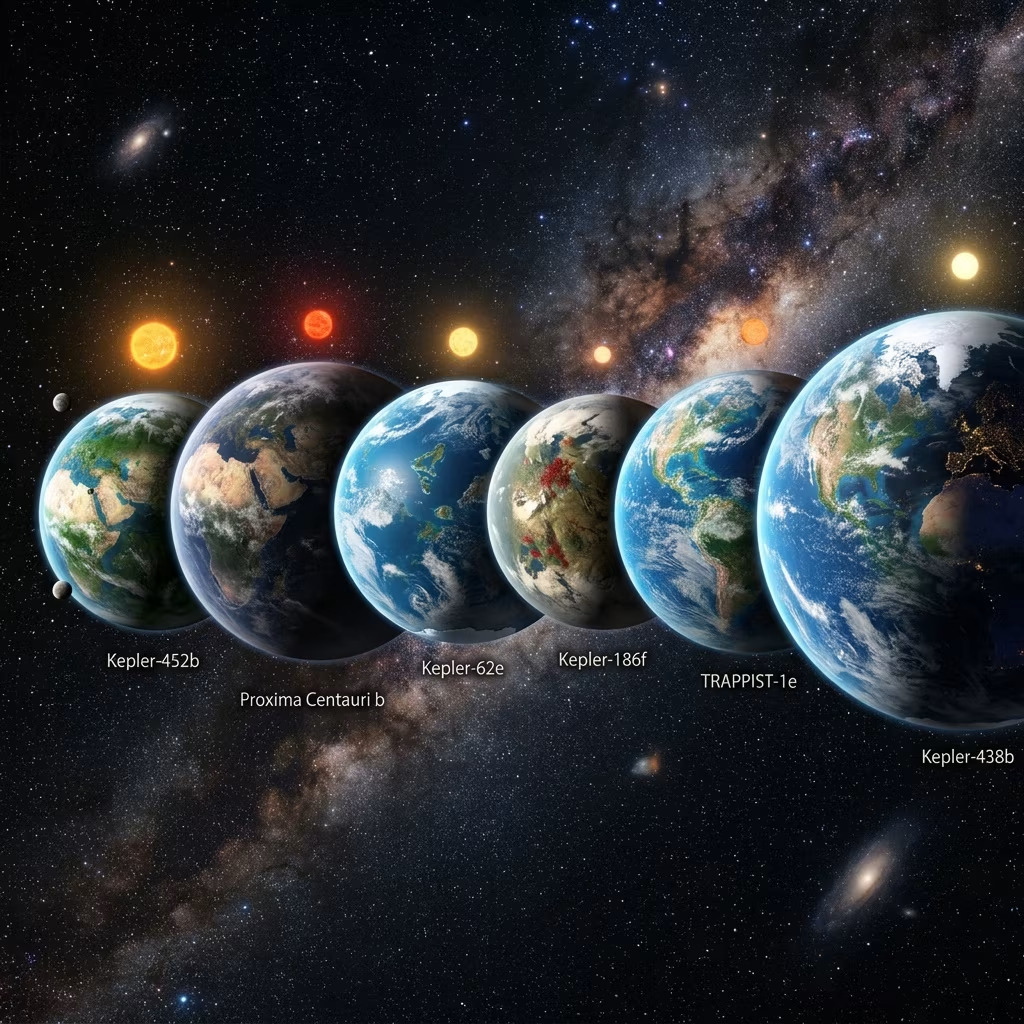
The Six Most Earth-Like Alien Planets Discovered
Since the first discovery of an exoplanet orbiting a star like our Sun in the 1990s, astronomers have catalogued thousands of worlds beyond our solar system. Among these, a handful stand out as the most Earth-like, intriguing scientists and the public alike with the possibility that they may harbour life. This comprehensive guide examines the six most Earth-like alien planets identified to date—detailing their discovery, characteristics, and their significance in the ongoing search for life beyond Earth.
What Makes an Alien Planet “Earth-Like”?
The term “Earth-like” refers to planets outside our solar system (exoplanets) that share important characteristics with Earth:
- Habitability Zone: The planet orbits its star at a distance permitting liquid water to exist on its surface.
- Similar Size and Mass: The planet is roughly Earth-sized or only slightly larger (sometimes called a “super-Earth”).
- Rocky Composition: Thought to be solid, rather than gaseous, like Earth’s terrestrial nature.
- Star Type: Typically orbits a star similar in type to our Sun—often G-type or cooler K/M-type stars.
These criteria are crucial as they dramatically improve the planet’s chances of being able to support life as we know it .
Six Most Earth-Like Alien Planets
Although new candidates appear frequently, these six exoplanets are widely regarded as the closest analogs to Earth based on their confirmed properties and interest for future research:
| Planet Name | Distance from Earth | Star Type | Planet Size | Orbit (Year Length) | Notable Feature |
|---|---|---|---|---|---|
| Kepler-452b | ~1,400 light-years | G-type (like our Sun) | 1.6 Earth radii | 385 days | Closest Sun-Earth analog |
| Kepler-186f | 500 light-years | M-type (red dwarf) | 1.1 Earth radii | 130 days | First Earth-sized world in habitable zone |
| Kepler-22b | 600 light-years | G-type | 2.4 Earth radii | 290 days | Early habitable zone candidate |
| Gliese 667Cc | 23.6 light-years | M-type | 1.5 Earth masses | 28 days | Most promising for habitability |
| HD 40307g | 42 light-years | K-type | 7 Earth masses | 197 days | Possible rocky super-Earth |
| K2-3d | 137 light-years | M-type | 1.5 Earth radii | 44.5 days | Potential for water |
Kepler-452b: Our Closest Sun-Earth Twin
Kepler-452b was discovered by NASA’s Kepler Space Telescope and announced in 2015. It orbits a G-type star much like our Sun, making it the most direct analog to Earth and our solar system discovered so far .
- 60% larger diameter than Earth; likely rocky.
- Spends 385 days to orbit its star, very close to Earth’s year.
- Receives a similar amount of energy from its star as Earth does from the Sun.
- Located in the “Goldilocks zone” where liquid water could exist.
Astronomers believe Kepler-452b could host surface water with Earth-like conditions, though its age—about 1.5 billion years older than Earth—means any life there could be more advanced, or the environment could have shifted toward a Venus-like state if a runaway greenhouse effect occurred .
Kepler-186f: The First Earth-Sized Habitable Zone Planet
Kepler-186f gained fame as the first truly Earth-sized planet found in the habitable zone of its star, a discovery announced in 2014 .
- Orbits an M-dwarf star in the constellation Cygnus.
- About 10% larger than Earth in diameter.
- Year lasts 130 Earth days.
- Stable, nearly circular orbit—ideal for climate stability.
- Could support life if it retains an atmosphere and water.
Kepler-186f’s sun is cooler and redder than our own, so the planet’s conditions would differ from Earth’s—potentially darker skies but a similar overall climate if its atmosphere retained heat effectively.
Kepler-22b: Early Habitable Zone Pioneer
Kepler-22b was one of the first confirmed planets in the habitable zone of a Sun-like star .
- Orbits a G-type star 600 light-years away.
- 2.4 times Earth’s radius—classed as a “super-Earth.”
- Year is about 290 Earth days.
- Possibly has water at the surface, but much remains unknown about its composition and atmosphere.
Despite uncertainties about whether Kepler-22b is rocky or gaseous, its location in the habitable zone inspired a wave of subsequent discoveries.
Gliese 667Cc: Prime Candidate for Life
Gliese 667Cc is part of a triple star system, orbiting an M-type (red dwarf) star just 23.6 light-years from Earth. Among the most promising for habitability, its mass and distance from its star suggest conditions suitable for liquid water [10].
- About 1.5 times the mass of Earth—likely rocky.
- Orbits its star in only 28 days.
- Receives about 90% of the light Earth receives from the Sun.
Its proximity—astronomically speaking—makes Gliese 667Cc an exciting target for future observations and potentially direct imaging.
HD 40307g: A Super-Earth in the Habitable Zone
HD 40307g, discovered using radial velocity measurements, is part of a system that hosts several planets. This super-Earth orbits near the inner edge of its star’s habitable zone [10].
- About 7 times the mass of Earth—potentially rocky or icy.
- Orbital period of 197 days.
- Much of the planet’s surface may be suitable for water, with prospect for moderate climates.
While its considerable mass raises questions about whether it’s more like Neptune than Earth, its location and data help astronomers set boundaries for what defines a ‘habitable zone planet.’
K2-3d: Water World Potential
K2-3d orbits an M-type star about 137 light-years away. Its radius is 1.5 times Earth’s, and it completes an orbit every 44.5 days [10].
- Potential for significant amounts of water on the surface.
- Ideal for future atmospheric studies and transit observations.
With advances in telescope technology, K2-3d is a candidate for more in-depth searches for biosignatures and atmospheric composition analysis.
Why the Search for Earth-Like Worlds Matters
Discovering exoplanets with Earth-like characteristics provides crucial clues to:
- The rarity or abundance of life-friendly worlds.
- The diversity of habitable environments.
- Whether life on Earth is unique or a cosmic norm.
- Planetary formation and evolution processes.
Such discoveries fuel both scientific exploration and public imagination, expanding our sense of place in the universe and driving the development of next-generation instruments.
Challenges in Finding Earth-Like Exoplanets
The search is complicated by several factors:
- Most exoplanets are found by indirect methods (transit, radial velocity), limiting available details.
- Atmospheric and surface properties are often unknown.
- Stellar activity, especially from red dwarfs, can affect habitability.
Upcoming missions, such as the James Webb Space Telescope and future ground-based observatories, promise leaps in our ability to study these planets directly.
Frequently Asked Questions (FAQ)
Q: What is the “habitable zone”?
A: The habitable zone (or “Goldilocks zone”) is the region around a star where conditions are perfect for liquid water to exist on a planet’s surface—an essential ingredient for life as we know it.
Q: Could any of these planets actually support life?
A: While all six have potential for habitability, confirmation requires atmospheric study and detection of biosignatures—chemical signals associated with life. None are confirmed to host life yet .
Q: How do astronomers detect Earth-like exoplanets?
A: They use methods such as the transit method (measuring dips in starlight as a planet passes in front) and radial velocity (detecting star wobble due to planet’s gravity). Space telescopes like Kepler and ground-based facilities are essential tools [11].
Q: Why are most Earth-like exoplanets found orbiting red dwarfs?
A: Red dwarfs are smaller and cooler, making it easier to detect planets in the right zone with current technology. Their habitable zones are closer to the star, so planets orbit more quickly, yielding more detection opportunities.
Q: What’s next for the study of Earth-like worlds?
A: Improved instruments will enable atmospheric characterization, detection of water vapour, oxygen, and other biosignatures. Future telescopes may even produce direct images of exoplanets in the habitable zone.
Key Takeaways and The Search Ahead
- Kepler-452b and Kepler-186f stand out as the best Earth analogs among thousands of known exoplanets.
- Each planet discussed offers unique insights into planetary diversity, habitability, and the ongoing search for life’s origins.
- The number of Earth-like candidates will continue to grow, bringing new opportunities for research and exploration.
The quest to find another Earth is as much about understanding our own planet as it is about exploring the universe. Every new discovery reminds us how precious—and how potentially ordinary—our home may be in the vast cosmic tapestry.
References
- https://www.space.com/19201-most-earth-like-alien-planet.html
- https://www.space.com/six-alien-planets-orbit-strange-harmony-toi-178
- https://www.planetary.org/video/the-most-earth-like-exoplanets
- https://science.nasa.gov/exoplanets/
- https://en.wikipedia.org/wiki/List_of_potentially_habitable_exoplanets
- https://en.wikipedia.org/wiki/Kepler-452b
- https://www.youtube.com/watch?v=rjIHFvxWjdk
- https://web.archive.org/web/20190529132331/https:/www.space.com/10744-alien-planets-solar-system-kepler-mission.html
- https://www.youtube.com/watch?v=O3kh0zC3nUI
- https://earthhow.com/earth-like-planets/
- https://www.jpl.nasa.gov/edu/resources/teachable-moment/exoplanets-and-the-search-for-habitable-worlds/
- https://www.livescience.com/space/exoplanets/32-real-planets-that-sound-like-science-fiction
- https://futurism.com/meet-7-alien-planets-most-likely-to-have-life
- https://www.livescience.com/55871-most-intriguing-earth-like-planets.html
- https://www.syfy.com/syfy-wire/potentially-habitable-kepler-452b-is-exoplanet-most-like-earth
- https://www.gsdvs.com/post/how-many-earth-like-planets-exist-in-the-universe


