Cancer Constellation: Guide to the Zodiac’s Faint Crab
The Cancer constellation stands out not for its brightness but for its deep mythological roots and astronomical treasures. Recognized as the zodiac’s least conspicuous constellation, Cancer connects stargazers to stories of ancient heroes, faint star patterns, and one of the most remarkable open star clusters visible in our night sky.
Overview of Cancer
Cancer is one of the twelve zodiac constellations, situated between Leo to the east and Gemini to the west. Its Latin name translates to “crab,” referencing the mythological creature it represents. Despite its historical and mythological importance, Cancer is notably dim, making it a challenging but rewarding celestial target for astronomers and enthusiasts alike.
- Symbol: The Crab
- Zodiac Position: Fourth sign of the zodiac
- Location: Between Gemini (to the west) and Leo (to the east), bordered by Lynx, Leo Minor, Leo, Hydra, Canis Minor
- Best Viewing: Northern Hemisphere in March; visible December through June
- Area: 506 square degrees, ranked 31st among constellations by size
Location and Visibility
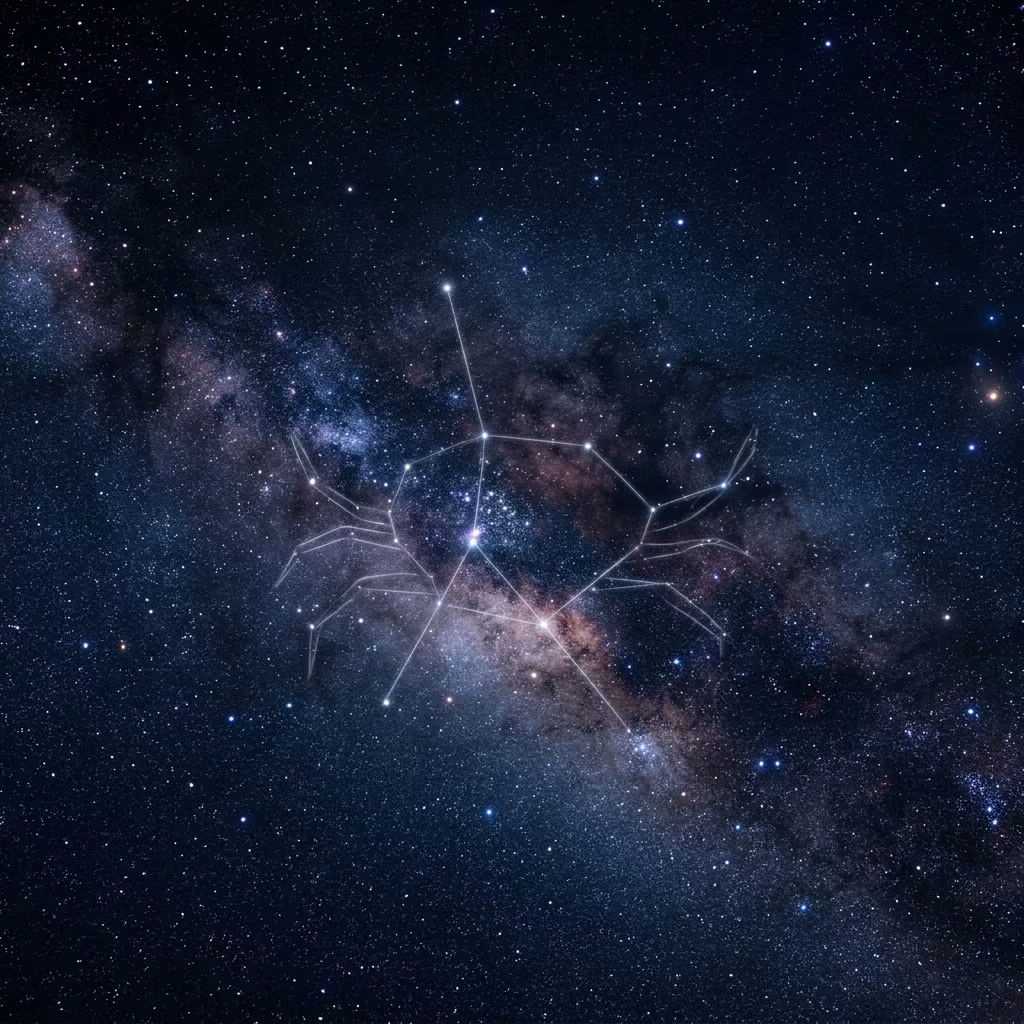
Despite residing along the ecliptic (the sun’s apparent path through the sky), Cancer is the faintest of the zodiac constellations. It lacks bright stars, making unaided observation difficult outside dark skies. Its main stars form a subtle upside-down “Y” shape.
- Latitude Range: Visible between 90°N and 60°S latitudes
- Best Month: Peaks in the evening sky during March in the Northern Hemisphere
- Southern Hemisphere: Visible from summer to autumn (December to May)
- Neighboring Constellations:
- Leo
- Gemini
- Hydra
- Canis Minor
- Leo Minor
- Lynx
Key Stars in Cancer
Cancer contains a handful of relatively dim stars. None are brighter than magnitude 3.5, making the constellation difficult to see with the naked eye from areas with light pollution. However, several stars have interesting characteristics and colorful histories.
| Star Name | Bayer Name | Apparent Magnitude | Description |
|---|---|---|---|
| Al Tarf | Beta Cancri (β Cnc) | 3.5 | Brightest star in Cancer; orange giant ~290 light years from Earth |
| Acubens | Alpha Cancri (α Cnc) | 4.3 | Traditionally marks the crab’s “claw”; quadruple star system |
| Asellus Australis | Delta Cancri (δ Cnc) | 3.9 | The “southern donkey”; points toward the Beehive Cluster (M44) |
| Asellus Borealis | Gamma Cancri (γ Cnc) | 4.7 | The “northern donkey” |
| Iota Cancri | Iota Cnc | 4.0 | Wide binary, yellow and blue stars |
Famous Deep Sky Objects
Though Cancer’s stars are modest in brightness, its deep sky features shine as primary attractions for telescopes and binoculars.
The Beehive Cluster (Messier 44, Praesepe)
Arguably Cancer’s most iconic feature, the Beehive Cluster (M44 or Praesepe) is a bright open star cluster easily visible to the naked eye from very dark sites. It appears as a faint, nebulous patch and, through binoculars, blooms into a swarm of dazzling stars. Its Latin name, “Praesepe,” means “manger” or “crib.” The cluster is about 577 light-years away and spans roughly 1.5 degrees of the sky—three times the width of the full moon.
- Age: Approximated at 600 million years
- Associated Stars: Flanked by Asellus Australis (south) and Asellus Borealis (north)
- Significance: Among the closest and most massive open clusters to Earth
- No. of Stars: Contains hundreds of stars, many visible through small telescopes
Messier 67
Located further south within Cancer, M67 is another open cluster, fainter than the Beehive but remarkable for its age and characteristics. Estimated to be 3.2 to 5 billion years old, M67 gives astronomers a glimpse into the distant galactic past and serves as a laboratory for stellar evolution studies. It lies approximately 2,700 to 2,900 light-years away.
- Age: 3.2–5 billion years
- Distance: ~2,700–2,900 light-years
- Observation: Appears as a faint patch; reveals dozens of stars under moderate telescopic power
Notable Exoplanetary Systems
Cancer hosts the remarkable 55 Cancri system, a binary star whose primary hosts at least five known exoplanets. This system has attracted significant attention since some of its planets are similar in mass to those in our solar system—though none reside in the habitable zone for life as we know it.
- Star: 55 Cancri (Rho¹ Cancri)
- Type: Binary system (yellow dwarf primary)
- Exoplanets: Five confirmed, with varied sizes; includes gas giants and a planet twice the size of Earth
Mythology and Cultural Significance
Cancer’s story is entwined with the legends of ancient Greece. The crab is most often linked to the tale of Hercules (Heracles) and his Twelve Labors. When Hercules fought Hydra (the water serpent), Hera—queen of the gods and no friend to Hercules—sent a giant crab to hinder him. The crab bit Hercules on the foot. He quickly crushed the creature, but Hera placed the crab in the sky as a reward for its service, enshrining it among the stars as Cancer.
- Babylonian Connection: Ancient Babylonians referred to Cancer not as a crab, but as a crayfish
- Zodiacal Importance: Cancer is the fourth astrological sign (June 22 – July 22)
- Personalities: In astrology, Cancer is associated with traits such as home-loving, caring, and “crabby” moods
- Tropic of Cancer: The latitude 23.4366° north—a key geographic marker—takes its name from the constellation; this is the northernmost point at which the sun can appear directly overhead
Observation Tips
Spotting Cancer demands patience and dark skies. Its lack of vivid stars makes it one of the sky’s more elusive patterns, yet its location near Leo and Gemini provides useful guides for star hopping. The Beehive Cluster is a great starting point for observers.
- Find Gemini and Leo in the sky. Cancer lies roughly midway between these two.
- Use Binoculars to search for the faint glow of the Beehive Cluster (M44). Once found, trace Cancer’s main stars around it.
- Look for an upside-down “Y” pattern that marks Cancer’s core. Beta Cancri (Al Tarf) sits at the southeastern end of the constellation.
Historical Facts and Astronomical Importance
- Recorded by Ptolemy: Cancer appeared in Claudius Ptolemy’s seminal star catalog in the 2nd century CE
- Ancient Views: In Babylonian astronomy (circa 3000 years ago), Cancer was known as “The Crayfish.”
- Astrological System: Cancer’s presence in the zodiac links it to cycles of the sun, especially marking solstice points in ancient times when the sun entered Cancer at the summer solstice.
- Astronomical Study: Cancer is home to planetary systems and star clusters of scientific interest, especially for research into stellar and planetary evolution
Fun and Lesser-Known Facts about Cancer
- Size: Cancer is the 31st largest constellation out of 88 modern constellations
- Symbolic Animals: The stars Asellus Borealis and Asellus Australis mean “northern donkey” and “southern donkey,” respectively
- Relation to Sun’s Path: The name “Tropic of Cancer” comes from the historical moment when the sun was in Cancer at the summer solstice
- Astrological Sign: People born between June 22 and July 22 are said to be Cancer in Western astrology, endowed with traits of loyalty and protectiveness
Frequently Asked Questions (FAQs)
Q: Why is Cancer so hard to see compared to other zodiac constellations?
A: Cancer is the dimmest of all zodiac constellations, with its brightest star (Al Tarf) ranking only magnitude 3.5. Light pollution further obscures it, so dark skies are essential for observation.
Q: What is the Beehive Cluster, and how do I find it?
A: The Beehive Cluster (Messier 44) is a bright open cluster in the heart of Cancer, visible as a misty patch to the naked eye under ideal conditions and spectacular through binoculars or a small telescope. Look for a slightly nebulous area midway between Gemini and Leo.
Q: What role did Cancer play in ancient mythology?
A: In Greek mythology, the crab represented by Cancer was sent by Hera to thwart Hercules during his battle with Hydra. Though Hercules crushed it, Hera immortalized the creature by placing it in the sky.
Q: Why is the Tropic of Cancer so named?
A: The Tropic of Cancer marks the most northerly latitude where the sun can be directly overhead. The name dates to ancient times, when the sun was in Cancer during the summer solstice—a result of the precession of Earth’s axis over millennia.
Q: What exoplanets have been found in Cancer?
A: The star 55 Cancri in Cancer hosts at least five known exoplanets, drawing attention for its similarities to our solar system, although none currently lie within its habitable zone.
Summary Table: Cancer at a Glance
| Aspect | Details |
|---|---|
| Symbol | The Crab |
| Area (deg²) | 506 |
| Brightest Star | Al Tarf (Beta Cancri) |
| Notable Deep Sky Objects | Beehive Cluster (M44), Messier 67 |
| Associated Myth | Greek legend of Hercules and the giant crab |
| Visibility | Northern Hemisphere (Dec–Jun, best Mar) |
| Neighboring Constellations | Leo, Gemini, Hydra, Canis Minor, Lynx, Leo Minor |
References & Further Reading
- Explore more at leading astronomy sites, books on mythology, and online star charts to experience the rich lore and celestial detail of Cancer.
References
- https://www.space.com/16970-cancer-constellation.html
- https://www.space.com/20550-cancer-crab-constellation-history.html
- https://space.visualstories.com/cancer-constellation-facts
- https://qubesky.com/cancer-constellation
- https://en.wikipedia.org/wiki/Cancer_(constellation)
- https://ameliasamazingspaceadventures.com/2017/01/28/curious-about-cancer-find-out-the-story-behind-the-star-sign-and-how-to-spot-this-constellation-in-the-night-sky/
- https://lovethenightsky.com/cancer-constellation/
- https://theskylive.com/sky/constellations/cancer-constellation
- https://www.constellation-guide.com/constellation-list/cancer-constellation/
- https://www.ebsco.com/research-starters/health-and-medicine/cancer-space-science
- https://www.youtube.com/watch?v=Ho7W1XkkFVI
- https://softschools.com/facts/space/cancer_constellation_facts/835/
- https://www.go-astronomy.com/constellations.php?Name=Cancer
- https://www.jameswebbdiscovery.com/universe/100-fascinating-facts-about-the-cancer-constellation
- https://universemagazine.com/en/the-constellation-cancer-what-interesting-things-can-be-seen-there/
- https://www.starregistry.com/constellation-name/cancer/
- https://www.britannica.com/place/Cancer-constellation