


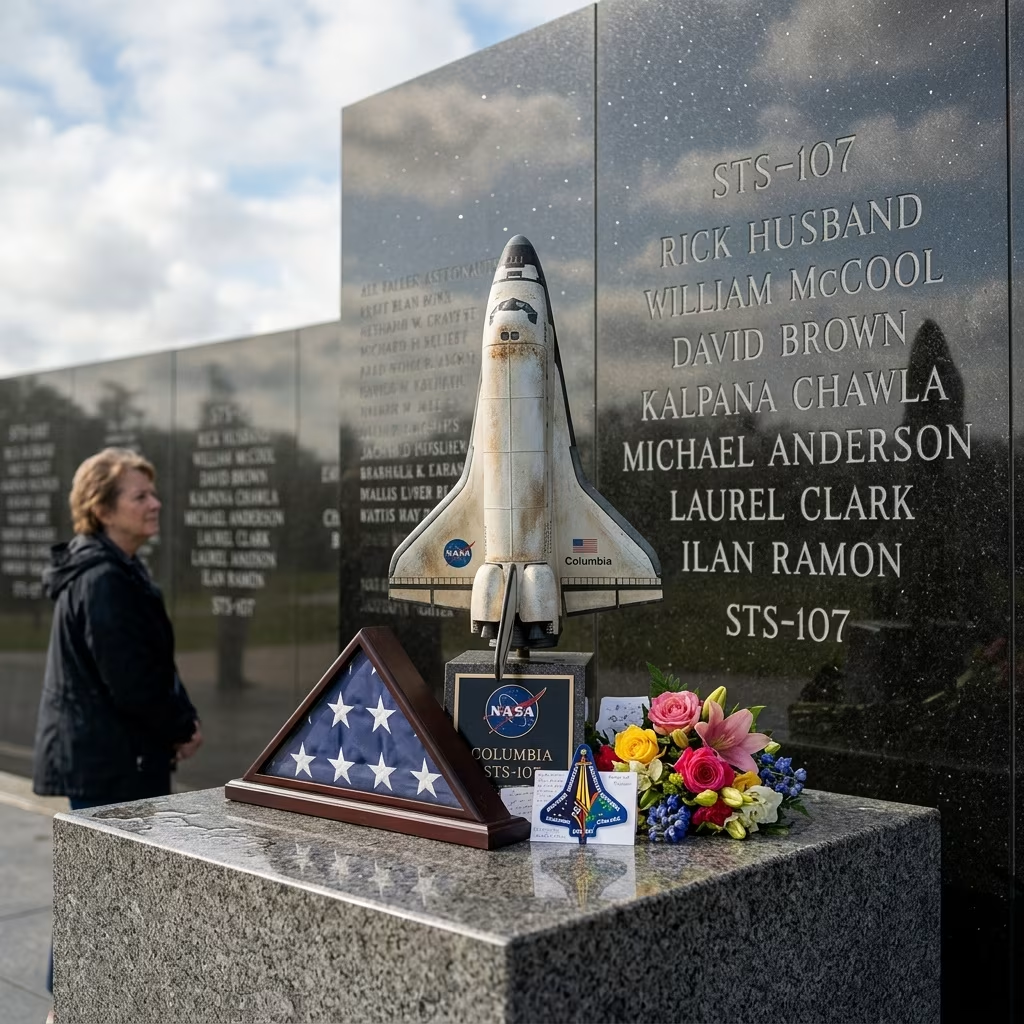
The Columbia Space Shuttle Disaster: Legacy and Lessons
The Columbia space shuttle disaster, one of the most somber milestones in the history of human spaceflight, occurred on February 1, 2003, when NASA’s Space Shuttle Columbia disintegrated during re-entry, claiming the lives of all seven crew members. This catastrophe reshaped NASA, accelerated the end of the Space Shuttle era, and left a profound legacy for astronaut safety and space program management worldwide.
Columbia’s Final Mission: STS-107
Space Shuttle Columbia’s 28th mission, designated STS-107, launched from Kennedy Space Center on January 16, 2003. The flight’s primary objective was to conduct an ambitious 16-day program of scientific experiments in microgravity, spanning disciplines such as biology, physics, and engineering.
- STS-107 was distinct from previous missions as it focused exclusively on research rather than construction or servicing of the International Space Station (ISS).
- The shuttle hosted more than 80 experiments, designed to utilize the limited window of microgravity available in low Earth orbit.
- The crew worked in shifts to ensure scientific operations continued around the clock.
Despite the mission’s scientific successes, disaster loomed unseen due to a critical event that occurred just minutes after launch.
The Crew of Columbia: Honoring Astronauts
The crew of Columbia STS-107 was a diverse and highly accomplished group of astronauts, including the first Israeli astronaut. Their dedication to science and exploration serves as a lasting inspiration.
| Name | Role | Background |
|---|---|---|
| Rick D. Husband | Commander | United States Air Force Colonel, veteran astronaut |
| William C. McCool | Pilot | Naval aviator, test pilot |
| Michael P. Anderson | Payload Commander | Physicist, Air Force officer |
| David M. Brown | Mission Specialist | Naval flight surgeon, aviator |
| Kalpana Chawla | Mission Specialist | First Indian-born woman in space |
| Laurel B. Clark | Mission Specialist | Naval flight surgeon |
| Ilan Ramon | Payload Specialist | First Israeli astronaut, Colonel in Israeli Air Force |
All seven perished in the disaster, making February 1, 2003, a day of international mourning for the global aerospace community.
The Launch: The Origin of Catastrophe
The seeds of the Columbia disaster were sown during launch—an event that initially appeared routine but concealed a fatal flaw. Precisely 81.9 seconds after takeoff, a segment of insulating foam from the shuttle’s external fuel tank’s bipod ramp separated and struck the left wing’s leading edge.
- This piece of foam, about the size of a briefcase, collided with one of the wing’s reinforced carbon-carbon (RCC) panels, creating a hole estimated to be as large as a dinner plate.
- The damage went undetected during the mission; no conclusive imaging or analysis was performed to assess potential punctures in the thermal protection system.
- A mysterious object, later referred to as the “Flight Day 2 Object,” was seen drifting away from the orbiter, but its significance was not fully understood at the time, contributing to missed opportunities for intervention.
This seemingly minor but critical impact would ultimately doom Columbia during re-entry, as the integrity of the shuttle’s crucial heat shielding was now fatally compromised.
Re-entry and Tragedy over Texas
On February 1, 2003, after a successful mission in orbit, Columbia began its descent back to Earth. As it entered the dense layers of the atmosphere over Texas at approximately 9:00 a.m. Eastern Standard Time and an altitude of 60 km (40 miles), disaster struck.
- Superheated gases, generated by friction during atmospheric re-entry, entered the breached left wing and rapidly eroded the internal structure.
- The shuttle’s flight control systems struggled to compensate for the structural failure, but within minutes, the vehicle lost integrity and disintegrated.
- The breakup was captured by television cameras and military radar, while residents across southeastern Texas and Louisiana reported witnessing debris falling from the sky.
All communication with the crew was lost, and recovery efforts soon revealed the catastrophic loss of both the vehicle and its crew.
Investigation: Uncovering the True Causes
The Columbia Accident Investigation Board (CAIB) launched an exhaustive inquiry to determine the root causes of the disaster. The investigation uncovered both technical faults and deeper organizational problems that enabled the accident to occur.
Technical Causes
- Physical breach: The external tank foam strike created a hole in the left wing’s RCC panel, compromising the shuttle’s thermal protection system.
- Thermal failure: During re-entry, superheated air entered the wing, melting and destroying structural components, leading to destruction of the orbiter.
Organizational Causes
- Normalization of deviance: Repeated foam strikes on past missions had not caused disasters, fostering a dangerous complacency—design flaws were accepted as routine risks.
- Communication failures: Engineers’ concerns about potential wing damage went unaddressed; critical information was not escalated to decision-makers in time to plan a rescue or other response.
- Management culture: The CAIB identified a “broken safety culture,” in which dissenting opinions were often overlooked and safety protocols inconsistently followed.
Timeline of Events
- Launch: January 16, 2003 – foam impact occurred;
- Flight Day 2: object seen departing orbiter, not properly investigated;
- Re-entry: February 1, 2003 – catastrophic loss over Texas.
Foam Shedding: A Persistent Risk
The foam insulation on the shuttle’s external tank was originally intended to prevent ice formation and reduce weight. However, shedding had been observed on prior missions without major consequences—until it proved fatal for Columbia.
Aftermath: NASA’s Grounding and Reform
The impact of Columbia’s loss was immediate and far-reaching. The tragedy led to grounding of the entire Space Shuttle fleet, suspension of ISS assembly, and a period of deep introspection within NASA and the global space community.
- Remaining shuttles—Discovery, Atlantis, and Endeavour—were grounded during the investigation and only gradually returned to flight with enhanced safety protocols.
- ISS operations continued with reduced two-person crews launched aboard Russian Soyuz spacecraft until shuttle flights resumed.
- NASA embarked on a comprehensive safety overhaul, prioritizing crew rescue capabilities, in-flight inspection systems, and stricter launch pre-checks.
Policy Changes and New Procedures
- Creation of the NASA Engineering and Safety Center (NESC) to independently evaluate safety concerns.
- Mandating on-orbit inspection of the shuttle’s thermal protection after every launch.
- Inclusion of contingency plans for possible repair or rescue missions should the shuttle be critically damaged in orbit.
Long-term Impact: Changing the Course of Spaceflight
The Columbia disaster’s consequences extended far beyond the STS-107 mission or the bounds of NASA itself. Its legacy continues to inform how the world approaches human spaceflight and high-risk engineering operations.
- In 2004, President George W. Bush announced the retirement of the Space Shuttle program after completion of the International Space Station, accelerating plans for new spacecraft focused on crew safety and “lifeboat” capabilities.
- NASA, ESA, Roscosmos, and other agencies have adopted lessons from the CAIB report to stress independent oversight, transparency, and an uncompromising approach to risk management.
- The loss contributed to reforms in organizational culture, emphasizing that technical dissent should be encouraged and elevated—not ignored.
Today, capsules like Orion and SpaceX Crew Dragon are designed with robust abort and crew survival systems, a direct reflection of the hard lessons learned from Columbia.
Commemorating the Crew and Shuttle
- Memorials, scholarships, and educational programs honor the legacy of the STS-107 astronauts.
- Wreckage from Columbia is preserved at Kennedy Space Center as a solemn reminder and as a resource for ongoing aerospace safety research.
Frequently Asked Questions
Q: What was the main cause of the Columbia disaster?
A: The main cause was damage to the left wing’s thermal protection system from foam debris shed during launch, which allowed superheated gases inside during re-entry, destroying the shuttle.
Q: How did the disaster affect U.S. space policy?
A: The accident led to a temporary suspension of shuttle flights, a complete reassessment of NASA safety practices, and directly influenced the retirement of the shuttle fleet in favor of new, safer vehicles.
Q: Were there any warning signs before re-entry?
A: Yes, but they were missed or underestimated. Some engineers suspected foam damage might have compromised the orbiter, but efforts to get high-resolution imagery and escalate concerns were hindered by communication breakdowns.
Q: What legacy did the Columbia crew leave?
A: The crew’s commitment to science and teamwork stands as a powerful testament to human exploration. Their loss prompted crucial reforms in spaceflight safety, helping safeguard future astronauts around the world.
Q: How is the Columbia disaster remembered today?
A: Annually, space agencies and the public commemorate the anniversary of the disaster. Educational initiatives, science centers, and memorials honor the crew’s achievements and remind us of the risks and responsibilities inherent in space exploration[10].
References
- https://en.wikipedia.org/wiki/Space_Shuttle_Columbia_disaster
- https://www.nasa.gov/remembering-columbia-sts-107/
- https://www.britannica.com/event/Columbia-disaster
- https://www.space.com/19526-columbia-shuttle-disaster-explained-infographic.html
- https://www.youtube.com/watch?v=S0FwvTr6F6o
- https://www.space.com/19605-columbia-shuttle-disaster-mystery-object.html
- https://www.youtube.com/watch?v=-euNiLdcu_I
- https://www.nasa.gov/mission/sts-107/
- https://stories.tamu.edu/news/2023/02/01/how-the-columbia-shuttle-disaster-changed-space-travel/
- https://www.spacesafetymagazine.com/space-disasters/columbia-disaster/
- https://humanfactors101.com/incidents/space-shuttle-columbia/
- https://en.wikipedia.org/wiki/STS-107
- https://spaceflightnow.com/columbia/report/011synopsis.html
- https://www.thespacetechie.com/space-shuttle-columbia-disaster-2003/
- https://spaceexplored.com/2021/02/01/this-day-in-space-february-1-2003-the-space-shuttle-columbia-disaster/
- https://www.skyatnightmagazine.com/space-missions/columbia-space-shuttle-disaster
- https://spaceflightnow.com/shuttle/sts107/
- https://www.scribd.com/document/623278975/Space-Shuttle-Columbia-disaster


