Hale-Bopp: The Bright and Tragic Visitor from the Edge of the Solar System
Few celestial events have gripped the public imagination like the arrival of Comet Hale-Bopp in 1997. For months, observers across the globe watched its shining spectacle, while scientists used the opportunity to gain unprecedented insights into the origins and dynamics of our solar system. However, the comet’s journey also became associated with a tragic chapter in human history, as fringe beliefs led to catastrophe. This article offers a comprehensive exploration of Hale-Bopp’s discovery, the science behind its brilliance, and its indelible mark on culture.
Overview: What is Comet Hale-Bopp?
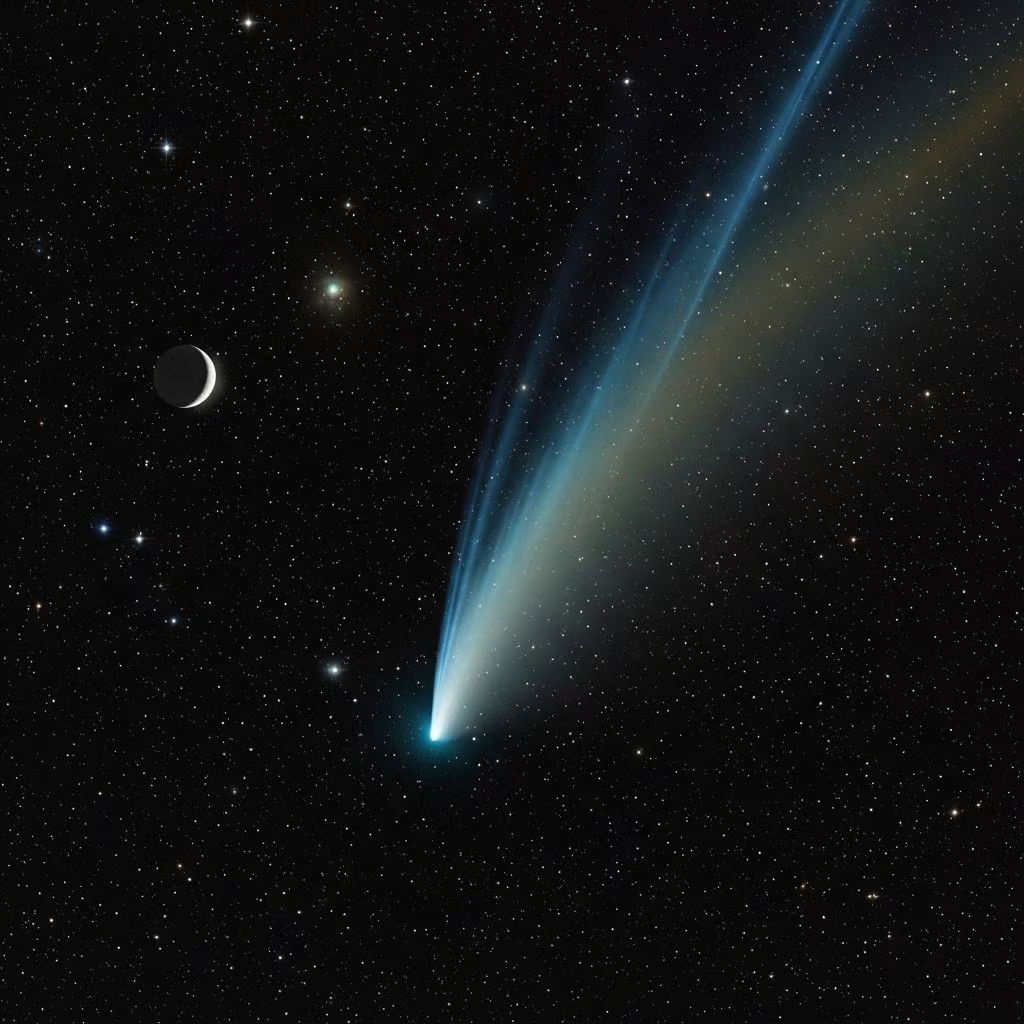
Comet Hale-Bopp (C/1995 O1) is a massive, long-period comet that became widely visible to the naked eye for an unprecedented 18 months, thrilling both scientists and amateur stargazers. Passing through the inner solar system in 1997, it outshone every comet of the previous two decades and is considered one of the most significant astronomical events of the 20th century.
- Type: Long-period comet
- First observed: July 23, 1995
- Closest passage to Earth: March 22, 1997
- Brightness: Apparent magnitude −1.8 at peak, visible to the naked eye even from light-polluted areas
Comets are icy bodies from the outer solar system that develop glowing comae and spectacular tails as they approach the Sun. Hale-Bopp’s nucleus, jets, and tails displayed exceptional activity and size, offering rich material for astronomers to study cometary science in detail.
A Double Discovery: Alan Hale and Thomas Bopp
The discovery of Hale-Bopp is a story of serendipity and shared wonder. On the night of July 23, 1995, Alan Hale, a professional astronomer in New Mexico, and Thomas Bopp, an amateur astronomer in Arizona, independently spotted a new fuzzy object near the globular cluster M70 in the Sagittarius constellation.
- Alan Hale: Noticed unfamiliar motion near M70, confirmed it was not a cataloged object, observed its movement—evidence that it was a comet.
- Thomas Bopp: Spotted the same object with friends; upon confirming its uniqueness, reported it as a comet discovery via telegram.
Both observers promptly notified the International Astronomical Union’s Central Bureau for Astronomical Telegrams, thus securing joint credit for what soon became known as Comet Hale-Bopp.
Naming and Designation
After confirmation, the comet was assigned the formal designation C/1995 O1. Its common name, Hale-Bopp, honors its co-discoverers. According to tradition, newly discovered comets often bear the names of those who first observed them and reported the findings. The official record was published in the International Astronomical Union Circulars.
- C/1995 O1: Indicates a non-periodic comet discovered in 1995.
- Hale-Bopp: Combines the surnames of its co-discoverers.
This naming is significant not only for its dual discoverers, but also because the comet was the most distant ever seen by amateur observers at the time (about 7.2 AU from the Sun).
Physical Features and Orbit
Hale-Bopp’s prominence is due in part to its extraordinary physical characteristics:
- Nucleus diameter: Estimated at 60 kilometers (37 miles)—among the largest comet nuclei ever studied.
- Mass: Five to six times the mass of Halley’s Comet.
- Orbit:
- Perihelion (closest to Sun): 0.914 AU (astronomical units)
- Aphelion (farthest from Sun): 370.8 AU—a vast elliptical orbit reaching deep into the Oort Cloud.
- Orbital period: Roughly 2,533 years, with the last visit to the inner solar system likely in 2215 BC; predicted return in 4385.
- Tail structure: Multiple tails up to 80 million km long, including a prominent dust tail and a blue ion tail due to solar wind interaction with its coma.
- Coma: The envelope of glowing gas and dust surrounding the nucleus reached exceptional brightness, signaling underlying activity even far from the Sun.
| Feature | Details |
|---|---|
| Nucleus Diameter | ~60 km |
| Orbital Period | ~2,533 years |
| Perihelion | 0.914 AU |
| Aphelion | 370.8 AU |
| Closest Approach to Earth | March 22, 1997 |
The Great Display of 1997
Hale-Bopp’s most celebrated moment began in early 1997, when the comet grew brighter and more pronounced in the sky. It was visible to the naked eye for over a year, from May 1996 to December 1997, a sharp contrast to the much shorter visibility window of other famous comets such as Halley’s Comet.
- Reached an apparent magnitude of −1.8 at its peak, making it brighter than nearly all other celestial objects except the moon and some planets.
- Viewed from a wide range of latitudes, including urban skies, often with striking double tails.
- Dominated public interest, partly due to widespread coverage on the emerging Internet—users shared images, updates, and observations, adding to its fame.
Comparison: Hale-Bopp vs. Other Famous Comets
| Comet | Size | Visibility | Visit Frequency | Closest Approach (AU) |
|---|---|---|---|---|
| Hale-Bopp | ~60 km | 18 months | ~2,500 years | 0.914 |
| Halley | ~11 km | Few weeks | ~75 years | 0.59 |
| Comet West | Unknown | Few months | ~254,000 years | Unknown |
Scientific Significance and Research
Hale-Bopp provided an exceptional opportunity for astronomical research:
- Compositional analysis: Revealed water, ammonia, methane, carbon monoxide, and more—key ingredients for planetary formation.
- Activity at distance: Showed activity tens of AUs from the Sun, possibly due to highly volatile compounds (like CO) in its nucleus.
- Jet dynamics: Large jets on the surface produced sudden dust outbursts up to eight times the volume of previous comets. Researchers learned much about cometary venting and crystalline ice conversion.
- Solar system formation: Analysis suggests Hale-Bopp formed near Jupiter and was later ejected into the distant Oort Cloud, making it representative of primordial solar system bodies.
“The surface of Hale-Bopp’s nucleus must be an incredibly dynamic place, with ‘vents’ being turned on and off as new patches of icy material are rotated into sunlight for the first time,” noted Harold Weaver, a Johns Hopkins astrophysicist.
Public Impact and Tragedy
The cultural influence of the comet was unprecedented for its time:
- Internet phenomenon: The early Internet played a vital role in sharing pictures, data, and updates on Hale-Bopp, encouraging mass participation in astronomy and space science.
- Mass observation: Millions worldwide tracked the comet’s progress, making it one of the most watched natural events of the 1990s.
- Dark chapter: Tragically, Hale-Bopp became associated with the Heaven’s Gate cult mass suicide in March 1997. Followers were convinced a UFO trailed Hale-Bopp and took fatal action to join it, a belief with no scientific basis.
The tragedy highlighted the need for public education and skepticism in the face of extraordinary claims. Many astronomers openly debunked rumors of spacecraft accompanying the comet, yet false information persisted among certain groups.
Legacy of Hale-Bopp
As Hale-Bopp faded from view in late 1997, its legacy endured in several key ways:
- Scientific discovery: Data from its extended passage enhanced understanding of cometary physics, solar system evolution, and icy bodies from the Oort Cloud.
- Public inspiration: Its accessibility helped foster interest in amateur astronomy and space science, inspiring a new generation of hobbyists and professionals.
- Reminder of skepticism: The Heaven’s Gate tragedy stands as cautionary tale about critical thinking and scientific communication.
Today, astronomers continue to analyze Hale-Bopp’s rich data, and educational initiatives reference its unique role in 20th-century space science. The comet is not expected to return until the year 4385, leaving its impact on both science and culture for future generations to reflect upon.
Frequently Asked Questions (FAQs)
Q: Will Hale-Bopp return during our lifetimes?
A: No. Its orbital period is roughly 2,500 years, meaning it won’t pass Earth again until approximately the year 4385.
Q: Was there really a spaceship following Hale-Bopp?
A: No scientific evidence supports claims that a UFO trailed the comet. Astronomers debunked such rumors, but unfortunately, cult beliefs led to tragedy.
Q: What made Hale-Bopp so much brighter than other comets?
A: Its massive nucleus produced large amounts of gas and dust and had dynamic venting, making it far brighter than other comets at similar distances from the Sun.
Q: How did the Internet affect Hale-Bopp’s fame?
A: The 1997 passage coincided with the rise of the Internet, which allowed rapid sharing of images and discoveries—boosting public interest and participation.
Q: How does Hale-Bopp compare to Halley’s Comet?
A: Hale-Bopp’s nucleus is much larger—about six times the size of Halley’s—and was visible for a much longer period. Halley’s appears about every 75 years; Hale-Bopp takes 2,500 years for a single orbit.
Q: What scientific discoveries arose from Hale-Bopp?
A: Scientists studied cometary composition, jet formation, and the dynamic processes that occur on a nucleus exposed to the Sun. It provided clues to solar system formation and comet activity.
Final Thoughts
The Hale-Bopp comet brought together science, spectacle, and caution in one event. It remains a touchstone for astronomers and a vivid memory for millions who looked skyward in 1997. Its brilliant trail is both a reminder of our place in the cosmos and of the enduring value of science and reason in interpreting the wonders of the universe.
References
- https://en.wikipedia.org/wiki/Comet_Hale%E2%80%93Bopp
- https://www.space.com/19931-hale-bopp.html
- https://science.nasa.gov/solar-system/comets/c-1995-o1-hale-bopp/
- https://theplanets.org/hale-bopp-comet-facts/
- https://www.britannica.com/topic/Comet-Hale-Bopp
- https://www.skyatnightmagazine.com/space-science/comet-hale-bopp-visitor-from-edge-solar-system
- https://allthatsinteresting.com/hale-bopp-comet
- https://www.eso.org/public/events/astro-evt/hale-bopp/comet-hale-bopp-summary-may16-97-rw/
- http://www.psrd.hawaii.edu/Feb97/Discovery.html
- http://www.cbat.eps.harvard.edu/pressinfo/HaleBopp.html
- https://www.cometwatch.co.uk/historic-bright-comets/comet-hale-bopp/
- https://www.iac.es/en/media/1439
- https://kids.britannica.com/students/article/Hale-Bopp/311563
- https://www.spacereference.org/comet/c-1995-o1-hale-bopp
- http://www.spaceopedia.com/solar-system/comets/hale-bopp/
- https://www.halebopp.com/what-is-comet-hale-bopp/
- https://www.eso.org/~ohainaut/Hale_Bopp/hb_ufo.html
- https://www.factsjustforkids.com/space-facts/comet-hale-bopp-facts/