


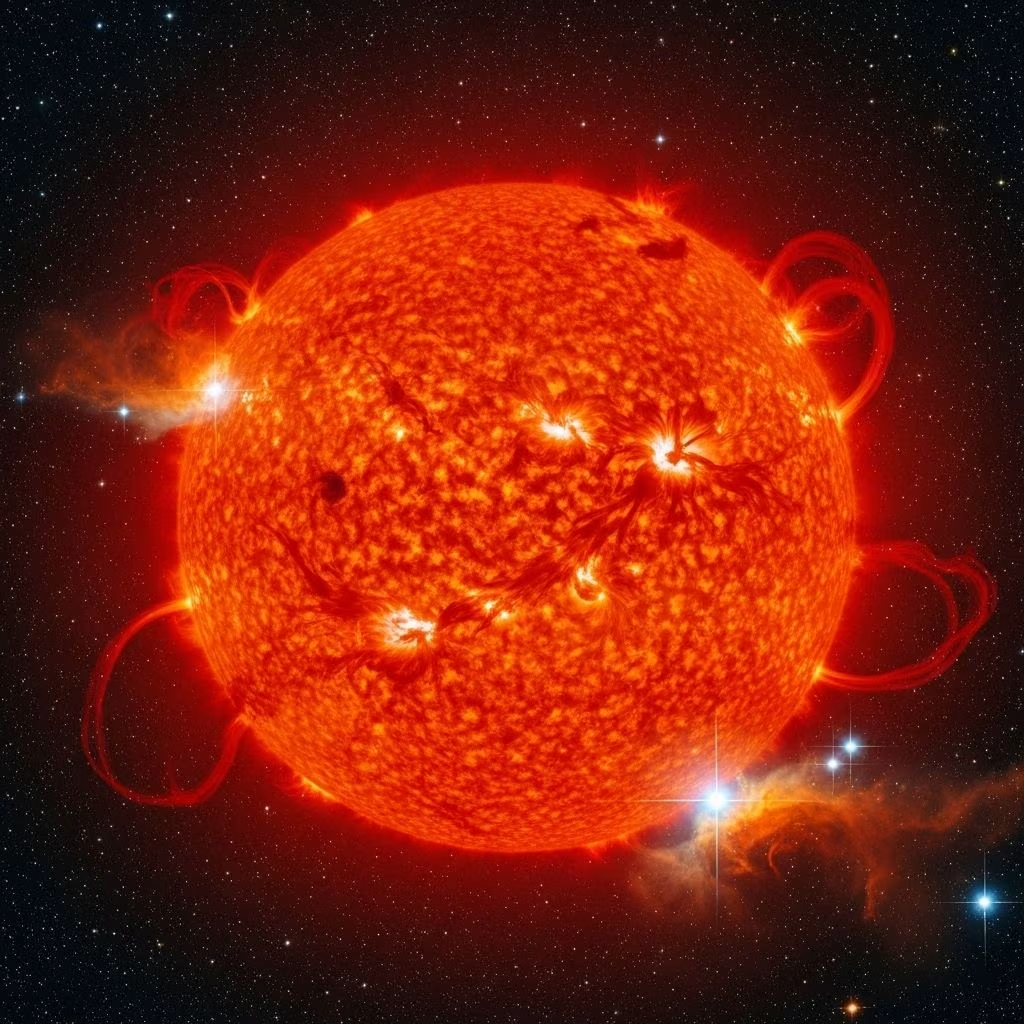
Red Giant Stars: The Majestic Final Act of Stellar Evolution
Red giant stars represent one of the most fascinating spectacles in the universe. As stars like our Sun exhaust their nuclear fuel, they drastically change both in size and luminosity, entering the red giant phase—a process that profoundly shapes the chemistry and evolution of galaxies. This article reveals what red giant stars are, how they form, their life cycle, and their lasting impact on the cosmos.
What Is a Red Giant Star?
A red giant is a stellar object that has entered the final phase of its evolutionary journey. Characterized by a bloated radius and a cooler surface temperature, red giants shine with a reddish hue and can swell to hundreds of times their original size. This phase is common for intermediate-mass stars, typically those between 0.8 and 8 solar masses, after they exhaust the hydrogen fuel at their cores.
- Surface temperature: 3,000 – 5,000 Kelvin, cooler than main-sequence stars.
- Size: Up to hundreds of times the Sun’s radius.
- Color: Reddish due to cooler outer layers.
Formation of Red Giant Stars
The journey to becoming a red giant begins when a star depletes its core hydrogen reserves. During its main sequence, a star balances gravitational pressure and thermal pressure from nuclear fusion. Once hydrogen is gone, this equilibrium is lost:
- The star’s core contracts under gravity and heats up.
- Hydrogen fusion shifts to a thin shell around the core.
- The outer layers expand enormously and cool, appearing red.
This transformation can take hundreds of millions of years. For most stars, this stage is short—only about 1% of their lifetime[13].
Internal Structure and Energy Production
Red giant stars have complex internal structures. The core shrinks and becomes hotter, and several concentric shells form, each fusing different elements:
| Region | Fusion Activity | Key Element |
|---|---|---|
| Core | Helium Fusion (Triple-alpha process) | Helium → Carbon/Oxygen |
| Inner Shell | Hydrogen Fusion (Shell burning) | Hydrogen → Helium |
| Outer Layers | Convective motion, no fusion | Cool plasma |
There are several branches in the red giant phase, depending on mass and age:
- Red-Giant Branch (RGB): Hydrogen fusion in a shell around a helium core.
- Horizontal Branch (HB): Helium core fusion activates, leading to stability.
- Asymptotic-Giant-Branch (AGB): Advanced phase, with core made of carbon/oxygen and both hydrogen- and helium-burning shells.
Notable Red Giants and Red Supergiants
Several red giants are prominent in our night sky and hold crucial roles in astronomical study:
- Arcturus: The brightest star in the constellation Boötes, one of the nearest red giants.
- Aldebaran: The “eye” of Taurus the bull, notable for its brightness and size.
- Betelgeuse: A famous red supergiant in Orion, known for its enormous radius and recent dimming events[11].
- Pollux, Mira, and Gacrux: Distinguished red giants with unique variability and characteristics[13].
The Fate of the Sun: Our Star’s Future Transformation
The Sun is currently in its long-lived main sequence stage but will become a red giant in about 5 billion years. Its transformation will profoundly affect the solar system:
- Expansion may engulf the inner planets, including Mercury and Venus.
- The Sun’s luminosity will dramatically increase, impacting Earth’s habitability.
- After shedding its outer layers, the Sun will end as a white dwarf, surrounded by a glowing planetary nebula[13].
Stellar Evolution: Red Giants vs. Red Supergiants
Mass determines a star’s destiny:
- Low- and intermediate-mass stars (like the Sun): Become red giants, end as white dwarfs.
- High-mass stars: Become red supergiants, undergo more complex fusion processes, and ultimately explode as supernovae[11].
After the red giant phase:
- Low-mass stars shed outer layers, form planetary nebulae, core becomes white dwarf.
- High-mass stars’ cores collapse, powering supernova explosions and forming neutron stars or black holes.
Red Giants and the Creation of Heavy Elements
Red giants play an essential role in cosmic chemistry. Nuclear fusion in their cores creates heavier elements, which are subsequently released into the galaxy when the star dies. This enrichment provides building blocks for:
- Planetary formation
- Cometary and asteroid composition
- The chemical makeup of life on Earth
Notably, carbon and oxygen—the backbone of organic chemistry—are synthesized inside red giant stars.
Observable Features: Brightness, Variability, and Starspots
Certain red giants exhibit dramatic variability. For example, some stars pulsate, periodically changing in brightness. Others, like the red giant studied by astronomers, display starspots far larger than our sun’s, revealing dynamic surface processes.
- Red giants: Often variable, sometimes pulsating.
- Starspots: Vast regions on the surface, orders of magnitude larger than those on the Sun.
- Light output: Can be 1,000 times brighter than the Sun.
Planetary Systems and Red Giants: A Second Chance?
The red giant phase isn’t solely a destructive process for accompanying planets. Recent research explores how expanding stars might offer “second chances” for planetary systems:
- Expanding habitable zones may temporarily revive outer icy worlds[10].
- Matter shed from red giants can enrich protoplanetary discs of nearby young stars.
- Some planets may even survive engulfment—a subject of ongoing research[10].
FAQs: Red Giant Stars
Q: How long do stars spend as red giants?
A: Stars typically spend only about 1% of their entire lifespan in the red giant phase, a few hundred million years compared to the billions spent on the main sequence[13].
Q: Will Earth survive the Sun’s red giant phase?
A: It is uncertain, but models suggest the Sun may expand enough to engulf Mercury, Venus, and possibly Earth. Well before this stage, increasing solar luminosity will render our planet inhospitable[13].
Q: What happens after the red giant phase?
A: After shedding their outer layers, red giants become compact white dwarfs. For massive stars, the endgame is a supernova[11].
Q: Why do red giants appear red?
A: Their bloated surfaces are cooler than main-sequence stars, emitting less energetic (redder) light.
Q: Are all red giants the same?
A: No. Red giants cover a wide range of masses and ages, and some become red supergiants, with even larger radii and more complex fusion processes[11].
Red Giants in Culture and Observation
Red giants have inspired astronomers and artists alike. Their spectacular appearance and crucial role in cosmic evolution make them favorite subjects for telescopic observation and astrophotography. Betelgeuse’s sudden dimming in 2019, for instance, captivated both professionals and amateur skywatchers[11].
Summary Table: Red Giant vs. Red Supergiant
| Feature | Red Giant | Red Supergiant |
|---|---|---|
| Mass Range | ~0.8–8 solar masses | >8 solar masses |
| Surface Temperature | ~3,000–5,000 K | ~3,500–4,500 K |
| Typical Size | Up to 100x Sun’s radius | Up to 1,000x Sun’s radius |
| End State | White dwarf/planetary nebula | Supernova/neutron star/black hole |
| Examples | Arcturus, Aldebaran | Betelgeuse, Antares |
Conclusion: Red Giants—Cosmic Legacy Makers
Red giant stars illuminate the complex, beautiful processes that govern the fate of stars and the birth of elements essential to life. Their eventual collapse fuels the galaxy with carbon, oxygen, and other heavy elements, influencing planetary systems and serving as a keystone in the cosmic cycle. Studying these titans reveals not just the fate of stars, but our own chemical heritage and future among the stars.
References
- https://www.space.com/mini-red-giant-stars-kepler-space-telescope
- https://www.space.com/the-universe/stars/this-red-giant-star-has-starspots-larger-than-the-entire-sun
- https://science.nasa.gov/universe/stars/types/
- https://www.ebsco.com/research-starters/astronomy-and-astrophysics/red-giant-stars
- https://en.wikipedia.org/wiki/Red_giant
- https://esahubble.org/wordbank/red-giant/
- https://space.fandom.com/wiki/Red_giant
- https://spaceaustralia.com/feature/red-giant-pulsed-sky
- https://study.com/academy/lesson/red-giant-definition-facts-quiz.html
- https://carlsaganinstitute.cornell.edu/news/second-chance-planets-around-red-giant-stars
- https://en.wikipedia.org/wiki/Red_supergiant
- https://www.youtube.com/watch?v=qb407nehKWc
- https://theplanets.org/types-of-stars/red-giant-star/
- https://www.go-astronomy.com/red-giant-stars.php
- https://spaceaustralia.com/news/stellar-weight-loss-discovered-red-giant-stars
- https://scitechdaily.com/astronomy-astrophysics-101-red-giant/
- https://space.fandom.com/wiki/Red_Giant


