


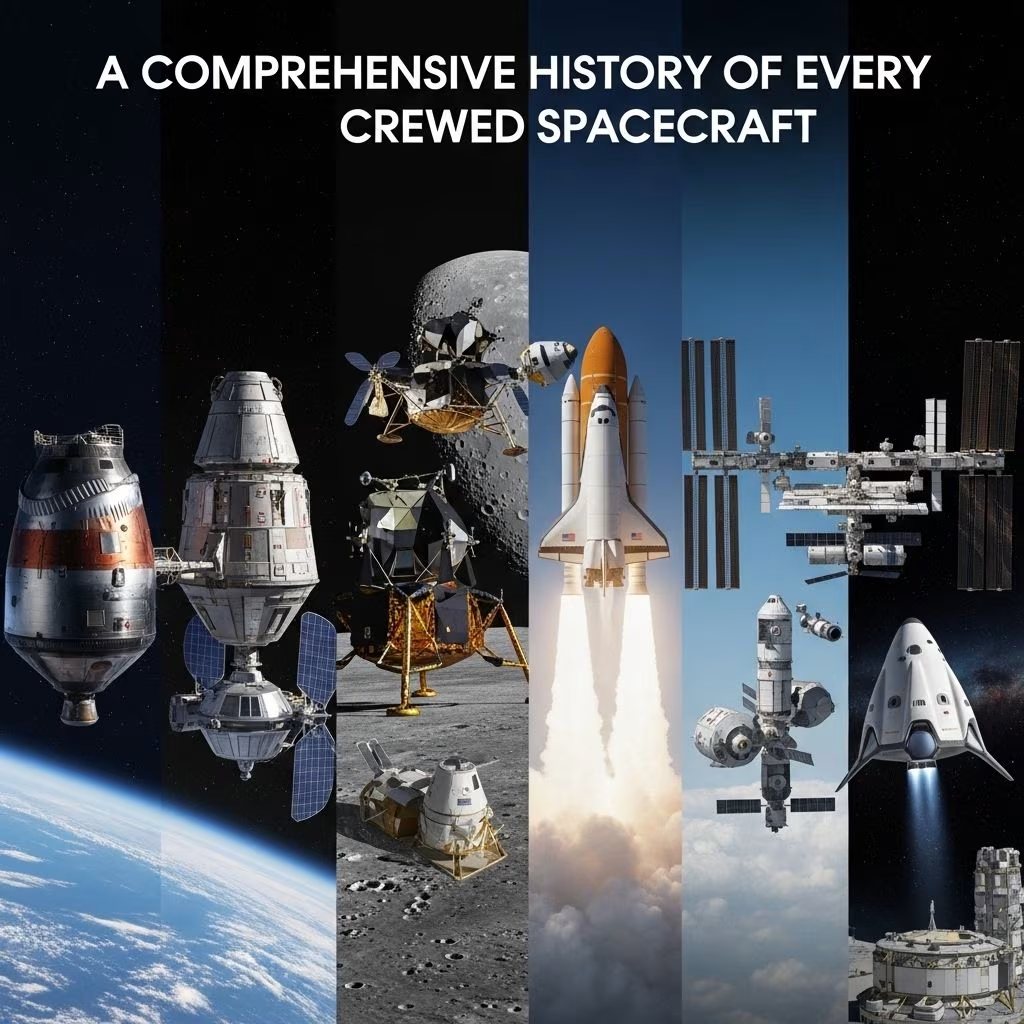
Every Crewed Spacecraft in Human Spaceflight History
Humanity’s drive to explore beyond Earth has produced a rich history of crewed spacecraft—vehicles specifically designed to safely transport astronauts, cosmonauts, and taikonauts through space. Since the earliest Cold War-era missions to contemporary commercial launches, each spacecraft contributes uniquely to our understanding and presence in space. This article outlines the milestones, evolution, and distinction of every crewed spacecraft, highlighting their missions, technological innovations, and impacts on space exploration.
Early Crewed Spacecraft: Milestones and Competition
Vostok: The Soviet Pioneer
- First Human in Space: Yuri Gagarin, Vostok 1, April 12, 1961.
- Spherical capsule, designed for solo flights.
- Total of six missions, ending with Vostok 6’s Valentina Tereshkova—the first woman in space.
- Major Cold War achievement, sparking global interest and competition.
Significant Vostok Flights:
- Vostok 1: Yuri Gagarin. First human spaceflight.
- Vostok 3 & 4: First simultaneous spaceflights.
- Vostok 5: Longest solo flight (5 days).
- Vostok 6: Valentina Tereshkova, first female astronaut.
Mercury: America’s Initial Leap
- First U.S. Crewed Spacecraft: Alan Shepard, Freedom 7, May 5, 1961.
- Project Mercury featured six crewed flights between 1961–1963.
- Missions tested human endurance and spacecraft recovery techniques.
- John Glenn’s Friendship 7: First American in orbit (1962).
Voskhod: Expanding Soviet Capabilities
- First multi-person crew (Voskhod 1, 1964).
- Voskhod 2: First spacewalk (Alexei Leonov, 1965).
- Short-lived program, superseded by Soyuz.
The Space Race Intensifies: Next-Generation Missions
Gemini: Bridging the Moon Landing Gap
- NASA’s Gemini program (1965–1966) focused on mastering orbital maneuvers essential for moon missions.
- Key achievements:
- New endurance records (Gemini VII: nearly 14 days in space).
- First American spacewalk (Ed White, Gemini IV).
- First space rendezvous (Gemini VI & VII).
Apollo: The Lunar Era
- Apollo 11: First moon landing, Neil Armstrong and Buzz Aldrin, July 20, 1969.
- Nine missions to the moon between 1968 and 1972.
- Technological innovations: Lunar Module, Command Module, Saturn V rocket.
- Apollo 13: Famous for life-saving improvisation after explosion.
- Lunar samples and surface exploration advanced planetary science.
Apollo Crewed Missions Table
| Mission | Year | Achievements |
|---|---|---|
| Apollo 7 | 1968 | First crewed Apollo flight (Earth orbit) |
| Apollo 11 | 1969 | First humans land on Moon |
| Apollo 13 | 1970 | Successful failure, emergency return |
| Apollo 17 | 1972 | Last crewed moon mission |
Soyuz: Enduring Russian Workhorse
- Introduced in 1967, now the longest-serving crewed spacecraft design.
- Multiple generations of upgrades (Soyuz-T, Soyuz TM, Soyuz TMA, Soyuz MS).
- Integral to Russian missions and International Space Station.
- Primary ferry for astronauts during Shuttle retirement before commercial vehicles matured.
- Renowned safety record and adaptability.
Space Stations and Modular Craft
Salyut: Soviet Early Stations
- World’s first space stations (Salyut 1 launched 1971).
- Demonstrated long-duration human habitation.
Skylab: U.S. Orbital Laboratory
- America’s first space station, operated 1973–1974.
- Three crewed expeditions, pioneering science in microgravity.
Mir Space Station
- Soviet, later Russian, station assembled in orbit 1986–1996.
- Hosted multinational crews, advanced modular construction.
- Set longevity records before deorbiting in 2001.
International Space Station (ISS) - Joint project by the U.S., Russia, Europe, Canada, Japan.
- Continuous human occupancy since 2000.
- Supported by Soyuz, Shuttle, and modern commercial vehicles.
- Hub for science, international collaboration, and space technology testing.
Reusable Crewed Vehicles: Shuttle Era
NASA’s Space Shuttle
- First operational reusable spacecraft (first flight: Columbia, April 12, 1981).
- Five orbiters: Columbia, Challenger, Discovery, Atlantis, Endeavour.
- 133 missions over three decades: satellite launches, ISS construction, science payloads.
- Tragic losses: Challenger (1986), Columbia (2003).
- Retired in 2011, closing a chapter in American crewed spaceflight.
Space Shuttle Program Table
| Orbiter | First Flight | Key Missions |
|---|---|---|
| Columbia | 1981 | First Shuttle flight; science missions |
| Challenger | 1983 | Notable early launches; lost in 1986 |
| Discovery | 1984 | Hubble deployment; ISS construction |
| Atlantis | 1985 | Final Shuttle mission (2011); ISS work |
| Endeavour | 1992 | ISS assembly; science |
China’s Crewed Spacecraft Program
Shenzhou
- First Chinese crewed flight: Shenzhou 5, Yang Liwei, October 15, 2003.
- Ongoing missions advancing orbital docking, long-duration stays, and space station development.
- Recent milestones: building and populating Tiangong space station.
Modern Era: Commercial Crewed Spacecraft
- SpaceX Dragon: First commercial orbital crew launch (May 2020).
- Boeing Starliner: Under development, aiming for ISS crew transfers.
- Virgin Galactic SpaceShipTwo and Blue Origin New Shepard: Suborbital, space tourism-focused.
- Private sector contributions increasingly vital for future crewed missions.
Comparison Table: Notable Crewed Spacecraft
| Spacecraft | Country/Entity | First Flight | Key Achievements |
|---|---|---|---|
| Vostok | USSR | 1961 | First human in space |
| Mercury | USA | 1961 | First American in space |
| Gemini | USA | 1965 | First U.S. spacewalk, rendezvous |
| Apollo | USA | 1968 | Humans on the Moon |
| Soyuz | USSR/Russia | 1967 | Longest operational crewed craft |
| Space Shuttle | USA | 1981 | Reusable crewed launch vehicle |
| Shenzhou | China | 2003 | Chinese human spaceflight |
| Dragon | USA (SpaceX) | 2020 | First commercial orbital crewed launch |
Special Missions & Milestones
- First woman in space: Valentina Tereshkova, Vostok 6 (1963).
- First American in orbit: John Glenn, Mercury-Atlas 6 (1962).
- Longest solo flight: Valery Bykovsky, Vostok 5 (1963, 5 days).
- First spacewalk: Alexei Leonov, Voskhod 2 (1965).
- First international mission: Apollo-Soyuz Test Project (1975).
- First private crewed flights: SpaceShipOne (2004, suborbital), SpaceX Crew Dragon (2020, orbital).
Frequently Asked Questions (FAQs)
Q: What was the first crewed spacecraft ever launched?
A: The Soviet Union’s Vostok 1 carried Yuri Gagarin into orbit on April 12, 1961, inaugurating human spaceflight.
Q: Which spacecraft landed the first humans on the Moon?
A: Apollo 11’s lunar module delivered Neil Armstrong and Buzz Aldrin to the Moon’s surface in July 1969.
Q: What is the longest-running crewed spacecraft program?
A: Russia’s Soyuz program, active since 1967, holds the record for most launches and operational longevity.
Q: Is there a commercial crewed spacecraft?
A: Yes, SpaceX’s Crew Dragon was the first private company to launch astronauts to orbit in May 2020.
Q: How many countries have launched their own crewed spacecraft?
A: As of 2025, only three countries—the USSR/Russia, the United States, and China—have launched indigenous crewed spacecraft.
The Evolving Future of Crewed Spacecraft
With decades of missions behind us, human spaceflight continues to evolve—propelled by technological innovation, international cooperation, and increasingly, private enterprise. As new vehicles like NASA’s Orion, SpaceX’s Starship, and China’s advanced next-gen spacecraft prepare for lunar and deep space exploration, the next chapter will build on the legacy of every mission outlined here. The drive to explore beyond Earth’s boundaries, started by Vostok and Mercury, continues as humanity sets its sights on Mars and beyond.
References
- https://en.wikipedia.org/wiki/Human_spaceflight
- https://www.nasa.gov/specials/60counting/spaceflight.html
- https://en.wikipedia.org/wiki/List_of_human_spaceflights
- https://www.space.com/11329-human-spaceflight-biggest-moments-50th-anniversary.html
- https://www.space.com/2281-45-years-mankind-crewed-spaceflight.html
- https://aerospace.org/article/brief-history-space-exploration
- https://www.britannica.com/science/space-exploration/Major-milestones
- https://www.fai.org/page/icare-history-pioneers
- https://www.britannica.com/science/space-exploration/Chronology-of-crewed-spaceflights
- https://www.spacex.com/mission/
- https://www.astronomy.com/space-exploration/human-spaceflight/
- http://satellite-space.com/2024/12/28/the-history-of-human-spaceflight-key-milestones-and-modern-developments/
- https://airandspace.si.edu/explore/topics/spaceflight/human-spaceflight
- https://www.astronomy.com/space-exploration/a-brief-history-of-human-spaceflight-in-the-united-states/
- https://www.nasa.gov/humans-in-space/
- https://www.sierraspace.com/blog/the-past-present-future-evolutions-of-human-spaceflight/
- https://www.youtube.com/watch?v=axY2Cshyxqg
- https://upf.com/book.asp?id=9780813054278


