Gamma-Ray Bursts: Unleashing the Most Powerful Explosions in the Universe
Gamma-ray bursts (GRBs) are the universe’s most energetic phenomena, capable of releasing more energy in seconds than our Sun will emit over its entire lifetime. Discovered by accident in the mid-20th century, these brief but extraordinary flashes of high-energy radiation have revolutionized our understanding of cosmic cataclysms and the formation of black holes far beyond our Milky Way.
What Is a Gamma-Ray Burst?
Gamma-ray bursts are intense flashes of gamma rays—the highest-energy form of electromagnetic radiation—unleashed in violent cosmic events. These bursts can last from a few milliseconds to several minutes, with their initial flash often succeeded by a longer-lived afterglow emitted across the electromagnetic spectrum, including X-ray, ultraviolet, visible light, infrared, microwave, and radio waves.
- Energy Output: Each GRB can briefly outshine an entire galaxy, sometimes outshining our own Sun by a factor of up to a million trillion.
- Occurrence: Most observed GRBs occur billions of light-years away, highlighting the immense energy necessary for their detection across such vast distances.
- Frequency: They are rare—perhaps a few per galaxy every million years.
Anatomy of a GRB Event
GRBs consist primarily of two phases:
- Prompt phase: The brief, initial flash of gamma rays, generally lasting from milliseconds to several minutes.
- Afterglow: A fainter but longer-lasting emission at longer wavelengths (X-ray, optical, infrared, sometimes radio), which can persist for days, weeks, or even longer.
Discovery: From Military Satellites to Cosmic Mysteries
The story of gamma-ray bursts begins not in a space observatory, but amidst the tensions of the Cold War:
- In 1963, as part of efforts to police the Nuclear Test Ban Treaty, the United States launched the Vela satellites to detect gamma rays from possible secret Soviet nuclear detonations.
- Instead of catching nuclear explosions on Earth, scientists were astonished to record 16 mysterious and powerful gamma-ray events coming from space.
- By 1973, scientists confirmed that the source of these eruptions lay beyond our solar system.
- Over decades, contributions from missions like the Italian Space Agency’s BeppoSAX and NASA’s Compton Gamma-Ray Observatory revealed that GRBs are scattered evenly throughout the sky and occur at cosmological distances, far across the universe.
- The Swift and Fermi satellites, among others, have since dramatically improved detection, follow-up, and the identification of afterglows.
Types of Gamma-Ray Bursts
Detailed analysis of GRB light curves—plots of their brightness over time—has revealed that there are two main categories of gamma-ray bursts, each with different origins and astrophysical implications:
| GRB Type | Typical Duration | Primary Cause | Astrophysical Outcome |
|---|---|---|---|
| Long-duration GRBs | 2 seconds to several minutes (average ~30s) | Collapse of a massive star (hypernova/supernova) | Birth of a black hole |
| Short-duration GRBs | Milliseconds to 2 seconds (average ~0.3s) | Mergers of binary neutron stars or neutron star–black hole pairs | Birth of a black hole |
Long-Duration GRBs
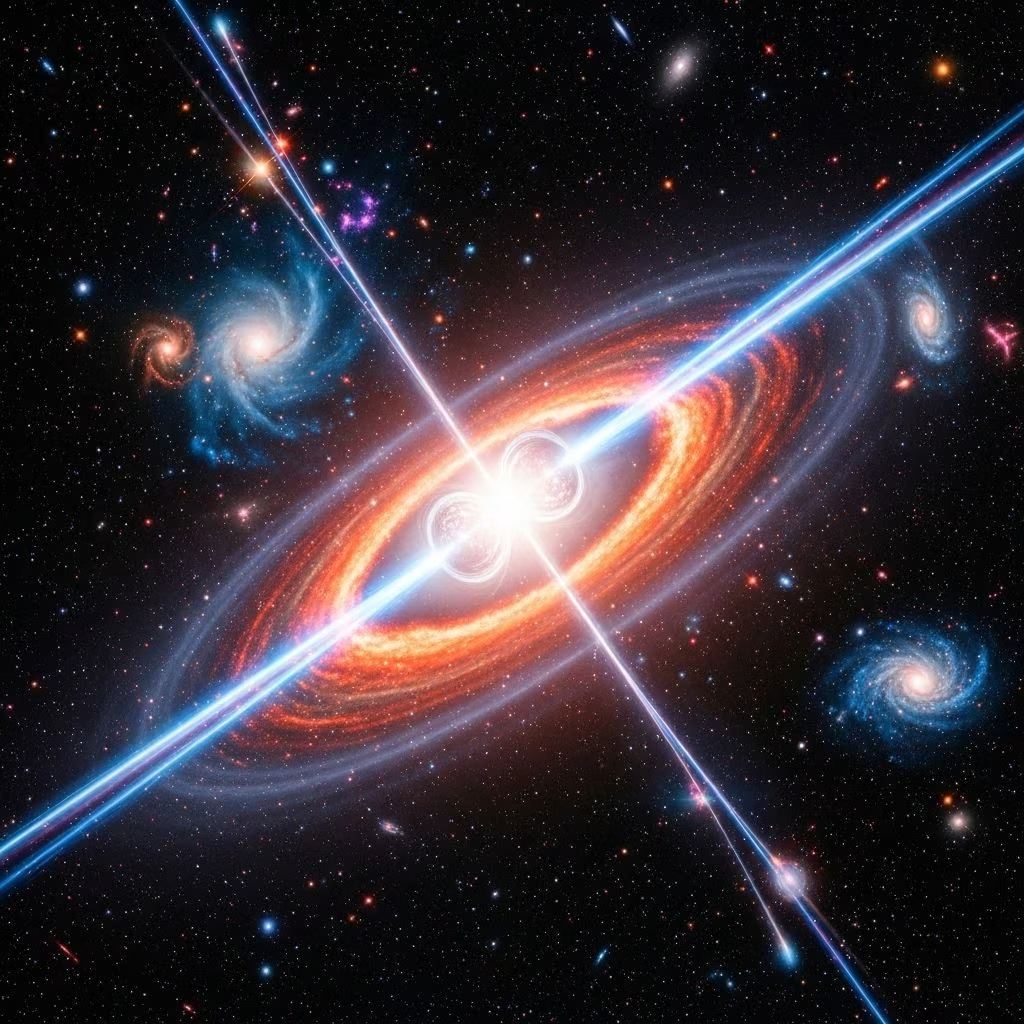
Long bursts—those lasting more than 2 seconds—are commonly associated with the death throes of massive stars. In these dramatic supernova or hypernova events, a star (at least several times more massive than the Sun) exhausts its nuclear fuel, collapses under its own gravity, and forms a black hole. Collimated jets of material blast outwards from the collapsing star at nearly light speed, emitting powerful gamma rays as they escape into space.
Short-Duration GRBs
Short bursts—under 2 seconds—are attributed to the violent collision and merger of neutron stars (or a neutron star and a black hole). When these ultra-dense cosmic remnants spiral together and merge, the resulting burst unleashes a torrent of gamma rays. This process also creates a newborn black hole, along with the emission of gravitational waves and the creation of heavy elements such as gold and platinum.
Physical Mechanisms: What Causes a GRB?
While the details are complex and still under study, two principal mechanisms are generally accepted:
- Massive Star Collapse (Collapsar Model): Drives long-duration GRBs when the core of a massive, rapidly rotating star collapses directly into a black hole, launching jets powered by gravitational and magnetic energy.
- Compact Object Mergers: Responsible for short-duration GRBs involving binary neutron stars or neutron star–black hole encounters. These mergers are now key sites for both high-energy emission and the cosmic production of heavy elements.
The resulting high-speed jets must be oriented toward Earth for us to detect a GRB—otherwise, we see only the afterglow or miss the event entirely.
Afterglow: The Multiwavelength Signature
After the initial, intense burst of gamma rays, GRBs produce an afterglow as their shock waves plow into surrounding material, radiating energy across a broad spectrum:
- X-rays
- Ultraviolet
- Visible light
- Infrared
- Radio waves
The afterglow can persist for hours to weeks (or even longer at radio wavelengths) and provides critical clues about the event and its environment.
How Bright and Powerful Are Gamma-Ray Bursts?
To appreciate their magnitude, consider these astonishing facts:
- A typical GRB can release as much energy in seconds as the Sun radiates in 10 billion years.
- Their peak luminosity can reach a quintillion (1,000,000,000,000,000,000) times that of the Sun.
- Despite their brief duration, this colossal energy is focused in narrow beams, making GRBs visible across cosmological distances.
Observing GRBs: Tools and Techniques
Because gamma rays are absorbed by Earth’s atmosphere, GRBs must be detected by space-based observatories. Key missions that have transformed our understanding include:
- Vela satellites (1960s): First detected GRBs by accident, opening up the field.
- Compton Gamma-Ray Observatory (NASA): Provided the GRB sky distribution showing bursts emanate from beyond the Milky Way.
- BeppoSAX (Italy): Enabled rapid follow-up observations, allowing astronomers to pinpoint afterglows and distances.
- Swift (NASA): Since 2004, has provided rapid localization and multi-wavelength follow-up, crucial for identifying GRB sources and afterglows.
- Fermi Gamma-ray Space Telescope: Continues to yield important data on GRB energies and populations.
Why Study Gamma-Ray Bursts?
Gamma-ray bursts are not only dramatic—they provide rare windows into the most extreme physics:
- Black Hole Formation: Each GRB reveals the birth of a black hole through cataclysmic collapse or collision.
- Cosmic Evolution: Studying the distribution and frequency of GRBs helps probe star formation and the evolution of galaxies across cosmic time.
- Element Formation: Observations of neutron star mergers (short GRBs) demonstrate how heavy elements are assembled in the universe.
- Testing Physics: GRBs allow astrophysicists to probe the limits of relativity, high-energy particle physics, and magnetic field generation.
Potential Dangers: Could a GRB Affect Earth?
Almost all GRBs ever observed have occurred outside our galaxy, vastly reducing their likelihood of affecting life on Earth. However, scientists theorize that a GRB pointed directly at Earth from within our Milky Way could devastate the planet’s ozone layer, raising the risk of mass extinctions. Some researchers have speculated that a GRB event might have been a contributing factor to the Late Ordovician mass extinction.
Related Phenomena: Soft Gamma Repeaters
While classical GRBs originate far from the Milky Way, our galaxy houses related objects known as soft gamma repeaters (SGRs). These are magnetars (highly magnetized neutron stars) that occasionally emit bursts of gamma rays, though much less energetic than extragalactic GRBs.
Major Milestones in GRB Research
- 1967: First GRBs detected by Vela military satellites.
- 1973: Confirmation of cosmic origin beyond the solar system.
- 1990s: BeppoSAX enables afterglow discovery and distance measurement, confirming extragalactic origin.
- 2004-present: NASA’s Swift satellite localizes and observes hundreds of GRBs, leading to rapid follow-up and detailed study.
Fun Facts about Gamma-Ray Bursts
- GRBs are among the surest signposts of black hole birth in the universe.
- The closest recorded GRB (as of now) occurred more than 100 million light-years away.
- Every point in the sky is equally likely to host a GRB, since they are seen scattered evenly everywhere—a testament to the breadth of cosmic violence.
- Despite millions of years between events in a single galaxy, enough galaxies exist for us to detect them regularly.
Frequently Asked Questions (FAQs)
Q: How were gamma-ray bursts first discovered?
A: GRBs were first detected accidentally by U.S. military Vela satellites in 1967, designed to monitor compliance with the Nuclear Test Ban Treaty. The bursts originated from deep space, not Earth or the Sun.
Q: What happens during a typical GRB event?
A: A GRB event consists of a brief, intense burst of gamma rays followed by a multi-wavelength afterglow, both resulting from an enormous release of energy from massive-star collapse or merging neutron stars.
Q: Are gamma-ray bursts dangerous for Earth?
A: GRBs are generally far outside our galaxy, making a threat extremely unlikely. However, if a powerful GRB occurred close to Earth and its jet was aimed at our planet, it could potentially disrupt our atmosphere and harm living organisms.
Q: How do astronomers classify gamma-ray bursts?
A: By analyzing the duration and characteristics of the gamma-ray emission, astronomers distinguish between long-duration and short-duration GRBs, leading to insights on their origins.
Q: What is the connection between GRBs and gravitational waves?
A: Short GRBs, caused by merging neutron stars, are expected to emit gravitational waves—ripples in spacetime detected by observatories like LIGO and Virgo.
References and Further Reading
- NASA Science – Gamma-Ray Bursts
- Imagine the Universe! – NASA GSFC
- Wikipedia – Gamma-ray burst
References
- https://en.wikipedia.org/wiki/Gamma-ray_burst
- https://science.nasa.gov/universe/gamma-ray-bursts-harvesting-knowledge-from-the-universes-most-powerful-explosions/
- https://www.merriam-webster.com/dictionary/gamma-ray%20burst
- https://imagine.gsfc.nasa.gov/science/objects/bursts1.html
- https://www.eso.org/public/science/grb/
- https://study.com/learn/lesson/gamma-ray-burst-origins-effects.html
- https://www.youtube.com/watch?v=Sc7Qd08ugQw
- https://www.skyatnightmagazine.com/space-science/what-is-a-gamma-ray-burst
- https://en.wikipedia.org/wiki/Gamma-ray_bursts
- https://astronomy.swin.edu.au/cosmos/g/gamma+Ray+burst
- https://www.britannica.com/science/gamma-ray-burst
- https://www.svom.eu/en/les-sursauts-gamma-en/
- https://www.youtube.com/watch?v=nwZSO6ULI2o
- https://www.astronomy.com/science/what-are-gamma-ray-bursts/