Higgs Boson: The ‘God Particle’ Explained
The Higgs boson is one of the most impactful discoveries in modern physics, shaping our comprehension of matter and the universe’s structure. Since its confirmation at CERN in 2012, this elusive particle has provided crucial experimental evidence for the Standard Model of particle physics, deepening our understanding of how basic building blocks acquire mass and influencing scientific research worldwide.
What Is the Higgs Boson?
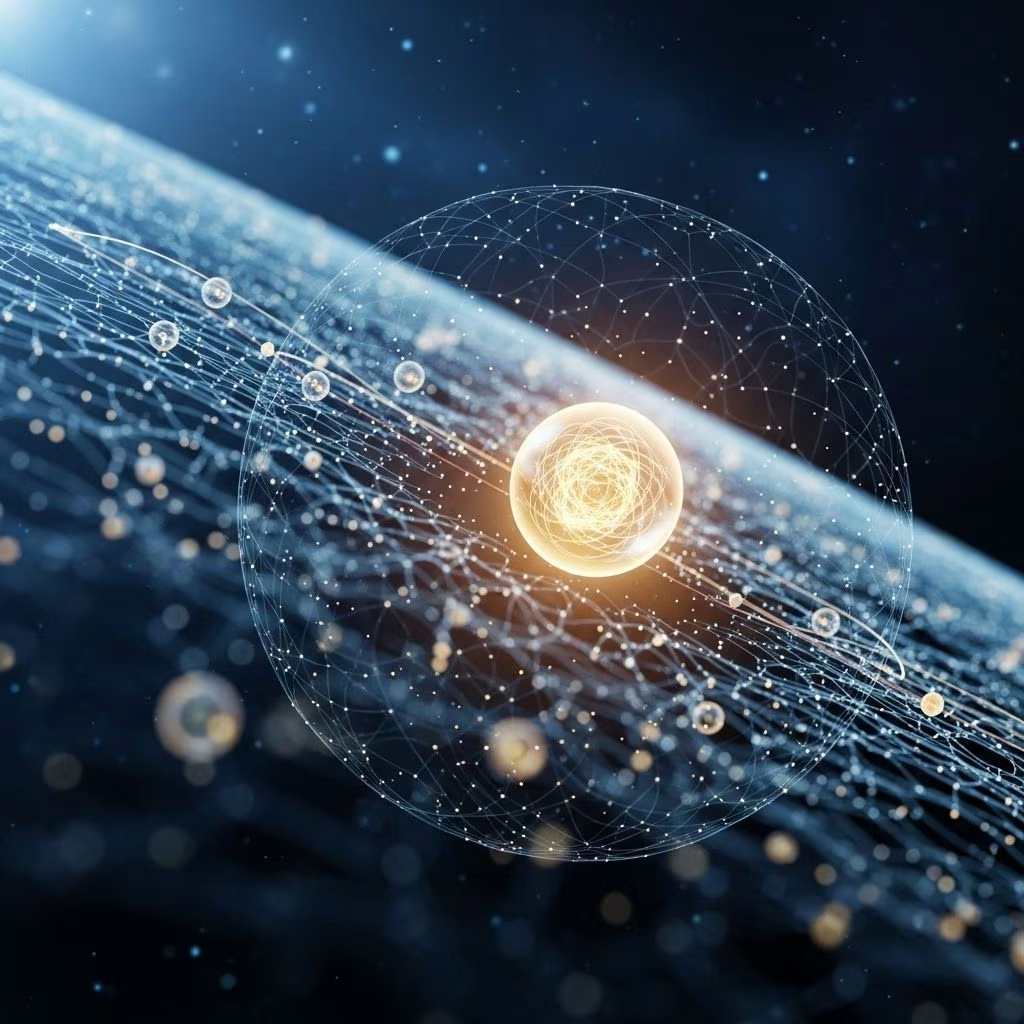
The Higgs boson is a subatomic particle, predicted in the 1960s by Peter Higgs and other theorists, that arises from the quantum excitation of the Higgs field—a fundamental energy field permeating the cosmos.
- It is the last missing elementary particle in the Standard Model of particle physics.
- It interacts with particles that gain mass via the Higgs mechanism.
- The boson itself has no electric charge, no color charge, zero spin, and exhibits even parity.
- It decays almost instantly after being produced, making detection challenging.
Particles like electrons and quarks acquire their mass by interacting with the omnipresent Higgs field. By contrast, massless particles such as photons do not interact with the Higgs boson.
Key Properties of the Higgs Boson
| Property | Details |
|---|---|
| Mass | About 125 GeV/c2 |
| Spin | 0 (scalar boson) |
| Charge | None (neutral) |
| Stability | Highly unstable; decaysalmost instantly |
| Role | Gives mass to other fundamental particles |
The Higgs Field and The Standard Model
The Higgs field is a fundamental scalar field predicted in the Standard Model, composed of components forming a complex doublet, key to the mechanism that gives mass to particles.
- The Higgs field exists everywhere, even in empty space.
- When certain particles travel through this field, they acquire mass; those that do not interact (like photons) remain massless.
- This property is essential to the structure of matter and the universe’s stability.
The Higgs mechanism, through symmetry breaking in the electroweak interaction, explains why weak force carriers (W and Z bosons) are massive while photons are not.
History of the Higgs Prediction and Discovery
The Higgs boson was predicted independently by several theorists in 1964 to solve the fundamental mystery of mass in particles. The scientific journey spanned five decades before experimental confirmation.
- 1964: Proposed by Peter Higgs, François Englert, and others.
- 2012: ATLAS and CMS experiments at CERN’s Large Hadron Collider (LHC) confirmed the Higgs boson’s existence.
- 2013: Nobel Prize in Physics awarded to Higgs and Englert for their theoretical prediction.
Detection was made possible by the unprecedented collision energies of the LHC, which produced Higgs bosons that quickly decayed into identifiable daughter particles.[10]
The Large Hadron Collider (LHC) and the Search for the Higgs Boson
- The LHC, operated by CERN in Geneva, Switzerland, is the world’s largest particle accelerator.
- It accelerates protons to near light speed and collides them, recreating conditions similar to the early universe.
- Detectors like ATLAS and CMS observed Higgs boson signatures in the aftermath of these collisions.
Why Is It Called The ‘God Particle’?
The nickname “God Particle” was popularized in the early 1990s, largely due to Nobel physicist Leon Lederman’s book “The God Particle.” The rationale behind this name is twofold:[13][14]
- The Higgs boson was seen as critical to the foundation of the universe, controlling why matter has mass and thus why the universe can form structure and life.
- Lederman’s original title—“The Goddamn Particle”—reflected its difficulty being detected, but publisher preference led to the more provocative “God Particle.”
- This name is controversial among physicists, as the particle is not connected to religious or metaphysical ideas but to fundamental physics.
Why Is the Higgs Boson Important?
- It confirms the last missing piece in the Standard Model, validating decades of theoretical physics.
- Explains how mass arises; mass is vital for forming atoms, molecules, stars, and planets — our universe could not exist without it.
- Experimental investigation of the Higgs offers potential windows beyond the Standard Model, which may uncover new physics.
- Understanding the Higgs boson informs nuclear physics, cosmology, and may have technological impacts in the long term.
Challenges in Detecting the Higgs Boson
Detecting the Higgs boson is difficult because:
- It is extremely short-lived, decaying in fractions of a second.
- The decay products are varied and complex, requiring precise instrumentation to reconstruct and identify the initial event.
Advanced statistical analyses and enormous computing resources are required to sift through collision data and find Higgs boson signatures among countless particle interactions.
Impact of the Discovery and Continuing Research
The discovery of the Higgs boson:
- Completed the Standard Model but also raised new questions—Is there one type of Higgs boson or several?
- Current research focuses on verifying whether the Higgs observed matches predictions precisely or if subtle differences exist that hint at new physical phenomena or dark matter.
- Some theories suggest the Higgs boson may interact with unknown particles or forces, a tantalizing prospect for future research.
FAQs about the Higgs Boson (‘God Particle’)
Q: What does the Higgs boson do?
A: The Higgs boson facilitates the Higgs field, which gives mass to other fundamental particles. Without it, most particles would be massless and matter as we know it would not exist.
Q: Have scientists observed the Higgs boson directly?
A: Scientists detected the Higgs through its decay products created by high-energy collisions at the LHC, not by observing the boson directly.[10]
Q: Why is it so hard to detect?
A: The particle decays almost instantaneously into other particles, and its production requires immense energies only accessible at facilities like the LHC.
Q: Does the Higgs boson relate to dark matter or other fundamental mysteries?
A: While the Higgs does not explain dark matter directly, ongoing research investigates whether it interacts with particles outside the Standard Model, which could yield new insights.
Q: Is the God Particle the ‘origin’ of mass?
A: The Higgs field is responsible for imparting mass to certain particles. However, the majority of the universe’s mass comes from the energy binding quarks inside protons and neutrons, not directly from the Higgs field.
How Does the Higgs Boson Affect Everyday Life?
- The physics explained by the Higgs field underpins why atoms exist, why matter forms, and ultimately why life is possible.
- While the boson itself doesn’t have direct applications, research in particle physics has led to technological innovations, including accelerators, detectors, and even advances in medical imaging and computing.
What’s Next for Higgs Boson Research?
Scientists continue to study the Higgs boson’s properties to answer key questions:
- Does the Higgs boson have siblings or variants?
- Are its interactions precisely as predicted, or do anomalies exist?
- Could it be a portal to new physics, such as supersymmetry or explanations for dark matter?
The ongoing upgrades to the LHC and future particle colliders may provide deeper insights, potentially resulting in revolutionary discoveries about the universe’s inner workings.
Summary Table: The Higgs Boson and Its Role
| Aspect | Description |
|---|---|
| Discovery | 2012 at CERN, confirmed by ATLAS and CMS experiments |
| Function | Imparts mass to some elementary particles |
| Physics Model | Central piece of the Standard Model |
| Nickname | ‘God Particle’, due to its foundational role |
| Remaining Questions | Potential links to unexplained phenomena, variants, new physics |
Conclusion
The Higgs boson, sometimes dramatically referred to as the ‘God Particle,’ stands as a touchstone in humanity’s quest to understand existence itself. It is neither divine nor magical, but rather a scientific triumph illuminating the deep structure of reality. As research progresses, the Higgs boson may yet guide us to new theories and unexpected discoveries about the universe’s most profound mysteries.
References
- https://www.youtube.com/watch?v=BiR1cPisge8
- https://en.wikipedia.org/wiki/Higgs_boson
- https://scitechdaily.com/science-made-simple-what-is-the-higgs-boson-god-particle/
- https://www.ndtv.com/science/what-is-higgs-boson-and-why-it-is-called-the-god-particle-5410111
- https://beyondthesestonewalls.com/blog/gordon-macrae/the-higgs-boson-god-particle-of-all-things-visible-and-invisible
- https://profmattstrassler.com/2024/04/12/peter-higgs-versus-the-god-particle/
- https://www.energy.gov/science/doe-explainsthe-higgs-boson
- https://www.britannica.com/science/Higgs-boson
- https://www.youtube.com/watch?v=CufRfgjDusg
- https://home.cern/science/physics/higgs-boson
- https://www.aspenideas.org/sessions/the-god-particle
- https://science.howstuffworks.com/higgs-boson.htm
- https://www.businessinsider.com/why-the-higgs-is-called-the-god-particle-2015-5
- https://answersingenesis.org/physics/higgs-boson-god-particle/
- https://www.cbsnews.com/news/god-particle-why-the-higgs-boson-matters/
- https://www.businessinsider.com/why-is-the-god-particle-such-a-big-deal-2012-7
- https://tubefabricatingservices.com/why-higgs-boson-matters-all-you-need-to-know-about-the-god-particle/