Space is vast beyond ordinary comprehension, with distances that dwarf anything encountered on Earth. For astronomers and scientists, quantifying these unfathomable expanses requires a unit that can represent the immense scales of the cosmos: the light-year. This measure, while frequently referenced in science fiction and popular science, holds a specific scientific definition and an essential role in our understanding of the universe.
Definition of a Light-Year
Contrary to what its name might suggest, a light-year is not a measure of time but rather a unit of distance. It refers to the distance that light, the fastest known entity in the universe, travels in the vacuum of space over the course of one year. [14]
- Speed of Light: Light moves at 299,792 kilometers per second (around 186,282 miles per second).
- Distance in a Year: Over one year, this amounts to about 9.46 trillion kilometers (or 5.88 trillion miles).
- Symbol: The commonly accepted symbol for a light-year is ly.
This astronomical unit allows scientists to express vast distances without resorting to enormously cumbersome numbers if measured in miles or kilometers. For example, writing the distance to the nearest star beyond the Sun as 4.2 light-years is much simpler and more understandable than the alternative: over 40 trillion kilometers.
Understanding How Far a Light-Year Is
To grasp the full enormity of a light-year, consider the following:
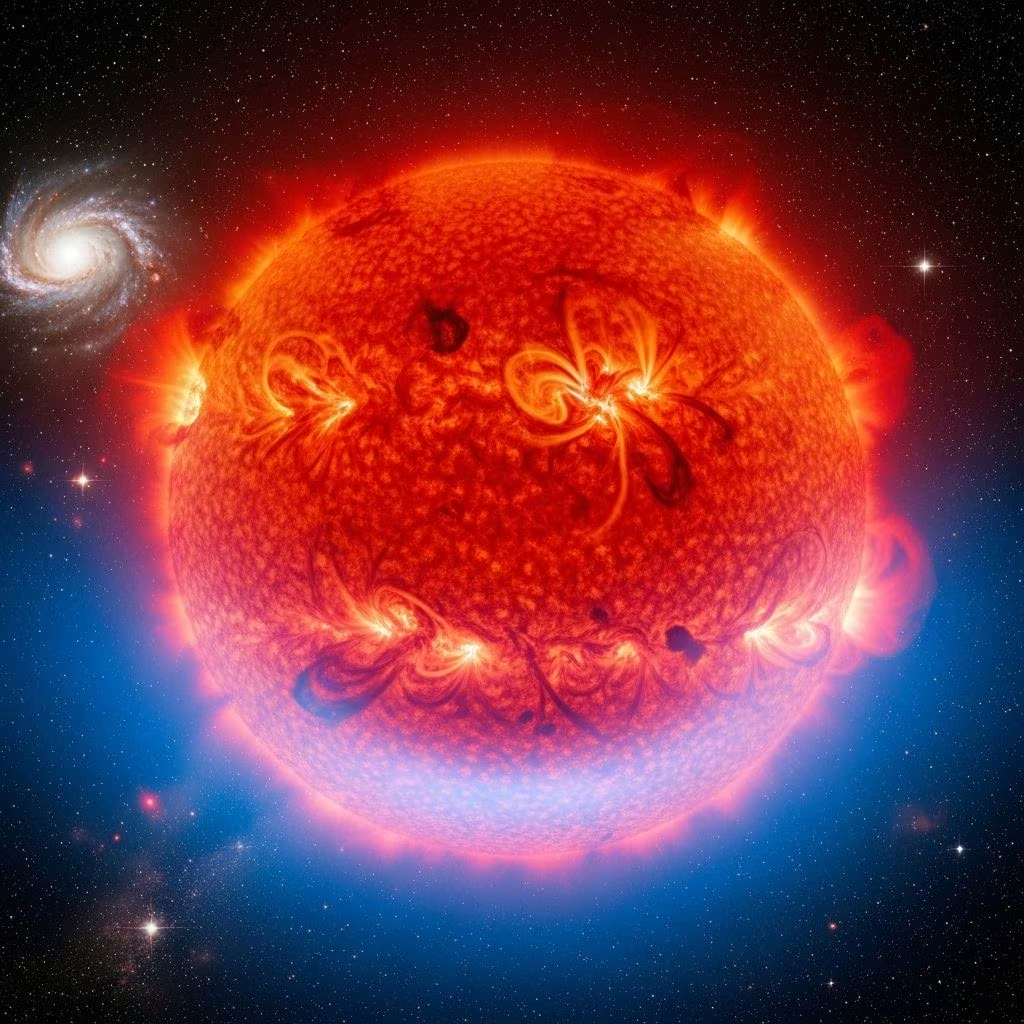
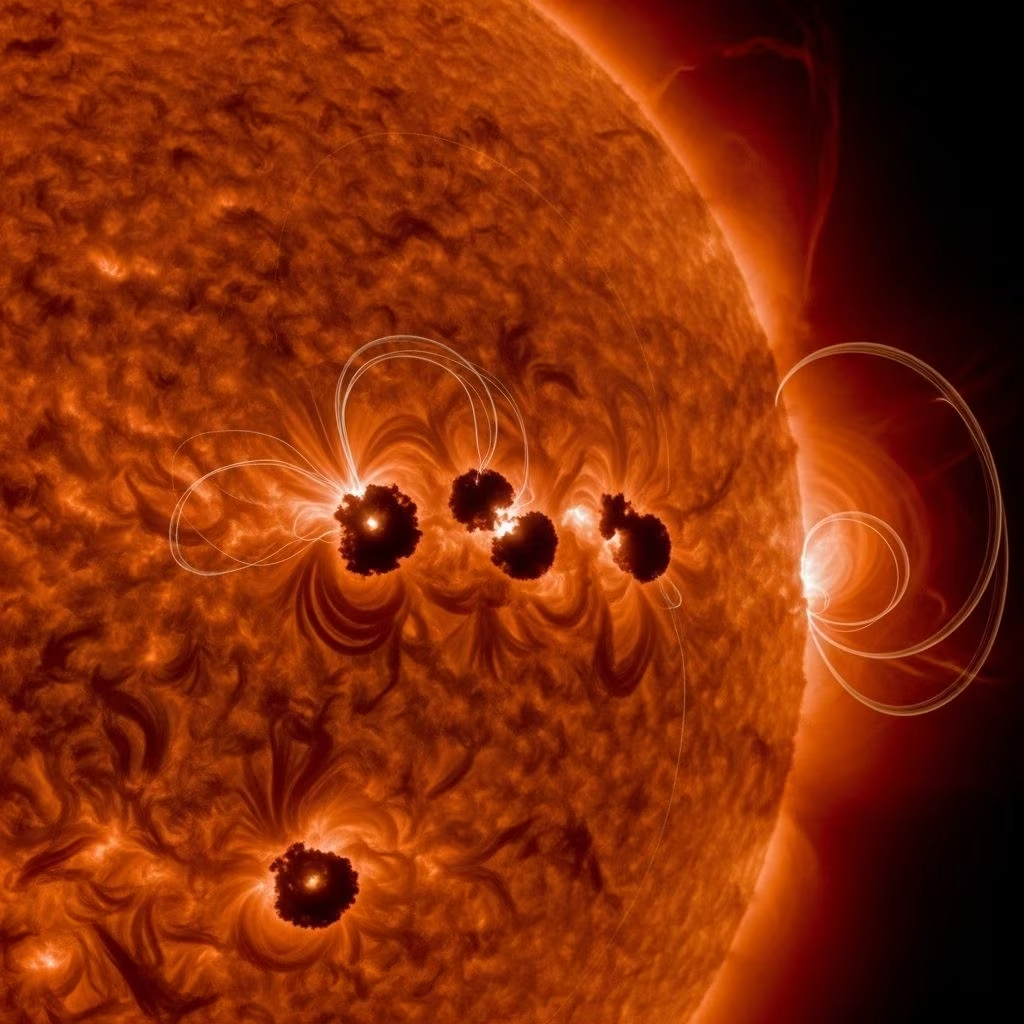
- Earth to Sun Distance: Light from the Sun takes about 8 minutes and 20 seconds to reach Earth. This is a minuscule fraction of a light-year.
- Nearest Star: Proxima Centauri, the closest star to our Sun, is approximately 4.25 light-years or about 40 trillion kilometers away.
- Milky Way Galaxy: Our own galaxy has a diameter of roughly 100,000 light-years.
- Observable Universe: The most distant galaxies observed by astronomers are over 13 billion light-years away, meaning their light set out shortly after the beginning of the universe.
Why Astronomers Use Light-Years
Celestial distances are so immense that using familiar terrestrial units like kilometers or miles becomes impractical. The light-year streamlines communication and understanding in astronomy.[14]
- If the distance to the Andromeda Galaxy were expressed in kilometers, it would require writing a number with 19 zeros: approximately 24,000,000,000,000,000,000 kilometers. In light-years, it is roughly 2.5 million.
- It immediately provides a clue to astronomers about how far back in time they are observing. A galaxy 1 million light-years away is being observed as it was 1 million years ago.
- It fundamentally links the idea of distance with time—because light takes time to traverse the universe, seeing distant objects is like looking into a time machine.
Table: Light-Year Compared to Other Units
| Unit | Equivalent Length | Use in Astronomy |
|---|---|---|
| 1 Kilometer (km) | 1,000 meters | Terrestrial, Solar System distances |
| 1 Astronomical Unit (AU) | ~149.6 million km (distance from Earth to Sun) | Solar System distances |
| 1 Light-Year (ly) | ~9.46 trillion km (5.88 trillion miles) | Interstellar, intergalactic distances |
| 1 Parsec (pc) | ~3.26 light-years | Common in star/galaxy distance measurement |
How the Distance of a Light-Year Is Calculated
Because the speed of light is a known constant in a vacuum, determining the length of a light-year involves a simple calculation:
- Formula: Distance = speed × time
- In a year (31,557,600 seconds), light travels:
299,792 km/s × 31,557,600 s = 9,460,730,472,580.8 kilometers - This figure is often rounded to about 9.46 trillion kilometers.
This enormous distance is necessary to express the staggering scales of space between stars, galaxies, and other cosmic objects.
Light-Years and the Lookback Time: Seeing Into the Past
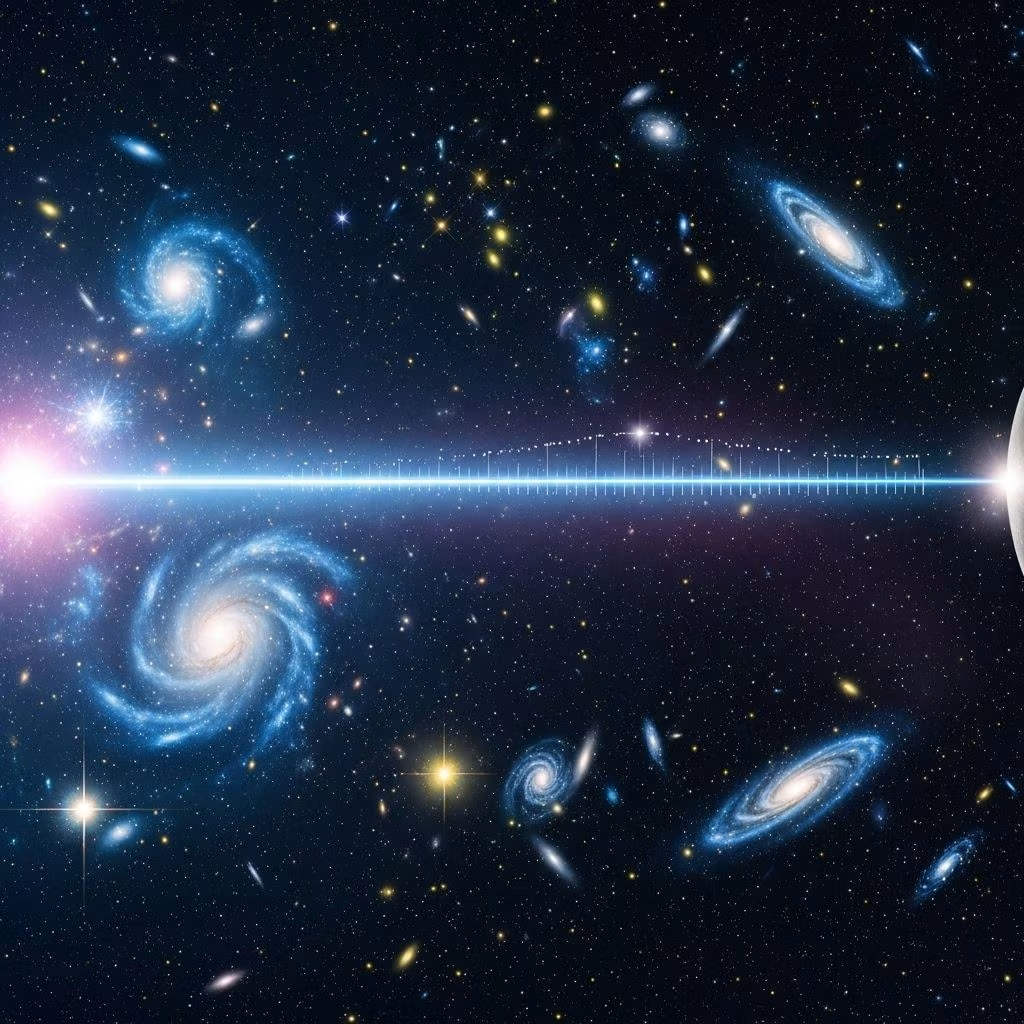
One of the most profound aspects of using light-years in astronomy is that it naturally embraces the concept of lookback time. Light does not traverse space instantly; it moves at a finite speed. When you gaze upon a celestial object that is one light-year distant, you see it as it appeared one year ago—because its light has taken a full year to reach you.[14]
- Observing nearby stars means seeing them as they were just a few years in the past.
- Observing distant galaxies means viewing ancient cosmic history—sometimes just a few hundred million years after the universe began.
- This time-travel effect allows astronomers to study the universe’s evolution over billions of years.
Examples: Cosmic Distances in Light-Years
- The Moon: About 1.3 light-seconds from Earth (Not even close to one light-year!)
- The Sun: 8.3 light-minutes away
- Alpha Centauri: 4.37 light-years
- Orion Nebula: ~1,344 light-years
- Center of the Milky Way: about 27,000 light-years
- Andromeda Galaxy: roughly 2.5 million light-years
- Most distant galaxy observed: Over 13 billion light-years
Why Not Use Kilometers or Miles?
Distances in space routinely exceed the scales of kilometers or miles by enormous magnitudes, making these units impractical for most astronomical measurements.
- Writing out numbers for even the closest star to our Sun in kilometers results in figures like 40,208,000,000,000.
- Light-years compress unwieldy numbers into manageable and meaningful terms.
- For small solar system measurements, kilometers, miles, and astronomical units still have utility, but for interstellar and intergalactic discussion, the light-year is essential.
Other Units of Astronomical Distance
Though the light-year is perhaps the most widely understood cosmic distance unit in public discourse, astronomers also use other specialized units:
- Astronomical Unit (AU): The average distance from the Earth to the Sun (about 149.6 million kilometers or 93 million miles). Useful for describing planetary distances within our solar system.
- Parsec (pc): Equivalent to about 3.26 light-years. Commonly used in professional astronomy, particularly when discussing exceedingly vast galactic or intergalactic distances.
Table: Common Astronomical Distance Units
| Unit Name | Symbol | Equivalent Length | Typical Usage |
|---|---|---|---|
| Kilometer | km | 1,000 meters | Planetary, spacecraft navigation |
| Astronomical Unit | AU | ~149.6 million km | Solar System |
| Light-Year | ly | ~9.46 trillion km | Stellar and extragalactic distances |
| Parsec | pc | ~3.26 light-years | Star clusters, galactic scales |
Common Misconceptions About Light-Years
- Misconception: A light-year is a unit of time.
- Fact: Despite the inclusion of the word “year,” a light-year measures distance only.
- Misconception: The term ‘light-year’ always refers to visible light.
- Fact: It refers to the distance any electromagnetic wave of light travels, including infrared, X-rays, and radio waves, as long as it moves at the speed of light in a vacuum.
How Light-Years Have Revolutionized Astronomy
The concept of the light-year has not only simplified communication but also shaped our understanding of the universe:
- Allowed astronomers to map galaxies, nebulae, and other cosmic structures at comprehensible scales.
- Enabled the study of cosmic history by connecting distance with age (lookback time).
- Expanded human comprehension of the universe, bridging the gap between the observable cosmos and concepts like cosmic background radiation left over from the Big Bang.
Frequently Asked Questions (FAQs) About Light-Years
Q: Is a light-year a measure of time or distance?
A: A light-year is a measure of distance, not time. It represents how far light travels in one year.
Q: Why do astronomers use light-years instead of miles or kilometers?
A: The scale of the universe is so vast that expressing distances in miles or kilometers becomes unwieldy. Light-years provide a more manageable and meaningful measure for such expansions.
Q: Can anything travel faster than light?
A: According to current physical laws, nothing can travel faster than light in a vacuum, making light the universal speed limit.
Q: If a star is 500 light-years away, are we seeing it as it is now?
A: No. We are seeing the star as it was 500 years ago because its light took that long to reach us.
Q: Are there other units like light-years for measuring space?
A: Yes. Astronomers also use parsecs (about 3.26 light-years) and astronomical units (the Earth-Sun distance).
Q: Does light travel at exactly the same speed everywhere?
A: Light travels at 299,792 kilometers per second in a vacuum. In other mediums, such as air or glass, light travels more slowly.
Conclusion: Light-Years Bridge the Gaps of Space and Time
In essence, the light-year is more than a unit of measurement—it is a conceptual bridge that helps humanity grasp the universe’s scale, witness cosmic history, and communicate discoveries with clarity. As our powers of observation improve, peering ever farther into the universe’s depths, the light-year remains an indispensable tool for making the incomprehensibly vast approachable and meaningful. Every time you look at the night sky, you’re not just looking at distant places—you are looking back across time, measured in light-years.
References
- https://www.space.com/curious-kids-is-it-possible-to-see-what-is-happening-in-distant-solar-systems-now
- https://science.nasa.gov/exoplanets/what-is-a-light-year/
- https://en.wikipedia.org/wiki/Light-year
- https://spaceplace.nasa.gov/light-year/en/
- https://spaceandtelescope.com/light-year-all-you-need-to-know/
- https://en.wikipedia.org/wiki?curid=23473595
- https://thespacevortex.com/2024/06/what-is-a-light-year-unraveling-the-cosmic-measure-that-defines-our-universe/
- https://www.space.com
- https://space.fandom.com/wiki/Light_year
- https://space.fandom.com/wiki/Light-year
- https://www.skyatnightmagazine.com/space-science/lightyear
- https://universemagazine.com/en/what-is-a-light-year/
- https://www.britannica.com/science/light-year
- https://onplif.com/why-light-years-matter-in-space-calculations-explained/
- https://www.encyclopedia.com/science-and-technology/astronomy-and-space-exploration/astronomy-general/light-year
- https://byjus.com/physics/value-of-one-light-year/
- https://cityastronomy.com/how-many-years-in-a-light-year/