How Was Earth Formed? The Birth and Early History of Our Planet
Earth’s journey from a cloud of cosmic dust to a vibrant, life-sustaining planet much like we observe today is one of the most remarkable sagas in natural history. Scientists believe our world emerged from the primordial chaos of the early solar system about 4.5 billion years ago, reshaped by violent collisions, volcanic eruptions, and continual change. But how did this process unfold? Here, we walk step-by-step through the major events and mysteries in Earth’s formation and early evolution.
From Cosmic Dust to Solar System: The Nebular Hypothesis
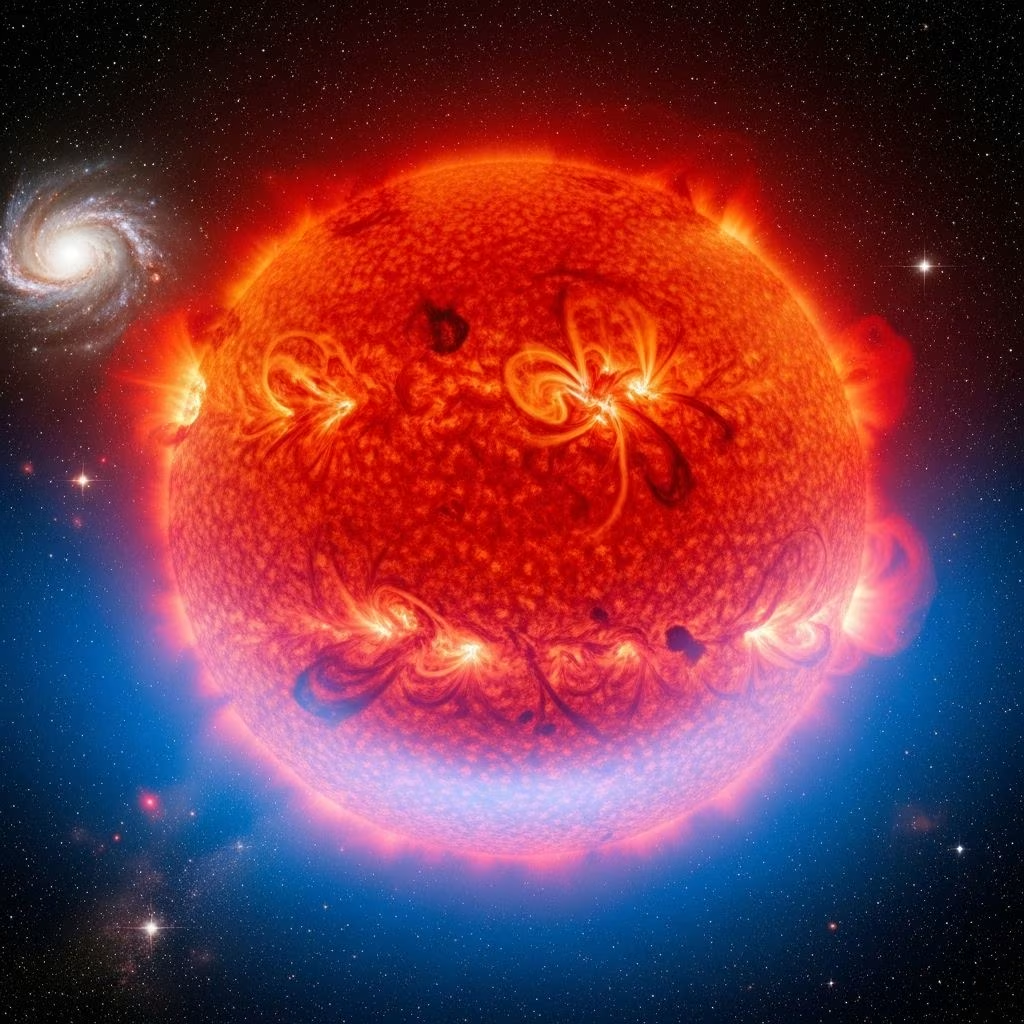
About 4.6 billion years ago, our solar system began as a swirling, diffuse solar nebula — a cold, vast cloud of dust and gas, mostly hydrogen and helium, mixed with heavier elements left behind by earlier stars in our galaxy. The nebula’s fate changed when it experienced a gravitational nudge, possibly from the shock wave of a nearby supernova explosion. Under gravity’s influence, the nebula contracted, started spinning, and gradually flattened into a disk — the protoplanetary disk.
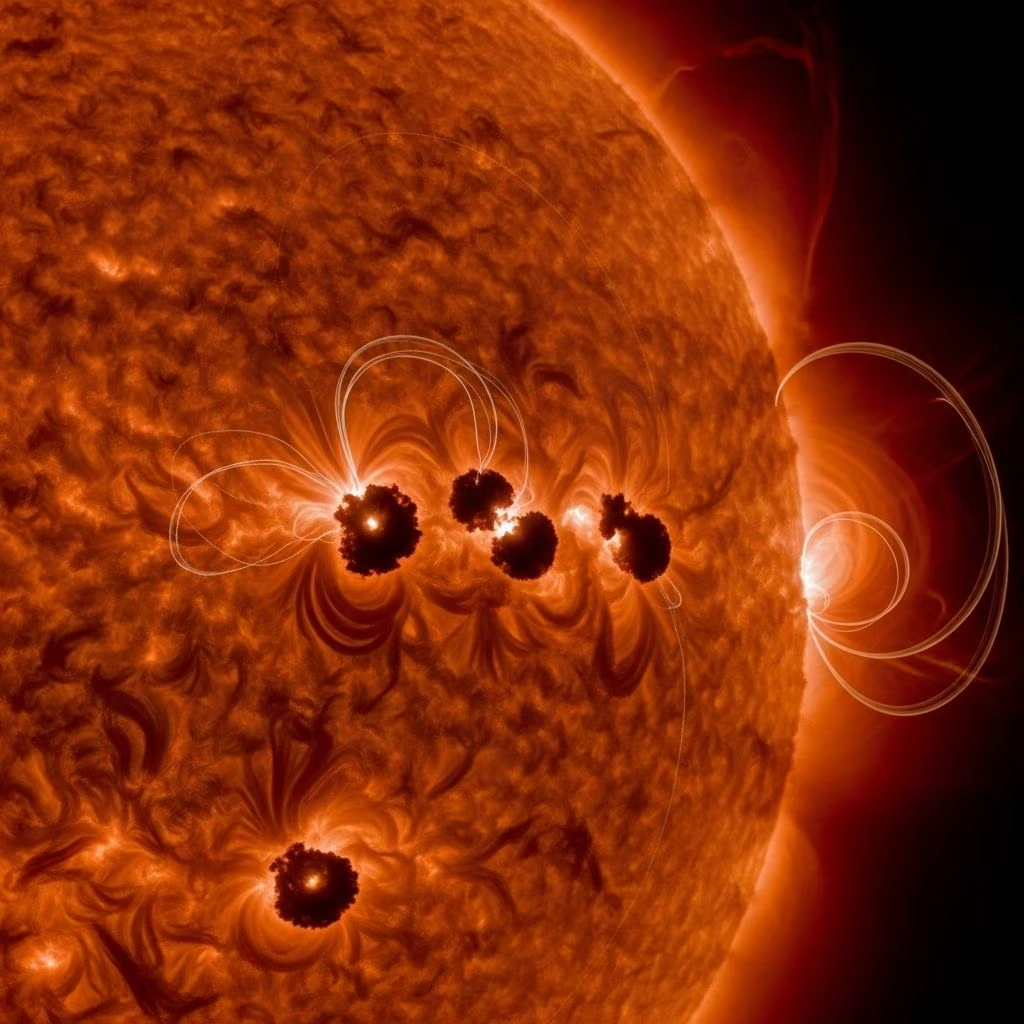
- The densest material collected at the center and ignited, forming the Sun.
- The rest of the spinning disk was peppered with clumps of matter, which began to stick together and grow through a process called accretion .
As this process unfolded, trillions of tiny dust particles collided and merged, building up larger bodies called planetesimals. Through countless impacts and mergers, some planetesimals grew more massive, becoming protoplanets — the seeds of planets, including the young Earth .
Timeline of Solar System Formation
| Event | Estimated Time |
|---|---|
| Collapse of solar nebula | ~4.6 billion years ago (bya) |
| Formation of planetesimals | ~4.55 bya |
| Formation of Earth | ~4.54–4.5 bya |
| Formation of Moon | ~4.5 bya |
Building Earth: Accretion and Differentiation
The formation of Earth was not a single event, but a sequence of relentless collisions and mergers lasting millions of years. Rocky and metallic planetesimals — essentially cosmic building blocks — slammed together, heating up the growing planet and supplying more mass through gravity-driven accretion . The process can be summarized in several key stages:
- Runaway growth: Large bodies attract more material, snowballing in size and accelerating growth.
- Oligarchic growth: A few massive protoplanets emerge, dominating their local orbital neighborhoods.
- Giant impacts: Continued collisions among large bodies dramatically reshape their composition and trajectories.
During accretion, the young Earth grew rapidly. Internal heating from radioactive decay, gravitational compression, and impacts caused the planet to partially melt. This led to a process called differentiation:
- Heavier elements like iron and nickel sank toward the center, forming the core.
- Lighter silicates migrated to the surface, forming Earth’s initial mantle and crust .
Early Bombardment and the Hadean Eon
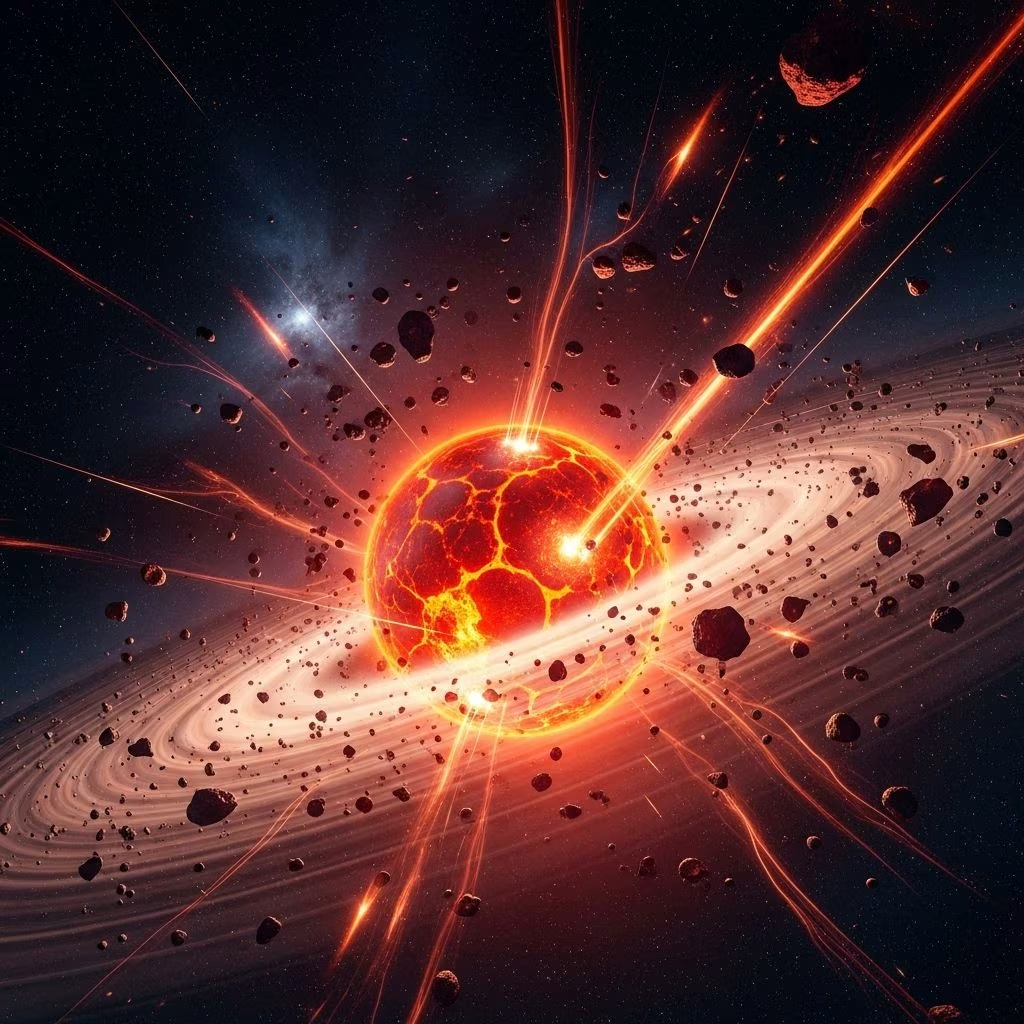
The earliest eon in Earth’s history, known as the Hadean (from ‘Hades’, after the Greek underworld), was defined by fierce heat and almost constant bombardment by leftover planetesimals, asteroids, and comets.
- This “Late Heavy Bombardment” period left Earth’s surface molten, with frequent massive impacts reshaping the crust.
- These impacts generated tremendous heat, vaporized surface rocks, and helped deliver important volatile compounds — including water — that would be crucial for forming oceans and an atmosphere .
- The intense bombardment also created craters, basins, and contributed to the evolving topography of the early Earth.
The Formation of the Moon
One of the most dramatic events in Earth’s early history was the colossal collision with a Mars-sized protoplanet, theorized to be called Theia .
- This impact ejected a massive amount of material into orbit around Earth, which eventually accreted to form the Moon.
- Evidence for this theory includes similarities in isotopic composition between Earth’s and the Moon’s rocks, and computer simulations supporting the dynamics of such a large impact .
The presence of the Moon helped stabilize Earth’s rotation and contributed to developing tidal forces, both of which influenced the later development of climate and life.
Cooling Down: Formation of the Crust, Oceans, and Atmosphere
As relentless impacts decreased and Earth radiated away its internal heat, the planet began to cool.
- A solid crust formed above a mostly molten mantle.
- Volcanic outgassing released water vapor, carbon dioxide, nitrogen, and other gases, building up the early atmosphere .
- As the surface cooled further, water vapor condensed, and oceans began to form — possibly within the first few hundred million years of Earth’s history.
The first oceans and atmosphere were very different from today:
- The early atmosphere was likely dense with carbon dioxide, methane, and ammonia, and contained almost no free oxygen .
- Intense volcanic activity and comets may have supplied much of the water and volatile elements essential for life’s eventual emergence.
Geological Activity: Tectonics and Volcanism Shape the Planet
The formation of a solid crust led to the start of plate tectonics, although the exact timing remains debated among scientists. Volcanic activity played a major role in:
- Outgassing—releasing gases trapped in Earth’s interior to the atmosphere.
- Building up landmasses and mountains from cooled lava flows.
- Recycling crustal rock, creating new rock, and evolving the planet’s surface features over billions of years.
Tectonic processes drove the movement and collision of large continental plates, leading to the slow but steady formation of continents, mountain ranges, and ocean basins.
From Chemistry to Biology: The Prebiotic World
Earth’s primitive landscape, for the first unit of its existence, was hostile — unstable land, poisonous air, raging volcanoes, and little to no oxygen. But these very conditions set the stage for crucial chemical reactions necessary for the origin of life.
- Lightning, heat from volcanic activity, and ultraviolet radiation provided the energy needed to power early, complex chemical reactions.
- Various theories debate how simple organic molecules first formed on early Earth — including abiogenesis (the formation of life from non-living matter), delivery of organics by comets and meteorites, and deep-sea hydrothermal vent chemistry .
- Eventually, these simple molecules assembled into more complex compounds and, ultimately, the first self-replicating systems – the distant ancestors of all known life.
Timeline: Major Eons in Earth’s Early History
| Eon | Time Period | Key Events |
|---|---|---|
| Hadean | 4.6–4.0 bya | Planet formation, heavy bombardment, crust begins to solidify, formation of Moon and first oceans |
| Archean | 4.0–2.5 bya | Stabilization of crust, early continents, emergence of simple life |
| Proterozoic | 2.5 bya–541 mya | Rise of oxygen, more complex life, long geological stability |
| Phanerozoic | 541 mya–present | Diversification of complex life, formation of modern continents |
Why Did Earth Become Habitable?
Several factors made Earth especially suited to harbor life, in contrast to its planetary neighbors:
- Location in the “habitable zone” of the solar system, allowing liquid water to exist on its surface.
- Sufficient gravity to hold its atmosphere over billions of years.
- Geological and chemical activity that recycled elements critical for life.
- Protection by a strong magnetic field (generated by its liquid iron core) to shield against solar wind and harmful radiation [10].
- The presence of the Moon, stabilizing axial tilt and moderating climate swings.
These features allowed the Earth’s environment to remain relatively stable over geological time, giving primitive life an opportunity to evolve and thrive.
How Do We Know? Evidence from Space, Rocks, and Science
The story of Earth’s formation is based on several lines of converging evidence, drawn from multiple scientific fields:
- Meteorites and Moon rocks: Chemical analysis of ancient meteorites and lunar samples provide clues about the age and original composition of the early solar system.
- Isotopic dating: Radioactive isotopes in ancient terrestrial rocks and meteorites have been used to precisely date the Earth and important planetary events .
- Observations of other star systems: Modern telescopes allow astronomers to watch disks of dust and gas forming around young stars today, supporting the nebular hypothesis as a universal process.
- Geological record: Rock strata on Earth preserve evidence of ancient impacts, volcanic eruptions, and atmospheric changes, providing a window into our planet’s prehistory.
Though our understanding continues to evolve as new discoveries are made, these threads together create a compelling narrative of our planet’s violent and fascinating birth .
Frequently Asked Questions (FAQs)
Q: When did Earth form?
A: Earth formed approximately 4.54 billion years ago by accretion of material in the early solar system .
Q: How did the Moon form?
A: The Moon likely formed when a Mars-sized body (Theia) collided with the early Earth, ejecting debris that eventually coalesced into the Moon .
Q: What was Earth like just after it formed?
A: Early Earth had a molten surface, experienced intense bombardment by space debris, and lacked a breathable atmosphere or stable oceans [11].
Q: How did water arrive on Earth?
A: Water was delivered through a combination of volcanic outgassing and impacts by water-rich comets or asteroids, slowly accumulating to form the early oceans .
Q: Why did Earth remain suitable for life while Venus and Mars did not?
A: Earth’s optimal distance from the Sun, active geology, stable climate, magnetic field, and protective atmosphere have allowed it to support liquid water and life for billions of years.
Key Takeaways
- Earth’s formation was a multi-stage process involving cosmic dust collapse, accretion of planetesimals, giant impacts, and ongoing geological activity.
- The Moon’s formation played a key role in stabilizing Earth’s environment.
- Intense bombardment, volcanism, and outgassing forged the atmosphere and oceans, paving the way for life’s emergence.
- Scientific evidence from geology, chemistry, astronomy, and planetary science all support this broad narrative of Earth’s birth and development.
Earth’s 4.5-billion-year story, from stardust to the dynamic blue planet, is written in the rocks beneath our feet, the air we breathe, and the evolution of all life. As research continues, we unlock new chapters — and find new inspiration in our cosmic origins.
References
- https://en.wikipedia.org/wiki/History_of_Earth
- https://study.com/academy/lesson/formation-of-the-earth-theories.html
- https://www.britannica.com/science/How-Was-Earth-Created
- https://news.uchicago.edu/explainer/formation-earth-and-moon-explained
- https://www.khanacademy.org/science/ap-biology/natural-selection/origins-of-life-on-earth/v/earth-formation
- https://www.youtube.com/watch?v=fJ0J4mbj0_o
- https://www.ncbi.nlm.nih.gov/books/NBK230211/
- https://www.khanacademy.org/science/cosmology-and-astronomy/life-earth-universe/history-life-earth-tutorial/v/earth-formation
- https://news.uchicago.edu/explainer/origin-life-earth-explained
- https://science.nasa.gov/earth/facts/
- https://astrobiology.nasa.gov/education/alp/earth-right-after-it-formed/
- https://www.youtube.com/watch?v=ye3LavIx9jg
- https://pmc.ncbi.nlm.nih.gov/articles/PMC1664683/
- https://www.amnh.org/exhibitions/permanent/planet-earth/how-has-the-earth-evolved
- https://www.gsi.ie/en-ie/education/our-planet-earth/Pages/The-Earth-through-time.aspx
- https://carnegiescience.edu/news/how-did-earth-get-its-water
- https://www.caltech.edu/about/news/earth-formed-from-dry-rocky-building-blocks
- https://cimss.ssec.wisc.edu/sage/geology/lesson1/concepts.html